

Fundamental Cutting Mechanics and Shear Dynamics in Shredder Blade Design
At our facility, we approach shredder blade design by mastering the physics of material reduction. Effective size reduction relies on three primary cutting modes:
- Pure Shear: High-precision slicing where the clearance between blades forces the material to part cleanly.
- Tear and Rip: Aggressive engagement designed to pull apart fibrous or soft materials.
- Crush Fracture: Utilizing brute force to snap brittle components.
Optimizing Intake and Precision
Smooth material intake is dictated by precise shredder blade designs that account for nip angle mechanics. We calculate the bite point to ensure the rotor grabs the feedstock without bouncing, preventing unnecessary motor strain.
When configuring your system, we prioritize these mechanical tolerances:
- Nip Angle: Optimized to prevent material "ride-up," ensuring constant downward pressure.
- Clearance Management: We calibrate blade-to-blade and counter knife gaps to account for thermal expansion. If your clearance is too tight, you risk galling; too loose, and you lose shear efficiency.
- Thermal Load Stability: Our designs anticipate the heat generated during continuous operation, maintaining geometric integrity even under heavy load.
Shredder Blade Geometries and Tooth Hook Profiles
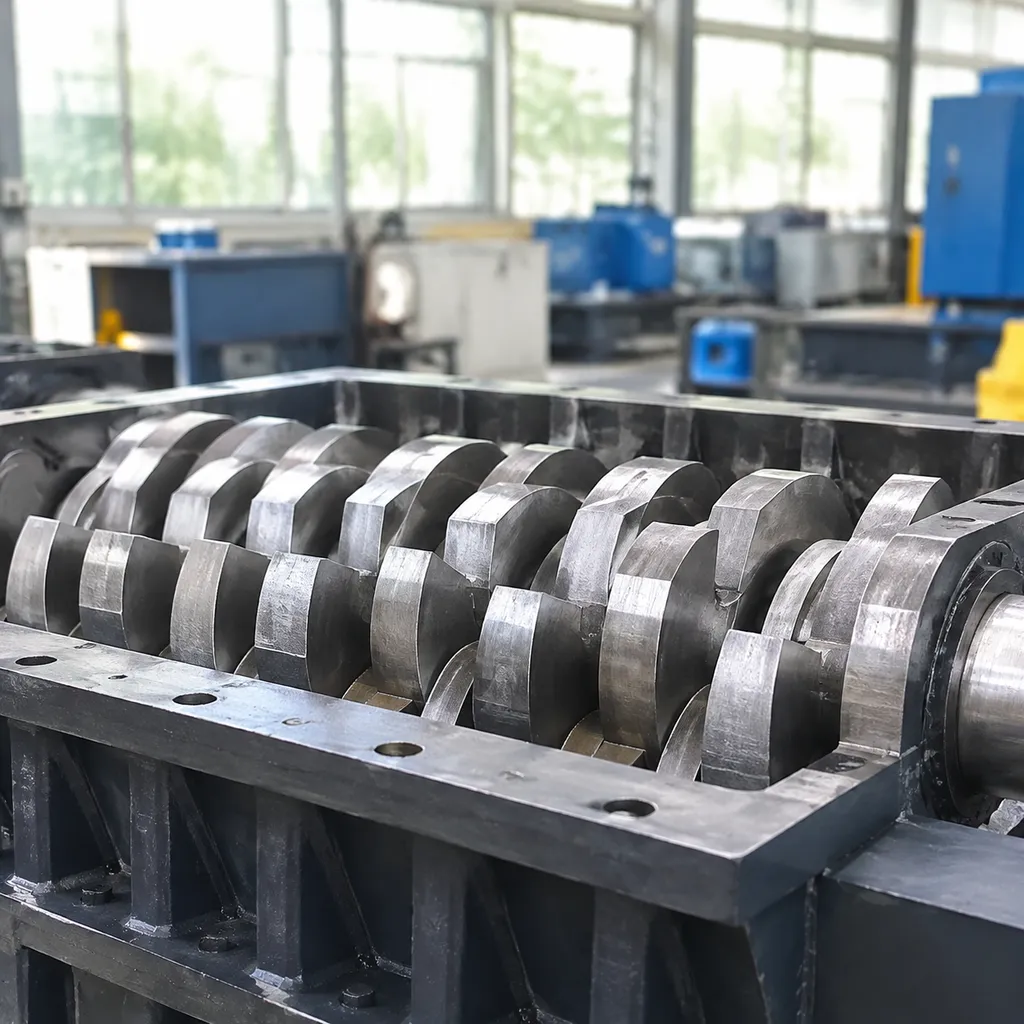
Getting the right cut comes down to matching the tooth geometry to the way material behaves under stress. In our workshop, we evaluate every shredder blade design by how effectively the cutting edge pierces, pulls, and clears feedstock without triggering drive motor overloads. Selecting the proper hook geometry stops material slippage, controls throughput sizing, and protects the entire drive train from shock fatigue.
| Hook Tip (Rake Angle) | Relief Angle |
| Root Radius | Inner Bore |
Single-Hook vs. Multi-Hook Configurations
The number of hooks per cutter directly governs bite aggression, torque distribution, and final particle size:
- Single-Hook Cutters: Deliver maximum penetration force per revolution. We deploy single-hook designs for bulky, high-resistance materials like solid purge chunks, heavy drums, and radial car tires where deep biting is essential to pull parts into the cutting chamber.
- Multi-Hook Cutters (3 to 5+ Hooks): Distribute cutting forces more evenly across the drive shaft. They produce a smaller, uniform particle cut in a single pass while dampening severe torque spikes, making them ideal for light plastics, electronic scrap, and general recycling streams.
Serrated and Scalloped Edges for Film and Fiber
Standard square-edged hooks often drag thin films, agricultural plastics, and synthetic fibers between blades instead of cutting them, causing wraps and friction jams. To counter this, we build specialized shredder blade designs featuring continuous serrated or scalloped outer profiles:
- Pinch-and-Shear Action: Scalloped profiles create localized shear points that slice flexible films cleanly before they stretch.
- Reduced Friction: Continuous serrations minimize contact drag across the face, keeping heat buildup low when processing low-melt polymers.
Hook Geometry: Rake, Relief, and Root Radii
Precision engineering of individual tooth angles determines whether a blade runs cleanly or chips under heavy shock:
- Rake Angle: A positive rake angle creates an aggressive drawing action that pulls bulky feedstock inward. For highly abrasive or shock-heavy scrap, we flatten the rake angle toward neutral to reinforce edge support.
- Relief Angle: Back-face clearance prevents the trailing section of the tooth from rubbing against uncut material, cutting down operational amperage draw and surface friction heat.
- Root Radius Relief: Sharp inside corners are structural weak points where stress fractures start. We machine generous, smooth root radii to dissipate high shock loads safely across the blade core. To balance these parameters for your chamber specs, reference our plastic shredder blade dimensions guide and specifications.
| Geometry Element | Typical Range | Primary Engineering Purpose |
|---|---|---|
| Rake Angle | 5° to 18° | Controls material intake pull and initial penetration |
| Relief Angle | 7° to 15° | Eliminates trailing flank friction and thermal buildup |
| Root Radius | R4 mm to R12 mm | Eliminates notch stress concentration at hook bases |
| Diameter-to-Thickness Ratio | 8:1 to 12:1 | Prevents lateral bending, edge binding, and shaft deflection |
Blade Knife Thickness and Diameter Ratios
Controlling shredder knife thickness relative to overall outer diameter stops cutting discs from flexing sideways under heavy lateral loads. When a cutter deflects, face-to-face cutting clearances fail, leading directly to edge binding, scoring, or fractured hooks.
We engineer our rotor cutters around rigid diameter-to-thickness ratios—typically keeping the outer diameter under twelve times the disc thickness for heavy-duty applications. For severe solid waste and metal-contaminated streams, thicker discs combined with heavy hub shoulders maintain perpendicular alignment across the shaft assembly, eliminating side wobble under peak operating loads.
Rotor Configurations and Shaft Assembly Integration
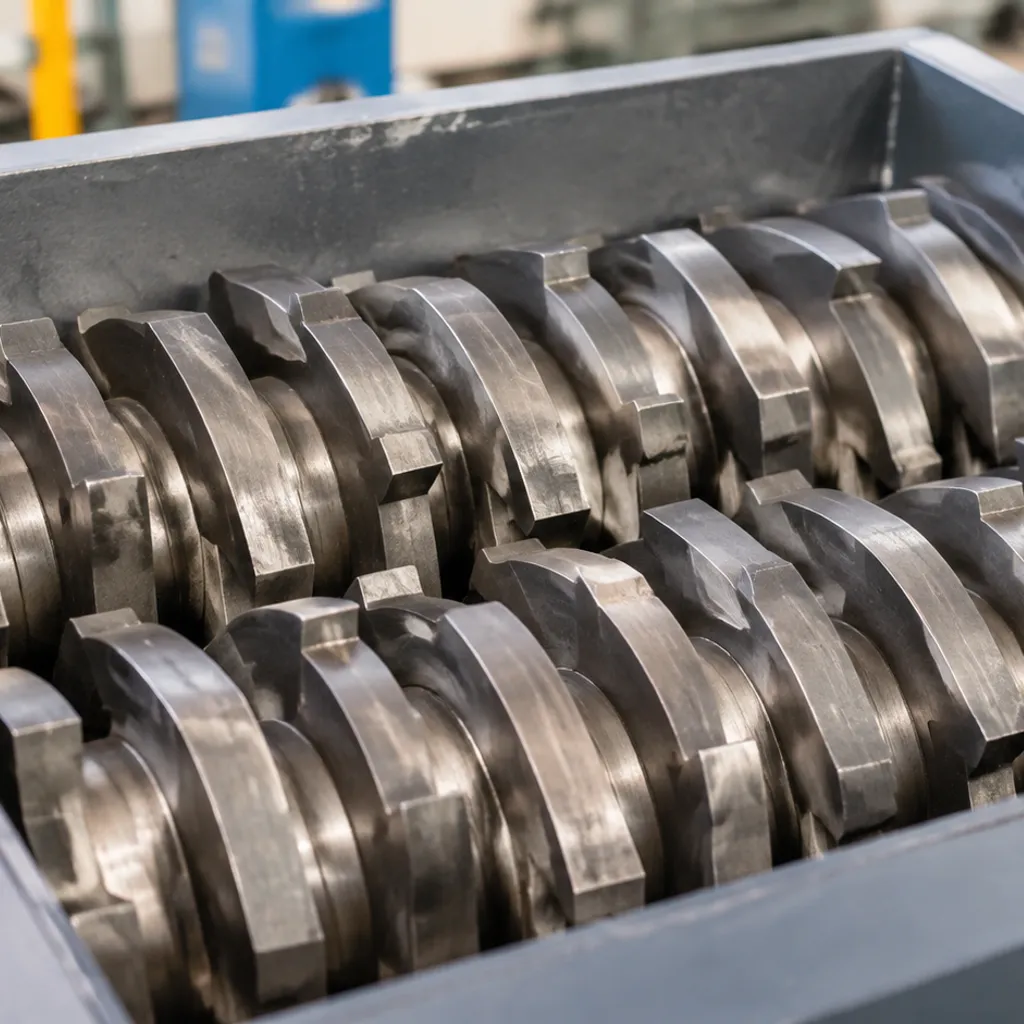
Getting your rotor setup right is the foundation of a reliable machine. Whether you are running dual shaft shredder blades for high-torque volume reduction or utilizing specialized single shaft shredder blades for precise particle sizing, the integration between the blade and the shaft is where performance is won or lost. In our experience, vibration and premature failure usually trace back to poor assembly habits rather than the steel itself.
Bore Profiles and Drive Systems
The connection between your shaft and your blade dictates how energy is transferred under heavy load. We work with several standard profiles to ensure a rock-solid fit:
- Hexagonal Bores: These are industry standards for dual-shaft machines. They allow for easy timing adjustments and provide a self-centering action.
- Splined Shafts: Best for high-torque applications where you need to distribute the load evenly across the entire circumference of the drive.
- Keyed Drives: A classic, cost-effective solution, provided you maintain tight tolerances to prevent "key-wobble" that can eventually destroy the keyway.
Precision Spacers and Axial Preload
A common mistake we see in the field is neglecting the blade shaft assembly tolerances. If your cutters have any wiggle room, you’ll experience uneven wear and potential jamming.
- Precision Ground Spacers: Use high-tolerance spacers to ensure blades are spaced correctly. If the spacers aren't perfectly flat and parallel, your knife clearance will be inconsistent across the rotor.
- Axial Preload Calibration: Proper tensioning is required to eliminate axial play. Without the correct preload, the blades will shift during the bite, leading to "chatter" that chips the edges of your shredder blade designs.
- Maintenance Tip: Always check your spacer surfaces for burrs or debris before re-installation. Even a few microns of buildup can compromise the entire stack alignment.
Tool Steel Metallurgy and Heat Treatment for Shredder Blades
Selecting the proper alloy and thermal processing is the backbone of any robust shredder blade design. When a rotor jams on tramp metal or grinds through highly abrasive glass-filled polymers, metallurgy dictates whether a tooth blunts gradually, deforms plastically, or shatters across the shaft.
Alloy Selection: Balancing Impact and Wear Resistance
Every recycling stream demands a tailored metallurgical foundation. In our shop floor builds, we match alloys directly to shredding mechanics and contamination risks:
- D2 / SKD11 Tool Steel: The standard choice for high-volume plastics, rubber, and general waste. Packed with 12% chromium and high carbon, it delivers outstanding abrasive wear resistance and edge retention under sliding friction. To evaluate specific grades, review our crusher blade materials guide comparing D2, SKD11, and alternative alloys.
- CrMoV Shock Steels (e.g., Modified A8, S7): Formulated for high-impact size reduction such as electronic waste, non-ferrous metals, and contaminated timber. Lower carbon content paired with elevated chromium, molybdenum, and vanadium yields extreme shock resistance, preventing catastrophic hook fracture under shock loading.
- Wear Plate Alloys: Used predominantly in heavy municipal solid waste (MSW) and primary shredders where toughness and field weldability take precedence over razor-sharp knife tolerances.
Through-Hardening vs. Surface Induction
Achieving the right hardness gradient prevents rotor shaft damage and costly blade failure:
- Through-Hardening: We vacuum heat-treat blades to a consistent 58–60 HRC across the entire cross-section. This works best for thin rotary knives and clean scrap where constant resharpening is required. However, large, monolithic hooks hardened completely through become brittle under violent torsional spikes.
- Surface Induction and Differential Tempering: For aggressive, high-torque dual-shaft cutters, we use targeted induction or differential tempering. The cutting perimeter and hook tips reach 56–58 HRC for peak blade wear resistance, while the blade bore and body remain at a ductile 45–48 HRC. This softer core flexes under sudden impact without cracking across the keyway or hex flats.
Tungsten Carbide Hardfacing and Protective Surface Coatings
To extend maintenance cycles on high-wear shredder blade designs, we reinforce critical cutting faces without compromising the base steel's structural integrity:
- PTA Hardfacing (Plasma Transferred Arc): Depositing tungsten carbide matrices directly onto the hook tips and front cutting profiles creates a wear layer rated over 62 HRC.
- Self-Sharpening Differential Wear: By applying carbide hardfacing to the primary rake face while leaving the relief face exposed, the softer base metal erodes slightly faster during operation. This differential wear continuously exposes a crisp, hard carbide cutting edge instead of rounding off into a blunt radius.
- PVD and Anti-Corrosion Coatings: Thin-film treatments like TiAlN limit abrasive wash and prevent chemical corrosion when shredding acidic, municipal, or damp agricultural biomass.
Application-Specific Shredder Blade Designs
Thin Knife Geometry for Plastics and Synthetic Films
Flexible polymers, woven poly bags, and thin synthetic films stretch and wrap around shafts if the cut is not clean:
- Scissor-Cut Tolerances: We utilize narrow shredder knife thickness profiles paired with ground shear faces to slice cleanly rather than pinch or stretch material.
- Anti-Wrapping Hooks: Shorter hook profiles cut off continuous strands immediately, preventing high-density tangles around the spacers.
- Clean Sizing: Sourcing from an experienced plastic shredder blade supplier for durable blade sets keeps clearances tight enough to stop thin films from slipping through un-sheared.
Heavy-Duty Single and Double-Hook Profiles for Radial Tires
Scrap tires present severe mechanical stress due to embedded high-tensile steel beads and abrasive synthetic rubbers:
- Massive Hook Profiles: We specify wide, low-count single or double hook profile teeth that generate maximum penetrating force per square inch.
- High-Impact Alloys: Slicing through vulcanized rubber and steel wire requires thick cross-sections to resist lateral deflection.
- Long-Lasting Edges: Equipping shafts with a durable rubber shredder blade for efficient recycling protects cutter tips from catastrophic fracturing when hitting high-load steel belts.
Multi-Tooth Cutter Designs for Circuit Boards and E-Waste Scrap
E-waste contains abrasive glass fiber (FR-4), precious metals, and structural aluminum that chew up standard cutting edges:
- Distributed Tooth Load: Multi-tooth rotary shear blades divide mechanical resistance across several contact points per rotation.
- Controlled Granulation: Shorter tooth pitch prevents oversized electronic scrap from passing through, creating uniform feedstock for downstream magnetic and eddy-current separators.
- Abrasive Wear Resistance: Tool steels engineered for high carbide density keep teeth sharp despite constant contact with fiberglass boards.
Aggressive Hook Designs for Municipal and Bulky Solid Waste
Handling commingled municipal solid waste (MSW), industrial pallets, and bulky household items demands an aggressive intake profile:
- Deep-Throat Rake Angles: Forward-canted hooks bite into oversized items instantly, pulling furniture, drums, and heavy cardboard down into the cutting chamber.
- Anti-Bounce Performance: High-profile grab points prevent large hollow pieces from floating or bouncing on top of counter-rotating shafts.
- Self-Relieving Cavities: Wide root pockets allow fragmented debris to discharge quickly onto the exit conveyor without packing between adjacent cutters.
Manufacturability, Blade Maintenance, and Lifecycle Costs
Every plant manager knows the sting of unplanned downtime caused by chipped edges, thermal warping, or uneven blade wear. When we evaluate shredder blade design on the plant floor, manufacturing feasibility and day-to-day maintenance carry just as much weight as cutting performance. Keeping your operating expenses low requires a balance between initial fabrication accuracy, straightforward regrinding routines, and the overall service life of each industrial shredder cutter.
Monolithic Solid Discs vs. Indexable Bolt-On Inserts
Choosing between a one-piece rotor knife and a modular insert system comes down to your incoming scrap stream, impact frequency, and repair turnaround times:
- Monolithic Solid Cutting Discs: Machined from a single block of forged tool steel. They offer maximum rigidity, eliminate loose-hardware failures, and withstand high-shock radial impacts. They are standard in heavy dual-shaft systems handling mixed scrap, tires, and demolition debris.
- Indexable Bolt-On Inserts: Feature replaceable cutting tips secured to a tough base carrier disc. Once an edge blunts or chips, you rotate the insert to an unused face without stripping the entire blade shaft assembly. These shine in high-abrasion applications like plastics, organics, and secondary processing. For lighter granulation setups, adopting dedicated profiles like our PET bottle crusher blade design guide helps balance tip accessibility with shear efficiency.
| Feature | Monolithic Solid Discs | Indexable Bolt-On Inserts |
|---|---|---|
| Initial Cost | Moderate to High | High carrier cost, low tip replacement cost |
| Shock Load Capacity | Superior; zero risk of bolt shear | Moderate; risk of seat deformation under shock |
| Downtime per Turn | High (requires full shaft strip-down) | Low (swap or index tips directly on the machine) |
| Best Application | Bulky metal, tires, MSW | Plastics, e-waste, secondary sizing |
Resharpening Limits and Grinding Passes
A successful shredder blade design must accommodate multiple regrinding cycles without compromising cutting clearance:
- Face Grinding over Hook Re-profiling: We prioritize surface-grinding the parallel side faces to restore crisp cutting corners. Removing 0.25 mm to 0.50 mm per pass typically cleans up edge rounding while keeping the tooth profile intact.
- Controlling Inter-Blade Clearances: Surface grinding narrows the blade knife thickness. To preserve the critical blade-to-blade gap and prevent material jamming or bypass, we compensate for stock removal using precision-ground shims during shaft reassembly.
- Grinding Limits: Most solid rotary shear blades tolerate 3 to 5 full regrinds. Once total material loss exceeds 8% to 10% of the nominal outer diameter, hook root geometry degrades, resulting in feed slippage and surging drive motor currents.
CNC Wire-Cutting and 5-Axis Grinding Standards
Producing dependable shredder blade designs requires strict machining standards to ensure exact stack tolerances:
- CNC Wire EDM (Electrical Discharge Machining): Used to burn tight bore configurations—such as hexagonal bores or complex splines—after heat treatment. This eliminates post-hardening distortion and ensures a dead-true slide fit onto the drive shaft.
- 5-Axis CNC Profile Grinding: Delivers uniform rake and relief angles across all cutting hooks, holding dimensional tolerances within ±0.01 mm.
- Uniform Cutting Faces: Precision-ground side faces eliminate axial runout along the rotor stack. By keeping faces perfectly flat and parallel, our team prevents side-rub friction, reduces operating temperatures, and stops localized blade galling before it starts.
Frequently Asked Questions About Shredder Blade Design
We regularly field questions regarding the optimization and maintenance of shredder blade designs. Below are the answers to the most common technical inquiries from our global customers.
Ideal Blade-to-Blade Clearance for Plastics
For most plastic applications, maintaining a tight clearance is vital for clean shear. We typically recommend a gap of 0.05mm to 0.15mm. If the gap is too wide, the material tends to stretch rather than cut, leading to "bridging" in the shredder chamber. Utilizing a high-quality shredder knife box ensures that your machine maintains these tight tolerances consistently.
Best Tool Steel for Wear and Impact
Finding the balance between hardness and toughness is the biggest challenge in shredder blade design. We generally prefer D2 or SKD11 tool steel for its excellent abrasive wear resistance. If your application involves high-impact debris that risks blade cracking, we suggest transitioning to a specialized CrMoV shock-resistant alloy to ensure the knife integrity lasts through heavy production cycles.
Impact of Hook Geometry on Power Consumption
The hook profile teeth directly dictate how much torque is required to initiate a cut. An aggressive hook design bites deeper into material, which can increase the load on the drive motor. If you notice your motor is frequently hitting amperage limits, we often recommend switching to a multi-tooth design with a shallower rake angle to reduce the instantaneous force required per revolution.
Resharpening Limits and Blade Lifecycle
The number of times you can resharpen a blade depends on the remaining profile depth and the original shredder knife thickness. Most industrial blades can be reground multiple times, provided the blade-to-blade clearance is adjusted to compensate for the loss of material. However, once the teeth lose their structural root radius, the blades must be replaced to prevent catastrophic failure or shaft damage. For reliable performance, always ensure you are using durable industrial cutting blades designed to handle repeated maintenance cycles.