

Formula details
Product Details
Overview
Tool Steel Metallurgy and Engineering Standards
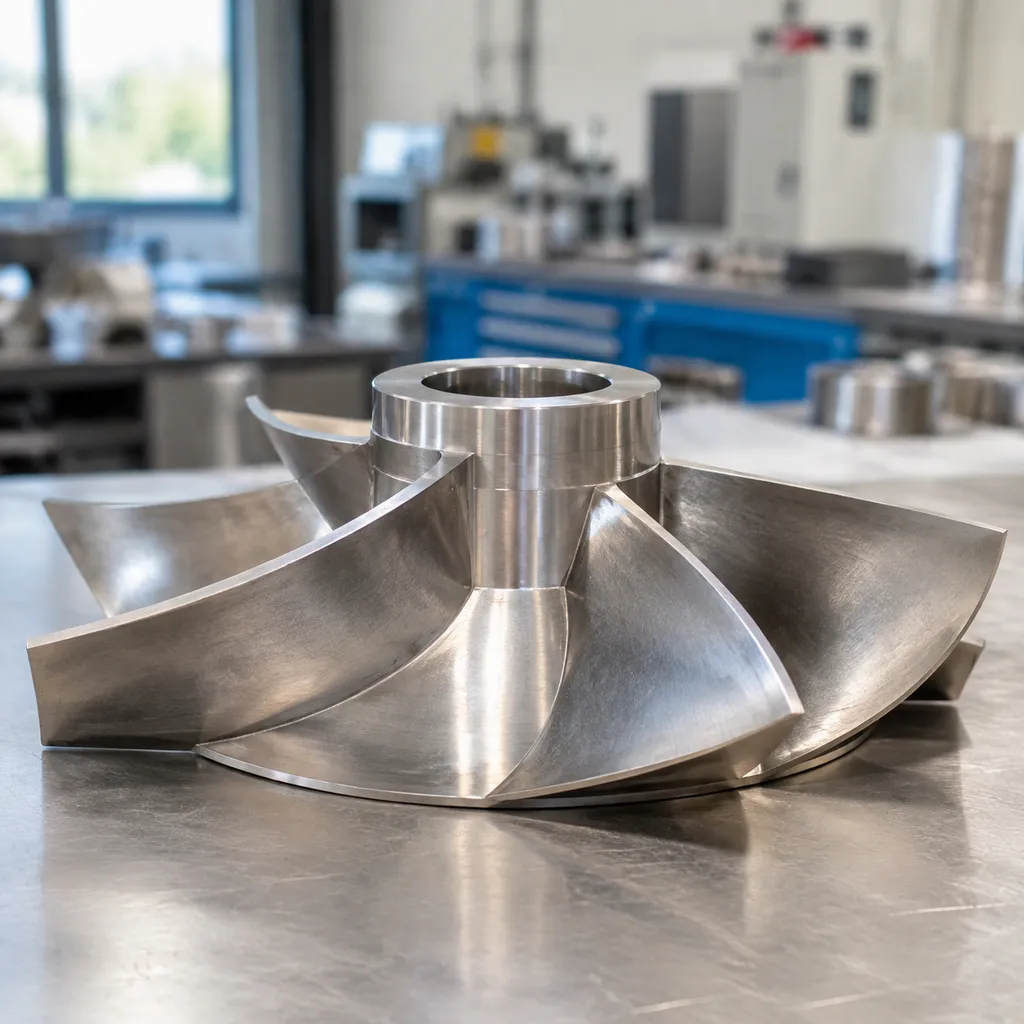
As an established plastic shredder blade supplier, we engineer industrial cutting components designed to eliminate premature wear, edge chipping, and catastrophic fracture. Polymer size-reduction environments expose a plastic shredder blade to extreme cyclic impact, friction-induced thermal spikes, and abrasive fillers like glass fiber and calcium carbonate. We enforce strict metallurgical selection criteria, automated vacuum thermal processing, and micro-precision grinding to deliver consistent performance across all shredder platforms.
Selecting Tool Steels for Abrasive and Rigid Plastics
Different polymer streams demand precise balances between abrasive wear resistance and mechanical fracture toughness:
- Abrasive Polymers (Glass-filled PA, PVC, composite scrap): Require elevated carbon and chromium content to form hard primary carbides that resist granular erosion.
- High-Mass Rigid Polymers (Extrusion purge, thick-wall HDPE pipe, solid runners): Demand high-toughness alloys capable of absorbing heavy shear shock without micro-chipping or catastrophic failure along the cutting edge.
- Film, Fiber, and Woven Materials (PP/PE film, supersacks): Require high-hardness alloys that hold an ultra-sharp cutting bevel to prevent material wrapping and excessive shredder motor amperage.
Alloy Composition and Material Properties
Selecting the proper alloy defines the service life of every plastic shredder blade set. We source certified, ESR-refined (Electro-Slag Remelted) forged tool steels to ensure structural density and structural purity.
| Steel Grade | Hardness (HRC) | Toughness | Wear Resistance | Primary Plastic Processing Application |
|---|---|---|---|---|
| D2 (AISI) | 58–60 | Moderate | High | General rigid plastics, post-consumer bottles, municipal plastic scrap |
| DC53 | 60–62 | Very High | Very High | Heavy purge blocks, thick-section sheets, high-impact size reduction |
| Cr12MoV | 56–58 | Balanced | Moderate | Standard commercial films, non-abrasive PE/PP sorting lines |
| Tungsten Carbide Inlaid | 88–92 HRA | Low-Impact | Maximum | Highly abrasive glass-reinforced resins and continuous high-wear granulation |
Vacuum Heat Treatment and Sub-Zero Cryogenic Hardening
Thermal processing dictates blade life. We utilize computer-controlled vacuum hardening furnaces followed by multi-stage tempering cycles:
- Atmospheric Protection: Vacuum chambers eliminate oxidation and surface decarburization, ensuring consistent surface-to-core hardness without micro-cracks.
- Deep Cryogenic Treatment: Controlled cooling down to -196°C (-320°F) transforms virtually all retained austenite into stable, wear-resistant martensite.
- Stress Relief Cycles: Triple-draw tempering neutralizes residual internal stresses, preventing dimensional distortion when the plastic shredder blade encounters severe shear shock under full load.
Precision Grinding Tolerances and Surface Roughness Ratings
Knife gap consistency directly influences granulate purity and electricity consumption. We finish each plastic shredder blade on multi-axis CNC surface and double-disk grinding centers:
- Dimensional Tolerance: Machined within ±0.005 mm (±0.0002 in) to guarantee exact drop-in fitment into rotor pockets and bed counter-knife blocks.
- Flatness and Parallelism: Maintained within 0.008 mm (0.0003 in) along the entire cutting edge length to allow razor-tight stator-to-rotor clearance gaps down to 0.1 mm.
- Surface Roughness: Precision lapped to Ra 0.2 to Ra 0.4 µm. This mirror-like profile minimizes frictional resistance, discourages melted polymer sticking, and reduces shredder amp draw during continuous, high-throughput runs.
Plastic Shredder Blade Configurations and Blade Sets
Every shredding system relies on exact rotor-to-stator blade geometry to maintain steady throughput, prevent rotor jamming, and protect drive motors from excessive amp spikes.
Single-Shaft Shredder Knives and Indexable Inserts
Single-shaft rotors utilize concave, flat-face, or crowned cutting blocks bolted directly into machined tool holders.
- Rotary cutting inserts: Standard sizes include 34×34mm, 40×40mm, and 60×60mm profiles with tapped center holes or countersunk through-holes.
- Multi-edge indexability: Four-way reversible designs allow operators to rotate dulled cutting edges three times before taking machines offline for regrinds.
- Pocket protection: Precision-milled seats prevent insert movement under heavy shear forces, extending tool life across dense purgings and baled rigid plastics.
To maintain continuous sizing efficiency across single-rotor setups, we supply industrial single-shaft shredder blades engineered with tight side-to-side tolerances to eliminate edge blow-by.
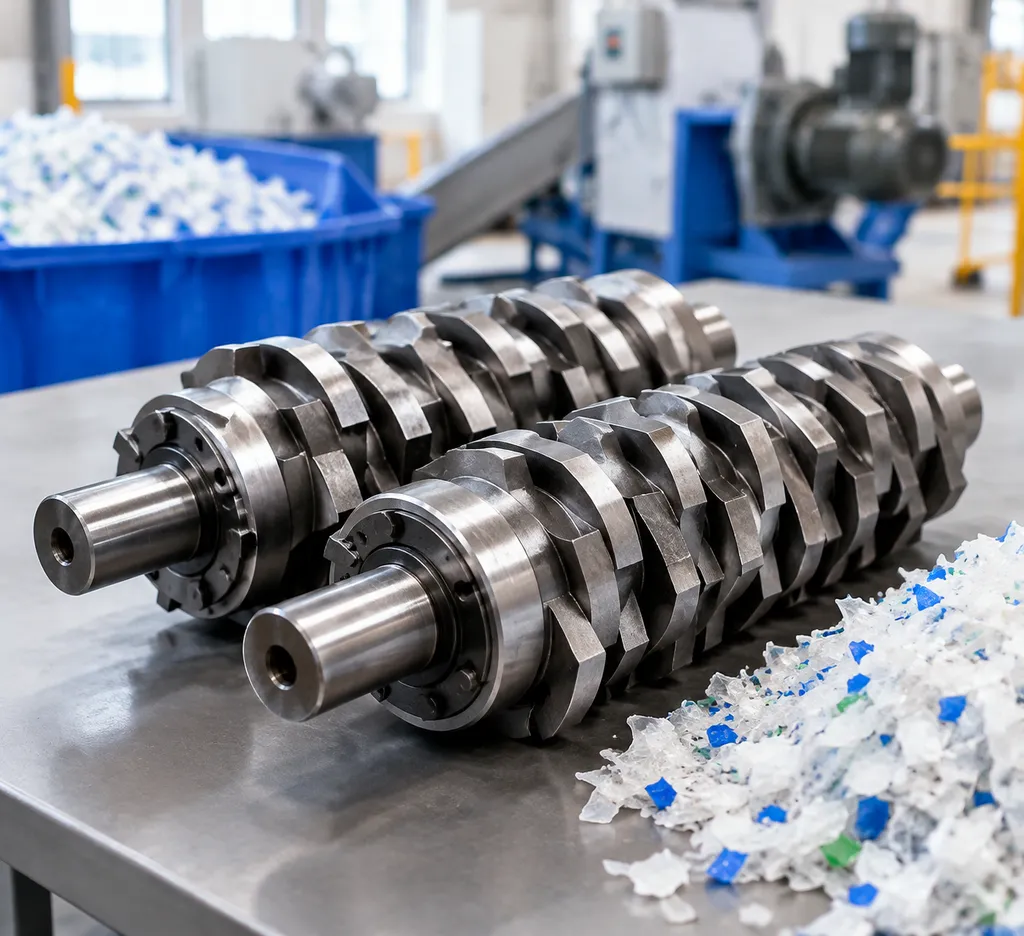
Double-Shaft and Four-Shaft Shredder Hook Profiles
Low-speed, high-torque dual-shaft shredders depend on aggressive hook geometries to draw in hollow containers, tough films, and bulky scrap.
- Hook configurations: Single-hook, multi-hook (3 to 24 teeth), and continuous-spiral patterns configured for specific feed stocks.
- Thickness and spacing: Disc thicknesses ground from 15mm to over 100mm, matched directly with hardened spacer rings.
- Intermeshing tolerance: We hold tight axial thickness limits within ±0.01mm to maintain consistent cutting clearances between opposing counter-hooks.
For operations processing contaminated baled plastics or high-impact scrap, our hardened double-shaft shredder blades are designed to eliminate shaft deflections and edge rounding during continuous operation.
Reversible Bed Knives and Stator Counter Blades
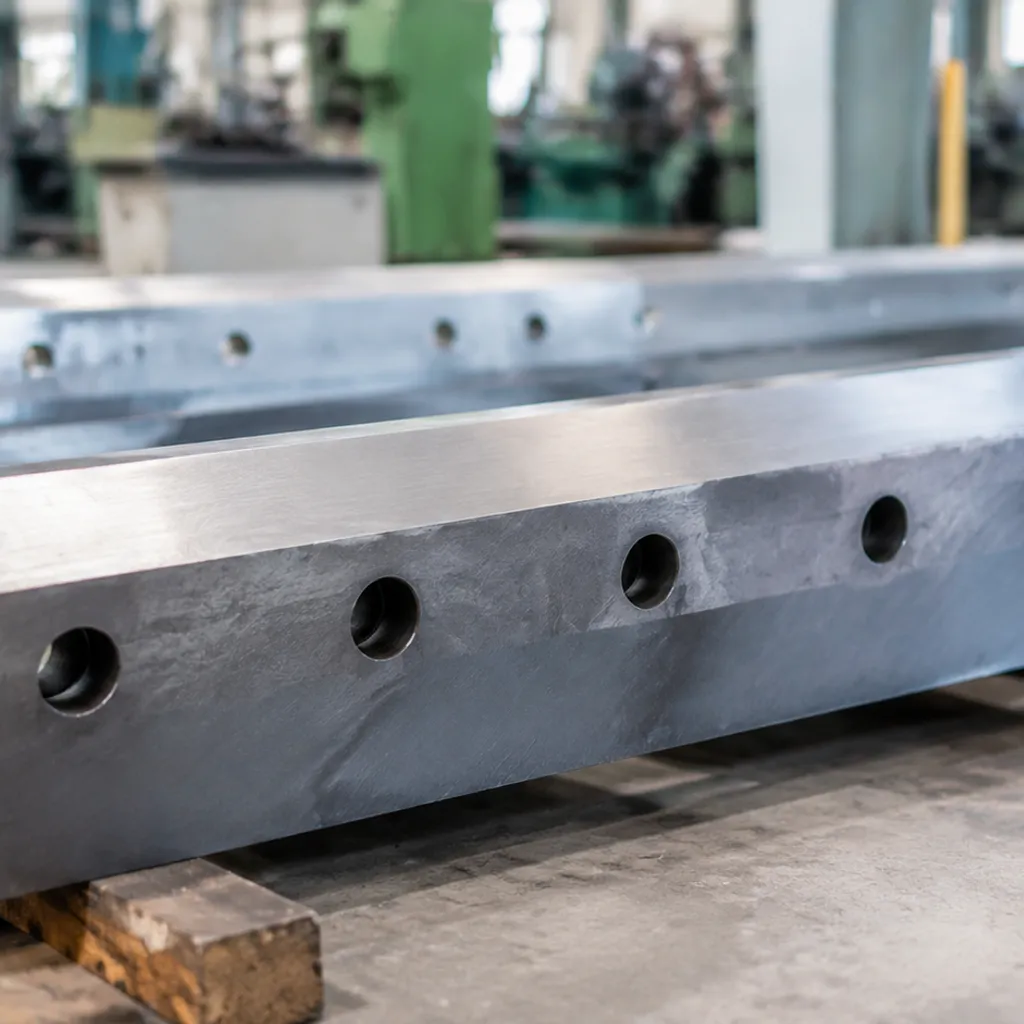
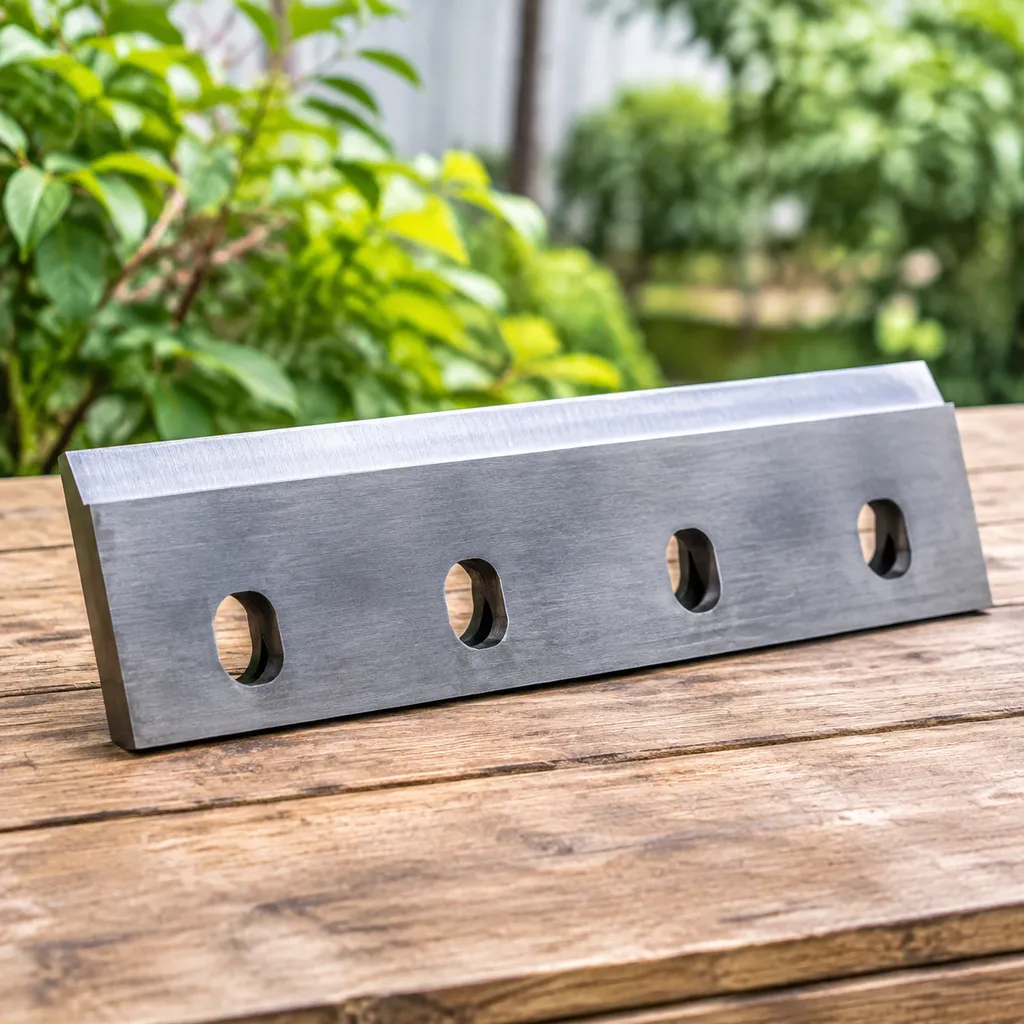
A sharp plastic shredder blade requires an equally durable counter edge. Stator blades absorb the direct opposing cutting load and must retain straightness over their entire length.
- Reversible wear edges: Dual-edge and four-edge ground stator bars double or quadruple service life before replacement.
- Segmented profiles: Multi-piece bed knife assemblies prevent thermal distortion and make individual section swaps faster and safer for maintenance crews.
- Adjustable mountings: Elongated bolt slots allow operators to reset the rotor-to-bed clearance to tight 0.5mm–1.0mm gaps as tools wear.
Matched Plastic Shredder Blade Sets with Hardware
Installing mismatched parts causes uneven wear across rotor shafts and triggers premature bearing fatigue. We assemble each matched plastic shredder blade set to run in total balance:
| Component | Standard Specifications | Functional Advantage |
|---|---|---|
| Rotary Blades | D2 / DC53, 58–62 HRC | High impact toughness and wear resistance |
| Counter Knives | D2 / Cr12MoV, 55–58 HRC | Slightly softer base to absorb shock without cracking |
| Spacers & Cleansers | 42CrMo / Tool Steel | Matches hook geometry; clears shredded debris |
| Mounting Hardware | Grade 12.9 High-Tensile Fasteners | Prevents bolt stretching, shearing, and pocket dropouts |
As dedicated plastic shredder blade suppliers, we pre-torque check, deburr, and match-grind complete tool sets, packaging them with certified mounting bolts and clamp bars so maintenance teams can complete fast turnarounds without plant delays.
Application-Specific Polymer Size-Reduction Performance
Every plastic stream hits a cutting edge differently. Running film through a cutter designed for solid pipe will wrap the rotor and drive up motor amps. Feeding thick purge blocks into brittle, ultra-hard knives will snap the tips clean off.
Shear-Cutting Blades for Film and Woven Jumbo Bags
Thin materials like LDPE agricultural film, BOPP packaging, and PP woven bulk bags stretch rather than shatter. To prevent wrapping around the shaft, these materials demand true scissor-action shear cutting with tight rotor-to-bed clearances (typically 0.1 mm to 0.2 mm).
- Edge Geometry: Razor-sharp acute bevels (30° to 45°) to shear flexible strands instantly.
- Steel Selection: High-carbon tool steels like DC53 or modified D2 that hold a keen edge under friction.
- Operating Benefit: Zero plastic stringing, lower drive motor load, and clean fragment release without thermal melting.
Impact-Resistant Knives for Solid Purge and Thick-Wall Plastic
Processing heavy injection purgings, HDPE pipe, and thick sheet profiles subjects your plastic shredder blade set to massive shock loads. Hardness must be balanced with exceptional fracture toughness to prevent catastrophic blade breakage.
- Edge Geometry: Reinforced, blunt cutting radiuses (typically double-bevel 55°–60°) engineered to bite into bulk density without fracturing.
- Core Toughness: Modified shock-resisting alloys heat-treated to 54–56 HRC to absorb mechanical shock without micro-cracking.
- Operational Fit: Proper plastic shredder blade design for high performance ensures that high-torque single-shaft rotors handle severe continuous impact.
Wear-Resistant Blades for Automotive Scrap and Electronic Waste
Automotive bumpers, interior trim, and WEEE plastics are loaded with aggressive abrasives: 30% glass fiber fills, calcium carbonate, metal staples, and dirt. Standard blades dull within dozens of operating hours.
| Performance Metric | Standard D2 Knives | Tungsten Carbide Tipped / Hard-Faced |
|---|---|---|
| Fiberglass Abrasion Resistance | Moderate | 4x to 6x longer edge retention |
| Typical Target Hardness | 58–60 HRC | 68–72 HRC (insert / inlay) |
| Primary Failure Mode | Accelerated flank wear | Controlled wash wear |
| Best Used For | Unfilled ABS, PP, PC | Glass-reinforced PA66, shredded dashboards |
Low-Fines Cutting Knives for Post-Consumer PET Bottle Recycling
Flake quality dictates washing and extrusion efficiency. Dull or poorly toleranced blades crush the polymer rather than slicing it, producing excessive dust and fine powder that clogs float-sink tanks and scorches in the extruder.
Our matched rotary and stationary plastic shredder blade configurations maintain uniform cutting clearances to deliver clean, crisp flake edges. Following proven PET bottle crusher blade design standards, our knives minimize thermal buildup and restrict polymer fines to less than 1% across standard wash-line operations.
Precision Manufacturing and Quality Control Processes
Ultrasonic Billet Testing and Multi-Axis Machining
Tool reliability starts at the molecular level. We reject substandard cast stock and source only certified forged tool steel billets.
- Ultrasonic Non-Destructive Testing (NDT): Every forged block undergoes 100% ultrasonic testing to identify internal micro-voids, slag inclusions, or density variations before machining starts.
- Multi-Axis CNC Shaping: We utilize advanced multi-axis CNC centers for rough and finish cutting. Achieving precise dimensional profiles guarantees that every rotary insert and stator knife seats flush into the shredder rotor pockets, eliminating knife deflection under heavy impact.
- Learn more about our manufacturing capabilities and precision machining standards designed to hold micro-level tolerances across production runs.
Decarb-Free Vacuum Hardening and Precision Grinding
Heat treatment defines blade life. Open-furnace hardening causes surface decarburization, leaving soft outer edges that dull rapidly during plastic recycling.
- Decarb-Free Vacuum Furnaces: We process all alloy steels in computerized vacuum furnaces. Quenching is automated to achieve uniform grain refinement throughout the entire core, not just the surface.
- Triple Sub-Zero Tempering: To convert retained austenite to stable martensite, our blades undergo multi-stage deep cryogenic tempering cycles. This prevents internal stress cracking when shredding thick-wall purges or dense regrind.
- Double-Disk Parallel Grinding: Hardened blanks move to horizontal double-disk surface grinders. We maintain strictly uniform blade thickness and edge-to-edge parallelism across every knife in a plastic shredder blade set, ensuring consistent shear clearances along the full length of the counter knife.
Dimensional Tolerances and Quality Benchmarks
We verify every production batch before packing and shipping. Our quality control lab inspects physical dimensions using Coordinate Measuring Machines (CMM) and verifies hardness across multiple points on the cutting face.
| Inspection Stage | Test Method | Quality Standard | Production Benefit |
|---|---|---|---|
| Material Integrity | Ultrasonic Flaw Detection | Zero internal porosity | Prevents catastrophic blade snapping under shock loads |
| Machined Geometry | CMM 3D Probing | Tolerances within ±0.01 mm | Drop-in fit for fast rotor maintenance and zero play |
| Core & Edge Hardness | Multi-Point Rockwell C | 58–62 HRC (Steel grade dependent) | Balanced impact toughness and sustained edge retention |
| Surface Flatness | Double-Disk Optical Gauging | Ra 0.4 µm roughness | Clean shearing with minimal plastic dust or frictional heat |
As direct plastic shredder blade suppliers, we log every production batch with material certs and CMM inspection sheets, ensuring reliable, repeatable performance in high-wear recycling environments.
Custom Plastic Shredder Blade Fabrication and Reverse Engineering
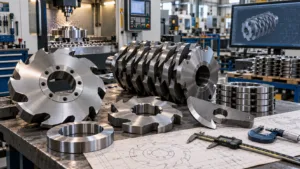
When standard replacement parts cause high motor amps or fail early, custom knife geometry solves the bottleneck.
Direct Manufacturing from 2D and 3D CAD Files
We work directly from customer engineering files—including DWG, DXF, STEP, and IGES formats. Our shop floor routes your drawings straight to multi-axis CNC machining centers and wire-EDM systems.
- Pocket Seating Accuracy: Critical bolt hole spacing and counterbore depths are held to ±0.02 mm to prevent knife shifting under heavy shock loads.
- Matched Consistency: Every plastic shredder blade set is machined in paired batches to ensure uniform weight and profile across the entire rotor.
- Fast Prototyping: Direct digital toolpaths eliminate tooling delays for custom cutter runs and trial profiles.
Reverse Engineering Worn Knives with Optical Mapping and Spectroscopy
Plants often run older or modified recycling machinery with missing OEM blueprints. When drawings are not available, our reverse engineering process reproduces the exact knife profile from a physical sample:
- Spectrometric Alloy Verification: We use optical emission spectrometry (OES) to identify the precise metallurgy of your sample, matching the alloy or upgrading it according to our crusher blade materials guide for improved wear life.
- Optical 3D Coordinate Scanning: Non-contact CMM scanners map the profile of rounded, chipped, or deformed parts, reconstructing the original factory datum lines.
- Hardness Testing: Benchtop Rockwell C testing determines the through-hardness core profile, ensuring replacements duplicate or exceed previous cycle life.
Optimizing Blade Bevel Angles to Boost Throughput
The angle of a cutting edge directly impacts shear force, motor amp draw, and edge longevity. Changing a standard single-bevel profile to a specialized geometry reduces rotor resistance and keeps cutting temperatures lower.
| Bevel Profile | Typical Cutting Angle | Primary Application | Operational Benefit |
|---|---|---|---|
| Acute Single Bevel | 30° – 35° | Film, raffia, thin-wall sheet | Clean scissors-action cut, eliminates stringing |
| Heavy Blunt Bevel | 50° – 60° | Pipe purge, lumps, thick regrind | High edge retention, resists catastrophic chipping |
| Compound Dual Bevel | 40° primary / 55° tip | Mixed rigid and semi-rigid plastics | Lower penetration force with reinforced edge strength |
Modifying the cutting relief angle on custom plastic shredder blade orders frees up motor capacity, lowers hydraulic feed pressure, and increases hourly tonnage without requiring extra machine horsepower.
Industrial Sourcing, Packaging, and Wholesale Delivery
Anti-Corrosion VCI Packaging and Export-Grade Crating
Precision ground tool steel reacts quickly to ocean freight moisture, humidity spikes, and temperature shifts during transport. We apply industrial-grade protective protocols to ensure every plastic shredder blade set reaches your plant free of flash rust, pitting, or edge damage:
- Dual-Layer Anti-Corrosion Treatment: Every blade undergoes a heavy coating of de-watering rust preventative oil, followed by vacuum-sealed Volatile Corrosion Inhibitor (VCI) poly wrapping to block atmospheric oxidation.
- Edge-Protected Dunnage: Cutting profiles, hooks, and counter-knife bevels sit in custom high-density foam inserts or heavy wax-coated edge protectors to prevent metal-on-metal chipping during transit.
- Export-Grade Plywood Crating: Sets are packed into reinforced, ISPM-15 compliant, heat-treated wooden crates bolted to internal frames, built to endure rough container drayage and forklift handling.
- Part Traceability: Every knife is laser-marked with heat numbers, steel grades, and rotor pocket locations according to our industrial knife markings and traceability guide, letting your maintenance crew verify clearances and positions during fast turnarounds.
Blanket-Order Fulfillment and Scheduled Safety Stock Programs
Lead times should never dictate your plant maintenance windows. For multi-facility recyclers and high-volume wash plants, we structure scheduled replenishment agreements:
| Program Feature | Standard Spot Orders | Scheduled Blanket Agreement |
|---|---|---|
| Inventory Holding | Built to order | 3–6 months reserved safety stock at our hub |
| Dispatch Window | Standard fabrication lead time | Same-day or 24-hour dispatch on call-off |
| Pricing Stability | Subject to tool steel raw material shifts | Fixed contract pricing locked for 12 months |
| Batch Quality | Per-run batch inspection | Single-lot forged runs for uniform HRC hardness |
Under these blanket programs, you draw down your stock as wear dictates. We monitor burn rates and automatically machine replenishment batches before your on-site reserves hit critical levels.
OEM Partnership Terms, MOQ Flexibility, and Worldwide Dispatch
Reliable plastic shredder blade suppliers must adapt to both custom machine builds and high-volume operations. We tailor commercial terms to support original equipment manufacturers and independent recycling facilities worldwide:
- Low Minimum Order Quantities (MOQs): We support single-prototype evaluation runs for custom rotor builds, as well as full-container production orders for global shredder OEMs.
- OEM Private Labeling: Direct laser marking of custom part numbers, brand logos, and batch codes directly on your custom plastic shredder blades.
- International Air and Sea Freight: Established logistics pipelines via air express (DHL/FedEx) for urgent emergency breakdowns, alongside reliable LCL and FCL sea freight routes for planned seasonal relines.
Whether you run single-shaft reducers on mixed rigids or high-torque double-shaft shredders processing post-consumer film, we build and deliver your wear tooling with predictable lead times and tight metallurgical control.
Technical and Sourcing FAQs
How to Select Between D2 and DC53 Tool Steels for Specific Plastic Streams
Choosing the right alloy balances edge retention against impact toughness. D2 provides high wear resistance for abrasive polymers, while DC53 offers double the toughness of D2 to eliminate edge breakout on dense purges.
| Steel Grade | Hardness Range | Primary Strengths | Best Polymer Applications |
|---|---|---|---|
| D2 (1.2379) | 58–60 HRC | High carbon/chromium abrasion resistance | Glass-filled nylon, PET flakes, rigid PVC pipe |
| DC53 | 60–62 HRC | Superior impact fatigue resistance, zero chipping | Thick-wall HDPE purges, large runners, LDPE baled film |
As an industrial plastic shredder blade supplier, we recommend DC53 when processing unsorted streams where tramp metal or sudden shock loads cause standard D2 edges to crack.
Manufacturing Custom Replacement Blades for Obsolete Shredder Brands
We reverse-engineer knives for discontinued, legacy, or imported recycling machinery without original drawings:
- Physical Samples: Send us worn or unbroken sample knives. We use optical 3D scanning and optical emission spectrometry to extract exact mounting hole coordinates, bevel geometry, and metallurgy.
- CAD Integration: We build manufacturing prints within 24 hours to match your rotor pockets and counter-knife beds.
- Fitment Guarantee: Every custom plastic shredder blade matches your machine’s factory tolerances without requiring on-site rotor modifications.
Preventing Cutting Edge Chipping and Premature Blade Wear
Edge failure usually stems from incorrect clearance gaps, excessive hardness, or wrong bevel angles:
- Clearance Gap Calibration: Maintain a consistent 0.1 mm to 0.3 mm gap between rotary hooks and stator knives. Too wide creates material pull and heat; too tight causes knife collision.
- Toughness Balancing: Drop operating hardness by 1–2 HRC if running heavy solid purges to stop catastrophic fracturing.
- Cutting Geometry: For single-shaft units processing thick lumps, our heavy-duty square shredder blades utilize concave dished faces that draw lower motor amps and reduce shearing impact on knife edges.
Standard Lead Times for Custom Plastic Shredder Blade Sets
We streamline production to keep recycling operations running without long plant shutdowns:
- Standard Profiles: Stocked blanks ship within 3 to 5 business days.
- Custom CNC Fabrication: Custom-machined plastic shredder blade set orders run on a standard 3- to 4-week cycle, including multi-stage vacuum heat treatment.
- Emergency Dispatch: Rapid manufacturing options are available within 10 to 14 days for urgent plant breakdowns.
Supplying Matched Grade 12.9 Mounting Hardware and Clamp Bars
We supply full-assembly installation kits to ensure safe, vibration-free seating:
- Fasteners: High-tensile Grade 12.9 socket head cap screws and countersunk bolts with anti-loosening chemical patches.
- Clamp Bars & Wear Plates: Precision-milled 42CrMo clamp bars designed to absorb cyclic vibration and hold rotor knife inserts rigid under high feed loads.
- Complete Replacement Kits: Every complete rotary shredder blade replacement package includes precision-ground shims, clamp bars, and matched hardware to eliminate installation delays.