
Browse Inquiries by Topic
Find fast, accurate answers regarding the knife ordering process, OEM blade customization options, tool steel metallurgical selection, and quality inspection standards.
Ordering & Logistics
Clear details on the knife ordering process, minimum order quantities (MOQ), production lead times, and global shipping terms.
- Order Placement Workflow
- Standard & Expedited Lead Times
- Flexible Minimum Order Quantities
- International Delivery Terms (FOB, DDP)
Customization & OEM
Technical guidance for OEM blade customization, CAD drawing submission, and reverse engineering from existing knife samples, including solutions for custom industrial knives.
- CAD & PDF Drawing Submissions
- Sample Reverse Engineering
- Custom Machine Knife Retrofits
- Prototype & Small Batch Production
Materials & Precision
Insights into industrial knife materials, alloy tool steel selection (D2, SKD11, Carbide), heat treatment, and tolerance specs for applications like recycling blades.
- D2, SKD11, HSS & Carbide Grades
- Vacuum Heat Treatment & Hardness
- Precision Knife Tolerances (±0.002mm)
- Wear-Resistant Surface Coatings
Support & Quality
Information regarding blade precision inspection, quality certifications, re-sharpening guidance, and claim resolutions.
- ISO Quality Management Standards
- Blade Precision Inspection Testing
- Re-Sharpening & Life Extension
- Warranty Support & Claim Handling
Need Direct Engineering Support?
Sharkcutting engineers provide expert guidance on blade material selection, CAD blueprint analysis, and custom cutting evaluations for your specific machine setup.
Browse Inquiries by Topic
Browse our structured technical knowledge base by category to locate rapid answers for your application and procurement workflow.
Ordering & Logistics
Focuses on order placement, standard and custom lead times, minimum quantities, and global shipping terms.
Customization & OEM
Covers CAD drawing requirements, reverse engineering from physical samples, and OEM custom retrofits.
Materials & Precision
Addresses steel metallurgy choices like D2, SKD11, High-Speed Steel, Carbide, heat treatment, and tolerances.
Support & Quality
Outlines quality assurance certifications, inspection criteria, re-sharpening guidance, and claim resolutions.
Standard versus Custom Machine Knife Ordering Specifications
Compare key procurement parameters between off-the-shelf industrial blades and engineered custom tooling manufactured by Sharkcutting.
| Procurement Parameter | Standard Off-the-Shelf Blades | Custom OEM Engineered Knives |
|---|---|---|
| Minimum Order Quantity (MOQ) | 1 to 5 pieces for catalog stock items | 10 to 50 pieces based on metallurgy & complexity |
| Standard Production Lead Time | 24 to 48 hours warehouse dispatch | 3 to 4 weeks upon CAD blueprint approval |
| Expedited Emergency Option | Same-day express dispatch available | 7 to 10 working days emergency production track |
| Sample Evaluation Availability | Immediate unit purchase for testing | Prototype run / pre-production sample upon CAD review |
| Steel Metallurgy Choices | Standard D2, SKD11, and M2 High-Speed Steel | Solid Carbide, Powder Metallurgy, M2/M42, Custom Alloys |
| Payment Terms & Incoterms | T/T, Credit Card; Express FOB, CIF, DDP | 30% deposit / 70% before dispatch, L/C; FOB, CIF, DDP |
Ordering, MOQ and Delivery Lead Times
What are the Minimum Order Quantities for standard vs custom machine knives
Sharkcutting provides flexible minimum order quantities designed to accommodate urgent equipment repairs as well as high-volume factory operations. For standard, catalog machine knives—including our premium range of slitting-knives, paper shearing blades, and standard shredder cutters—the Minimum Order Quantity (MOQ) starts at just 1 to 5 pieces.
For custom machine knives requiring specialized geometry, unique hole patterns, or non-standard metallurgy, the MOQ typically ranges from 10 to 50 pieces. This minimum accounts for CNC setup time, specialized heat treatment furnace runs, and precision grinding calibration.
- Standard Catalog Blades: MOQ of 1 to 5 units for immediate fulfillment.
- Custom OEM Machine Knives: MOQ of 10 to 50 units depending on steel alloy and tooling setups.
- Prototype & Trial Batches: Low-volume evaluation runs available upon drawing sign-off.
What are the typical delivery lead times for circular slitting blades and shear knives and are rush orders supported
Standard circular slitting blades, shear-slitting-knives, and stock industrial cutters stored in our distribution inventory are dispatched within 24 to 48 hours after purchase confirmation.
For custom engineered machine knives requiring dedicated forging, CNC profiling, vacuum heat treatment, and precision surface grinding, standard delivery lead times are 3 to 4 weeks.
When emergency production stoppages occur, Sharkcutting supports an expedited manufacturing protocol. Rush orders can be manufactured and dispatched via international air freight express within 7 to 10 business days.
What is the process for requesting evaluation samples prior to full volume production runs
We encourage field testing evaluation samples to verify cutting edge durability, tolerances, and material performance before committing to a major production run.
- Technical Consultation: Submit your CAD drawings, sample blade, or operational parameters to our technical team.
- Blueprint Sign-off: Our engineering department generates detailed 2D/3D manufacturing drawings for formal approval.
- Sample Production: Prototype samples are produced using the exact steel grade, heat treatment, and grinding steps targeted for mass production.
- Commercial Adjustment: Sample tooling costs are credited back to your account upon placement of the full volume order.
Which international logistics arrangements and commercial payment structures are available
Sharkcutting provides seamless international trade logistics and transparent financial terms for industrial buyers worldwide.
We support FOB, CIF, CFR, and DDP (Delivered Duty Paid) via air express (DHL, FedEx, UPS), ocean container freight, or air cargo for rapid customs clearance.
Standard terms include Telegraphic Transfer (T/T with 30% deposit and 70% balance prior to shipment), Irrevocable Letter of Credit (L/C at sight), and credit terms for qualified recurring buyers.
Customization Specifications Metallurgy and Machining Tolerances
Can Sharkcutting manufacture custom blades if original engineering drawings are unavailable
Yes, our reverse engineering capabilities allow us to produce precise replacement blades even when technical drawings are completely missing. You can send a worn or used sample blade directly to our technical center.
We utilize coordinate measuring machines (CMM), optical profile projectors, and spectrographic alloy analyzers to reconstruct exact 2D/3D CAD blueprints and determine the optimum steel metallurgy prior to manufacturing.
How do I select between D2 SKD11 High Speed Steel M2 M42 and Solid Tungsten Carbide
Alloy selection depends on substrate abrasiveness, production speed, operating temperature, and required sharpening intervals.
- D2 / SKD11 Tool Steel: High wear resistance and exceptional shock resistance. Best for paper converting, corrugated board, plastic recycling, and general slitting.
- High-Speed Steel (M2 / M42): Superior thermal hardness and impact strength. Preferred for automated high-speed shearing and tough composite cutting.
- Solid Tungsten Carbide: Extreme hardness and unmatched edge longevity. Ideal for continuous thin-film slitting, battery foil converting, and non-woven fabrics where down-time costs are critical.
What manufacturing tolerances can be achieved for circular slitters and heavy duty shredder knives
Sharkcutting utilizes state-of-the-art CNC double-disc grinding and lapping machinery to achieve microscopic precision across our entire line of circular-slitter-knives.
For precision circular slitting blades, thickness tolerances are maintained within ±0.001 mm with parallelism and flatness within 0.002 mm. Heavy-duty shredder knives and granulator blades are manufactured within ±0.02 mm to ensure smooth bolt alignment and balanced rotor operation.
Are specialized surface coatings TiN TiAlN DLC and custom heat treatment hardness levels available
Yes, customized surface treatments reduce friction coefficients and eliminate material adhesion issues such as glue buildup or soft polymer smearing.
PVD coating choices include Titanium Nitride (TiN), Titanium Aluminum Nitride (TiAlN), Diamond-Like Carbon (DLC), and non-stick Teflon. Vacuum heat treatment allows custom target hardness ratings ranging from 58 HRC up to 68 HRC tailored to your material requirements.
Quality Inspection Standards and After Sales Support
How does Sharkcutting ensure batch to batch dimensional consistency for large production runs
Every production lot undergoes strict Statistical Process Control (SPC). Our quality control department performs 100% optical inspection on key dimensions and Rockwell hardness verification for every heat treat batch.
Full Mill Test Certificates (MTC), heat treatment reports, and dimensional inspection sheets are included with every export shipment.
What is the process for addressing dimensional discrepancies or shipping damage
Sharkcutting provides a comprehensive Quality Guarantee on all delivered cutting tools. If any blade fails to meet verified drawing tolerances or arrives damaged:
- Submit photos or inspection reports within 14 days of shipment receipt.
- Our quality team issues an expedited RMA and prioritizes replacement manufacturing.
- Replacement units are shipped via express air freight at no additional cost to your firm.
Do you offer re sharpening guidelines and technical maintenance support
Yes, proper blade maintenance extends tool life significantly and reduces long-term tooling expense. We provide detailed re-sharpening technical guides specifying grinding wheel composition, coolant flow rates, and maximum stock removal per pass.
Our engineering specialists are also available for technical consultations to review on-site sharpening setups and shear clearance calibrations.
What maintenance procedures maximize the operational lifespan of industrial blades
To maximize blade service life and maintain pristine cut quality, implement three standard operating protocols:
- Clearance Calibration: Verify blade gaps using feeler gauges to prevent side-load friction and edge chipping.
- Residue Removal: Clean adhesive or polymer buildup using approved non-corrosive solvents after every shift.
- Corrosion Control: Apply a uniform coating of protective anti-rust oil prior to storing idle knives.
Didn't Find the Answer You Were Looking For
Our application engineers and technical specialists are available to review your engineering drawings, assist with alloy selection, or prepare a tailored commercial proposal.
Get personalized technical blade consultations within 24 business hours.
Customization Specifications, Metallurgy & Machining Tolerances
Engineered precision is critical for seamless machine integration, prolonged blade lifespan, and minimal production downtime. Below are expert technical responses regarding custom engineering capabilities, tool steel metallurgy selection, micro-inch tolerances, and high-performance surface coatings provided by Sharkcutting.
Can Sharkcutting manufacture custom blades if original engineering drawings are unavailable?
Yes. Sharkcutting specializes in full reverse-engineering workflows when legacy engineering drawings or technical CAD files are missing. Our engineering facility utilizes non-contact optical 3D laser scanners, precision coordinate measuring machines (CMM), and laboratory-grade hardness testing to recreate exact specifications from physical samples.
Whether you provide a worn sample knife, a damaged blade segment, or mating shaft components, our application team reconstructs the complete geometry while identifying mechanical weaknesses to optimize OEM blade customization performance.
Our 4-Step Reverse Engineering Protocol
- 1 Laser Metrology: Non-destructive 3D scanning captures micro-scale edge geometry and mounting dimensions.
- 2 Metallurgical Analysis: Spectrographic testing determines exact alloy composition and core hardness.
- 3 3D CAD Modeling: Parameterized 2D/3D engineering drawings are generated for client sign-off.
- 4 Prototype Validation: First-article trial runs ensure 100% mechanical fit and cutting performance.
How do I select between D2/SKD11, High-Speed Steel (M2/M42), and Solid Tungsten Carbide for my application?
Selecting the ideal tool steel or hard metal compound requires balancing abrasion resistance, impact toughness, and operating thermal stress. Choosing inappropriate industrial knife materials leads to premature edge chipping, thermal degradation, or frequent blade changeover costs.
| Material Grade | Hardness Range | Core Strengths | Primary Applications |
|---|---|---|---|
| D2 / SKD11 Tool Steel | 58 - 62 HRC | High carbon/chromium alloy offering high toughness, strong wear resistance, and cost-effective versatility. | Paper slitting, heavy plastic granulating, metal shearing, and general recycling applications. |
| HSS (M2 / M42) | 62 - 66 HRC | Superior hot-hardness, excellent red-hardness retention, and friction heat endurance. | High-speed rotary film slitting, automated packaging lines, and tissue converting. |
| Solid Tungsten Carbide | 88 - 92 HRA | Extreme micro-hardness, exceptional edge retention, and virtually zero wear in high-friction environments. | Carbide slitter blade material for abrasive foil slitting, magnetic media, and battery electrode cutting. |
Our metallurgy engineers analyze your substrate properties (thickness, shear strength, abrasive fillers like glass fibers or titanium dioxide) to recommend the optimal tool grade for custom machine knives.
What manufacturing tolerances can be achieved for circular slitters and heavy-duty shredder knives?
Sharkcutting operates state-of-the-art CNC high-precision surface, cylindrical, and profile grinders capable of achieving strict precision tolerance specs for high-performance circular slitter knives. Microscopic dimensional control prevents axial runout, blade friction, and uneven knife wear during continuous operation.
Circular Slitter Blades
- ▪ Parallelism & Flatness: Up to ±0.00005 in (±0.0012 mm)
- ▪ Bore Diameter Tolerance: H3 to H5 precision fit
- ▪ Thickness Variation: Within 0.001 mm across batch runs
- ▪ Surface Finish: Mirror finish down to Ra 0.1 µm
Heavy-Duty Shredder Knives
- ▪ Overall Thickness Tolerance: ±0.001 in (±0.025 mm)
- ▪ Pitch & Keyway Accuracy: Class 2 precision machining
- ▪ Cutting Edge Radius: Custom-ground 0.2 mm to 1.5 mm
- ▪ Hardness Uniformity: Within ±1 HRC across whole blade body
Are specialized surface coatings (TiN, TiAlN, DLC) or custom heat treatment hardness levels available?
Yes. We provide tailored surface treatments and controlled atmospheric heat treatments to maximize blade life under demanding operating environments. Specialized Physical Vapor Deposition (PVD) coatings dramatically reduce surface friction and material buildup.
Titanium Nitride (TiN)
Surface Hardness: ~2300 HVGolden PVD coating providing universal friction reduction and enhanced surface wear protection for paper and foil converting.
Titanium Aluminum Nitride (TiAlN)
Surface Hardness: ~3000 HVHigh thermal oxidation resistance up to 800°C. Ideal for dry high-speed slitting and abrasive synthetic fibers.
Diamond-Like Carbon (DLC)
Co-efficient of Friction: <0.1Ultra-slick non-stick surface preventing adhesive accumulation when cutting pressure-sensitive tapes and labels.
In addition to PVD coatings, Sharkcutting performs multi-stage vacuum heat treatment paired with deep cryogenic freezing (-300°F / -185°C) to eliminate residual austenite, enhance toughness, and lock in precise dimensional stability.
Need Custom Metallurgical Guidance or Engineering Tolerance Verification?
Our application engineers analyze your exact cutting substrate, production speed, and machine parameters to recommend ideal alloys, custom heat treatments, or PVD surface coatings.
Quality Inspection Standards & After-Sales Support
Discover how Sharkcutting safeguards blade precision through rigorous CMM dimensional inspection, standardized metallurgical heat treatments, express claim resolution, and comprehensive lifecycle re-sharpening guidance.
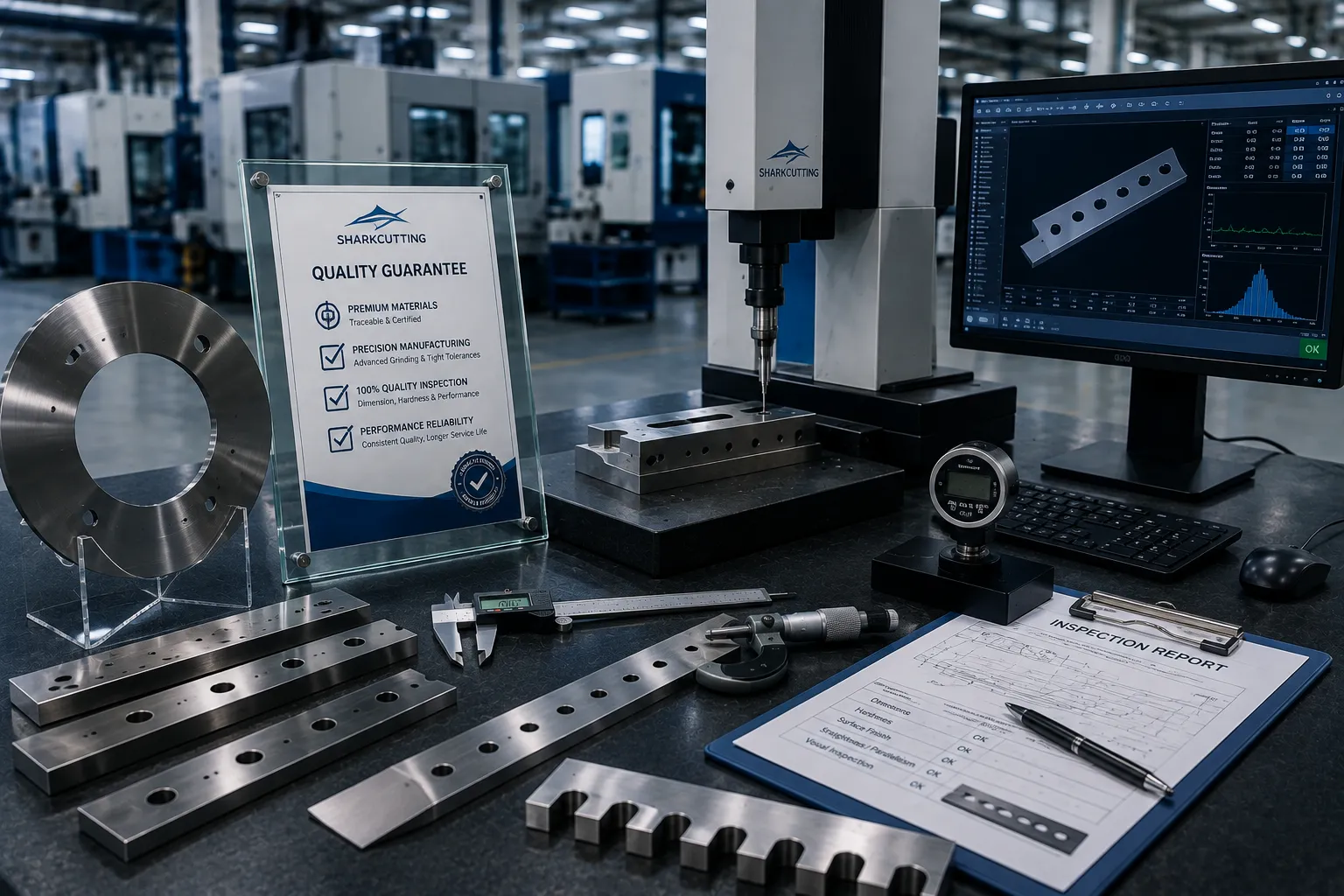
Sharkcutting Quality Guarantee
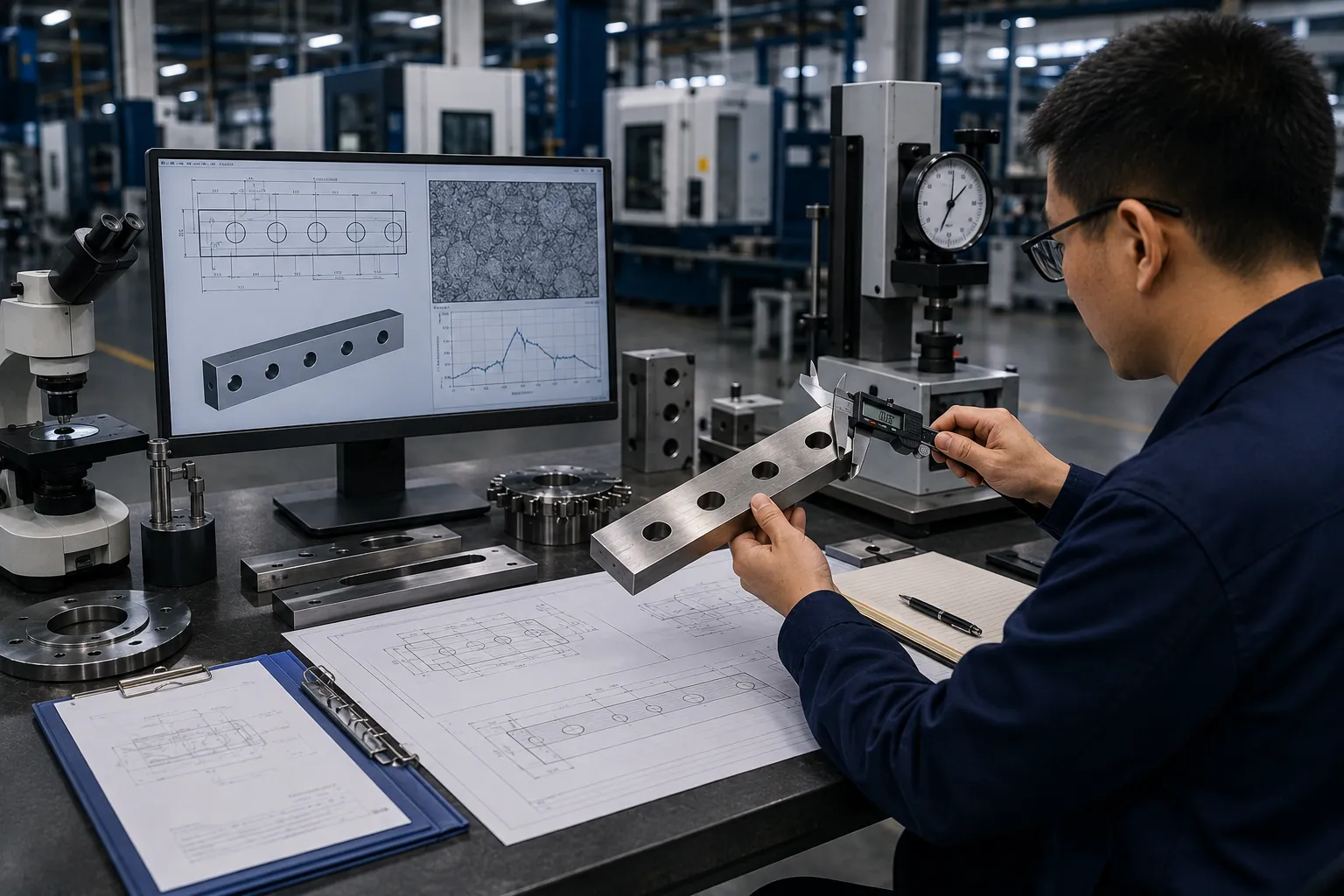
Every piece of industrial machine knives undergoes multi-point micrometer checks, hardness testing, and optical coordinate measuring prior to dispatch.
- ±0.001mm Tolerance capabilities for high-precision circular slitters
- 100% Traceable Metallurgy for D2, SKD11, HSS, and Tungsten Carbide
- Full Inspection Reports delivered with custom volume production runs
Need Direct Technical Consultation?
Our application engineers assist with regrinding schedules, wear analysis, and alloy troubleshooting.
Contact Cutting Experts Question 1: How does Sharkcutting ensure batch-to-batch dimensional consistency for large production runs?
Maintaining strict batch-to-batch dimensional consistency is paramount for high-speed industrial slitting, recycling shredders, and specialized packaging machine knives. Sharkcutting utilizes a closed-loop quality assurance framework that governs every stage of manufacturing:
- Metallurgical Verification: Raw tool steels (D2, SKD11, High-Speed Steel, Carbide) undergo spectrographic analysis to guarantee uniform carbide distribution and chemical purity before machining starts.
- Controlled Vacuum Heat Treatment: Computerized thermal cycles with cryogenic deep freezing eliminate retained austenite, securing consistent hardness (e.g., 58–64 HRC) across entire production lots.
- Precision CNC Grinding: Multi-axis CNC grinders maintain strict dimensional tolerances for thickness, bore concentricity, and lateral runout down to ±0.001mm.
- CMM & Optical Inspection: Automated Coordinate Measuring Machines (CMM) and laser profile scanners measure 100% of critical dimensions for high-volume orders, generating comprehensive inspection logs prior to shipment.
Question 2: What is the process for addressing dimensional discrepancies or shipping damage?
Sharkcutting guarantees all delivered products strictly match approved CAD drawings and commercial specifications. In the rare event of a dimensional variance or transit damage, we enforce a streamlined 24-hour response protocol to minimize operational downtime:
Submit order numbers, dimensional discrepancy photos, or transit damage details within 14 days of receipt.
Our engineering team evaluates CMM records and production logs within 24 to 48 hours for immediate verification.
Verified claims trigger priority remake slots with expedited air freight shipping at zero extra cost.
Export Protective Packaging Standard: To prevent corrosion and impact damage during international transport, all Sharkcutting blades are treated with VCI anti-rust oil, heat-sealed in protective barrier film, and shipped inside heavy-duty, steel-strapped wooden cases.
Question 3: Do you offer re-sharpening guidelines and technical maintenance support?
Yes, Sharkcutting provides detailed blade maintenance manuals and regrinding parameters with every major blade family. Proper re-sharpening can extend blade operating lifespans by up to 300% while maintaining crisp cut edges and clean material separation.
Key Re-sharpening Support Services
- Optimal Angle Charts: Customized bevel specifications tailored to specific slit substrates (e.g., BOPP film-cutting-knives, foil, corrugated paper, tissue).
- Abrasive Wheel Selection: Guidance on Cubic Boron Nitride (CBN) wheels for High-Speed Steel and resin-bonded diamond wheels for Solid Tungsten Carbide.
- Thermal Shock Prevention: Coolant flow velocity and grinding feed rates designed to eliminate surface micro-cracking and temper loss.
Our engineering team offers free technical blade consultations to review your in-house grinding setups or recommend certified regional regrinding partners.
Question 4: What maintenance procedures maximize the operational lifespan of industrial blades?
Achieving peak blade performance and maximizing total cut cycles requires systematic preventative maintenance. Follow these key industry practices recommended by Sharkcutting application specialists:
Clearance Calibration & Radial Alignment
Ensure horizontal overlap and axial blade gap match substrate thickness exactly. Incorrect clearance causes premature burring and edge micro-chipping.
Torque Balancing on Arbor Shafts
Apply calibrated torque wrenches when securing circular slitter assemblies to avoid arbor deflection and runout distortions.
Routine Cleaning & Polymer Residue Removal
Clean adhesive build-up, resin, or plastic dust using approved non-abrasive solvents. Unchecked buildup increases friction and operating temperatures.
Controlled VCI Storage Conditions
Store spare industrial knives vertically in wood-lined racks or protective VCI sleeves at humidity levels below 50% to prevent oxidation.
Didn't Find the Answer You Need?
Our application engineers are available to review your CAD drawings, recommend the right blade material and geometry, and prepare a tailored solution for your cutting equipment and production requirements.
Drawing Review
CAD and tolerance evaluation
Alloy Selection
Steel, HSS and carbide guidance
Custom Quote
Factory-direct technical proposal