
Tired of premature edge chipping and costly machine downtime?
Choosing the right crusher blade material can make or break your processing efficiency. Go too hard, and your knives shatter under heavy impact. Go too soft, and they dull within days.
Whether you are granulating abrasive rigid plastics, tearing tough films, or recycling bulky scrap, finding the sweet spot among industrial crusher blade materials—from D2 and SKD-11 to specialized high-wear alloys—is the key to maximizing blade life and slashing operating costs.
In this guide, you’ll discover the exact steel grades, hardness trade-offs, and metallurgical properties needed to pick the perfect blade for your operation.
Let's dive in!
Why Crusher Blade Material Dictates Operating Costs
In recycling and size-reduction plants, knife replacement and rotor maintenance represent your single largest controllable operating expense. When a cutter dulls or fractures prematurely, the cost is never just the price of a replacement knife—it is lost throughput, surging motor amperage, burned drive belts, and hours of unscheduled technician labor.
Selecting optimal crusher blade materials means optimizing the exact metallurgy to survive your specific feedstock without catastrophic failure.
Balancing Wear Resistance and Impact Toughness
Every cutting knife operates under a fundamental metallurgical trade-off: wear resistance vs impact toughness.
- Wear Resistance (Hardness): Higher carbon and vanadium content yields extreme surface hardness (58–62 HRC). This retains sharp cutting edges against abrasive feedstocks like glass-filled polymers or dirty plastics, preventing rapid dulling.
- Impact Toughness: Lower hardness combined with elements like chromium, nickel, or molybdenum allows the steel matrix to absorb mechanical shock without shattering when striking uncrushables or thick, dense cross-sections.
Pushing hardness too high causes micro-chipping along the cutting bevel. Dropping hardness too low causes rapid edge roll, plastic deformation, and excessive friction that melts feedstock instead of cutting it cleanly.
How Wrong Steel Choices Lead to Blade Chipping and Downtime
Mismatched alloy selection creates immediate operational bottlenecks:
- Catastrophic Blade Chipping: Running high-hardness, low-toughness cold-work tool steels on baled metals, thick purgings, or uncleaned scrap causes the blade edges to fracture upon impact.
- Secondary Machine Damage: Shucked steel fragments enter the cutting chamber, scoring the screen, gouging the rotor pocket, and destroying bed knives.
- Thermal Edge Rolling: Using low-alloy steel for abrasive, high-speed granulating generates frictional heat that anneals the edge, rapidly widening your blade gap clearance and causing the motor to trip on overload.
- Labor Overhead: Every chipped knife requires an emergency shutdown, rotor cleanout, unbolting, gap recalibration, and rebalancing.
The Cost Equation: Raw Material Investment vs. Knife Replacement Frequency
A budget knife made from substandard steel delivers an illusion of upfront savings that vanishes during the first production run.
| Cost Factor | Low-Grade Carbon Steel (e.g., Standard 65Mn) | Premium Tool Steel / Alloy (e.g., Vacuum-Hardened D2/H13) |
|---|---|---|
| Initial Purchase Price | Low | Moderate to High |
| Edge Retention Lifespan | 40–80 Operating Hours | 250–500+ Operating Hours |
| Regrinding Frequency | Frequent (High material loss per grind) | Low (Light dressing passes only) |
| Risk of Rotor Jam / Stall | High (Dull edges increase load) | Low (Consistent shear geometry) |
| Total Cost of Ownership (TCO) | High (Driven by downtime & labor) | Lowest per processed ton |
Investing in application-matched crusher blade material slashes overall operating expenditures by extending maintenance intervals, keeping rotor energy draw flat, and maximizing continuous hourly tonnage.
Common Crusher Blade Materials and Metallurgy
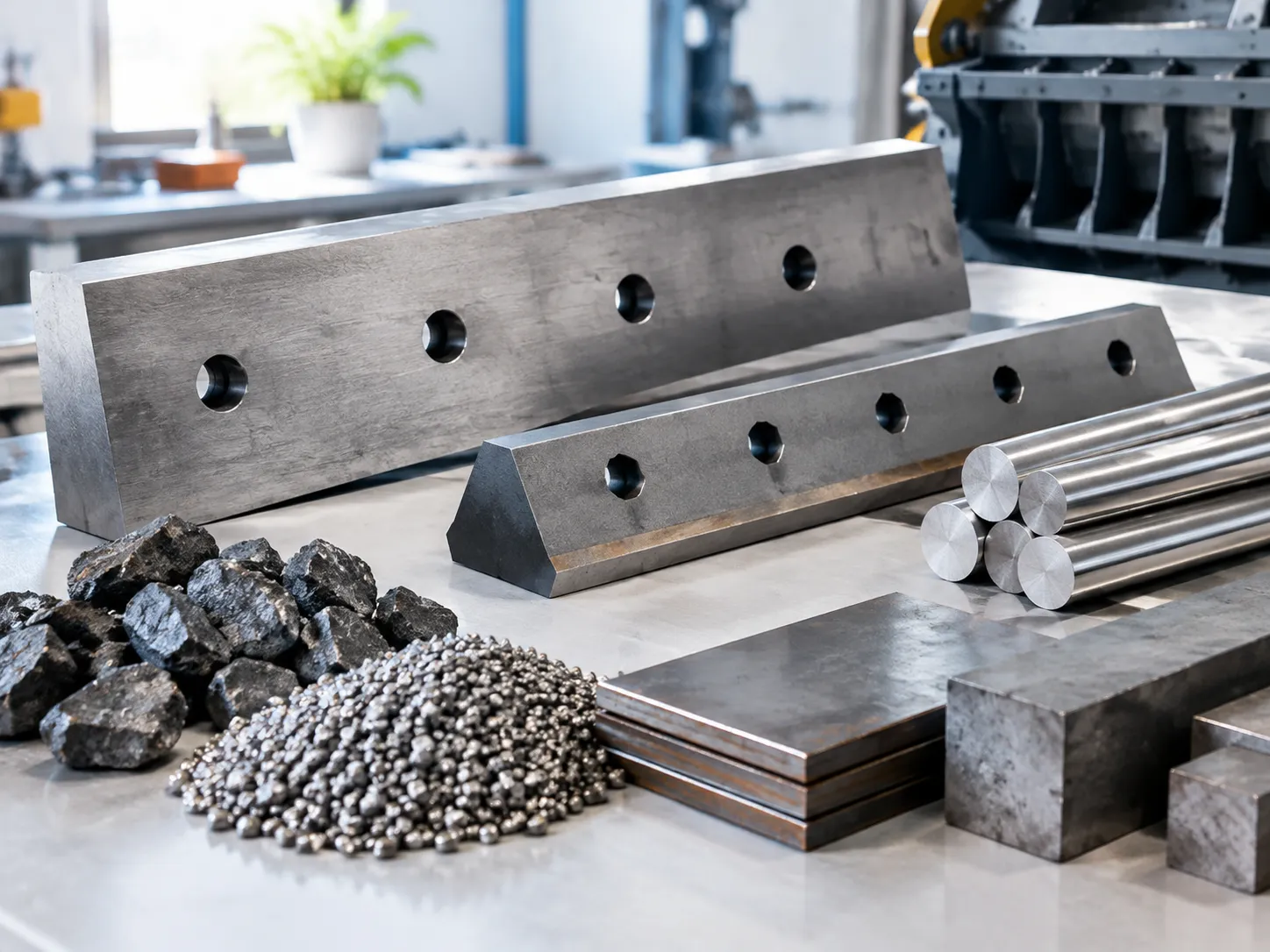
Choosing the right crusher blade material comes down to how your knives handle shear stress, continuous friction, and shock loads. In our shop and out in recycling yards, we see operations burn through thousands of dollars in downtime simply because their alloy choice clashes with their feedstock.
Here is how the primary crusher blade materials stack up in field performance, chemistry, and working life.
| Material Grade | Hardness | Primary Advantage | Best Applications |
|---|---|---|---|
| D2 / SKD11 | 58–60 HRC | Abrasive wear life | PET, HDPE, rigid plastics, granulators |
| H13 / SKD61 | 52–56 HRC | Extreme shock load | Thick purgings, scrap metal, e-waste |
| 9CrSi | 54–57 HRC | Low initial cost | Light film, clean runners, soft rubber |
| 65Mn Spring Steel | 50–54 HRC | Shatter resistance | Primary shredders, pallets, demolition |
| Tungsten Carbide | 88–92 HRA | Extreme edge life | Glass-filled polymers, dense composites |
| HSS / M2 | 61–64 HRC | Razor edge retention | Thin film, stretch wrap, synthetic fiber |
D2 (1.2379 / SKD11) Cold-Work Tool Steel
D2 tool steel crusher blades are the industry standard for general plastic recycling. With roughly 12% chromium and 1.5% carbon, D2 forms dense, hard chromium carbides throughout its matrix.
Hardness Profile: Heat-treated to 58–60 HRC.
Performance: Exceptional resistance against abrasive sliding wear. Edge retention on clean polymers is second to none among standard tool steels.
Limitations: Prone to micro-chipping if tramp metal or thick stones hit the cutting chamber. Keep SKD11 granulator knives on clean, rigid polymers like PET bottle flakes, PVC pipe regrind, and HDPE regrind.
H13 (1.2344 / SKD61) Hot-Work Tool Steel
When feedstocks contain heavy contaminants, thick cross-sections, or occasional uncrushables, an H13 shock resistant blade is your best insurance policy against catastrophic rotor failure.
Hardness Profile: Drawn back to 52–56 HRC.
Performance: High vanadium and molybdenum levels provide massive impact toughness. Instead of shattering under violent impact, H13 deforms slightly, protecting your rotor and bearing housings.
Limitations: Lower carbon means it dulls faster on purely abrasive materials than cold-work tool steel. We specify it for heavy electronic waste, copper cable chopping, automotive shredders, and massive injection molding purgings.
9CrSi Low-Alloy Tool Steel
For budget-sensitive plants running clean, low-impact scrap, 9CrSi delivers adequate hardness at a fraction of the raw material cost.
Hardness Profile: Tempered to 54–57 HRC.
Performance: Easy to machine and fast to resharpen on conventional surface grinders.
Limitations: Low alloy content limits impact resistance and abrasive wear limits. It fits light-duty film shredders, agricultural drip-tape recycling, and soft plastic processing where blades require frequent rotation regardless of steel grade.
65Mn and High-Carbon Spring Steels
Primary shredders and bulky reduction machines depend on high-yield spring steels like 65Mn (equivalent to AISI 1065).
Hardness Profile: 50–54 HRC.
Performance: Excellent elasticity, high yield strength, and structural fatigue resistance under repeated shock loads.
Limitations: Edge dulling happens rapidly on abrasive polymers. We use 65Mn primarily for coarse shredder hooks, wood waste, pallet recycling, and municipal solid waste pre-shredding where blade survival under heavy shock matters far more than a razor-sharp cut.
Tungsten Carbide Inserts
For hyper-abrasive feedstocks like glass-filled nylon (PA66-GF30) or printed circuit board scrap, standard wear resistant steel alloys fail in days. Brazing solid tungsten carbide blade tips onto a tough steel backer solves abrasive wear failure.
Hardness Profile: 88–92 HRA (roughly equivalent to 70+ HRC).
Performance: Extreme micro-hardness that handles continuous abrasive grit without losing its profile. Just as specialized carbide options for precision cutting extend tool life in continuous high-friction operations, solid carbide inserts eliminate the weekly knife swaps typical of abrasive recycling lines.
Limitations: Carbide possesses zero shock resistance. If a high-tensile steel bolt enters the cutting chamber, the carbide will shatter instantly.
High-Speed Steel (HSS / M2)
Granulating ultra-thin film, stretch wrap, woven polypropylene bags, or spun nylon requires shearing rather than crushing. M2 high-speed steel holds the keenest edge under high cutting speeds.
Hardness Profile: 61–64 HRC.
Performance: Rich in tungsten, molybdenum, and vanadium, M2 maintains an ultra-sharp cutting bevel that prevents plastic film from pulling, stretching, or wrapping around the rotor shaft.
Limitations: High hardness makes it brittle against foreign tramp metals. Run M2 only with strict metal detection systems ahead of the granulator infeed.
Crusher Blade Material Comparison: Hardness, Toughness, and Life
Target Rockwell Hardness (HRC) Ratings Across Steel Grades
Achieving the longest service life requires holding specific blade hardness HRC rating bands. Stepping outside these ranges usually ruins performance:
- D2 / SKD11 (58–60 HRC): High carbon and high chromium deliver exceptional abrasive wear resistance. Push it to 61 HRC and the edge will chip; drop it below 57 HRC and edge retention degrades rapidly.
- H13 / SKD61 (50–54 HRC): Sacrifices ultimate edge retention for extreme shock resistance. We run this when shock absorption matters more than abrasive wear.
- 9CrSi (56–58 HRC): Reliable mid-range hardness for light, clean scrap, but prone to micro-chipping under sudden shock loads.
- 65Mn (52–56 HRC): High spring characteristics. It absorbs severe strikes without breaking, though edges roll faster under abrasive friction.
- Tungsten Carbide Tips (89–92 HRA / Equivalent 72+ HRC): Hyper-hard wear surfaces bonded to alloy backings. Unmatched edge life against abrasive plastics, but will shatter if struck by foreign steel.
Chipping Risk vs. Dulling Speed in Continuous Crushing
When evaluating crusher blade materials, we balance two primary failure modes:
- Abrasive Dulling: The cutting radius gradually rounds out. The machine consumes more kilowatts, material melts against the rotor, and granulate quality drops. This happens when the chosen alloy lacks carbide volume or thermal hardness.
- Edge Chipping: Stress exceeds the tensile limit of the matrix, breaking chunks off the edge. This is caused by over-hardened steel, improper tempering, or wrong alloy selection for contaminated scrap streams.
Balancing edge retention against fracture resistance follows the core principles covered in our slitter blade material guide, where matching steel microstructure to the specific processing load determines actual running costs.
Metallurgy Comparison Matrix for Quick Steel Selection
The table below breaks down how standard industrial alloys compare under production conditions:
| Alloy Grade | Target Hardness | Wear Resistance | Impact Toughness | Chipping Risk | Primary Feedstock Fit |
|---|---|---|---|---|---|
| D2 (1.2379) | 58–60 HRC | Very High | Moderate | Medium | Rigid plastics, PET bottles, clean PE/PP |
| H13 (1.2344) | 50–54 HRC | Moderate | Extreme | Very Low | Electronic scrap, thick wall purgings, auto parts |
| 9CrSi | 56–58 HRC | Medium | Medium-Low | High | Film, paper edge-trim, clean sheet flakes |
| 65Mn | 52–56 HRC | Low-Medium | High | Low | Pallets, contaminated wood scrap, cardboard |
| Tungsten Carbide | 89–92 HRA | Extreme | Very Low | Severe | Glass-filled nylon, carbon-fiber composites |
| M2 (HSS) | 61–63 HRC | High | Moderate-Low | Medium-High | High-speed thin film and fiber granulators |
Matching Crusher Blade Materials to Your Feedstock
Every recycling line destroys cutting edges differently. Feeding abrasive polymers into low-alloy steel turns sharp knives dull within hours, while dropping scrap metal onto brittle high-carbon steel causes catastrophic edge fractures. We always match the crusher blade material directly to the mechanical properties of your feedstock to protect your rotor and balance wear resistance against impact toughness.
Best Blade Steels for Rigid Plastics and PET Bottles
Rigid thermoplastics like PET bottles, HDPE drums, and glass-filled nylon exert severe friction on cutting edges rather than brutal impact shocks.
- Primary Steel Choice: D2 (1.2379 / SKD11) cold-work tool steel.
- Operating Hardness: 58–60 HRC.
- Why It Works: With 12% chromium, D2 forms dense chromium carbides that fight off abrasive dulling. It keeps knife edges sharp over long production runs, which cuts down dust and fines.
- Alternative for Reinforced Resins: For plastics containing 15%+ glass fiber or mineral fillers, we recommend brazed tungsten carbide inserts to prevent rapid edge rounding.
Heavy-Duty Alloys for Scrap Metal, E-Waste, and Copper Wire
Recycling electronic scrap, aluminum extrusions, and baled copper wire exposes blades to brutal shock loads, pinch jams, and uncrushable tramp metals. High-carbon steels will crack here.
- Primary Steel Choice: Modified H13 (1.2344 / SKD61) or S7 shock-resisting tool steel.
- Operating Hardness: 52–56 HRC.
- Why It Works: These hot-work and shock alloys feature a balanced chromium-molybdenum-vanadium matrix. They yield under extreme deflection rather than snapping, shielding your rotor assemblies from catastrophic failures. Operators handling mixed metals often pair these with tooling inspired by heavy shear setups, like a coil slitter knife for precise metal cutting, to maintain clean shear faces under heavy tonnage.
Tough, Wear-Resistant Options for Rubber and Whole Tires
Tire recycling presents a double challenge: high-friction, heat-generating vulcanized rubber combined with high-tensile steel bead wire.
- Primary Steel Choice: H13 for high-torque shredding; tempered D2 for ambient rubber granulation.
- Operating Hardness: 54–56 HRC.
- Why It Works: Pure hardness fails on whole tires because embedded steel wires generate severe lateral shear forces. Blades need enough ductility to slice steel cord without micro-chipping. Geometry and steel stability matter just as much as alloy grade, mirroring principles found in a specialized rubber slitting knife angle guide for clean cuts where friction reduction dictates tool longevity.
Impact-Ready Materials for Wood Pallets, Timber, and Biomass
Wood recycling equipment constantly encounters embedded deck nails, dirt, gravel, and steel banding. Chipping resistance is the single most important factor.
- Primary Steel Choice: 65Mn spring steel or hardfaced low-alloy steel.
- Operating Hardness: 50–54 HRC.
- Why It Works: Spring steels absorb severe torsional impacts when teeth strike hardened nails. While the cutting edge dulls faster than high-alloy tool steel, 65Mn dents rather than fracturing. It keeps machines running continuously and allows for low-cost, repeatable shop regrinding.
| Feedstock Type | Primary Wear Challenge | Recommended Blade Material | Working Hardness |
|---|---|---|---|
| PET, PE, PP Plastics | Surface abrasion, heat generation | D2 / SKD11 | 58–60 HRC |
| Glass-Filled Polymers | Hyper-abrasive friction | Tungsten Carbide Inserts | 88–92 HRA |
| E-Waste & Light Scrap | Heavy impact, pinching, deflection | H13 / S7 Shock Steel | 52–55 HRC |
| Tires & Scrap Rubber | High heat, steel bead wire shear | Modified H13 / Low-temp D2 | 54–56 HRC |
| Pallets & Dirty Biomass | Metal strike shock, grit abrasion | 65Mn / Modified Carbon Steel | 50–54 HRC |
Heat Treatment and Surface Coatings That Extend Crusher Blade Life
Vacuum Hardening and Triple Tempering to Stabilize Microstructures
Conventional atmospheric furnaces leave scale and cause surface decarburization, creating soft outer skins that dull on day one. We process tool steels in controlled vacuum hardening furnaces with high-pressure nitrogen quenching to keep blade chemistry uniform right down to the cutting edge.
- Atmosphere control: Vacuum chambers eliminate oxygen, preventing decarburization and preserving raw hardness across critical shear edges.
- Triple tempering cycles: High-carbon, high-chromium crusher blade materials like D2 demand three distinct tempering stages. This relieves deep internal stresses and converts unstable microstructures into homogeneous, tempered martensite.
- Hardness control: Delivers consistent core-to-case hardness, landing at an optimal 58–60 HRC for granulator knives or 52–56 HRC for high-impact shredder blocks without introducing brittle failure zones.
Cryogenic Treatment to Eliminate Retained Austenite
Standard quenching frequently leaves 5% to 15% soft retained austenite trapped within high-alloy steels. Under continuous mechanical shock, this unstable phase randomly transforms into un-tempered martensite, causing internal micro-stress and unprovoked edge cracking.
We run deep cryogenic processing directly after the primary quench:
- Sub-zero soaking: Knives are slowly brought down to -196°C (-320°F) using liquid nitrogen and held for 24 to 36 hours.
- Phase conversion: Freezing forces virtually all retained austenite to transform cleanly into stable martensite.
- Carbide refinement: The extreme cold precipitates ultra-fine eta-carbides throughout the steel matrix.
- Field result: Provides a 30% to 50% boost in edge retention and stops spontaneous spalling when cutting abrasive glass-filled nylon, wire-heavy tires, or dirty post-consumer plastics.
Hard-Chrome, TiN, and DLC Coatings to Cut Down Friction
Heat buildup accelerates abrasive wear and causes film, sticky adhesives, and low-melt polymers to gum up rotor gaps. Surface coatings lower coefficient friction while adding an armor-like wear layer over the base crusher blade material:
| Coating Type | Hardness (HV) | Friction Coeff. | Primary Operating Benefit |
|---|---|---|---|
| Hard Chrome Plating | ~900–1,000 | 0.20 | Shields against corrosive volatiles (PVC, acidic organics) and light washdown |
| Titanium Nitride (TiN) | ~2,300 | 0.40 | Ultra-hard protective shell that fights high-volume abrasive dust and mineral fillers |
| Diamond-Like Carbon (DLC) | ~2,500–3,500 | < 0.15 | Superior lubricity; stops plastic smearing and reduces drive-motor amperage |
Applying specialized coatings to high-throughput tooling like square shredder blades keeps rotor operational temperatures low, preventing thermal softening of the cutting face during non-stop production runs.
Hardfacing and Laser Cladding for Blade Rebuilds
Scrapping massive, heavy-section knives after surface wear ruins maintenance budgets. Rebuilding high-wear zones restores critical cutting geometry at a fraction of replacement cost:
- PTA and GMAW hardfacing: Lays down tough chromium-carbide or tungsten-carbide weld beads along worn shear edges. Ideal for massive single-shaft shredder hooks running contaminated municipal scrap.
- Laser cladding: Delivers a concentrated, low-heat thermal profile to bond tungsten or Stellite powder matrices. The pinpoint heat-affected zone (HAZ) prevents base metal warping and core embrittlement, allowing tight tolerances on precision rotor profiles.
- Traceability verification: Always track rebuild passes alongside industrial knife markings and traceability records to monitor base-metal preheating requirements, tempering states, and maximum allowable weld layers across every working set.
How to Prevent Premature Crusher Blade Wear and Failure
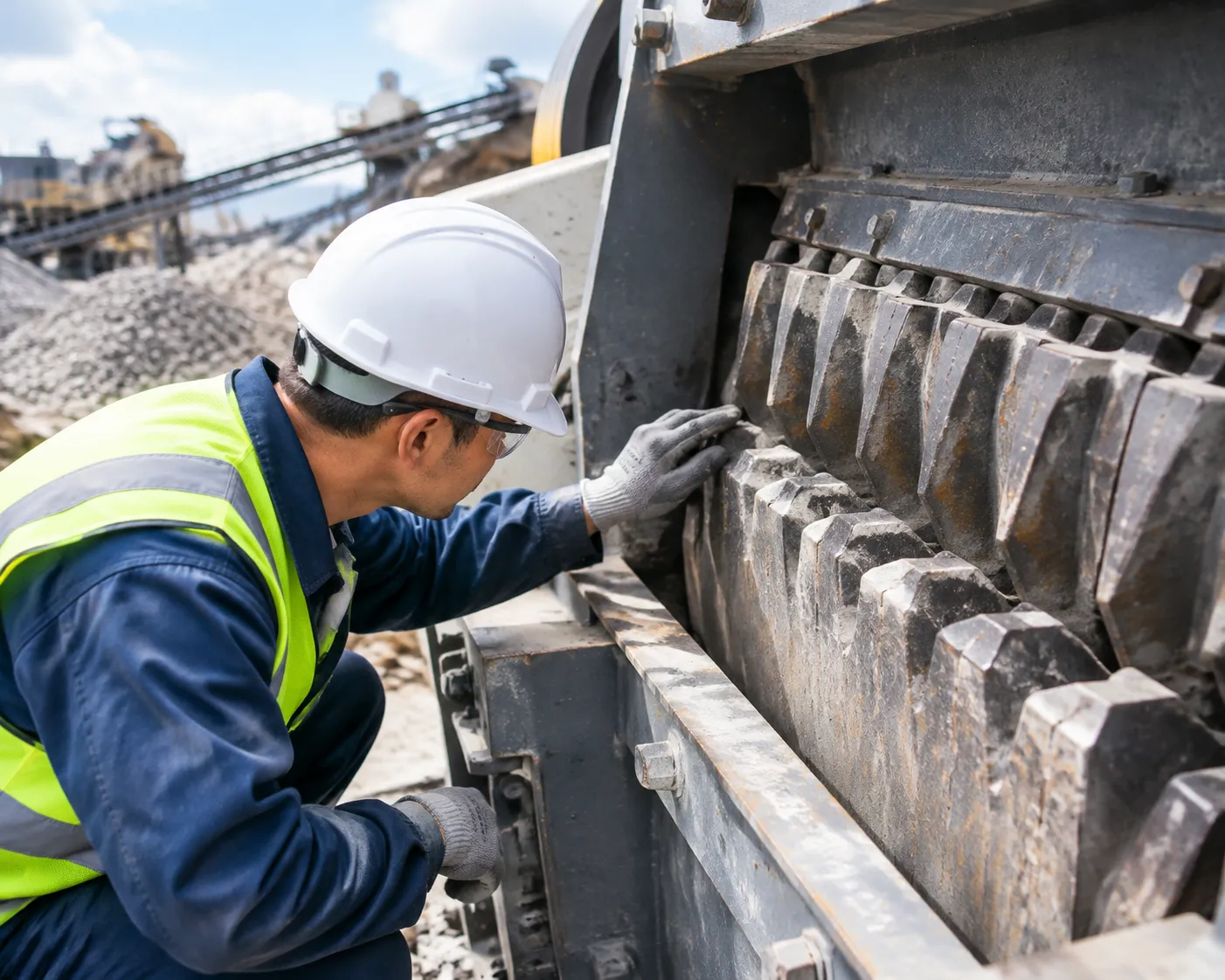
We see operators blame steel suppliers for broken knives when the root cause is poor gap setup, aggressive grinding, or ignored micro-fractures. Maximizing knife service life requires tight mechanical tolerances and disciplined maintenance.
Setting Optimal Blade Clearance and Rotor Gap Tolerances
The clearance between your rotor blades and bed knives directly dictates cutting efficiency, motor load, and mechanical stress.
- Too tight (< 0.10 mm on soft materials): Thermal expansion during continuous runs causes metal-to-metal rubbing, immediately wrecking knife edges.
- Too wide (> 0.50 mm on thin plastics): Feedstock folds and tears rather than shears cleanly, wedging material into gaps and pushing rotor bearings out of alignment.
- Standard benchmark: Keep blade gaps between 0.15 mm and 0.30 mm for general plastics. Heavy rubber and tough polymers require 0.30 mm to 0.50 mm.
Check your knife clearances with feeler gauges at both ends and the center of every knife pocket after installing our replacement crusher blades. Re-torque all mounting bolts to OEM specs after the first two hours of operation under full load.
| Feedstock Type | Recommended Gap Tolerance | Failure Risk if Gap is Incorrect |
|---|---|---|
| Thin Film & PET Flake | 0.10 mm – 0.20 mm | Material jamming, edge rubbing |
| Rigid Regrind (HDPE/PP) | 0.20 mm – 0.30 mm | Chipped cutting edges, high fines |
| Heavy Scrap & Solid Purge | 0.35 mm – 0.50 mm | Excessive motor load, rotor deflection |
Regrinding Rules to Avoid Thermal Micro-Cracking
Improper sharpening ruins quality crusher blade materials faster than abrasive feedstock. Aggressive passes generate localized surface heat exceeding 600°C, causing localized re-hardening and microscopic stress checks across the cutting edge.
- Flood cooling is non-negotiable: Never dry-grind cold-work tool steels like D2 or high-alloy grades. Use high-flow synthetic coolant directed right at the contact point.
- Light depth passes: Keep downfeed to a maximum of 0.01 mm to 0.02 mm per pass to prevent temper burn.
- Match wheel grade to steel hardness: Use open-structure, vitrified bond aluminum oxide wheels for standard tool steels, and CBN (cubic boron nitride) wheels for tungsten carbide or high-vanadium alloys.
- Deburr properly: Hand-stone the wire burr off the edge after final grinding. Leaving a feathered burr leads to instant edge chipping on your first production batch.
Spotting Fatigue Cracks Before a Catastrophic Rotor Wreck
A chipped blade edge is an annoyance; a shattered knife inside a running cutting chamber destroys rotor shafts, bed blocks, and screens. Fatigue cracks develop quietly near bolt holes and along the rear clamping shoulders under repeated impact loads.
- Routine visual checks: Clean blade surfaces completely during knife rotations. Look for hairline shadow lines extending outward from bolt seats.
- Liquid penetrant testing (PT): Spray dye penetrant on heavy-wear knives every three regrind cycles. This catches sub-surface fatigue before a knife snaps under impact.
- Retire over-ground knives: Every knife has a minimum grinding limit. Running blades ground past the safe clamp line reduces clamping surface area, allowing the knife to rock, flex, and shear off its bolts during operation. Equip your machinery with dedicated recycling blades matched to your machine's exact clamping profiles to prevent rotor disasters.
Frequently Asked Questions About Crusher Blade Materials
What is the best all-around steel for plastic granulator blades?
For standard clean plastic recovery, D2 tool steel (1.2379 / SKD11) remains our top recommendation for crusher blade material. It balances high carbon and high chromium content, giving you superior wear resistance against standard polymers like HDPE, PP, and PET.
- Best use: Clean production scrap, runners, and unreinforced bottles.
- Working hardness: 58–60 HRC gives optimal edge retention without excessive brittle risk.
- Alternative: If your feedstock contains glass fibers or chalk fillers above 15%, upgrade to premium granulator blades with tungsten carbide inserts to counter severe abrasive wear.
Why are my crusher blades cracking instead of wearing down smoothly?
Blade cracking points to an imbalance where your crusher blade materials lack sufficient impact toughness for the operating load. The most common causes we see on shop floors include:
- Hardness too high: Heat treatment pushed D2 or cold-work steel past 60 HRC, turning the cutting edge brittle under shock loads.
- Tramp material impact: Unsorted metal bolts, stone, or thick purgings hitting knives running tight tolerances.
- Thermal micro-cracking: Improper dry regrinding on the knife bevel that creates surface stress fractures.
- Incorrect steel grade: Using high-carbon wear steels for heavy, thick-walled parts instead of shock-resistant grades like H13 or modified spring steels.
Can I sharpen carbide-tipped crusher blades on standard shop grinders?
No. Standard aluminum oxide or silicon carbide grinding wheels will ruin tungsten carbide blade tips immediately. Standard abrasive wheels cause thermal shock, surface glazing, and micro-fractures along the brazed joint.
- Required equipment: Use a rigid wet surface grinder equipped with a diamond wheel (resin-bonded, 120–240 grit).
- Coolant flow: Maintain continuous flood coolant. Never interrupt coolant flow during the pass, as rapid heat cycles crack carbide inserts.
- Feed rates: Keep depth per pass under 0.005 mm to 0.01 mm to prevent edge chip-out.
What HRC hardness is ideal for industrial shredder knives?
The target blade hardness HRC rating depends directly on the mechanical action of your machine and feedstock contamination levels. For high-torque shredder blades, toughness takes priority over pure hardness:
- Primary shredders & tire recycling: 52–56 HRC using modified H13 or alloy tool steel to absorb continuous heavy impacts without snapping.
- Secondary single-shaft shredders: 54–57 HRC for consistent shear performance on dense plastics and wood.
- Granulators & pelletizers: 58–62 HRC for razor-sharp shearing of thin film, rigid sheet, and light bulk parts.