
Formula details
Product Details
Overview
Key Four Shaft Shredder Blade Features
Tooth Geometry and Hook Profile Configurations
Hook geometry determines how effectively the shredder grabs, tears, and shears inbound materials. We configure hook count, penetration angle, and clearance profiles to match your specific feed stream:
- Single-Hook Cutters: Deliver maximum grabbing force and aggressive penetration for bulky, hollow items like plastic drums, light scrap metal, and rigid plastics.
- Multi-Hook Designs (2 to 5 Hooks): Provide rapid cutting cycles and uniform output sizing for electronic scrap (WEEE), municipal solid waste, and pre-sorted film.
- Integrated Cleaning Profiles: Scalloped gullet roots ensure clean material discharge into the sizing screen, reducing side-wall friction and preventing rotor binding.
| Cutter Hook Configuration | Target Applications | Primary Operational Benefit |
|---|---|---|
| Single-Hook | Heavy plastics, bulk refuse, metal scrap | Deep bite, maximum pulling torque |
| Double-Hook | Wood scrap, automotive plastics, e-scrap | Balanced cutting force, reduced vibration |
| Multi-Tooth (3–5 Hooks) | Film bales, textiles, high-volume sizing | High cut frequency, tighter output size |
Tool Steel Grades and Vacuum Heat Treatment
Premature wear and edge fractures usually stem from improper alloy selection or substandard hardening. We manufacture our industrial shredder knives from vacuum-degassed tool steels, subjected to automated multi-stage vacuum heat treatment and deep cryogenic cycles.
- D2 / 1.2379 / SKD11: High carbon, high chromium alloy offering superior edge retention and abrasive wear resistance; typical hardness at 58–60 HRC.
- DC53 / Premium Cold-Work Die Steel: Eliminates brittle fracture risks associated with D2 by delivering double the impact toughness at 58–62 HRC.
- H13 / 1.2344 Hot-Work Steel: Excellent thermal stability and fracture resistance under continuous, high-shock shredding loads; hardened to 52–54 HRC.
- Hardox Alloys (Hardox 500/600): Optimized for high-impact structural scrap where extreme shock absorption takes priority over razor edge retention.
Tight CNC Manufacturing Tolerances and Surface Finish
Precision axial clearance between mating cutters is critical to prevent blade collision and edge rounding:
- Thickness Tolerance: Ground to within ±0.01 mm to ±0.02 mm to prevent tolerance stack-up across long four-shaft arrays.
- Parallelism & Flatness: Controlled within 0.02 mm, preventing blade binding, friction buildup, and shaft runout.
- Surface Roughness: Precision ground to Ra 0.4–0.8 µm, minimizing material adhesion, film wrapping, and side-plate friction.
- Bore Fitment: Precision wire-EDM and CNC broaching for hex, square, and splined bores to guarantee zero shaft slippage under peak torque.
Individual Replacement Cutters, Spacers, and Complete Cutter Sets
We support both scheduled routine maintenance and full shaft overhauls with modular four shaft shredder parts:
- Individual Replacement Blades: Direct-match dimensional duplicates to replace chipped or localized worn knives without replacing entire rotor stacks.
- Precision Spacers: Manufactured from hardened alloy steel to maintain exact side clearance between the four intermeshing shafts.
- Complete Pre-Engineered Sets: Fully matched cutter, spacer, and cleaning finger kits tailored to OEM specifications or custom shredder configurations.
Applications and Materials for Industrial Shredder Blades
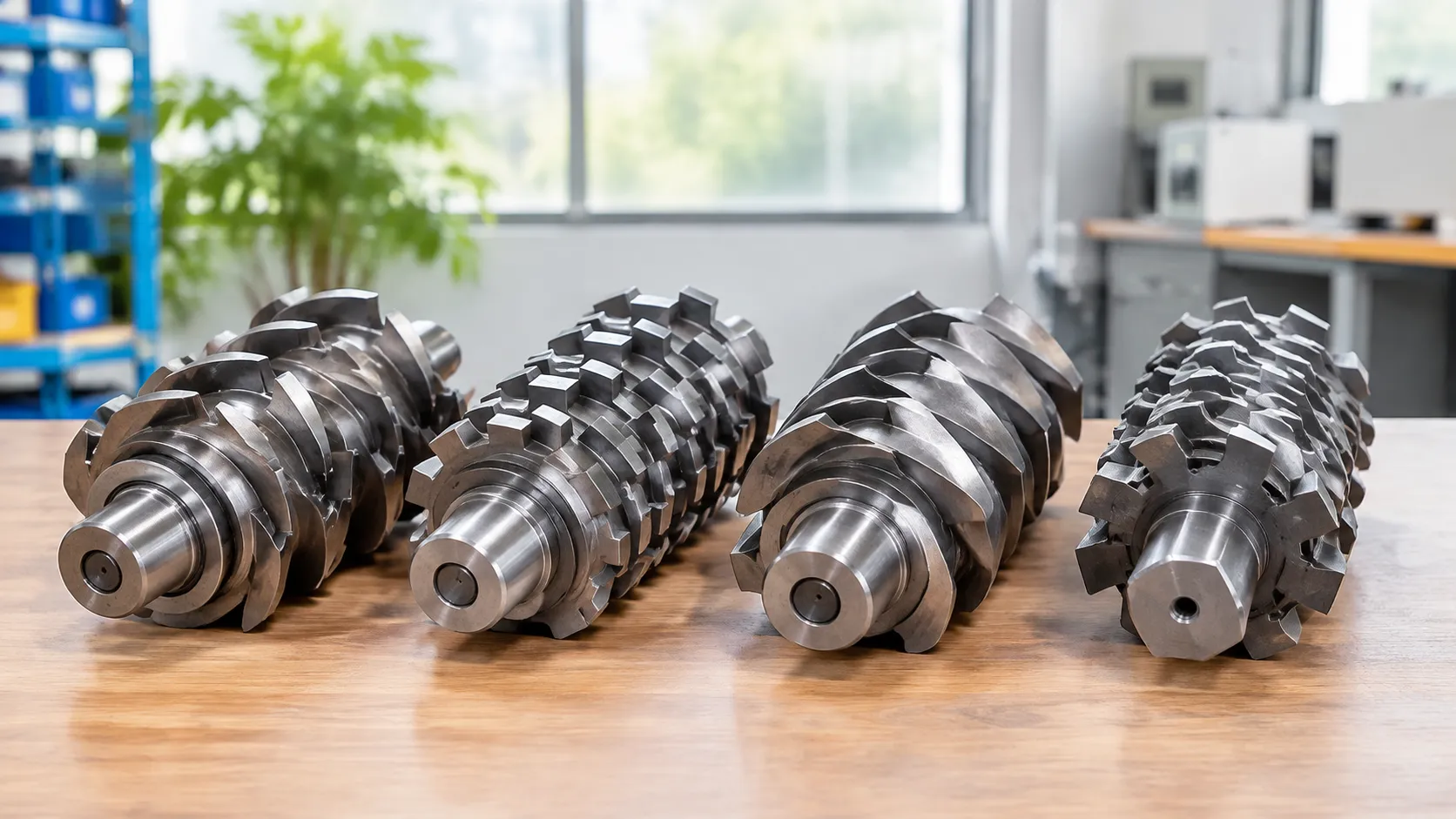
Our four shaft shredder blades are engineered to handle a wide range of industrial waste streams, ensuring consistent throughput across varying material densities. We provide durable solutions for the following primary applications:
- Municipal and Commercial Refuse: Designed for high-volume reduction of household waste, bulky commercial items, and unsorted municipal solid waste (MSW) where toughness is essential to prevent blade breakage from tramp metal.
- Plastics Recycling: Optimized for processing film bales, rigid containers, and thick-walled plastic scrap. We prioritize specific hook profiles that prevent material wrapping and ensure clean shearing of polymers, which you can evaluate further in our plastic shredder blade dimensions guide.
- Wood and Biomass: Built to withstand the stress of shredding wood scrap, pallets, and organic matter. These knives maintain their edge through high-impact cycles typical in green waste facilities and pallet recycling operations.
- E-waste and Light Metals: Tailored for the complex challenges of electronic scrap and lightweight scrap metal. These blades utilize high-hardness steel grades that resist abrasion and micro-chipping caused by mixed metal and circuit board components.
By selecting the correct blade geometry for your specific material input, you can significantly reduce machine strain and extend the interval between maintenance cycles.
Four Shaft Shredder Blade Fitment and Machine Compatibility
Proper fitment keeps your shredder running smoothly and prevents catastrophic shaft damage. A four shaft shredder blade must seat perfectly against mating knives, spacers, and cleaning fingers across both the drive shafts and auxiliary shafts. Understanding your equipment's specific drive profile alongside related blade crusher machine types and key features ensures our replacement cutters drop in without costly field modifications.
Matching OEM Shredder Brands and Machine Specifications
We engineer direct-replacement four shaft shredder knives and cutters compatible with major global recycling equipment brands, including:
- Untha (RS30, RS40, RS50, RS100 series)
- SSI Shredding Systems (Quad series)
- Erdwich (HA and EKZ four-shaft units)
- Weima, Granutech-Saturn, and custom industrial shredder setups
Hexagonal, Splined, and Keyway Bore Configurations
Power transfer depends on exact bore geometry. If the internal bore has play, high torque will roll the shaft corners and crack the cutter hubs. We broach and wire-cut bores to exact tolerances:
| Bore Style | Common Application | Key Fitment Benefit |
|---|---|---|
| Hexagonal | Heavy-duty e-waste and scrap metal units | Distributes radial torque evenly across six flats to eliminate keyway shear |
| Splined (Involute/Straight) | High-torque secondary clean shredders | Provides maximum surface contact and zero rotational backlash under reversing loads |
| Single/Double Keyway | Standard solid waste and plastics shredding | Precision-milled keyways designed for tight interference fit with minimal runout |
Verifying Outer Diameter, Thickness, and Hook Count
Dimensional accuracy dictates product output size and prevents jamming. We machine replacement quad shaft shredder cutters to your exact operational parameters:
- Outer Diameter (OD): Dictates bite depth and screen clearance. Common sizes range from 200 mm to 650 mm.
- Blade Thickness: Controls shredded particle width. Standard profiles range from 15 mm to 50 mm, ground flat within ±0.02 mm to prevent stack accumulation errors.
- Hook Count: Single-hook blades maximize penetration on tough solids; multi-hook (2 to 5 hooks) designs pull high volumes of lightweight films, tires, and containers efficiently.
Shaft Arrangement, Spacer Alignment, and Cleaning Finger Clearance
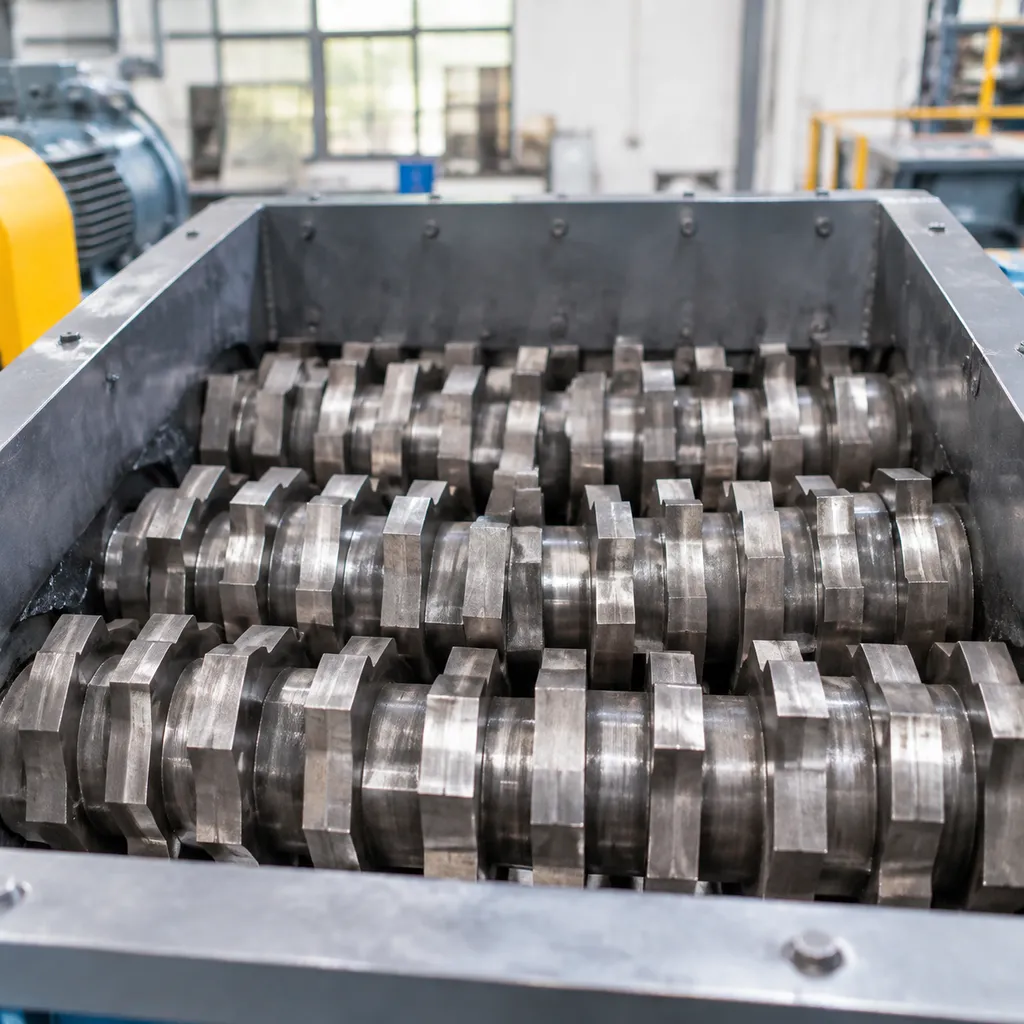
A four-shaft setup uses two cutting shafts at the bottom and two feed/pre-shred shafts on top. Tight side-clearance between the interleaving cutters is critical:
- Axial Gap Control: Cutters require uniform side clearance (typically 0.1 mm to 0.3 mm) across all four shafts to shear material cleanly without scuffing.
- Precision Spacers: Ground to mirror blade parallelism, keeping the entire cutter stack true under heavy side loads.
- Cleaning Finger Alignment: Precise outer hub profiles prevent cleaning combs from dragging, reducing friction, amp spikes, and premature heat build-up.
Blade Material Selection and Custom Manufacturing
Selecting the right alloy balance prevents catastrophic edge breakage and premature abrasive wear. In quad shaft setups, lower cutting shafts endure high torsional loads while upper shafts pull and tear material continuously. We balance shredder blade steel grade selection directly against your operational scrap mix to maximize uptime between maintenance cycles.
Choosing Impact Toughness vs. Wear-Resistant Tool Steels
Every scrap stream requires a specific trade-off between shock absorption and edge retention:
- D2 / SKD11 (High Carbon, High Chromium): The industry standard for abrasive materials like plastics, electronic scrap, and tire shredding. Excellent abrasion resistance with moderate shock capability.
- DC53: A high-toughness upgrade over D2. It prevents hook chipping under unpredictable, heavy-impact loads while maintaining equal or better wear resistance.
- H13 (Hot-Work Tool Steel): Best suited for high-impact feedstocks containing tramp metal or stone contamination. Delivers exceptional core toughness to resist cracking under shock loads.
- Hardox 500 / 600: Cost-effective structural wear plates ideal for primary volume reduction where ductility and weld repairability outweigh ultra-sharp edge requirements.
| Steel Grade | Typical Hardness | Primary Strength | Best Applications |
|---|---|---|---|
| D2 / 1.2379 | 58–60 HRC | Abrasive wear resistance | E-waste, plastics, tires, paper |
| DC53 | 60–62 HRC | Chipping resistance & strength | Mixed commercial waste, rigid drums |
| H13 / 1.2344 | 52–56 HRC | Extreme shock impact toughness | Scrap metal bundles, heavy pallets |
| Hardox 500 | 48–52 HRC | Ductility, crack prevention | Bulky MSW, high-contamination scrap |
Precision CNC Wire-Cutting, Heat Treatment, and Tempering
Raw tool steel blanks undergo precision CNC wire-EDM profiling to cut complex hook geometry without introducing mechanical micro-cracks. We then subject the cutters to computer-controlled vacuum furnaces.
Following proper D2 steel heat treatment protocols, we execute multiple high-temperature tempering cycles to eliminate residual stresses, transform retained austenite, and establish consistent hardness from the hook tip to the core. This thermal discipline ensures our rotary shredder cutters maintain edge integrity under heavy multi-shaft torque.
Custom Fabrication from CAD Drawings or Worn Samples
Our custom shredder blade manufacturing adapts directly to your operating machinery:
- From CAD / DXF / Step Files: We machine directly to your engineered blueprints, ensuring precise match of hook angles, drive bores, and side clearances.
- From Physical or Worn Cutters: Send us a worn blade sample. We use 3D laser scanners to reverse-engineer original hook profiles, hex bores, and spacer cutouts, correcting for wear patterns to restore factory-correct cutting geometry.
Quality Control, Metallurgical Testing, and Dimensional Inspection
Every production batch of heavy duty shredder knives undergoes strict quality gates prior to dispatch:
- Spectrometer Alloy Verification: Confirming chemical composition of each raw steel lot before machining begins.
- Digital Rockwell Hardness Testing: Multi-point testing across cutting teeth and shaft bores to verify uniform HRC depth.
- CMM Dimensional Inspection: Checking bore tolerances (within ±0.02 mm), outside diameters, and side face flatness.
- Parallelism & Surface Grinding: Precision double-disc surface grinding ensures flat mating surfaces that prevent lateral play, binding, and shaft deflection across your cutter pack.
Cutting Performance and Wear Life Factors
Maximizing the working life of a four shaft shredder blade requires proactive maintenance and tight operational controls. In quad-shaft systems, cutting forces are distributed across two primary drive shafts and two secondary sizing shafts. If wear develops unevenly, it accelerates machine strain, increases energy draw, and degrades final particle sizing.
Managing Feed Contamination and Abrasive Wear
Unsorted material streams present the biggest hazard to industrial shredder knives. Abrasive fines like silica, dirt, and glass cause rapid abrasive wear along cutting flanks, while tramp metals create shock loads that fracture hardened tooling.
- Pre-Screening Feeds: Remove bulk non-shreddables, heavy iron tramp, and aggregate before infeed hoppers.
- Toughness Selection: For streams with unpredictable foreign objects, opt for shock-resistant shredder blade steel grade selections (such as modified H13 or DC53) over ultra-hard but brittle grades.
- Corrosive Stream Handling: When processing wet municipal waste, vulcanized rubber, or chemical plastics, specify tool steels with higher chromium content to prevent micro-pitting along the edge.
Maintaining Uniform Clearance Across All Four Cutter Shafts
A four shaft shredder blade setup depends on clean scissor-action shear between adjacent rotating knives and cleaning combs. When clearances open up, material tears rather than cuts, wrapping around shafts and driving up motor amperage.
| Operating Parameter | Recommended Target | Risk of Non-Compliance |
|---|---|---|
| Blade-to-Blade Axial Gap | 0.25 mm – 0.50 mm (stream dependent) | Pinching, edge rollover, high heat |
| Cleaning Comb Clearance | 0.50 mm – 1.00 mm uniform | Material wrapping, chamber jamming |
| Shaft Centerline Deviation | < 0.05 mm across the bed | Accelerated one-sided tooth wear |
| Stack Tightening Torque | Factory spec (hydraulic nut checked) | Spacer looseness, axial knife drift |
We recommend measuring shaft-to-shaft clearances weekly using feeler gauges across multiple points along the cutting chamber.
Identifying Early Hook Rounding, Micro-Chipping, and Stress Cracks
Early visual inspection of quad shaft shredder cutters stops minor wear from turning into catastrophic hub or shaft failures:
- Hook Nose Rounding: The hook tip loses its bite first. When the radius exceeds 3 mm to 5 mm, feed intake slows and throughput drops sharply.
- Micro-Chipping Along Cutting Edges: Caused by brittle fatigue or light metal impact. If addressed early, these micro-fractures can be ground out before running into deep crack lines.
- Radial Stress Cracks: Developing from the keyway, splined bore, or tooth roots due to excessive torque or jamming. Blades showing radial cracks must be retired immediately to prevent in-chamber fragmentation.
Re-Sharpening Guidelines and Hardfacing Restoration
Refurbishing heavy duty shredder knives keeps operating costs down compared to complete changeouts. Depending on wear severity, we utilize two primary restoration methods:
- Precision Surface Re-Grinding: When edge rounding is minimal, grinding down the side faces of the rotary shredder cutters restores sharp 90-degree cutting edges without compromising hook geometry. We always use flood coolant during grinding to prevent surface annealing and micro-cracking.
- Hardfacing and Re-Profiling: For heavily rounded hooks, rebuild the worn profile using specialized hardfacing weld alloys with high carbide matrices, followed by CNC profile grinding. The weld deposit must closely match the base steel's thermal expansion properties to prevent spalling under impact loads.
Replacement and Maintenance Procedures for Four Shaft Cutters
Safe Cutter Shaft Disassembly and Stack Removal
Stack teardown requires controlled lifting and proper rigging to protect shaft journals and operators:
- Lockout/Tagout (LOTO): Isolate main drives, hydraulic pusher systems, and fluid couplings before opening the shredder housing.
- Remove Cleaning Fingers First: Back off and extract lateral cleaning combs to clear the path for cutter extraction.
- Shaft Rigging: Secure nylon slings around the core shafts. Support the drive and non-drive ends evenly with overhead cranes to prevent bending moments on bearing journals.
- De-stacking: Pull individual rotary shredder cutters and spacers in sequence. Mark every component by shaft position (Shafts 1–4) and stacking order if doing partial swaps or targeted rotations.
Unlike servicing single shaft shredder blades mounted via single-bolt holders, a four-shaft assembly relies on stacked compression across the entire hex or splined shaft profile.
Inspecting Shafts, Spacers, and Cleaning Combs for Wear
Re-stacking fresh blades on worn mating hardware guarantees early failure. We evaluate every component in the cutting chamber during service intervals:
| Component | Critical Inspection Points | Rejection Criteria / Service Limit |
|---|---|---|
| Drive Shafts | Hex flats, splines, keyseats, and runout | Torsional twist >0.05 mm, spline step wear >0.5 mm |
| Spacers | Parallelism, face galling, thickness loss | Thickness variation >0.03 mm across parallel faces |
| Cleaning Combs | Tip clearance, lateral bending, burrs | Tip-to-spacer clearance exceeding 1.5 mm |
| Blade Faces | Hook radius, side-face scoring, bore fit | Hook radius >3 mm, side-scuffing >0.25 mm |
Correct Re-Stacking, Torque Specs, and Alignment Checks
Stack assembly must maintain precise axial compression without introducing bow across the shafts:
- Clean Mating Surfaces: Stone away all burrs and wire-brush carbon residue from shaft flats, blade bores, and spacer faces. A single trapped metal flake will skew the entire stack out of parallel.
- Staggered Hook Timing: Align the hook profiles in the specified factory spiral pattern to distribute cutting loads evenly and prevent simultaneous torque spikes across all four shafts.
- End-Nut Pre-Load and Torque: Apply anti-seize paste to shaft threads. Torque locknuts incrementally in 25% stages up to manufacturer torque ratings (typically 1,200 to 2,800 Nm depending on shaft diameter).
- Clearance Verification: Check radial and axial clearances between opposing cutters using feeler gauges. Target side clearance should consistently sit between 0.1 mm and 0.3 mm across all four shafts.
Preventing Shaft Deflection, Binding, and Premature Dulling
Uneven torque and worn spacers cause shaft deflection. Deflection makes the cutter faces pinch against adjacent blades, generating friction heat that anneals tool steel and dulls cutting edges rapidly.
To eliminate binding:
Verify Free Rotation by Hand: Rotate each shaft through 360 degrees using a manual lever or barring tool before closing the cutter chamber. The stack must turn smoothly with no tight spots or steel-on-steel dragging.
Balance Spacer Packs: Always install precision-ground spacers. Mismatched spacer thicknesses throw off blade timing relative to the lower sizing screen and opposite cutting shafts.
Monitor Cold-Start Amperage: Track motor load closely for the first two hours after installing fresh replacement shredder blades. Any abnormal amp spike indicates stack binding or insufficient face clearance.
Custom Ordering and RFQ Process for Four Shaft Shredder Blades
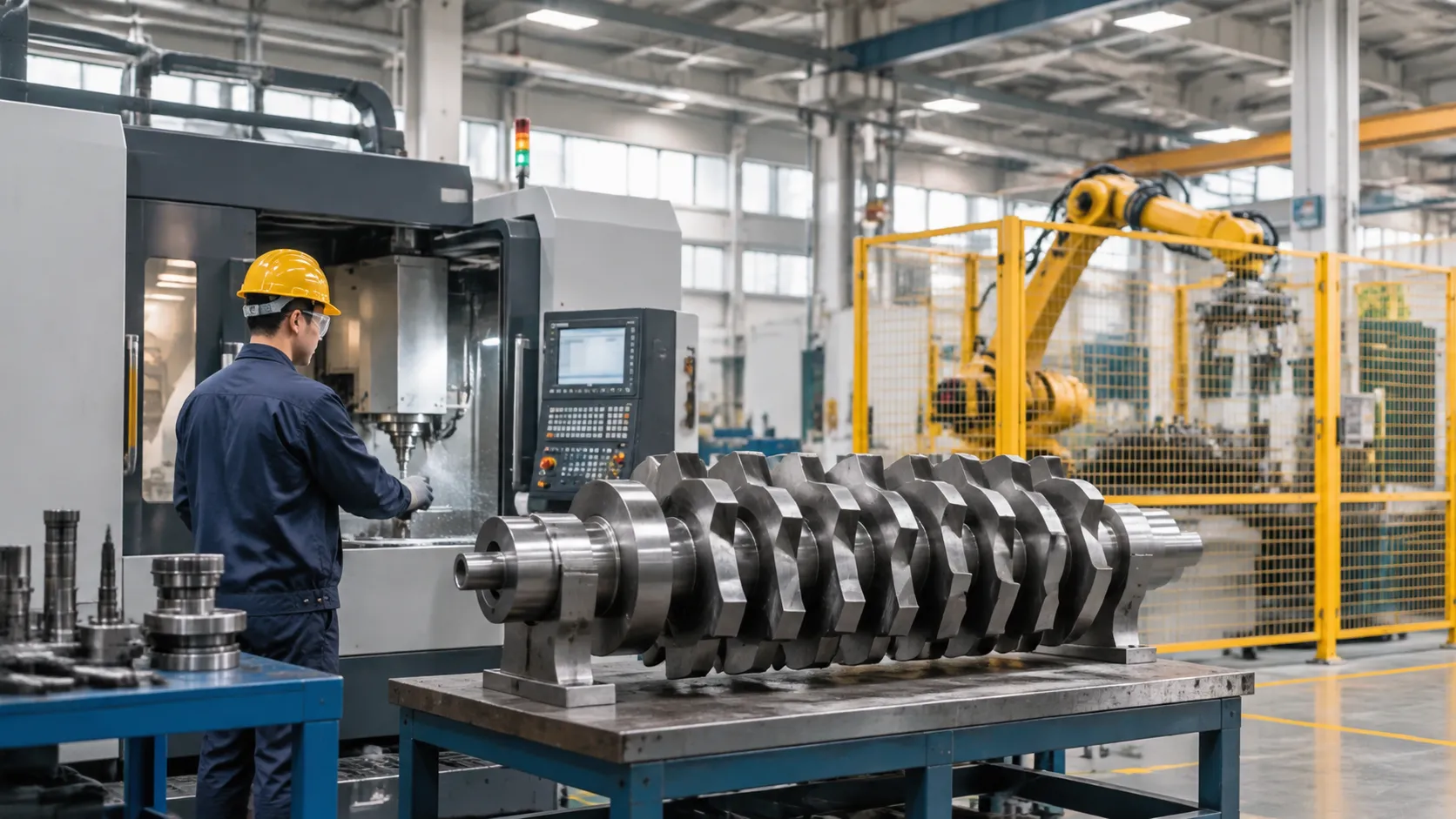
To provide an accurate quote for custom or replacement four shaft shredder blades, we require specific technical data. Our procurement process is streamlined to minimize downtime, whether you are supplying engineering drawings or sending in physical samples for reverse engineering.
Information Required for RFQ
When requesting a quote, please provide the following technical specifications to ensure complete compatibility:
| Requirement | Detail Needed |
|---|---|
| Material/Grade | Specify preferred tool steel (e.g., D2, H13) |
| Dimensions | Outer Diameter (OD), Inner Bore, and Thickness |
| Bore Configuration | Hex, Spline, or Keyway shape and size |
| Hook Geometry | Number of hooks and specific hook profile |
| Tolerance | Required machining precision and surface finish |
Reverse Engineering and Production Workflow
If you do not have original blueprints, we offer professional reverse-engineering services. You can send us your worn samples, and our team will perform precise measurements to replicate the original design specifications.
- Engineering Analysis: We measure key dimensions and analyze the chemical composition of your sample.
- CAD Design: Our team creates a CAD file for your approval before production begins.
- Batch Testing: We conduct metallurgical hardness and dimensional inspections on every production lot.
- Quality Assurance: Full material traceability is provided, ensuring that every knife meets international standards.
Shipping and Logistics
We understand that equipment downtime is costly. Our logistics team handles global shipping with heavy-duty, anti-corrosive packaging to protect the sharpened edges during transit. We coordinate with reliable freight partners to ensure your industrial shredder knives arrive safely and on schedule, regardless of your location. Once your order is dispatched, we provide tracking and verification details to keep your maintenance team informed.
Why Source Four Shaft Shredder Blades from Sharkcutting
We eliminate the complexity of the supply chain by providing direct manufacturer pricing, removing the middleman markups that inflate maintenance costs. Our approach is built on providing high-quality precision replacement blades that meet the rigorous demands of industrial operations without the premium price tag.
Key advantages of partnering with us include:
- Tailored Metallurgy: We adapt our steel grades to the specific scrap streams you process, ensuring the blade chemistry matches your throughput needs.
- Precision OEM Interchangeability: Our four shaft shredder blades are engineered for seamless integration with all major machine brands, maintaining tight tolerances for perfect shaft alignment.
- Quality Assurance: Every cutter undergoes strict CMM (Coordinate Measuring Machine) inspection to verify dimensions and geometry.
- Full Traceability: We maintain complete material logs, offering full traceability from the raw tool steel batch to the finished component.
By controlling the entire manufacturing process, from CNC wire-cutting to vacuum heat treatment, we ensure our heavy-duty shredder knives deliver the durability and consistent performance required to minimize your machine downtime.
Frequently Asked Questions About Four Shaft Shredder Blades
How do four shaft shredder blades differ from two shaft shredder blades?
Two-shaft systems rely purely on counter-rotating shafts to tear material in a single pass. Four shaft shredder blades operate in a synchronized setup where two upper shafts draw material downward while two lower shafts handle high-torque sizing against an integrated sizing screen.
- Particle Control: Uncut bulk stays inside the cutting chamber until it passes through the screen holes.
- Blade Profile: Cutters on a quad shaft system are often thinner, featuring aggressive hook profiles designed to grab, pull, and shear simultaneously.
- Wear Distribution: Workload is distributed across four drive shafts, which reduces continuous impact stress on individual knife teeth.
What tool steel grade is best for shredding mixed electronic scrap?
Mixed e-waste contains tough plastics, abrasive printed circuit boards, and stray structural steel. Standard D2/SKD11 often suffers micro-chipping on unexpected metal studs.
For high-yield e-scrap processing, we manufacture replacement shredder blades from DC53 or H13 tool steel hardened to 56–58 HRC. This metallurgy balances wear resistance against structural impact toughness, preventing tooth snap. When high-fraction steel scrap is present, our heavy-duty metal shredder blade configurations provide the impact absorption needed to keep shafts running without downtime.
Can Sharkcutting produce custom shredder knives from a worn sample?
Yes. If original manufacturing drawings are unavailable, send a sample blade directly to our engineering team.
- Laser & CMM Scanning: We measure keyway dimensions, spline pitch, hex bore tolerances, and outer hook profiles.
- Wear Reconstruction: Our CAD engineers trace the original unworn cutting tip geometry to restore cutting efficiency.
- Spectrometry Testing: We analyze the chemical composition of the base metal to replicate or upgrade the alloy tool steel grade.
How often should four shaft shredder blades be inspected or rotated?
Preventive inspection schedules depend directly on abrasive content in your waste stream:
- Weekly Checks: Inspect blade-to-blade side clearance, cleaning comb alignment, and hook edge sharpness.
- Clearance Tolerance: Keep axial gap between mating cutters within 0.1 mm to 0.3 mm to prevent material jamming.
- Rotation & Stacking: Rotate or flip reversible cutters every 600 to 1,200 operating hours to maintain even wear patterns across all four shafts.
What critical details are needed to request a fast, accurate quote?
To receive a complete proposal within 24 hours, provide our sales team with these core parameters:
- Dimensions: Outer diameter (OD), inner bore profile (hexagonal, keyed round, or splined diameter), and blade thickness.
- Tooth Configuration: Number of hooks (single, double, or multi-hook) and hook depth.
- Target Material: Type of scrap processed (tires, e-waste, plastics, MSW, or scrap aluminum).
- Machine Match: OEM shredder brand and model number, or a 2D/3D technical drawing (PDF, DWG, STEP).