
Understanding Industrial Blade Performance: Hardness, Toughness & Wear Resistance
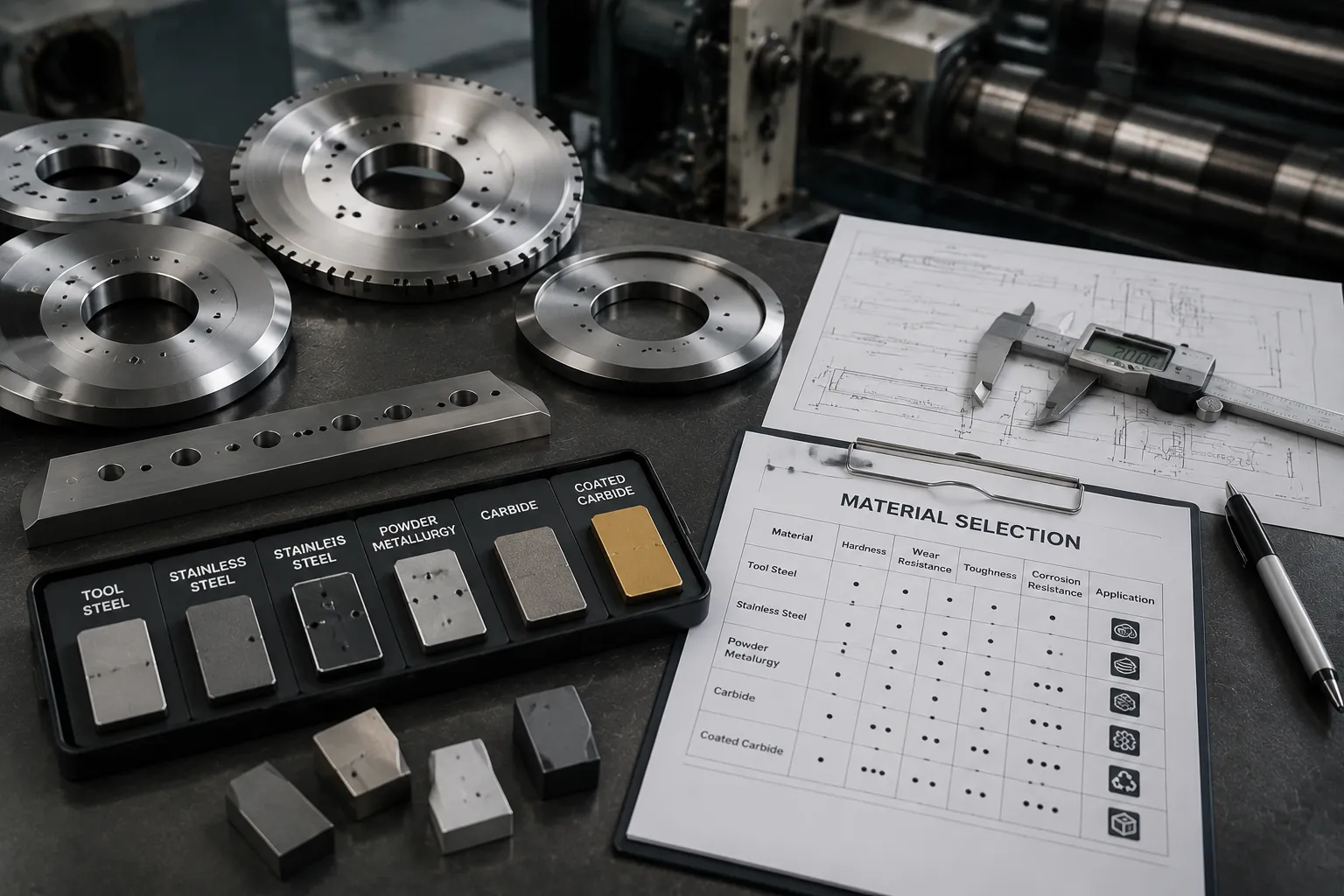
Selecting the right material for industrial cutting applications requires a precise balance of core mechanical properties. Increasing edge hardness boosts blade wear resistance, but often reduces impact toughness against severe shock. Conversely, choosing shock-resistant tool steel improves structural integrity during heavy impacts, but may require more frequent resharpening during continuous high-speed converting. Successfully evaluating tool steel vs carbide performance tradeoffs ensures uninterrupted production, extended knife longevity, and maximum throughput across demanding industrial environments.
Blade Wear Resistance and Edge Retention
Blade wear resistance dictates how effectively a cutting edge maintains its micro-sharpness under continuous abrasive friction. Substrates containing silica, mineral fillers, or metallic foils accelerate edge degradation unless supported by rich carbide volume.
- Abrasive Wear Protection: Resists severe edge erosion during high-speed film, foil, and paper slitting.
- Adhesive Wear Defense: Prevents material galling, micro-welding, and resin buildup during continuous film conversion.
- Downtime Reduction: Extends uninterrupted slitting cycles between scheduled knife re-grinding intervals.
Impact Toughness and Fracture Resistance
Impact toughness measures a blade's capacity to absorb heavy shock without catastrophic fracture, edge chipping, or micro-cracking. Heavy-duty recycling shredders and thick-gauge shear equipment require high fracture-toughness alloys.
- Shock Load Absorption: Endures sudden mechanical impacts during heavy-duty shredding without sudden snapping.
- Micro-Chipping Prevention: Preserves keen blade profile geometry under high-load shear cutting forces.
- Production Line Protection: Prevents metal fragment liberation into processed materials and downstream equipment.
Thermal Stability and Corrosion Immunity
High-speed slitting friction rapidly generates localized thermal spikes at the cutting edge. Thermal stability ensures the material maintains its heat-treated hardness, while corrosion resistance protects against aggressive chemicals and moisture.
- Red Hardness Retention: Maintains critical temper hardness and structural integrity under friction-induced heat.
- Corrosion Resistance: Withstands wet recycling washing, chemical additives, and high-humidity processing.
- Dimensional Stability: Prevents thermal expansion distortion and axial deflection across wide slitting gangs.
Optimizing Tool Steel vs Carbide for Operational Efficiency
Evaluating tool steel vs carbide options requires balancing substrate abrasion with machine rigidity. High-performance tungsten carbide knives deliver up to 50 times the service life of conventional steel when cutting abrasive films, nonwovens, and battery separator foils, though they demand rigid machine setups to prevent shock damage. Conversely, proven D2 tool steel blades and high-speed steel knives offer exceptional impact toughness and vibration resistance at a lower initial capital investment.
At Shark Cutting, learn more about us and how our metallurgical specialists evaluate your material substrate, line speeds, blade geometries, and shock factors to determine the exact knife hardness vs toughness threshold for your operation. If you have custom specifications or need tailored tooling advice, feel free to contact us. By aligning industrial knife material selection with total cost of ownership, we deliver maximum operational uptime and consistent cut quality.
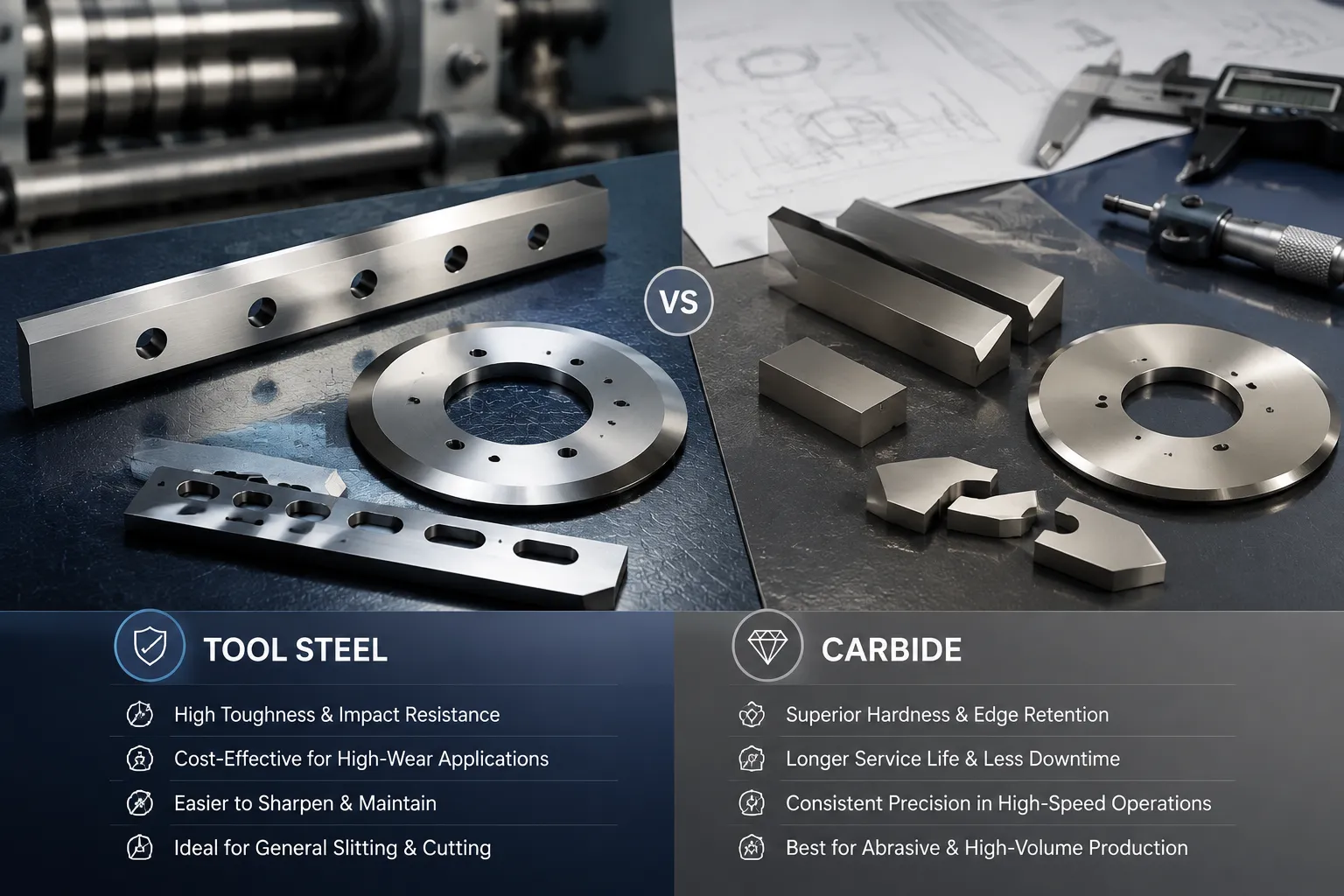
Industrial Blade Material Selection Matrix
Evaluate core metallurgical categories to pinpoint the optimal trade-off between hardness, shock resistance, and blade lifespan for your specific processing demands.
| Material Class | Hardness Range | Wear Resistance | Impact Toughness | Recommended Applications |
|---|---|---|---|---|
| Cold Work Tool Steel (D2 / A2 / SKD11) | 58 - 62 HRC | Moderate to High | Moderate | Paper slitting, packaging film converting, and standard plastic recycling shredder blades. |
| High-Speed Tool Steel (M2 / M42 / SKH51) | 62 - 66 HRC | High | Good | High-speed web rewinding, continuous foil converting, and elevated-friction rotary slitting. |
| Powder Metallurgy Steel (CPM / PM Steels) | 60 - 65 HRC | Very High | Excellent | Abrasive filled polymers, dense nonwoven slitting, and heavy-duty high-speed shear cutting. |
| Solid Tungsten Carbide Alloys | 88 - 93 HRA | Extreme | Low to Moderate | Ultra-thin plastic film slitting, lithium battery cathode foil cutting, and high-precision nonwovens. |
Cold-Work Tool Steels and High-Speed Steel (HSS) Series
Selecting the optimal tool steel grade is critical to minimizing downtime and maintaining clean shearing edges in demanding converting lines. At Sharkcutting, we precision-manufacture industrial knives from premium cold-work tool steels, high-speed steels (HSS), and shock-resistant alloy steels. Each alloy composition is carefully selected and vacuum heat-treated to optimize the trade-off between wear resistance, edge toughness, and thermal stability for high-output slitting and cutting machinery.
Cold-Work Tool Steel Series
Engineered for ambient and moderate-temperature shearing, cold-work tool steels deliver high abrasive wear resistance and dimensional stability. These alloys are ideal for high-precision paper converting, packaging film slitting, and general industrial machine knives where cost efficiency and long edge life are essential.
- D2 / SKD11: High-carbon, high-chromium tool steel offering outstanding abrasive wear resistance and long-lasting edge sharpness for high-volume paper, foil, and film slitting blades.
- A2 / SKD12: Air-hardening tool steel that balances superior impact toughness with uniform wear resistance, ideal for precision punch dies and shear blades.
- O1 / SKS3: Oil-hardening steel with exceptional dimensional accuracy during heat treatment, suited for intricate circular slitters and tight-tolerance machine knives.
High-Speed Steel (HSS) Knives
Formulated with tungsten, molybdenum, vanadium, and cobalt, high-speed steel blades maintain high hot hardness and edge stability under continuous friction heating. HSS blades excel in automated high-speed rewinders, rotary slitters, and synthetic substrate converting.
- M2 / SKH51: The industry-standard high-speed steel providing exceptional red hardness, fine carbide distribution, and superior edge retention for high-velocity slitting knives.
- M42 Cobalt HSS: Premium cobalt-alloyed high-speed steel delivering extreme hot hardness for cutting highly abrasive synthetic films, composite webs, and tough polymers.
- M35 Alloy Steel: 5% Cobalt HSS grade providing enhanced yield strength and heat resistance during continuous high-speed web slitting operations.
Shock-Resistant Alloy Steels
Specially formulated to withstand heavy shock loads, dynamic shear stress, and severe impact without chipping or micro-fracturing. Crucial for heavy-duty plastic recycling granulators, tire shredders, metal scrap shears, and wood chipping equipment.
- S7 Shock Steel: High-impact alloy engineered to absorb intense dynamic force and prevent catastrophic blade breakage during heavy recycling and shearing.
- Chipper & Granulator Steel: Custom low-alloy shock steel designed specifically for severe impact in wood chipper blades and heavy plastic granulator knives.
- L6 Nickel-Alloy Steel: Tough nickel-chromium tool steel offering maximum fatigue strength and resistance to thermal shock in heavy industrial shearing.
Tool Steel Grade Specifications & Performance Matrix
Compare key physical properties and recommended industrial knife applications across our primary tool steel and alloy options.
| Steel Grade | Hardness Range | Wear Resistance | Toughness Level | Thermal Resistance | Recommended Application |
|---|---|---|---|---|---|
| D2 Tool Steel (AISI D2 / SKD11) | 58 to 62 HRC | High | Moderate | Moderate | Circular slitter knives, paper guillotines, thin film slitters, packaging blades |
| A2 Tool Steel (AISI A2 / SKD12) | 56 to 60 HRC | Moderate-High | High | Moderate | Shear blades, carton trimming knives, punch dies, metal shearing tools |
| M2 High-Speed Steel (M2 HSS) | 62 to 65 HRC | Very High | Moderate | Very High | High-speed rotary slitters, film rewinder blades, foil cutters, rotary die blades |
| M42 Cobalt HSS (AISI M42) | 64 to 67 HRC | Extreme | Moderate-Low | Extreme | Abrasive synthetic slitting, rubber shearing, continuous high-friction web cutting |
| S7 Shock Steel (AISI S7) | 54 to 58 HRC | Moderate | Maximum | Moderate | Heavy plastic granulator knives, metal scrap shears, shredder blocks, wood chipper blades |
Metallurgical Quality and Vacuum Heat Treatment Standards
At Sharkcutting, alloy selection is only the first step in manufacturing high-performance machine blades. Raw tool steel quality depends on clean alloy chemistry and consistent microstructural grain refinement. We source tool steel stock exclusively from ISO-certified steel mills, guaranteeing tight chemical tolerances for carbon, chromium, molybdenum, and vanadium.
When evaluating carbide vs steel knives, high-grade steel alloys remain the preferred choice for cutting lines subject to severe dynamic shock, side-loading, or complex knife geometry. Through computer-controlled vacuum heat treatment and multi-pass cryogenic tempering, Sharkcutting ensures uniform hardness profiles and stress relief across the entire blade.
Carbide Grain Dispersal
Ensures fine, evenly distributed alloy carbides to prevent localized chipping and extend cutting edge life.
Sub-Zero Cryogenic Treatment
Transforms retained austenite into stable martensite, maximizing dimensional stability and wear resistance.
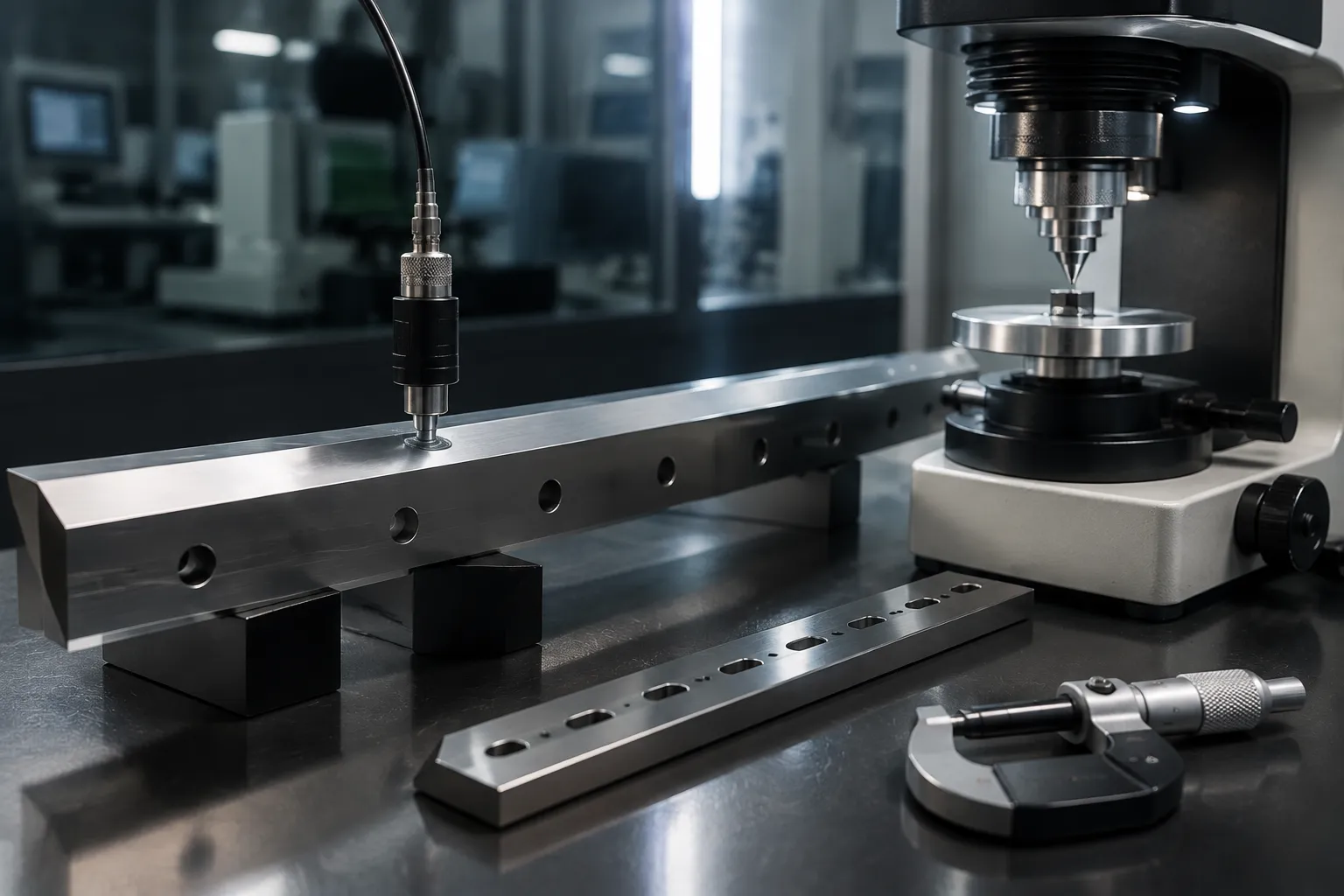
Every Sharkcutting tool steel blade undergoes rigorous ultrasonic flaw detection and HRC hardness testing prior to precision finish grinding.
Need Assistance Selecting the Right Tool Steel Grade?
Our experienced material engineers will analyze your substrate materials, production speeds, and wear patterns to recommend or custom-formulate the ideal tool steel grade for your machinery.
Tungsten Carbide and Advanced PM Materials
Maximize production uptime, cut quality, and edge sharpness with industrial-grade solid tungsten carbide, powder metallurgy (PM) steels, and composite alloy technologies engineered by Sharkcutting.
Solid Tungsten Carbide Grades
Formulated with sub-micron grain microstructures, solid tungsten carbide knives offer unmatched hardness ranging from 88 to 93 HRA. They deliver exceptional abrasion resistance for demanding micro-slitting and continuous converting applications.
- • Operational Lifespan: Lasts 10 to 50 times longer than standard high-speed steel.
- • Precision Cutting: Ensures clean, burr-free cuts on delicate films, foils, and flexible substrates.
- • Primary Applications: Battery electrode slitting, nonwoven converting, and technical film processing.
Powder Metallurgy PM Steels
Powder metallurgy processes create fine, evenly distributed alloy carbides. Advanced PM steels eliminate carbide segregation, offering a superior balance of high impact toughness and exceptional wear resistance under severe mechanical stress.
- • Chipping Resistance: Prevents edge fracturing and micro-spalling under high-impact shear loads.
- • Homogeneous Microstructure: Delivers uniform regrinding characteristics and predictable, repeatable tool life.
- • Primary Applications: Heavy recycling, abrasive foil converting, and dense synthetic slitting.
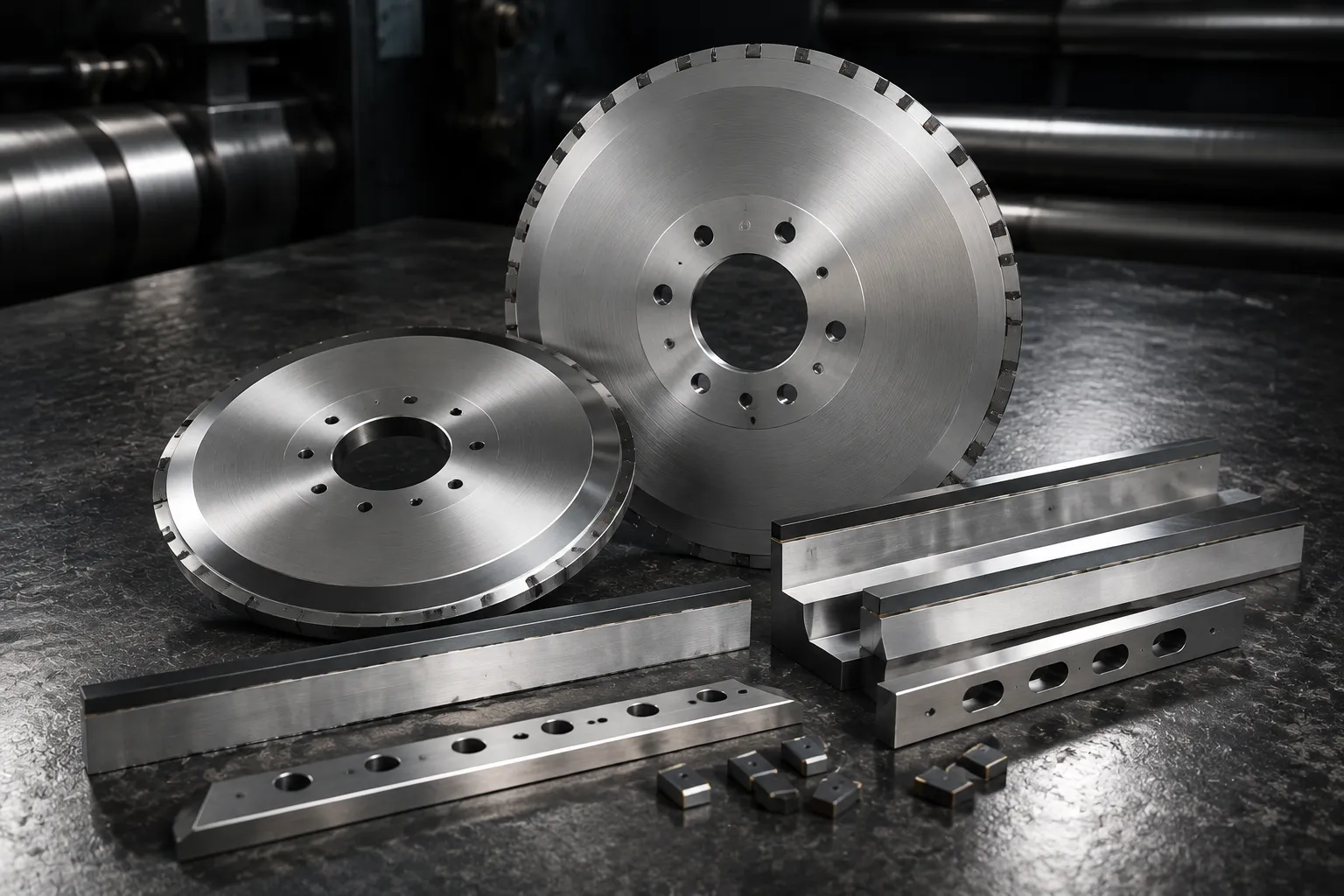
Carbide Inlaid and Tipped Slitting Blades
Sharkcutting utilizes state-of-the-art vacuum brazing and mechanical bonding techniques to join tungsten carbide cutting edges with tough alloy steel support bodies. This hybrid design delivers extreme cutting edge performance without the fragility or material cost of solid carbide.
Advanced Blade Material Comparison Matrix
Compare physical properties and performance metrics to select the right substrate for your machine operations.
| Material Grade | Hardness Range | Wear Resistance | Impact Toughness | Relative Service Life |
|---|---|---|---|---|
| Standard D2 Tool Steel | 58 to 62 HRC | Standard Baseline | Moderate | 1x Baseline |
| M2 High-Speed Steel | 62 to 65 HRC | High | Moderate-High | 3x to 5x |
| CPM Powder Metallurgy Steel | 60 to 66 HRC | Very High | High | 5x to 12x |
| Solid Tungsten Carbide | 88 to 93 HRA | Extreme | Rigid / Low Impact | 10x to 50x |
Calculating Total Cost of Ownership and Machine ROI
While tungsten carbide and PM steel blades carry higher initial purchasing costs, their extended wear cycles dramatically lower total operating expenses. Fewer blade changeovers mean reduced machine downtime, lower grinding labor expenses, and consistent cutting quality that minimizes material scrap.
Match Blade Steel Grades to Your Cutting Application
Choosing the right industrial knife material directly impacts edge retention, machine uptime, and cut quality. Review our application matrix below to match your processed materials with the optimal tool steel or tungsten carbide grade.
Plastic Recycling
High-impact shock steels designed to resist heavy impact and severe contamination during shredding.
Film & Foil Slitting
Sub-micron tungsten carbide grades engineered for ultra-clean, burr-free slitting at high speeds.
Paper & Packaging
Precision D2 and HSS tool steels balancing razor-sharp wear resistance with long service life.
Rubber & Synthetics
Thermal-resistant CPM alloys and carbide-inlaid edges built for extreme friction and tough substrates.
Industrial Blade Material Matrix
Compare physical capabilities across primary knife steels and hard metal grades
| Target Material / Application | Recommended Knife Grade | Impact Toughness | Wear Resistance | Heat / Corrosion Resistance | Key Operating Advantage |
|---|---|---|---|---|---|
| Scrap Plastics & Granulation | S7 Shock Steel / AISI D2 | Superior | Good | Fair | Prevents edge chipping under heavy shock loads |
| Lithium Foil & Polymer Film Slitting | Micrograin Tungsten Carbide | Moderate | Superior | Excellent | Extreme wear life and clean, burr-free cut edges |
| High-Speed Paper & Packaging Slitting | M2 High-Speed Steel (HSS) | Good | Excellent | Moderate | Maintains edge sharpness at elevated rewinding speeds |
| Wet Washing & Food Packaging Converting | Stainless Steel / Inlaid Carbide | Good | Good | Superior | Resists chemical corrosion and moisture pitting |
| Heavy Rubber & Tire Fiber Cutting | CPM Powder Metallurgy Steel | Outstanding | Outstanding | Good | Combines carbide-like wear resistance with high steel toughness |
Need Help Selecting the Right Knife Material?
Selecting the ideal blade alloy minimizes premature wear and costly machine stoppage. Learn why sharkcutting engineers evaluate your cutting speeds, processed substrates, and failure modes to recommend the precise tool steel or carbide matrix for your industry.
Custom failure analysis and worn-blade metallurgical testing.
Precise HRC/HRA hardness tuning tailored to your material shear stress.
Mill-certified steel sourcing with vacuum heat treatment traceability.
Precision Heat Treatment and Quality Control for Industrial Blades
Raw tool steel and advanced high-alloy materials reach peak operational capability only through rigorous, highly controlled thermal processing. At Shark Cutting, specialized heat treatment for industrial blades unlocks maximum material potential by transforming raw chemical compositions into dense, uniform microstructures. Through automated atmosphere controls, multi-stage temperature management, and strict metallurgical verification, we achieve exacting blade hardness control within tight ±1 HRC tolerances. This guarantees superior wear resistance, long-lasting edge sharpness retention, and robust impact toughness across every production lot.
Vacuum Thermal Processing
Advanced high-vacuum furnace chambers completely prevent oxygen exposure during elevated-temperature heating. This ultra-clean thermal environment eliminates surface decarburization, oxidation, and thermal stress cracks across D2, A2, SKD11, and M2 tool steel grades.
- Automated furnace ramp & soak timing
- High-pressure inert gas quenching
Deep Cryogenic Blade Treatment
Sub-zero cryogenic blade treatment cools tool steel down to -300°F (-185°C). This cryogenic stabilization transforms soft retained austenite into ultra-hard martensite, dramatically boosting blade wear life, edge toughness, and dimensional stability.
- Relieves deep internal mechanical stress
- Extends continuous wear life significantly
Multi-Cycle Precision Tempering
Successive tempering cycles relieve residual quenching stresses while fine-tuning core toughness. Computerized soak duration controls guarantee strict target Rockwell C scale units with consistent batch-to-batch repeatability.
- Dual and triple tempering protocols
- Optimal hardness vs. toughness balance
Metallurgical Microstructure Inspection
Every heat-treated production lot undergoes comprehensive non-destructive testing, cross-sectional hardness profiling, and microstructure inspection. Optical microscopy confirms uniform grain structures and verifies zero internal void defects.
- Multi-point Rockwell & Vickers testing
- Full metallurgical batch traceability
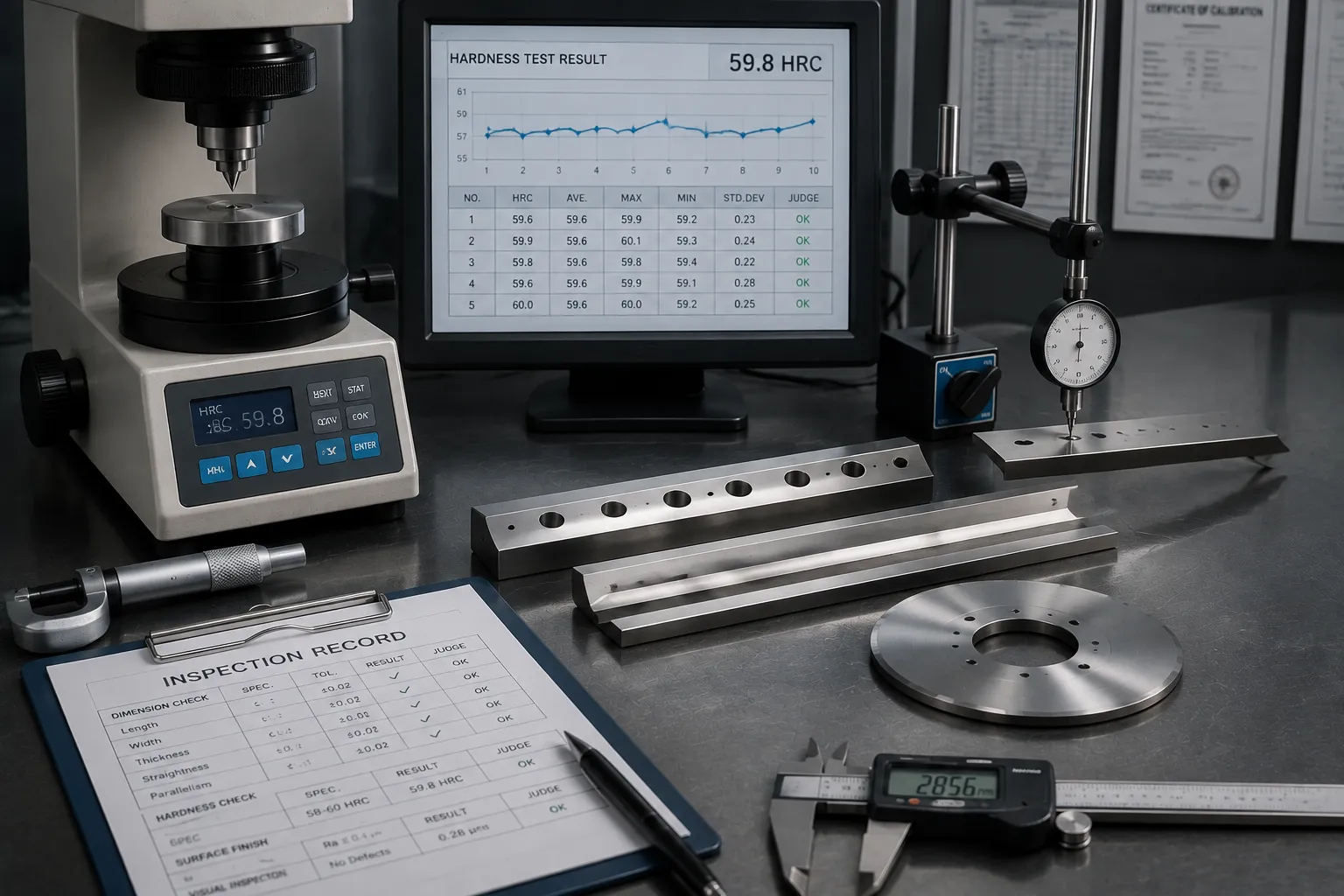
Quality Verification Standards & Hardness Assurance
Long-term industrial blade performance relies fundamentally on internal metallurgical consistency. Even premium tungsten carbide or powder metallurgy tool steels underperform if thermal cycles fluctuate. Shark Cutting enforces digital heat logging, automated atmosphere control, and rigorous metallurgical testing at every stage of industrial knife manufacturing, adhering to strict quality-control procedures.
Thermal Treatment Process & Material Compatibility Matrix
| Treatment Process | Compatible Material Families | Typical Hardness Target | Primary Operational Advantage |
|---|---|---|---|
| Vacuum Hardening | D2, A2, SKD11, High-Speed Steels (HSS) | 58 to 64 HRC (±1 HRC) | Clean surface finish, zero oxidation, and precise dimensional stability during slitting and shearing. |
| Deep Cryogenic Freeze | CPM Powder Metallurgy, M2 HSS, High-Cr Steels | 60 to 66 HRC | Converts retained austenite into fine martensite for maximum wear resistance and extended blade life. |
| Triple Tempering | S7 Shock Steel, Hot-Work Tool Steels | 54 to 58 HRC | Maximizes fracture toughness and impact energy absorption to prevent edge chipping under heavy shock. |
| HIP Sintering & Quality Control | Tungsten Carbide Grades & Inlaid Alloys | 88 to 93 HRA | Eliminates micro-porosity to deliver maximum hardness for ultra-precise film, foil, and paper slitting. |
Industrial Blade Material Frequently Asked Questions
Selecting the optimal substrate and metallurgy for precision cutting tools requires balancing wear life, fracture toughness, and total operating cost. Sharkcutting provides premium cold-work tool steels, high-speed steel alloys, powder metallurgy, and micro-grain tungsten carbide custom-engineered for demanding slitting, converting, and recycling machinery. Explore expert engineering answers to common material selection and procurement questions below, or visit our comprehensive FAQ section for additional guidance.
Wear Resistance vs. Impact Toughness
Harder alloys like tungsten carbide drastically extend edge retention, but require tailored bevel profiles and shock-resistant heat treatments to prevent chipping under heavy loads.
Thermal Hardness in High-Speed Slitting
High-speed steels (HSS) maintain critical Rockwell hardness under high friction heat, preventing edge softening and premature wear during continuous high-velocity converting.
Deep Cryogenic Treatment Benefits
Sub-zero thermal processing converts residual austenite into stabilized martensite, guaranteeing exceptional dimensional stability and uniform HRC across the entire blade.
Tungsten Carbide Knife ROI vs. Standard Tool Steel
While solid micro-grain tungsten carbide knives carry a higher initial investment than cold-work tool steels like D2 or SKD11, they deliver substantially lower operating costs per cut. In high-speed film slitting, paper converting, battery separator cutting, and nonwoven slitting, tungsten carbide blades routinely achieve 10 to 50 times longer wear life before requiring regrinding.
Calculating total return on investment (ROI) involves factoring in reduced machine downtime, lower maintenance labor costs, fewer blade changes, and consistently sharp, burr-free slit edges. Sharkcutting helps plant managers evaluate total cost of ownership (TCO) to determine exact payback periods for solid carbide, carbide-tipped, and carbide-inlaid options.
- Significant reduction in unscheduled downtime and knife changeover frequency
- Burr-free slit edges that reduce dust contamination and web defects
- Fewer sharpening cycles and lower total lifetime tooling costs
Preventing Edge Chipping and Premature Blade Failure
Edge chipping typically occurs when blade hardness exceeds the fracture toughness required for severe shock loads or contaminated substrates. For instance, operating ultra-hard blades during heavy-duty plastic recycling or thick-gauge sheet metal shearing creates micro-structural stress concentrations that lead to edge spalling.
Sharkcutting resolves premature chipping through tailored shock-resistant steel grades, such as modified S7, A2 tool steel, or CPM powder metallurgy alloys, combined with custom edge geometry. Implementing a micro-honed edge, secondary bevel chamfer, or targeted multi-stage tempering absorbs high impact loads without compromising cut cleanliness.
Material Options for Corrosive and High-Temperature Applications
When slitting wet substrates, processing acidic chemical films, or granulating in washed recycling lines, standard carbon tool steels suffer rapid surface oxidation and micro-pitting. Micro-pitting dulls razor-sharp cutting edges long before abrasive mechanical wear occurs.
Sharkcutting manufactures blades from specialized martensitic stainless steels (such as 440C and 1.4116) as well as corrosion-resistant nickel-binder tungsten carbide grades. These materials maintain pristine edge geometry in high-humidity or chemically aggressive environments while upholding high Rockwell hardness.
Choosing Between D2 Tool Steel, High-Speed Steel, and Carbide
D2 tool steel is a high-carbon, high-chromium cold-work steel featuring prominent chromium carbide structures. It serves as an economical, wear-resistant choice for low-to-medium speed cutting where abrasive wear resistance is the main priority.
High-speed steels (HSS) such as M2, SKH51, and cobalt-enhanced M42 contain tungsten, molybdenum, and vanadium. These alloying elements form fine vanadium carbides that resist thermal softening at elevated temperatures. M2 HSS is the industry standard for high-speed shear slitting and rewinding where continuous friction generates significant heat.
| Material Grade | Hardness Range | Core Advantage | Optimal Applications |
|---|---|---|---|
| D2 Cold-Work Tool Steel | 58–62 HRC | Excellent Abrasive Wear Resistance | Paper Slitting, Packaging, Plastic Granulation |
| M2 High-Speed Steel (HSS) | 62–65 HRC | High Thermal Stability & Red Hardness | High-Speed Converting, Foil & Film Slitting |
| Micro-Grain Tungsten Carbide | 88–92 HRA | Maximum Lifespan & Razor Edge Hold | Lithium Battery Film, Nonwovens, Thin Polyfilm |
Heat Treatment Precision and Hardness Tolerances
The mechanical properties of premium industrial tool steel are fully unlocked through precise thermal processing. Sharkcutting utilizes state-of-the-art computer-controlled vacuum heat treatment furnaces followed by multiple stress-relieving tempering cycles to prevent surface decarburization and internal stresses.
To eliminate unstable retained austenite, blades undergo deep cryogenic treatment at sub-zero temperatures (-320°F / -196°C). This process transforms retained austenite into tempered martensite, ensuring ultimate dimensional stability, warp-free precision grinding, and guaranteed hardness tolerances within ±1 HRC across the entire cutting surface.
Custom Material Matching and Metallurgical Failure Analysis
When standard steel grades fail to achieve target blade life, Sharkcutting provides comprehensive custom metallurgical consultation. Clients can submit worn blade samples or substrate specifications directly to our engineering laboratory for detailed evaluation.
Our engineers perform microstructural grain analysis, hardness profiling, and wear pattern mapping. We then recommend engineered alloy upgrades, powder metallurgy tool steels (CPM grades), or specialized PVD surface coatings (such as TiN, TiAlN, or DLC) to eliminate persistent premature wear.
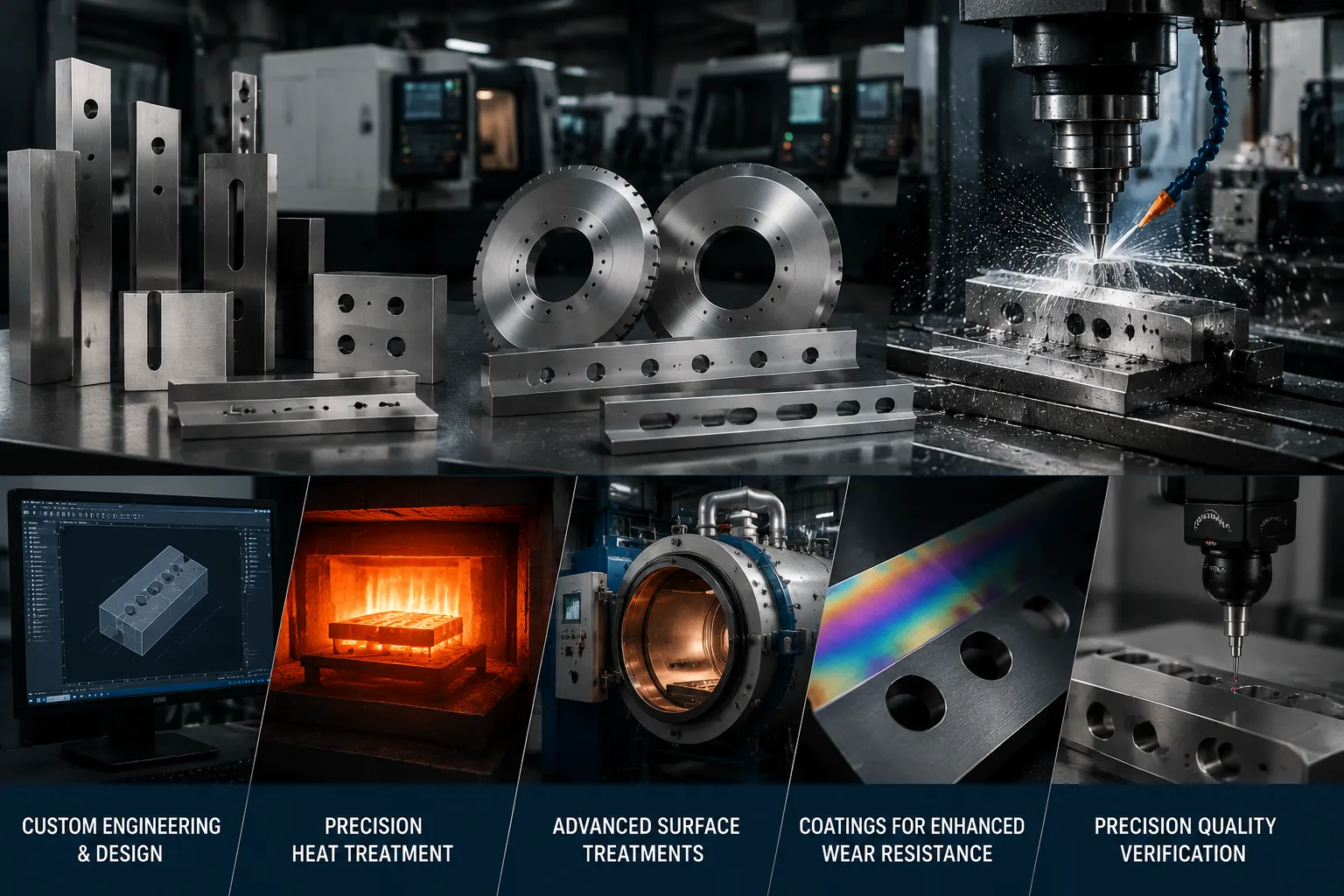
Sharkcutting Technical Engineering Capabilities
Custom-engineered tool steels, advanced surface treatments, and precision heat treatment optimized for maximum line performance.
- Microstructural grain analysis & wear pattern mapping
- Sub-zero deep cryogenic stress relief treatment
- Powder metallurgy (CPM / PM) steel grade selection
- Solid, tipped, and inlaid tungsten carbide options
Material Selection Quick Reference
Need immediate technical guidance on alloy selection, hardness ranges, or regrinding compatibility for your machinery?
Looking for the Ideal Industrial Blade Material for Your Operation?
Tell us about your cutting materials, machine parameters, and wear expectations. Our material engineers will match your process with the optimal tool steel or tungsten carbide grade to maximize blade life and throughput. If you need step-by-step guidance, read our detailed guide on how-to-choose-slitting-knives for top and bottom configurations.
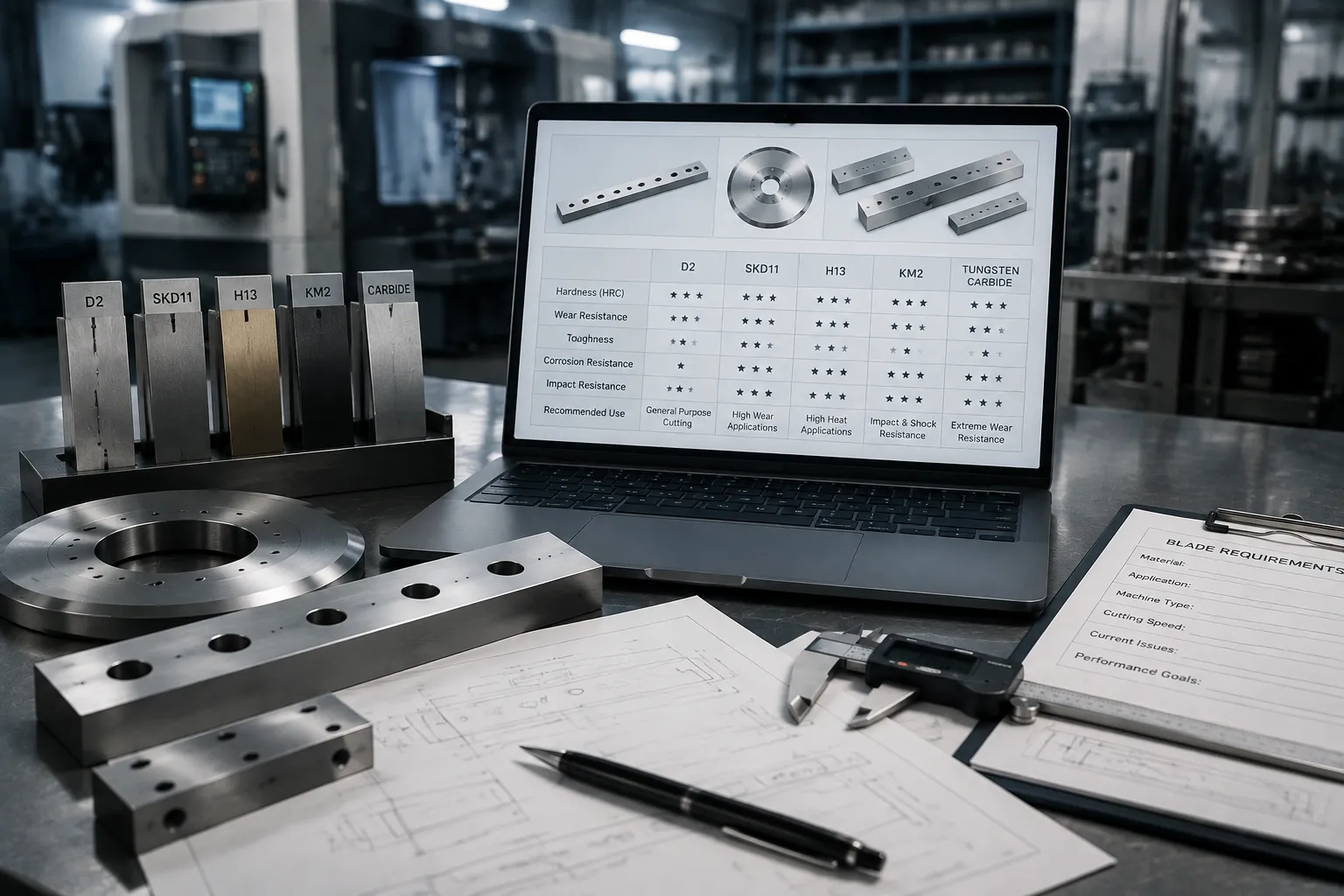
Custom Blade Steel Selector
Share your material specifications or current blade pain points for a tailored engineering recommendation within 24 hours.
Guaranteed confidential review and proprietary alloy recommendation.
±1 HRC
Hardness Tolerance
10–50x
Carbide Wear Lifespan
100%
Vacuum Heat Treated
24 Hours
Expert Response Time