
Micron-Precision Industrial Knife Manufacturing & Custom Blade Production
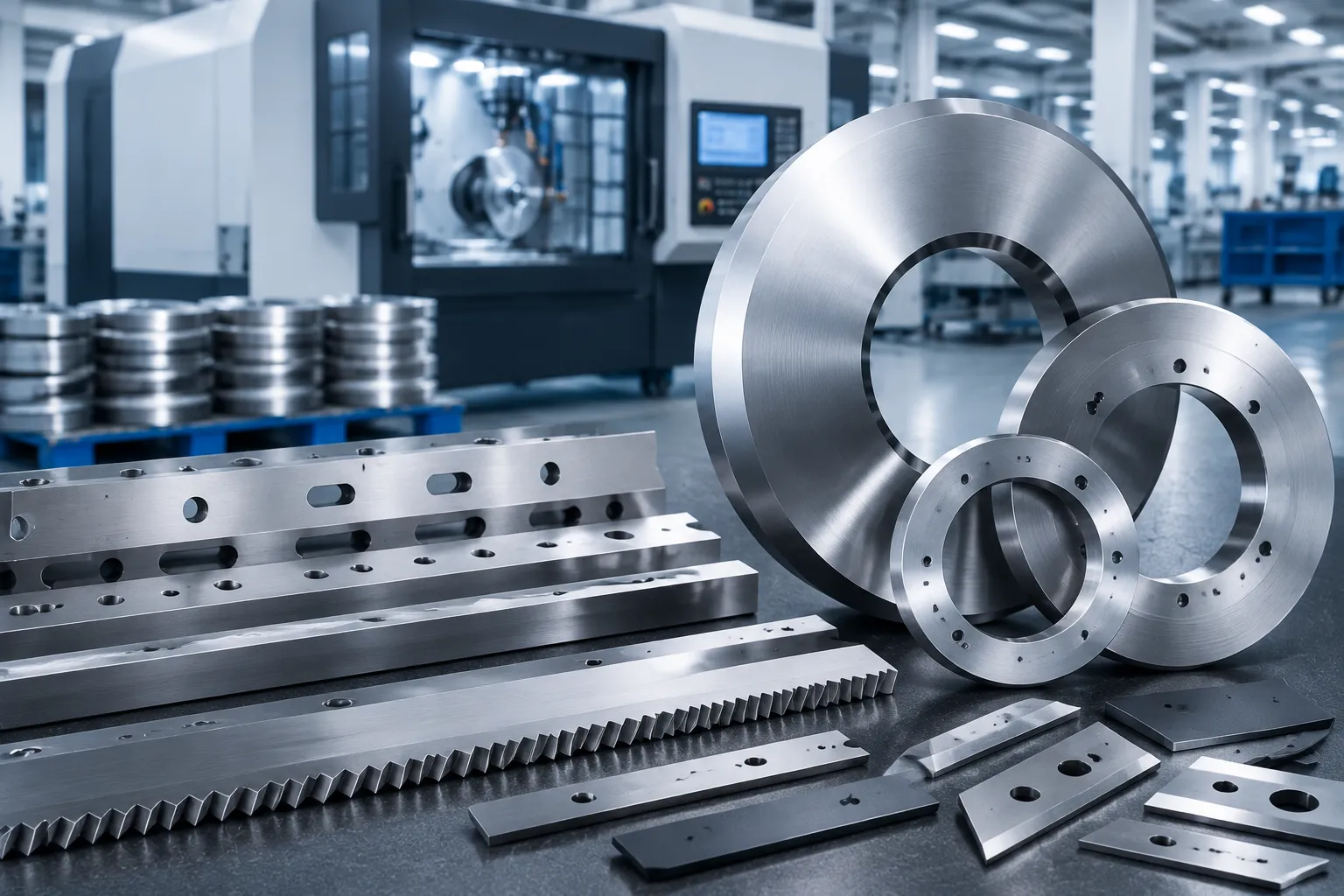
Sharkcutting pairs advanced multi-axis CNC grinding centers with controlled heat treatment to produce high-durability industrial machine knives, slitting blades, and custom cutting tools engineered for uninterrupted high-speed production.
Quantifiable Production Performance
Sharkcutting enforces strict, real-time quality monitoring at every stage of production to guarantee that every blade shipment adheres to demanding global machining tolerances and stringent manufacturing standards.
Machining Tolerances
Ultra-precise CNC profile grinding delivers exceptional dimensional repeatability for demanding slitting, shearing, and conversion processes, including high-precision paper cutting knives.
Raw Materials in Stock
High-speed steels, powder metals, and micro-grain tungsten carbides are continuously stocked to streamline custom production timelines for film cutting knives and specialized tooling.
First-Pass Quality Yield
In-line optical measurement and strict heat treatment audits verify blade hardness accuracy and uniform edge geometry across every lot.
Batch Process Traceability
Comprehensive mill test certificates and vacuum heat treatment logs link every finished industrial knife back to its raw material heat lot.
Engineering Precision Built Into Every Blade Shipment
At Sharkcutting, our advanced manufacturing facility integrates multi-axis automated CNC grinders with real-time laser measurement tools. Every production batch undergoes rigorous hardness verification and metallographic inspection to exceed international manufacturing standards across all industrial tooling and heavy-duty recycling blades.
Core Manufacturing Process & Technical Overview
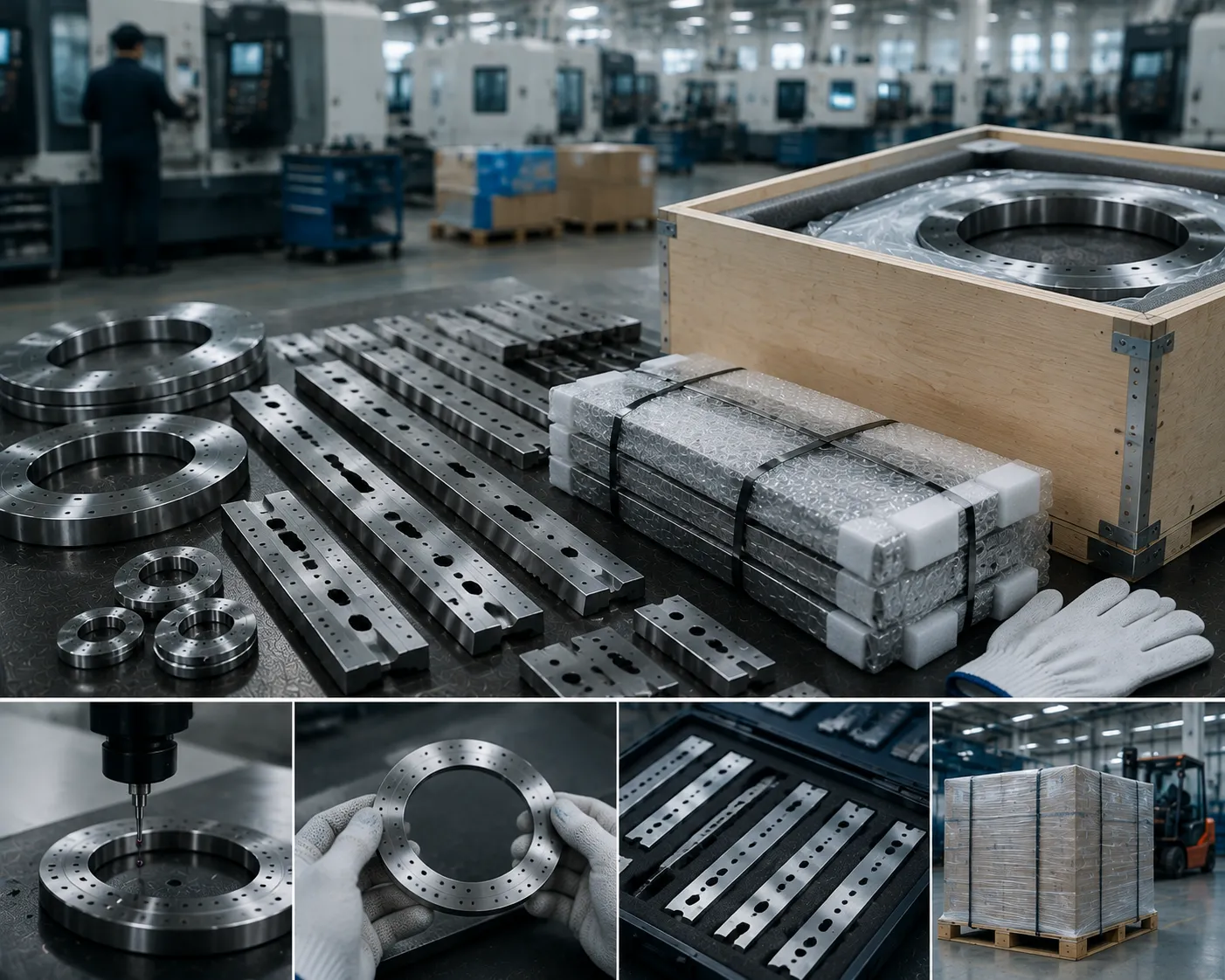
At Sharkcutting, our industrial machine knives manufacturing process integrates advanced raw material metallurgy, multi-axis CNC machining, high-precision blade grinding, and automated metrology. From initial forging and stress-relieving thermal cycles to micron-level edge profiling, every stage across our production facility is engineered to deliver tight tolerance control, exceptional wear resistance, and long operational tool life.
Integrated Manufacturing Chain & Equipment Depth
High-performance industrial knives demand absolute engineering discipline throughout every manufacturing phase. Sharkcutting’s integrated production line pairs advanced multi-axis CNC machine fleets with computerized vacuum furnaces and high-precision metrology stations. By executing all critical operations in-house, we prevent structural anomalies and ensure uniform mechanical properties across high-volume OEM supply runs and specialized custom orders.
Our versatile tooling setups accommodate complex blade configurations, including circular slitting knives, straight shearing blades, dish slitters, and custom-profiled cutters tailored for continuous material processing.
Metallurgical Science & Edge Geometry Control
Long-term blade durability starts with disciplined alloy selection. Sharkcutting sources certified high-speed steels (HSS), premium tool steels (D2, M2, A8, H13), and ultra-fine grain tungsten carbide grades. Through precise multi-stage heat treatment processes and sub-zero cryogenic conditioning, our metallurgists refine grain structures to boost impact toughness and prevent edge chipping under heavy loads.
Equipped with automated multi-axis CNC surface, rotary, and profile grinders with continuous diamond wheel dressing, our blade grinding capability achieves fine surface finishes down to Ra 0.1 µm. This superior finish minimizes friction, reduces heat generation during high-speed shearing, and preserves keen cutting edges through extended production cycles.
4-Stage Precision Production System
Rigorous process controls from alloy selection to zero-defect delivery
Forging & Substrate Prep
Selection of certified alloy tool steels, powder metallurgy steels, and tungsten carbide blanks. Precision forging and stress-relieving annealing establish dense grain structures and remove internal tension.
CNC Machining & Grinding
Multi-axis CNC precision machining forms exact blade contours, mounting slots, and bevel geometries. Super-abrasive CBN wheels apply final edge profiles with extreme dimensional fidelity.
Vacuum Heat & Cryogenics
Computer-controlled vacuum heat treatment prevents decarburization, while deep cryogenic tempering (-300°F) converts retained austenite into martensite for balanced toughness.
Metrology & Inspection
Micron-level dimensional verification using optical profile projectors, Zeiss CMMs, dynamic runout testing, and ultrasonic flaw scanning ensures zero-defect delivery.
Technical Equipment Depth & Processing Metrics
A breakdown of machine setups, processing parameters, and technical tolerances maintained across our industrial knife manufacturing process.
| Process Stage | Equipment & Tooling Fleet | Technical Capability | Tolerance Output |
|---|---|---|---|
| Forging & Annealing | Automated Radial Presses & Pre-Heat Ovens | Thermal stress-relieving and carbide structural distribution | ±0.05mm rough blank |
| CNC Precision Machining | 5-Axis CNC Milling & Machining Centers | High-precision contouring, slotting, counter-sinking, and beveling | ±0.002mm machining |
| Blade Grinding Capability | Multi-Axis CNC Surface, Rotary & Profile Grinders | Super-finish edge grinding with online diamond wheel dressing | Ra 0.1 µm surface finish |
| Heat Treatment Process | Computerized Vacuum Furnaces & Cryo Chambers | Decarburization-free vacuum quenching and sub-zero cryo tempering | ±0.5 HRC hardness range |
| Metrology & Quality Control | Optical Profile Projectors & Zeiss CMM Systems | 3D coordinate verification, runout testing, and flaw scanning | Zero-Defect Inspection |
Specialized Tooling Capabilities & Custom Engineering
Looking for tailored blade geometries or custom alloy formulations? Sharkcutting engineering teams partner with industrial machine manufacturers and high-volume processors worldwide to co-develop customized cutting tools—including high-precision paper-cutting-knives and heavy-duty packaging-machine-knives—engineered for superior throughput and reduced maintenance downtime.
Machining Tolerance Standard
Steel Heat Lot Traceability
Precision Materials & Substrate Formulations
Every converting application requires a specific balance of wear resistance, impact toughness, and edge-retention characteristics. Sharkcutting manufactures custom industrial blades using premium mill-certified substrates.
AISI M2, M3:2 & D2 Grades
Precision-forged alloy steels engineered for continuous high-speed rotary cutting, high fatigue resistance, and exceptional edge retention under mechanical stress.
CPM 10V, CPM 3V & ASP Series
Particle metallurgy alloys offering uniform carbide distribution, eliminating directional weakness for up to 300% greater toughness than standard tool steel.
Micro-Grain & Sub-Micron Grades
Sintered cobalt-bound tungsten carbide engineered for abrasive film, foil, and fiber slitting. Yields up to 10x longer service life compared to standard tool steel grades.
Stainless & Shock-Resistant Alloys
High-chromium stainless alloys (440C, 1.4116) and shock-resistant S7 tool steel tailored for high-impact coil shearing, wet environments, and sanitary converting.
Metallurgical Quality Guarantees
- 100% Spectrographic Chemistry Validation
- Sub-Micron Grain Structure Verification
- Zero-Porosity Ultrasonic Flaw Detection
- Certified High-Purity Ingot & Powder Sourcing
Thermal Dynamics & Deep Cryogenic Processing
HRC 58–68 TargetHardness without toughness causes catastrophic micro-chipping; toughness without hardness leads to rapid edge wear. Sharkcutting utilizes computer-controlled vacuum furnaces paired with deep liquid nitrogen cryogenic treatment at -196°C (-320°F) to lock in optimal mechanical properties.
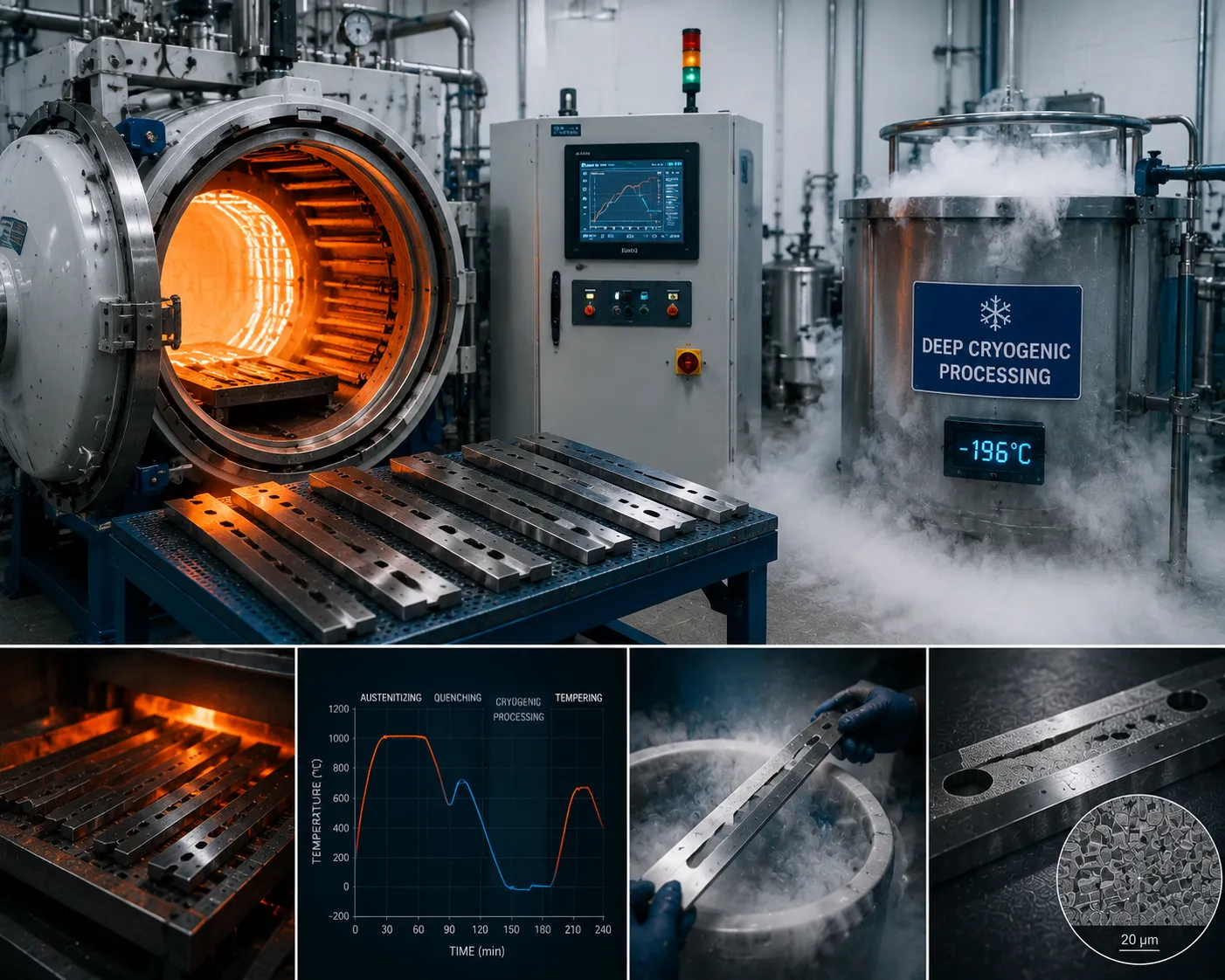
Vacuum Austenitizing & High-Pressure Gas Quenching
High-vacuum thermal cycles eliminate surface decarburization and ensure uniform core-to-edge hardness.
Deep Liquid Nitrogen Cryogenic Soak (-196°C)
Transforms unstable retained austenite into wear-resistant martensite, maximizing dimensional stability.
Triple Precision Tempering & Stress Relief
Relieves internal micro-stresses while locking in exact target Rockwell C hardness across every batch.
Substrate & Alloy Compatibility Matrix
Select your primary cutting substrate below to view our engineered alloy recommendations, custom thermal processing parameters, target Rockwell hardness, and expected wear life extension.
Optimized Formulation for Flexible Film & Multilayer Laminates
Engineered for razor-sharp edge retention with sub-micron polished bevels. Micro-grain tungsten carbide knives or CPM-10V prevent burr formation, stretch tearing, and polymer buildup during high-speed slitting up to 800 m/min.
Technical Specs & Parameters
Substrate Metallurgy: High-Speed Steels, Powder Metallurgy & Tungsten Carbide Knives
In continuous industrial slitting and shearing operations, long-term blade performance depends on substrate chemistry and microstructural consistency. At Sharkcutting, we evaluate the shear forces, thermal friction, and abrasive wear mechanisms inherent in your specific converting process before selecting an alloy formulation. High-performance lines often rely on specialized tooling such as shear-slitting-knives to maintain tight tolerances, whereas conventional ingot-cast steels often suffer from carbide segregation and directional grain orientation, creating microscopic weak zones that foster edge chipping under load.
To overcome these physical limitations, our metallurgical engineers specify Powder Metallurgy (PM) steels and micro-grain tungsten carbide formulations. PM steels are manufactured via high-pressure gas atomization, rapid solidification, and hot isostatic pressing (HIP), producing uniform, spherical carbide particles throughout the matrix. This isotropic microstructure grants PM high-speed steel blades up to 300% greater toughness at elevated hardness levels compared to conventionally cast D2 or M2 tool steels, making them ideal for high-impact slitting and abrasive shearing across various configurations, including precision circular-slitter-knives.
| Material Grade | Alloy Classification | Hardness Range | Wear Resistance | Impact Toughness | Primary Industrial Application |
|---|---|---|---|---|---|
| AISI D2 / 1.2379 | Cold-Work Tool Steel | 58 – 62 HRC | Standard | Moderate | General paper slitting, cardboard pelletizing, light converting |
| AISI M2 / 1.3343 | High-Speed Steel (HSS) | 62 – 65 HRC | High | High | High-speed rotary shear, food slicing, film perforating |
| CPM-10V / CPM-3V | Powder Metallurgy (PM) | 60 – 65 HRC | Very High | Exceptional | Abrasive synthetic rubber, metal coil edge trimming, heavy shear |
| Micro-Grain Tungsten Carbide | Sintered WC-Co Carbide | 88 – 92 HRA (75+ HRC eq.) | Extreme | Moderate | Ultra-thin film slitting, foil converting, battery separator film |
| Stainless 440C / 1.4125 | Martensitic Stainless | 56 – 60 HRC | Moderate | High (Corrosion Resistant) | Medical packaging, sanitary converting, washdown environments |
Thermal Dynamics & Blade Heat Treatment
Conventional heat treatment relies on open-air oil quenching or atmospheric salt baths, which frequently cause surface oxidation, decarburization, and residual micro-stress concentrations. Sharkcutting processes all industrial knives in computer-controlled vacuum heat treatment furnaces with high-pressure argon gas quenching.
- Retained Austenite Transformation: Standard room-temperature quenching leaves up to 15% unstable retained austenite in tool steel, leading to dimensional warping during operation. Our deep cryogenic soak at -196°C transforms retained austenite into stable, ultra-hard martensite.
- Eta-Carbide Precipitation: Cryogenic treatment triggers the precipitation of ultra-fine sub-microscopic eta-carbides throughout the steel matrix, dramatically enhancing resistance to micro-abrasive wear without compromising impact toughness.
Application Matching & Wear Resistance Optimization
Matching blade metallurgy to specific cutting media is essential for maximizing blade wear life and eliminating costly downtime. Different substrates impose distinct mechanical stresses: abrasive wear from inorganic fillers in paperboard, adhesive friction from sticky elastomers, or severe shock impact during metal shearing.
- Flexible Film & Foil Converting: Requires ultra-sharp edge radii (< 0.5 µm) and high compressive strength to prevent film stretch tearing. Micro-grain tungsten carbide knives and polished PM high-speed steel blades deliver pristine edge quality.
- Heavy Coil Shearing & Slitting: High-impact metal shearing demands maximum fracture toughness. Cryogenically treated S7, CPM-3V, or heavy-duty D2 tool steel prevents catastrophic edge cracking under extreme shear loads.
Full-Process Quality Control & Inspection System
Sharkcutting operates an end-to-end quality control system engineered to eliminate batch-to-batch variation and deliver strict micro-tolerance consistency across all industrial machine knives. From incoming raw material spectrographic chemical verification to automated 3D CMM dimensional inspection and dynamic blade runout control, every tool undergoes multi-point testing before final dispatch.
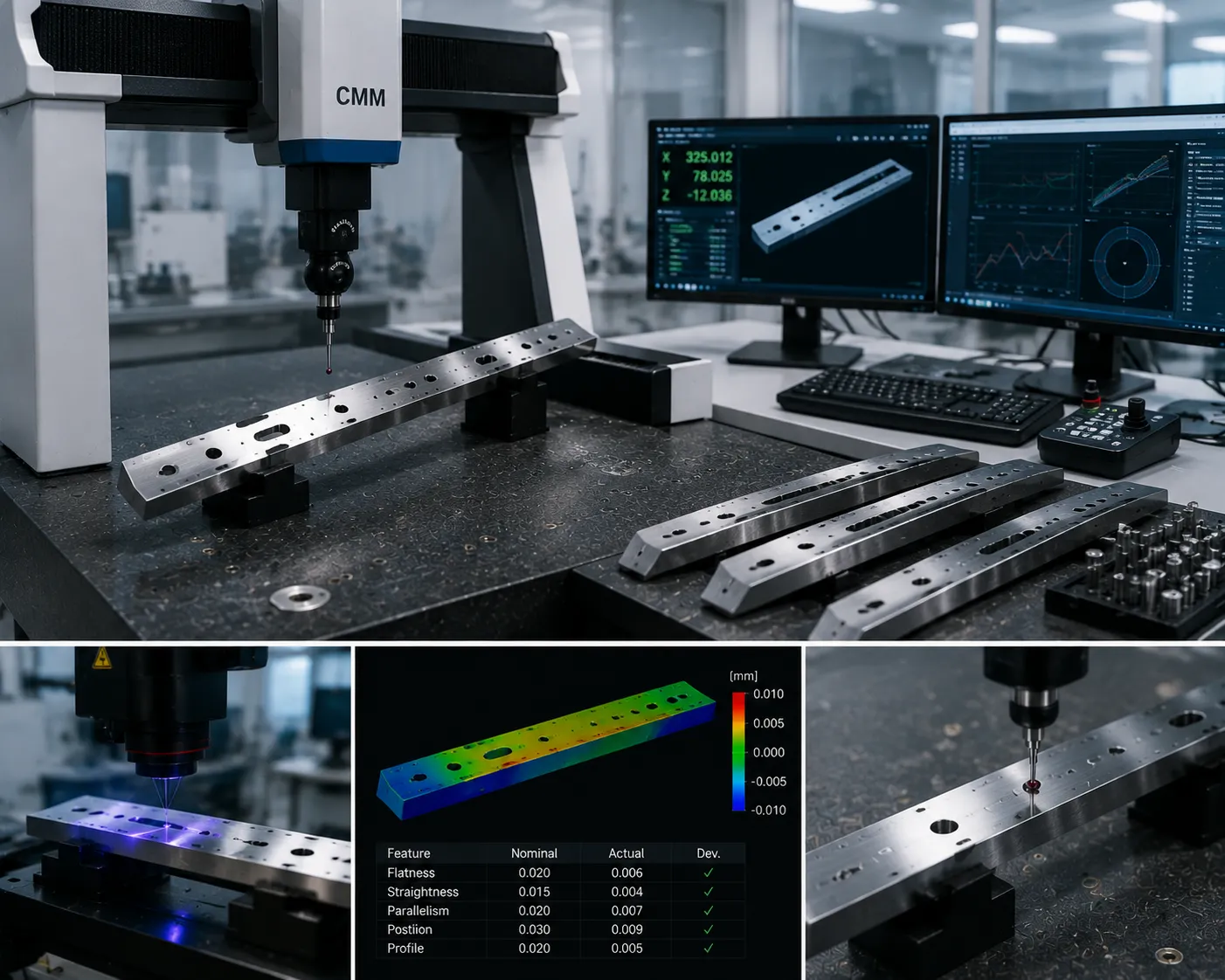
3D Coordinate Measuring Machine (CMM) & Laser Optical Profile Verification
Metrology Infrastructure Benchmarks
Advanced dimensional inspection systems continuously verify production runs, locking in sub-micron tolerances across complex blade profiles, bevel angles, and mounting configurations.
Every production lot includes complete Material Test Reports (MTR), full spectrographic heat chemistry documentation, and optical dimensional inspection certificates.
5-Stage Quality Assurance Protocol
Incoming Inspection & Spectrographic Chemical Analysis
Raw Material AuditSpectrographic analysis confirms raw steel alloy composition before manufacturing begins. Every ingot and coil is verified against mill test certificates to ensure optimal chemistry, eliminating metallurgical flaws prior to blanking and initial shaping.
- Chemical Profiling: Precise verification of carbon, chromium, vanadium, molybdenum, and tungsten content.
- Substrate Integrity: Ultrasonic testing to detect internal inclusions, micro-voids, and structural anomalies.
In-Process Metrology & Optical Profile Inspection
Real-Time Machining ControlDuring multi-axis CNC grinding, automated Coordinate Measuring Machine (CMM) tracking and non-contact optical profile comparators continuously measure edge geometry, hole spacing, and bevel angles against original CAD models.
- Optical Projection: High-magnification checks for edge burrs, micro-chipping, and profile accuracy.
- Closed-Loop Feedback: Sub-micron measurements feed real-time offset adjustments directly to CNC grinders.
Blade Runout & Flatness Verification
Vibration SuppressionDynamic runout testing and non-contact laser displacement gauges measure Total Indicator Reading (TIR) on circular rotary slitting knives, eliminating axial wobble and machine vibration in high-speed slitting operations.
- Axial & Radial Runout: High-speed rotational equilibrium tests guarantee dynamic balance on arbor shafts.
- Flatness & Parallelism: Multi-point displacement measurement prevents binding and material drag.
Hardness Uniformity & Metallurgical Testing
Rockwell & Vickers TestingFollowing vacuum heat treatment and deep cryogenic conditioning, Rockwell and Vickers hardness testing across the entire blade profile ensures consistent wear resistance, edge retention, and toughness without localized brittleness.
- Rockwell C (HRC): Multi-zone surface and core hardness testing to verify deep martensitic transformation.
- Micro-Vickers (HV): Precise micro-indentation testing on thin cutting edges and anti-friction coatings.
Pre-Shipment Audit & Documented Compliance
Zero-Defect SignoffBefore applying protective anti-corrosion coatings and export-grade packaging, a final quality audit verifies key dimensional tolerances. Comprehensive inspection documentation is compiled for full supply chain transparency.
Comprehensive Metrology Benchmarks & Tolerances
Sharkcutting maintains demanding precision standards for custom industrial blade manufacturing, OEM replacement knives, and heavy-duty cutting components, including specialized paper cutting knives. All metrology operations take place in climate-controlled inspection rooms to eliminate thermal expansion variables.
| Inspection Parameter | Testing Instrument & Method | Standard Industry Tolerance | Sharkcutting Guaranteed Standard |
|---|---|---|---|
| Linear Dimensions & Hole Pitch | 3D CNC Coordinate Measuring Machine (CMM) | ±0.020 mm | ±0.002 mm |
| Edge Bevel & Contour Profile | High-Resolution Optical Profile Comparator | ±0.10° angle | ±0.02° angle |
| Dynamic Rotary Blade Runout | Laser Displacement Gauge & Dial Indicator | 0.015 mm TIR | < 0.005 mm TIR |
| Surface Roughness (Ra) | Contact Profilometer & Laser Surface Analyzer | Ra 0.4 µm | Ra 0.1 µm (Mirror Finish) |
| Hardness Uniformity Spread | Digital Rockwell & Vickers Hardness Tester | ±2.0 HRC variance | ±0.5 HRC variance |
Complete Heat Traceability & Batch Tracking
Full manufacturing accountability protects continuous production operations. Every Sharkcutting knife features permanent laser-etched heat codes linked directly to raw material test reports, heat treatment logs, and final QC inspection sign-offs.
Detailed Quality Protocol Documentation
This quality assurance overview connects directly to specialized technical resources covering specific CMM inspection procedures, destructive and non-destructive material testing, and certified export compliance protocols.
Quality Certifications & Export Compliance Standards
Sharkcutting maintains certified quality management systems, complete material heat-code traceability, and full export compliance to support global OEM procurement.
ISO 9001:2015 Certification
Our certified quality management system governs every stage of industrial knife production, from incoming steel verification to high-precision CNC finishing.
- Audited Manufacturing Facilities
- ISO 9001 Certified Knife Manufacturer
Raw Material Heat Traceability
Every blade features laser-etched heat numbers linked directly to original Mill Test Reports (MTR), ensuring total material purity and consistency.
- Traceable Quality Records
- Mill Test Reports (MTR) Included
Global Export Compliance
All cutting tools, including heavy-duty shredder blades, comply with international safety and material regulations, ensuring frictionless cross-border logistics and customs clearance.
- Full Export Compliance Standards
- Cross-Border Supply Chain Ready
Validate Your Custom Industrial Blade Solution
Submit your technical drawings, worn blade samples, or application requirements. Our engineering team will evaluate material selection, edge geometry, heat treatment options, and manufacturing feasibility for your cutting application.
Start Your Blade Evaluation
Get professional recommendations for blade materials, hardness range, coating options, and production solutions from our engineering specialists.
Request Engineering AssessmentSuitable for packaging converting, paper processing, plastic recycling, nonwoven cutting, and industrial slitting applications.
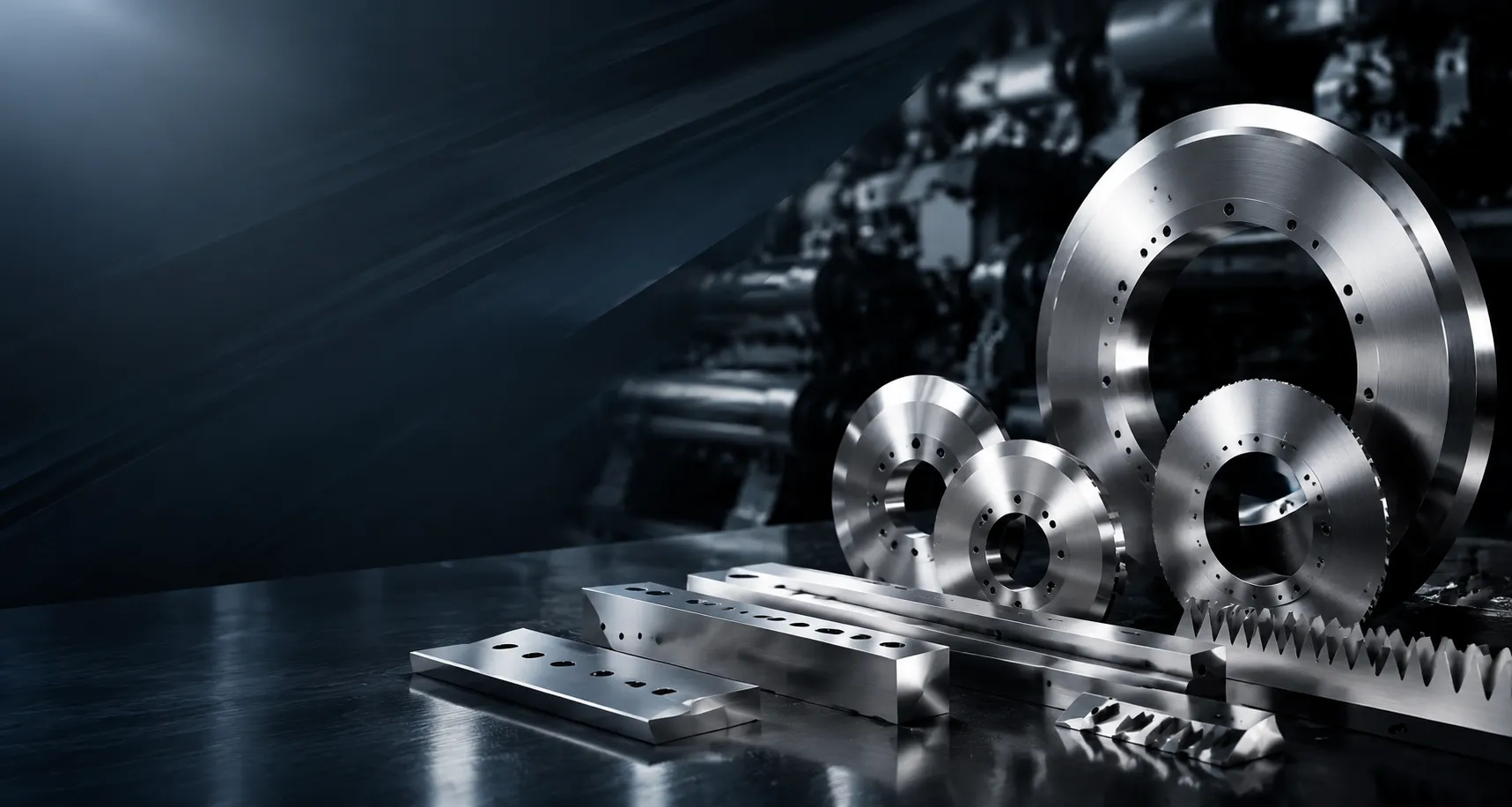
Sharkcutting Global Supply Infrastructure
Strict adherence to international trade and material standards
Manufacturing Capabilities & Engineering FAQ
Sourcing custom industrial machine knives requires exact engineering standards, certified metallurgy, and predictable delivery schedules. At Sharkcutting, our application engineers work directly with plant operations teams, procurement managers, and machinery builders to resolve complex cutting challenges. Whether you are addressing high wear rates on abrasive converting lines, establishing an OEM blade production program, or sourcing emergency replacement knives, we deliver full technical transparency from drawing submittal to final inspection.
Explore detailed technical responses below regarding custom blade manufacturing lead time, micro-machining tolerances, thermal processing standards, and certified factory documentation.
Q1 What are the standard and expedited lead times for custom industrial knife orders?
Standard custom blade manufacturing lead time is 3 to 5 weeks following final drawing approval and technical sign-off. This timeline covers alloy selection, precision CNC blanking, computer-controlled vacuum heat treatment, sub-zero cryogenic stabilization, and multi-axis finish grinding.
To support urgent line maintenance and prevent unscheduled plant downtime, Sharkcutting offers flexible production scheduling options:
- Emergency Replacement Program: Complete production in 7 to 10 business days for circular slitters, shear knives, and straight cutting blades using pre-inspected tool steel and carbide blanks.
- Prototype Fast-Track: Initial engineering samples delivered in 5 to 7 business days for Design for Manufacturability (DFM) testing and fitment verification.
- Raw Material Reserve Stock: On-site inventory of over 50 alloy grades (D2, M2, CPM-10V, Tungsten Carbide) eliminates raw material procurement delays.
Q2 What micro-tolerances and surface roughness (Ra) finishes can your machinery achieve?
Sharkcutting’s temperature-controlled machining centers and optical lapping equipment deliver tight industrial knife tolerances required for high-speed automated slitting and converting equipment.
| Precision Specification | Standard Commercial Capability | Ultra-Precision Capability |
|---|---|---|
| Thickness Tolerance | ±0.005 mm (±0.0002 in) | ±0.002 mm (±0.00008 in) |
| Flatness & Parallelism | 0.008 mm per 1,000 mm length | 0.003 mm per 1,000 mm length |
| Surface Roughness (Ra) | Ra 0.2 µm (8 µin) | Ra 0.1 µm (4 µin) Mirror Polish |
| Bevel Angle Accuracy | ±15 arc minutes | ±5 arc minutes |
| Axial Runout (Rotary Blades) | 0.010 mm TIR | 0.005 mm TIR |
Ultra-smooth surface finishes achieve ultra-low Ra values to reduce friction and material buildup during film slitting, paper slitting, foil shearing, and continuous tissue converting—minimizing slitting dust and extending edge life by up to 300%. For film converting applications, explore our precision razor slitting knives.
Q3 Can Sharkcutting reverse-engineer worn machine blades from engineering drawings or physical samples?
Yes. Sharkcutting specializes in reverse engineering and technical support for obsolete, custom, or discontinued machine blades as part of our comprehensive OEM blade production FAQ services.
Our engineering review follows a proven four-step process:
- 1 3D Laser Scanning & CMM Inspection: We capture precise non-contact point cloud data from worn or damaged physical samples to reconstruct original nominal geometry.
- 2 Spectrographic Metallurgy Analysis: Optical emission spectroscopy identifies exact alloy compositions, enabling us to replicate or upgrade material grades (e.g., upgrading from D2 steel to M2 HSS or Solid Tungsten Carbide).
- 3 Wear Pattern & Failure Mode Analysis: Our metallurgists inspect worn edges for micro-chipping, thermal cracking, or galling to optimize edge angles and heat treatment specifications.
- 4 CAD Model Approval: We supply full 2D PDF blueprints and 3D STEP models for your engineering team’s review before production begins.
Q4 How do you guarantee consistent hardness and blade geometry across high-volume production batches?
Batch-to-batch consistency is guaranteed through automated process control across thermal processing and precision finish grinding:
- Computerized Vacuum Heat Treatment: Atmosphere control prevents surface decarburization, while multi-zone thermal sensors maintain temperature uniformity within ±2°C across the furnace charge.
- Deep Cryogenic Treatment (-300°F / -185°C): Sub-zero liquid nitrogen processing converts retained austenite into stable martensite, eliminating internal stresses and preventing distortion in service.
- Multi-Point Hardness Verification: Rockwell (HRC) and Vickers (HV) micro-hardness measurements across every lot ensure hardness variance stays within ±1.0 HRC.
- In-Process Optical Inspection: In-line laser positioning systems adjust grinding parameters automatically to maintain uniform bevel geometry across thousands of units.
Q5 What certified factory test documentation (MTR, CMM reports) accompanies shipped orders?
To support ISO 9001 compliance and strict international export standards, every Sharkcutting order includes complete material traceability and inspection documentation.
Standard quality documentation packages include:
- Mill Test Certificate (MTR / EN 10204 3.1): Documents raw material heat chemistry and mechanical properties directly from accredited steel mills.
- CMM Dimensional Inspection Report: High-precision coordinate measurement logs comparing drawing specifications against actual finished dimensions.
- Heat Treatment & Hardness Records: Certified furnace cycle charts and post-temper hardness test results.
- Dynamic Balance & Surface Roughness Logs: Individual measurement reports for high-RPM rotary slitters and circular shear blades.
Have Custom DFM Specifications?
Our technical team reviews CAD submittals (STEP, IGES, DXF, PDF), assesses material requirements, and provides engineering feedback with formal quotes within 24 hours.
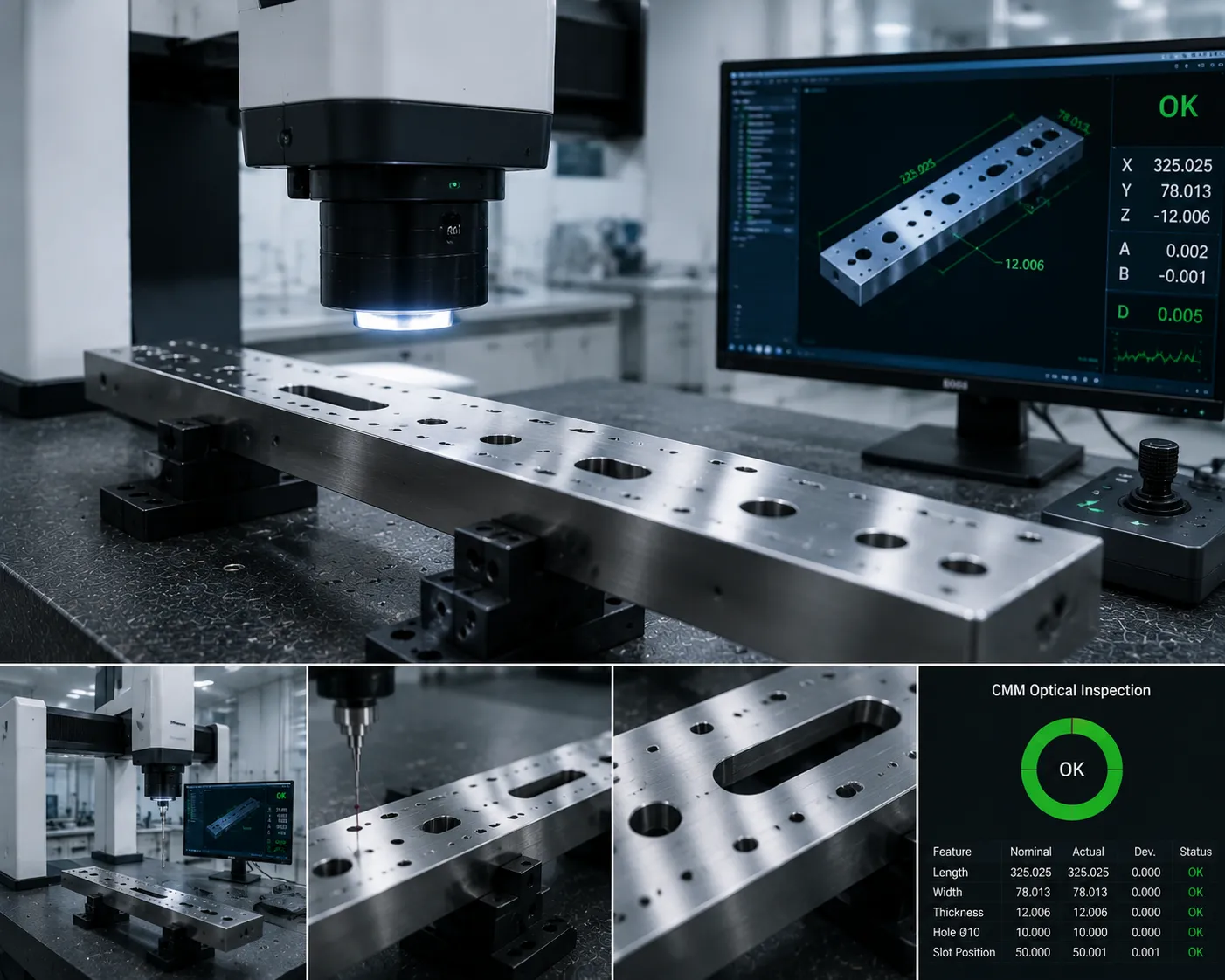 CMM Optical Inspection
 Zero-Defect Metrology Controls
Every production batch undergoes dynamic runout and dimensional measurement before vacuum packaging and international export delivery. We offer specialized solutions including paper cutting knives to meet unique processing needs.