
Industrial High-Precision Film Cutting Knives & Thin-Film Slitting Blades
Engineered for high-speed, burr-free slitting of BOPP, PET, PE, and flexible multilayer films. Explore our high-performance slitting knives to prevent edge dusting, film tearing, and downtime with tungsten carbide and tool steel blades tailored for flexible packaging lines.
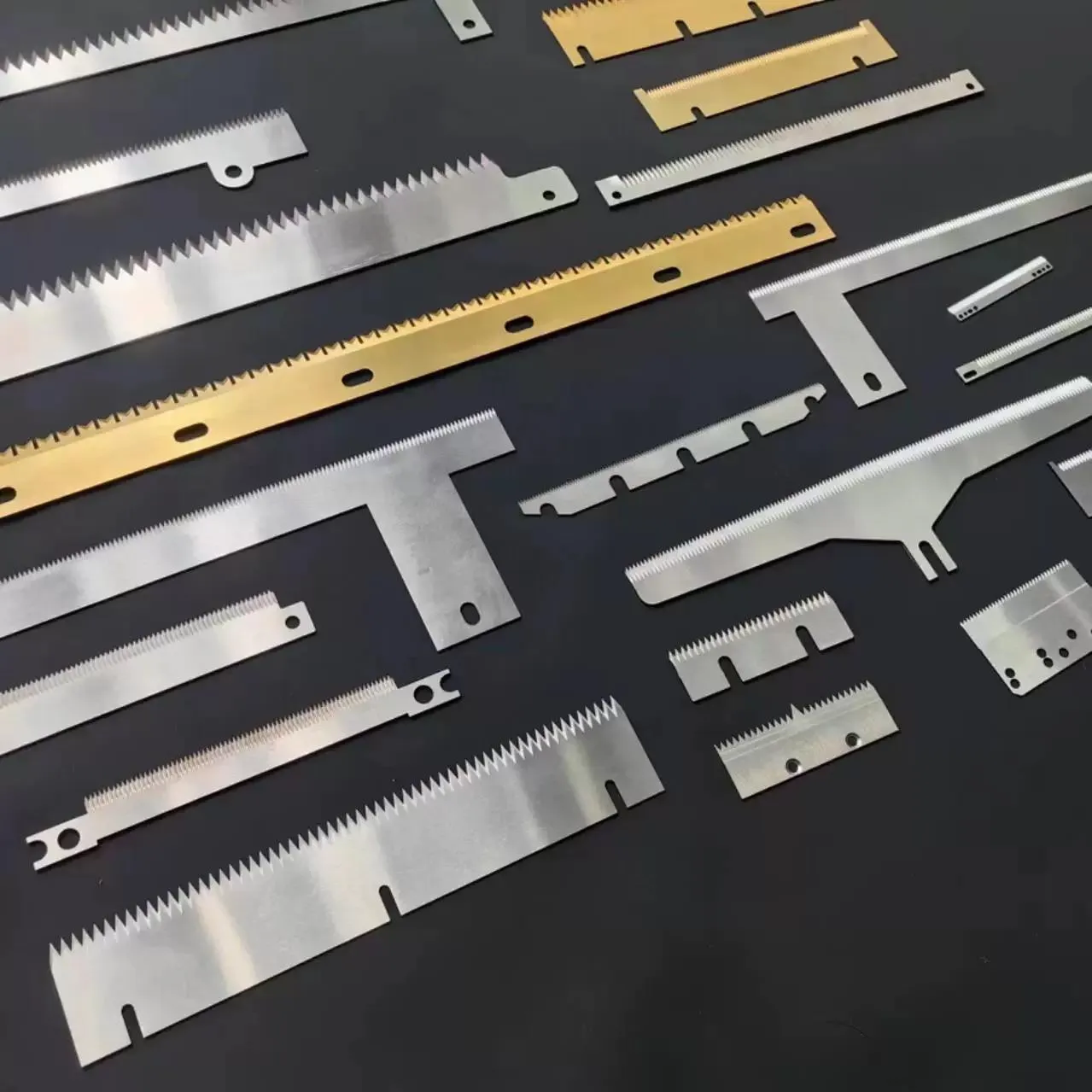
Sharkcutting Mirror-Finish Series
Tungsten Carbide & HSS Alloys
±0.002 mm
Dimensional Tolerance Precision
Ra 0.05
Mirror-Finish Edge Grinding
+30% Longer
Operational Blade Lifespan
Precision Material Engineering for Converting Applications
Select from our premium alloy compositions engineered specifically to withstand adhesive wear, thermal degradation, and mechanical stress during high-speed film conversion.
Solid Tungsten Carbide Blades
Formulated with ultra-fine submicron grain structures, our solid tungsten carbide slitting knives deliver up to 50 times longer service life compared to standard steel, ensuring burr-free razor cuts at high speeds.
Target Substrates
- Highly Abrasive BOPP & PET Films
- Ultra-Thin Technical Capacitance Films
- Metallized Flexible Packaging Laminates
Blade Geometry & Categories from an OEM Industrial Blade Manufacturer
Explore precision knife configurations engineered specifically for continuous rotary slitting, razor scoring, and heavy shear cutting.
Circular Film Cutters
Engineered for continuous rotary slitting on high-speed roll-converting equipment. Delivers vibration-free operation, superior edge cleanliness, and tight axial runout tolerances. Discover our specialized circular slitter knives for severe operational demands.
3-Hole Razor Slitting Blades
Ultra-sharp razor slitting knives designed for inline web slitting of delicate polymer films without creating edge fraying or contamination-inducing polymer dust.
Shear Slitting Top and Bottom Knives
Precision-matched male and female shear slitting knives providing clean scissor-action cutting for heavy gauge films, multi-layer laminates, and aluminum foil structures.
Industrial Slitting Blades & Converting Technical Parameters
Matching blade dimensions, hardness levels, and edge angles to line operating speeds is critical to prevent micro-chipping and film stretch. Select Sharkcutting as your reliable industrial blade supplier to enjoy high cost-performance pricing, long tooling lifespan, and global worry-free technical after-sales service.
| Blade Type | Primary Metallurgy | Hardness Rating | Surface Finish | Recommended Web Speed | Primary Substrates |
|---|---|---|---|---|---|
| Carbide Film Blades | Solid Tungsten Carbide | 89 - 92.5 HRA | Ra 0.05 μm | 1,000 - 1,200 m/min | BOPP, Ultra-thin PET, CPP |
| Razor Slitting Knives | HSS M2 / Carbide / Ceramic | 62 - 65 HRC / 90 HRA | Ra 0.08 μm | 600 - 900 m/min | PE, Blown Film, Polyolefins |
| Industrial Slitting Blades | Tool Steel D2 / High Speed Steel | 60 - 64 HRC | Ra 0.10 μm | 400 - 800 m/min | Laminates, Foils, Thick PE |
| Coated Special Alloy Blades | Carbide + TiN / TiAlN PVD Coating | 3,000 HV Coating | Ra 0.05 μm | 800 - 1,100 m/min | Adhesive Tape, Battery Separators |
Edge Bevel Angles & Web Integrity
Selecting the proper bevel angle directly impacts cutting force and web edge quality. Narrow acute angles reduce cutting resistance on delicate polymer films, while compound double bevels provide the structural rigidity required for high-speed continuous runs on abrasive materials.
Micro-Ground Finishing & Friction Control
Precision mirror-ground edges with an Ra 0.05 finish prevent film friction and material buildup. Proprietary heat treatment eliminates internal stresses, guaranteeing precise dimensional stability and razor-sharp edge retention across long production cycles.
High-Precision Film Cutting Knives for BOPP, PET, and Flexible Packaging Slitting
Industrial polymer converting requires razor-sharp edge control fine-tuned to specific resin behaviors. Standard off-the-shelf blades generate edge micro-fractures, material stretching, web breaks, and ambient polymer dust. Sharkcutting manufactures high-performance thin-film slitting blades, flexible packaging knives, and custom carbide tools designed to withstand demanding continuous converting operations while delivering burr-free cut edges and consistent roll tension. Explore our complete selection of industrial slitting knives engineered to optimize web handling efficiency.
Slitting Edge Quality & Micro-Structure Analysis
Microscopic inspection of film edge integrity under continuous high-speed converting conditions.
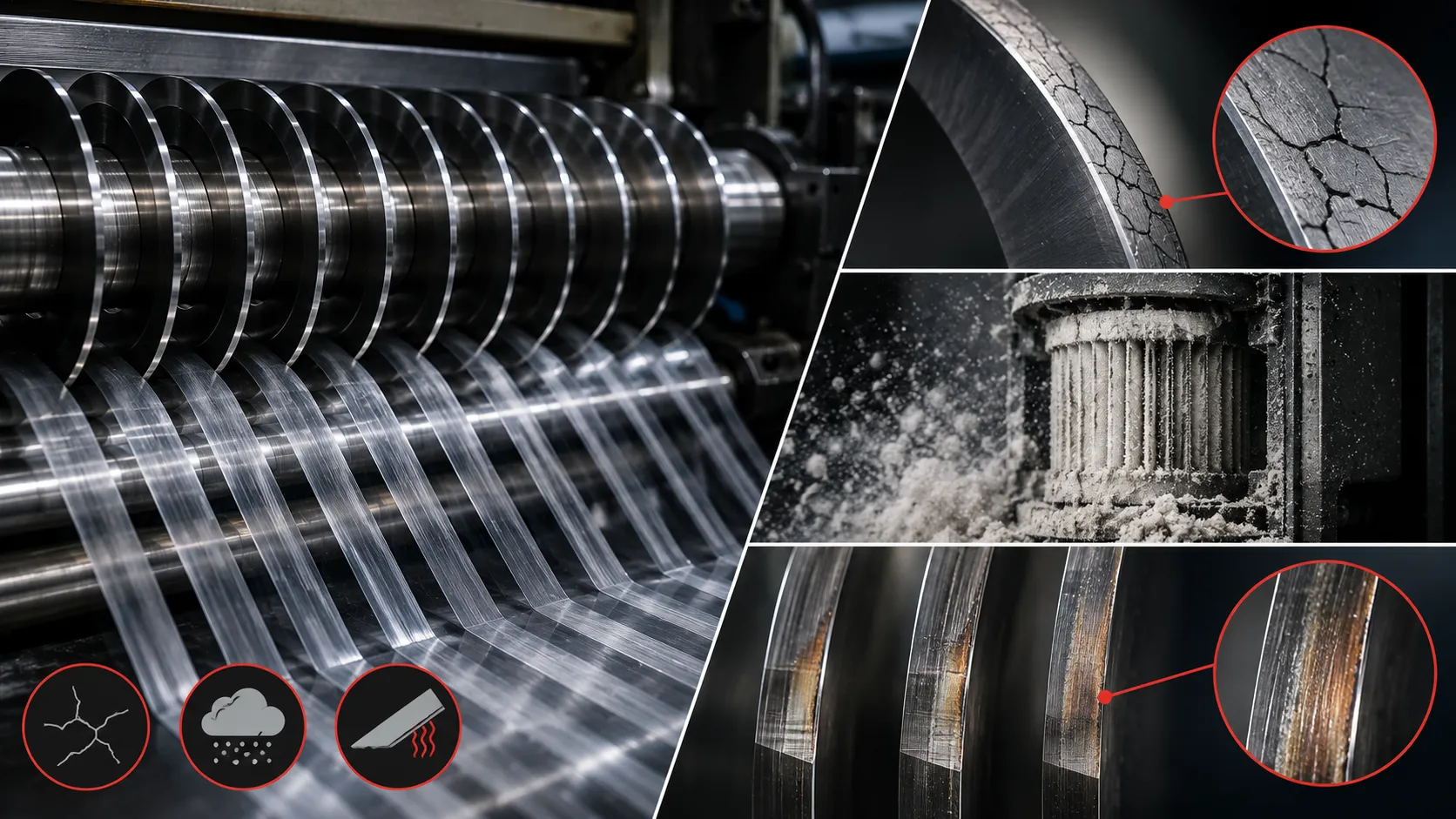
Micro-Fracturing & Polymer Dust Accumulation
- • Micro-fissures and stress cracks that cause web breaks during secondary slitting or rewinding
- • Heavy airborne polymer debris requiring frequent cleanroom shutdowns and filter replacements
- • Edge burning, thickness deformation, and premature blade dulling along continuous slit lanes
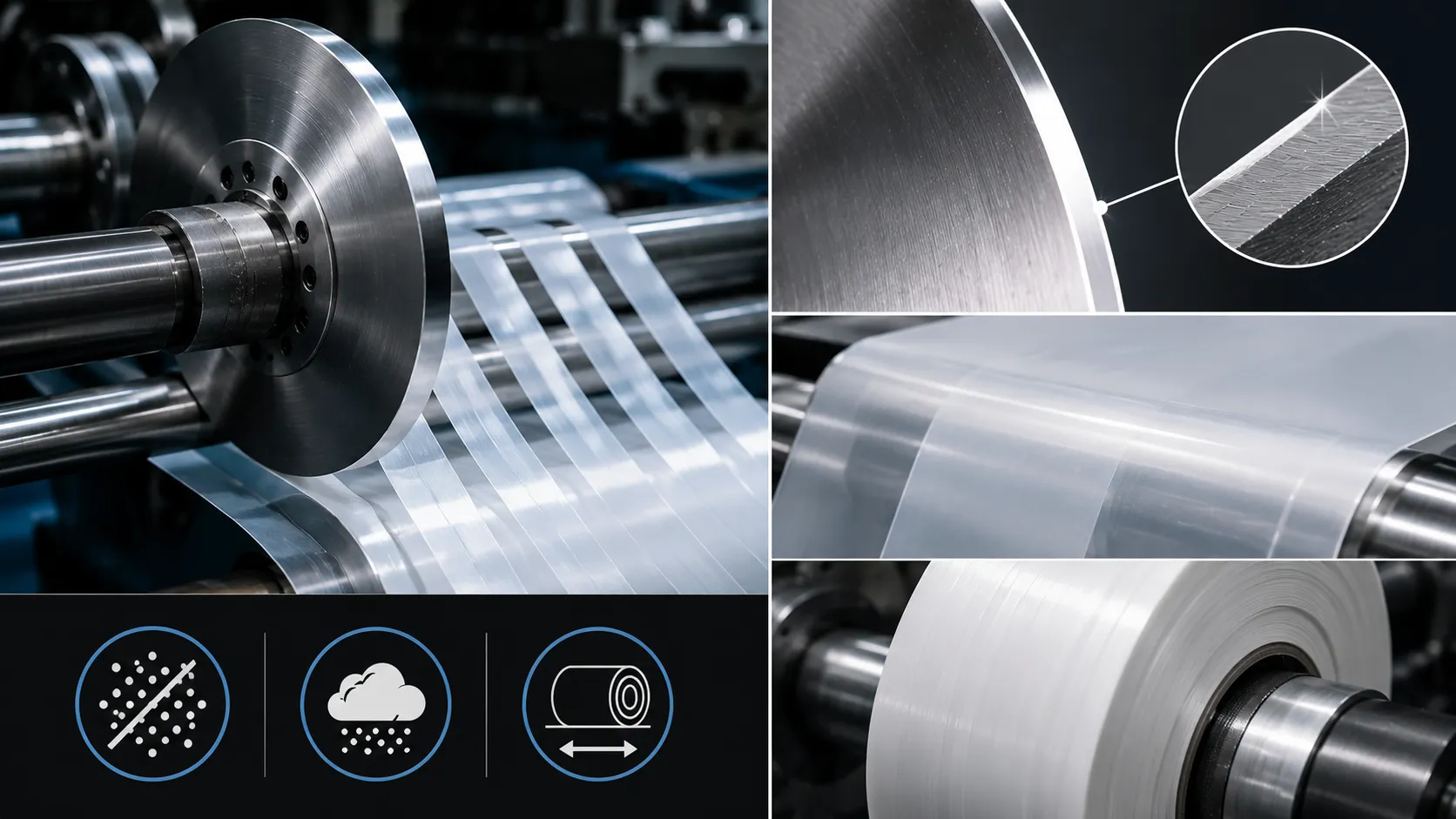
Mirror-Finish Ra 0.05 Burr-Free Shear Edge
- • Micro-ground edge profiles that eliminate stress points, tensile failure, and edge tearing
- • Near-zero dust generation meeting strict cleanroom and medical packaging standards
- • Smooth, parallel edge profiles ensuring uniform tension during high-speed roll rewinding
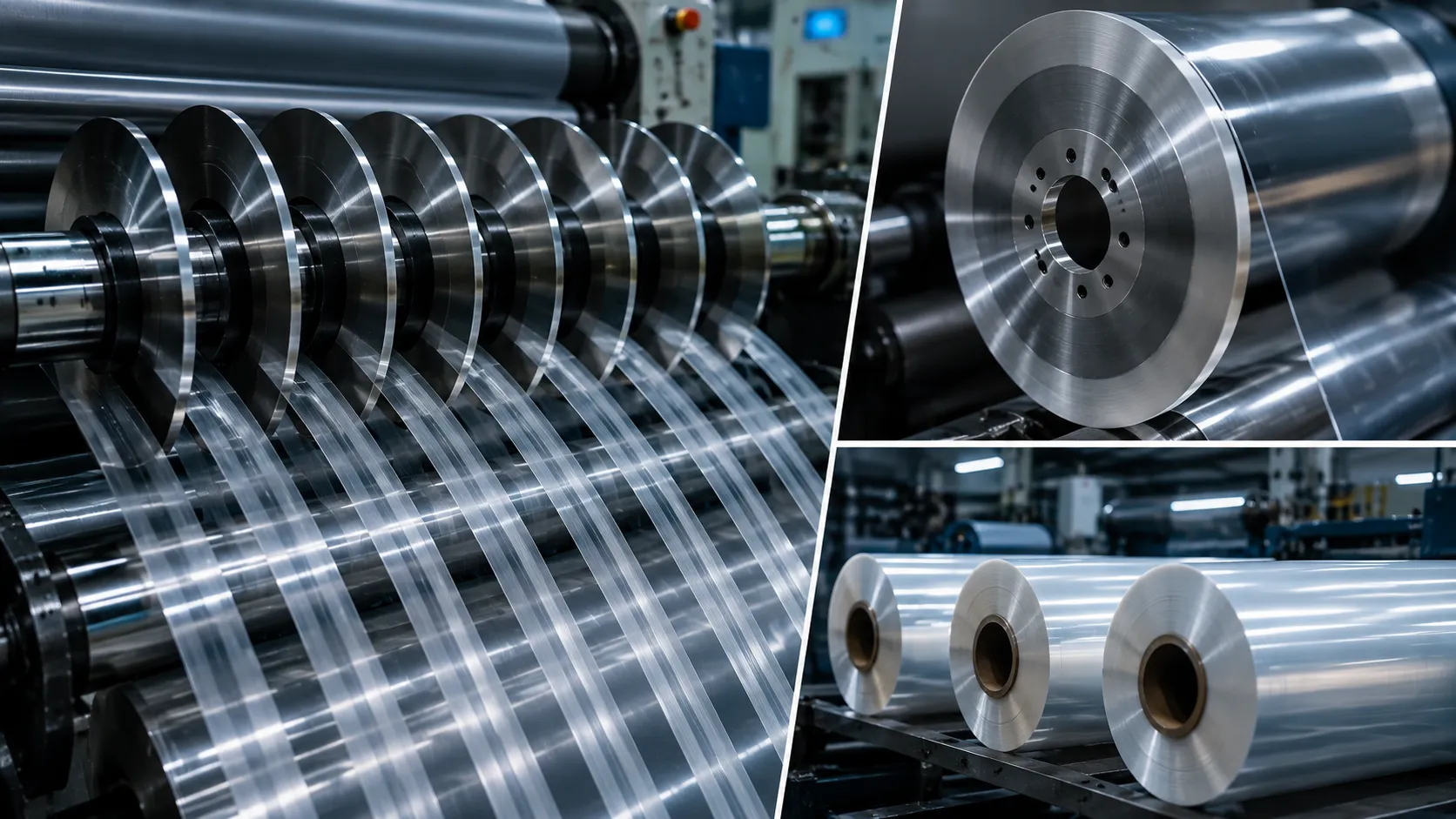
BOPP Film Cutting & High-Speed PET Slitting Blades
Biaxially oriented polypropylene (BOPP) and polyethylene terephthalate (PET) films exhibit exceptionally high tensile modulus and brittle fracture behavior. Lower-grade blades induce micro-cracks along the slit margin, leading to catastrophic web splits under high winding tension.
- ✓ Ultra-Flat Edge Geometry: Micro-ground cutting edges distribute shearing force evenly to eliminate stress focus points across high-speed BOPP film cutting operations.
- ✓ Advanced Wear Coatings: Specialty TiAlN, DLC, and ceramic surface treatments reduce resin adhesion and frictional heat build-up.
- ✓ High-Speed Shearing Stability: Precision PET slitting blades maintain sharpness and dimensional consistency at line speeds exceeding 1,000 m/min.
Flexible PE & PP Flexible Packaging Knives
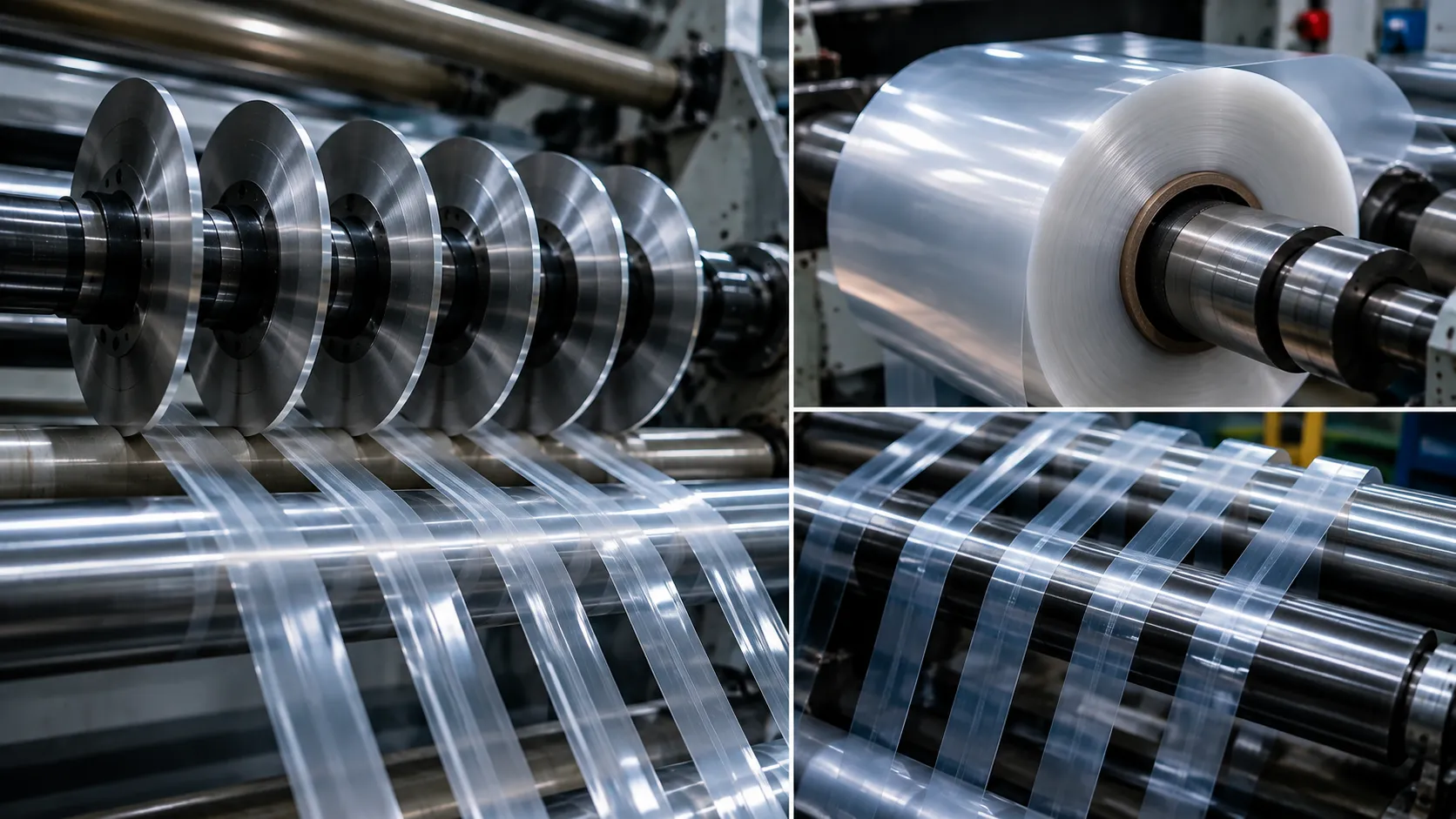
Low-density polyethylene (LDPE), LLDPE, and cast polypropylene (CPP) tend to stretch, yield, and form heavy beads when engaged by dull or improper blade angles. This results in edge necking, blade drag, and uneven roll profile formation across flexible packaging lines.
- ✓ Acute Double-Bevel Geometry: Sharp razor-slitting-knives cleanly slice elastic webs without causing localized material stretching.
- ✓ Low-Friction Surface Polish: Mirror-polished bevel faces prevent plastic film dragging, polymer buildup, and edge curling.
- ✓ Sustained Edge Retention: Carbide film blades deliver prolonged sharpness during continuous high-volume packaging converting.
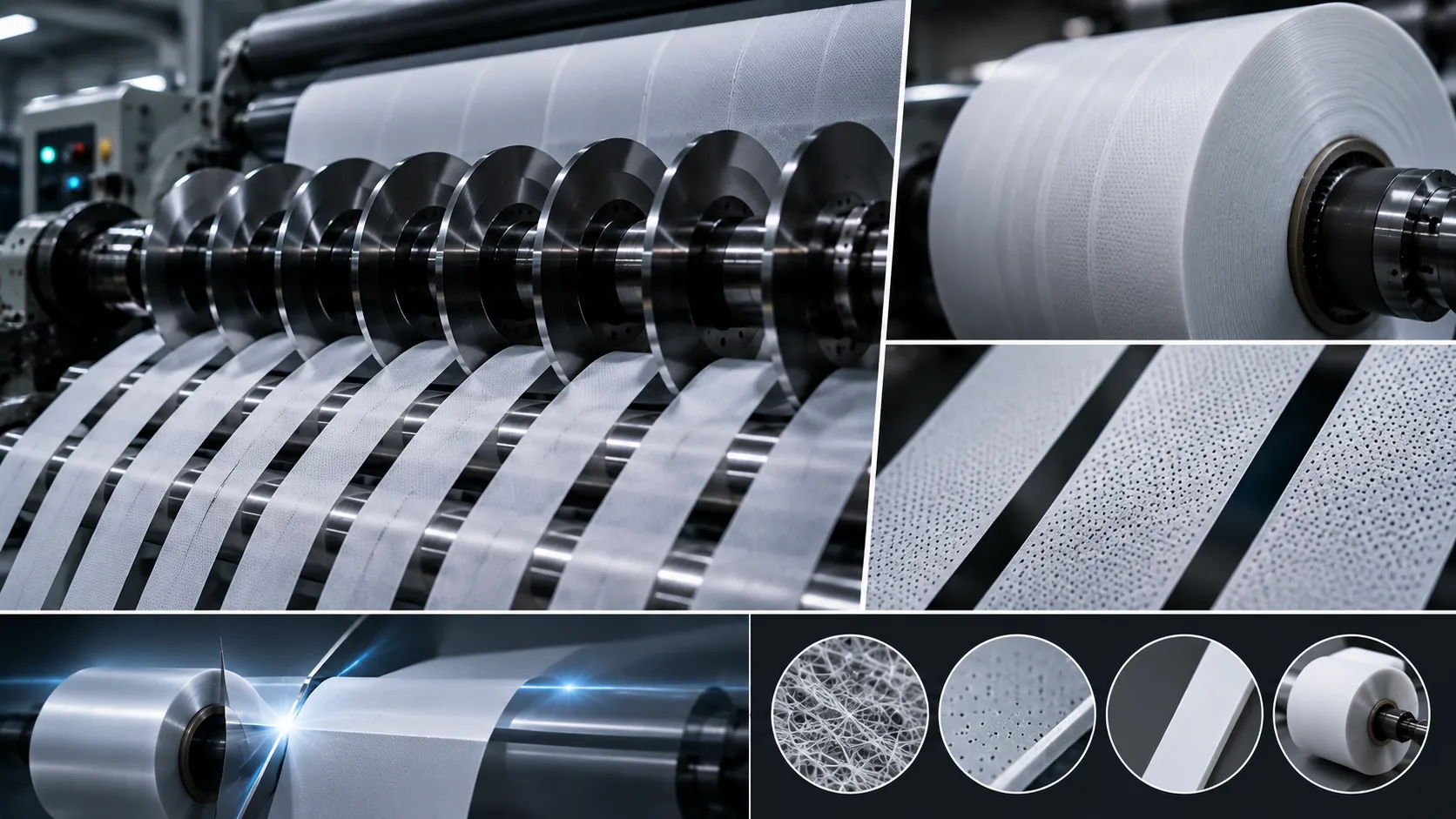
Lithium Battery Separators & Barrier Film Slitting
Battery separator membranes (PE/PP microporous) and multi-layer barrier laminates require zero particulate contamination during slitting. Microscopic blade debris can cause internal short circuits in energy storage cells or compromise sterility in pharmaceutical packaging.
- ✓ Dust-Free Mirror Polishing: Ground and lapped to Ra 0.05 to eliminate burrs and structural particulate shedding.
- ✓ Cleanroom Compatible Materials: Vacuum-heat-treated tungsten carbide and ceramic blades engineered for controlled environment processing.
- ✓ Exacting Shear Tolerances: Matched male and female shear-slitting-knives assemblies ensure crisp separation without foil or film delamination.
Optical & Ultra-Thin Specialty Film Slitting
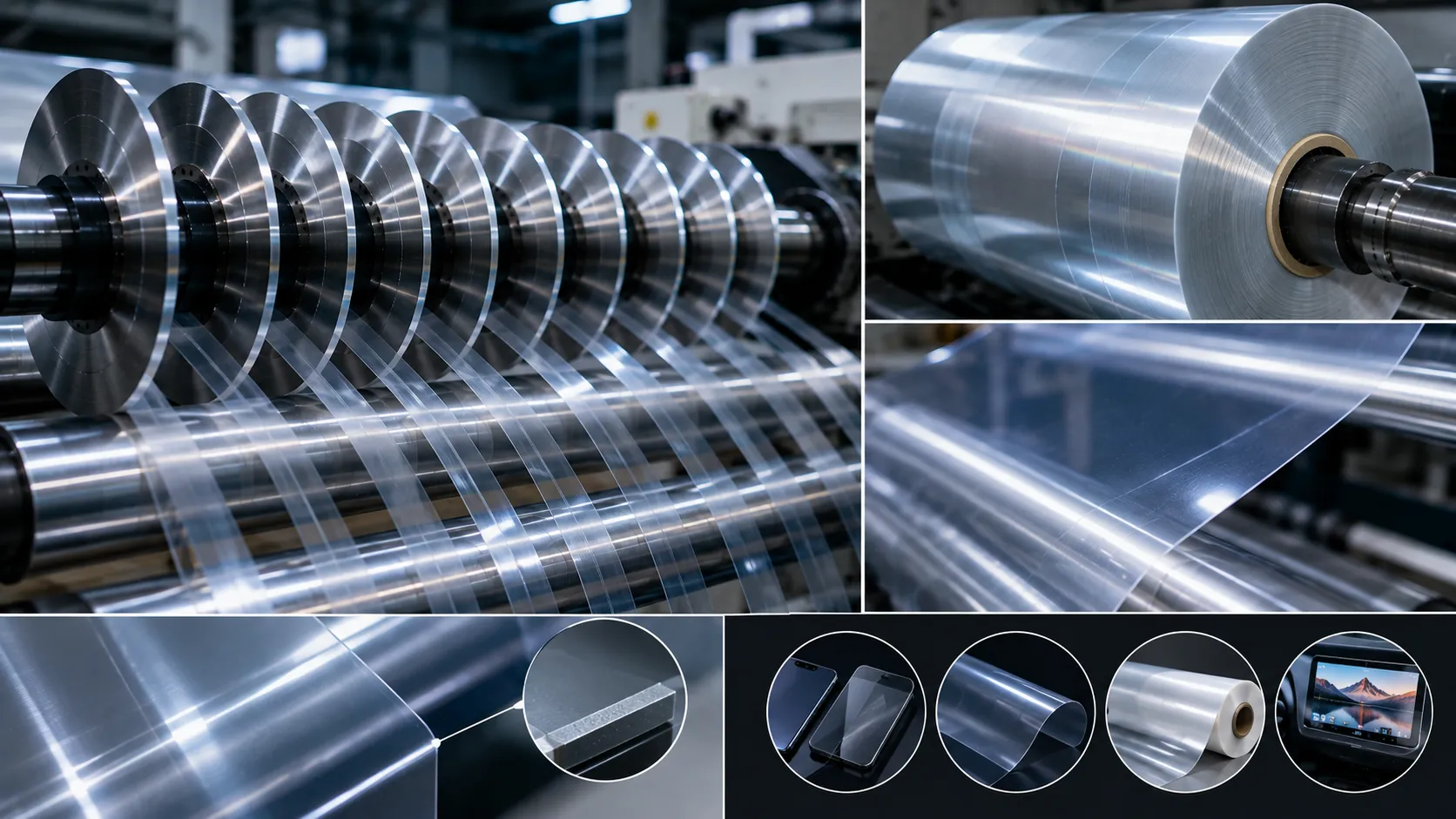
Optical-grade TAC, COP, PET release liners, and coated display films demand non-abrasive slitting solutions. Friction-induced static charges or thermal edge burnishing damage delicate functional coatings and destroy optical clarity.
- ✓ Micro-Ground Edge Precision: Eliminates surface scratching, static discharge, and edge micro-cracking on delicate functional coatings.
- ✓ Thermal-Dispersive Geometry: Optimized clearance angles prevent localized friction heating, web melting, and edge burnishing.
- ✓ Micron-Level Tolerance Control: Strict thickness and parallelism controls within ±0.002 mm guarantee flutter-free slitting performance.
Substrate & Blade Selection Matrix
Quick reference guide for converting engineers to match film resins with optimal blade configurations.
| Substrate Material | Primary Slitting Defect | Recommended Blade Type | Recommended Bevel & Finish | Target Hardness |
|---|---|---|---|---|
| BOPP / Rigid PET | Micro-cracks, tensile web breaks | 3-Hole Razor / Solid Carbide Circular Slitter | Double bevel 18°–22°, Ra 0.05 Mirror Finish | 89–92 HRA |
| PE / LLDPE / CPP | Film stretching, bead edges, necking | Acute Razor / Shear Slitting Blades | Single/Double acute 12°–15°, Anti-friction Polish | 62–65 HRC (HSS/D2) |
| Lithium Separators | Airborne polymer particles, contamination | Ultrafine Carbide Slitting Blades | Precision ground 20° edge, Ultra-Polished | 91–93 HRA |
| Optical TAC / COP | Surface scratches, static edge burnish | Ceramic-Coated Carbide Blades | Non-scratch bevel, TiAlN / Low-friction Coat | 92–94 HRA |
Need Custom Bevel Geometries or Specialized Coatings for Your Slitting Lines?
Drawing on decades of industrial knife engineering expertise, Sharkcutting provides custom edge radii, specialized bevel angles, and high-performance surface coatings tailored to your exact resin formulations. Upgrade your converting performance, maximize blade wear resistance, and maintain perfect edge quality across every roll.
Blade Precision Grinding & Quality Inspection Workflow
Sharkcutting manufacturing facilities strictly adhere to ISO quality management systems to guarantee unit-to-unit consistency. Guided by strict geometric tolerance verification, our multi-stage production process delivers high-durability reliability for enterprise B2B procurement across all our industrial machine knives.
Raw Material Spectrometry
Spectrometric analysis verifies raw tungsten carbide grade and high-alloy tool steel composition before machining begins.
Thermal & Cryogenic Processing
Vacuum heat treatment and deep cryogenic cooling relieve internal stress to enhance structural toughness and edge life.
Micro-Ground Edge Grinding
Precision blade precision grinding on multi-axis German CNC equipment crafts a micro-ground cutting edge down to Ra 0.05, ideal for high-precision razor slitting knives.
Full Quality Inspection
Every blade undergoes 100% optical quality inspection and CMM dimensional profiling before protective packaging.
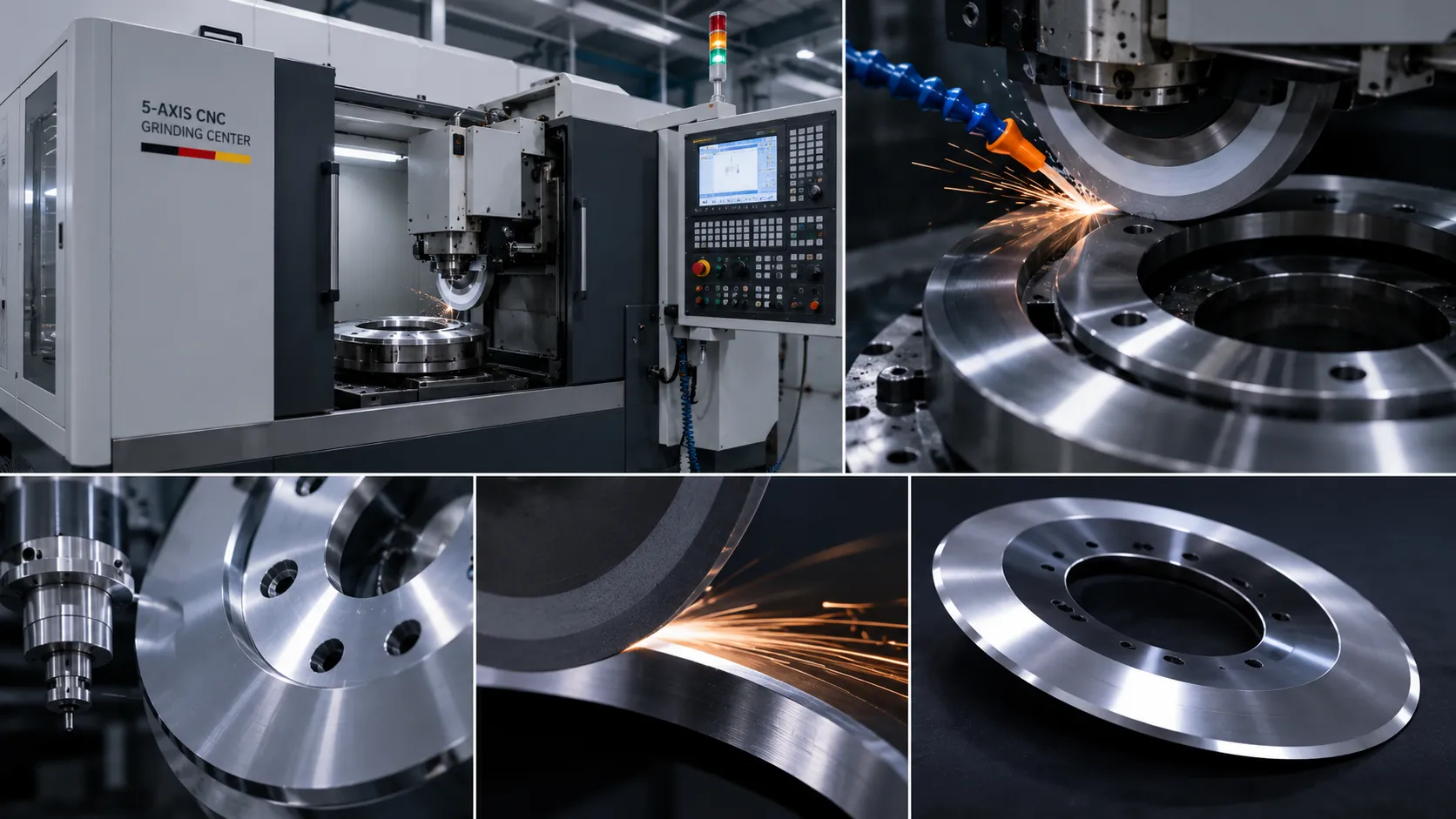
Advanced German CNC Grinding
Utilizing German multi-axis CNC technology, Sharkcutting crafts every micro-ground cutting edge to eliminate film dusting, prevent edge fraying, and maintain peak slitting performance across heavy-duty paper cutting knives.
ISO Quality Management Systems
Strict geometric tolerance verification guarantees exact repeatable accuracy, reducing production line downtime and knife replacement frequency for global converters.
Custom Film Knives and Precision OEM Slitting Blades
Sharkcutting delivers end-to-end industrial knife customization for high-speed film converting lines, flexible packaging plants, and slitter rewinder OEM manufacturers. From initial CAD drawing appraisals and substrate metallurgy selection to rapid prototype batching and volume delivery, our custom film knives and specialized slitting knives are engineered to eliminate edge dusting, prevent polymer stretching, and maximize blade wear life across continuous slitting operations.
Reverse Engineering and CAD Specification Matching
Whether upgrading existing slitting machinery or sourcing replacement tooling for legacy equipment, our engineering team manufactures high-precision OEM slitting blades to exact machine prints or physical worn samples. We provide direct-fit replacement blades, including custom shear slitting knives, engineered for leading converting machinery brands including Kampf, Atlas Converting, Titan, Dusenbery, Ashe, and Goebel.
- ✓ CAD Integration: Native processing of .DWG, .DXF, .STEP, and .IGES file formats with full geometric verification.
- ✓ Sample Reverse Engineering: Coordinate optical profiling and spectrographic alloy analysis of original customer blades.
- ✓ Private Labeling & Serialization: High-precision laser etching for custom part numbering, OEM branding, and batch traceability.
Customizable Parameters and Surface Metallurgy
Configure blade geometries, such as ultra-sharp razor slitting knives, and wear-resistant coatings to eliminate specific converting issues such as polymer tensile distortion, static adhesive drag, and particulate buildup.
| Parameter | Custom Options & Capabilities |
|---|---|
| Dimensions & Tolerances | Outer diameters up to 500 mm, thickness down to 0.10 mm, dimensional tolerances held to ±0.002 mm. |
| Bevel Profiles | Single bevel, double bevel, asymmetric compound angles, hollow ground faces, and micro-honed edges. |
| Mounting Features | Precision drive keyways, locating pin holes, specialized bore chamfers, and countersunk mounting slots. |
| Specialty Coatings | PTFE anti-stick, TiN (Titanium Nitride), TiAlN, DLC (Diamond-Like Carbon), and CrN (Chromium Nitride). |
| Substrate Alloys | Submicron solid tungsten carbide, M2/D2 High-Speed Steel, Powder Metallurgy PM steels, and zirconia ceramic. |
Service Level Agreement and Rapid Production Workflow
Sharkcutting utilizes a structured OEM/ODM manufacturing workflow designed to eliminate lead-time bottlenecks and accelerate line validation for high-speed converting machinery.
CAD drawing review, metallurgy evaluation, and comprehensive technical quotation.
Rapid tooling prototyping and sample fabrication for pilot line trial runs.
Full-scale batch manufacturing, safety stock inventory programs, and worldwide freight.
Need a Custom Slitting Blade for Your Production Line?
Send us your CAD drawing, worn blade sample, machine model, or cutting requirements. Our engineering team will evaluate blade geometry, material grade, edge profile, and coating options for your application.
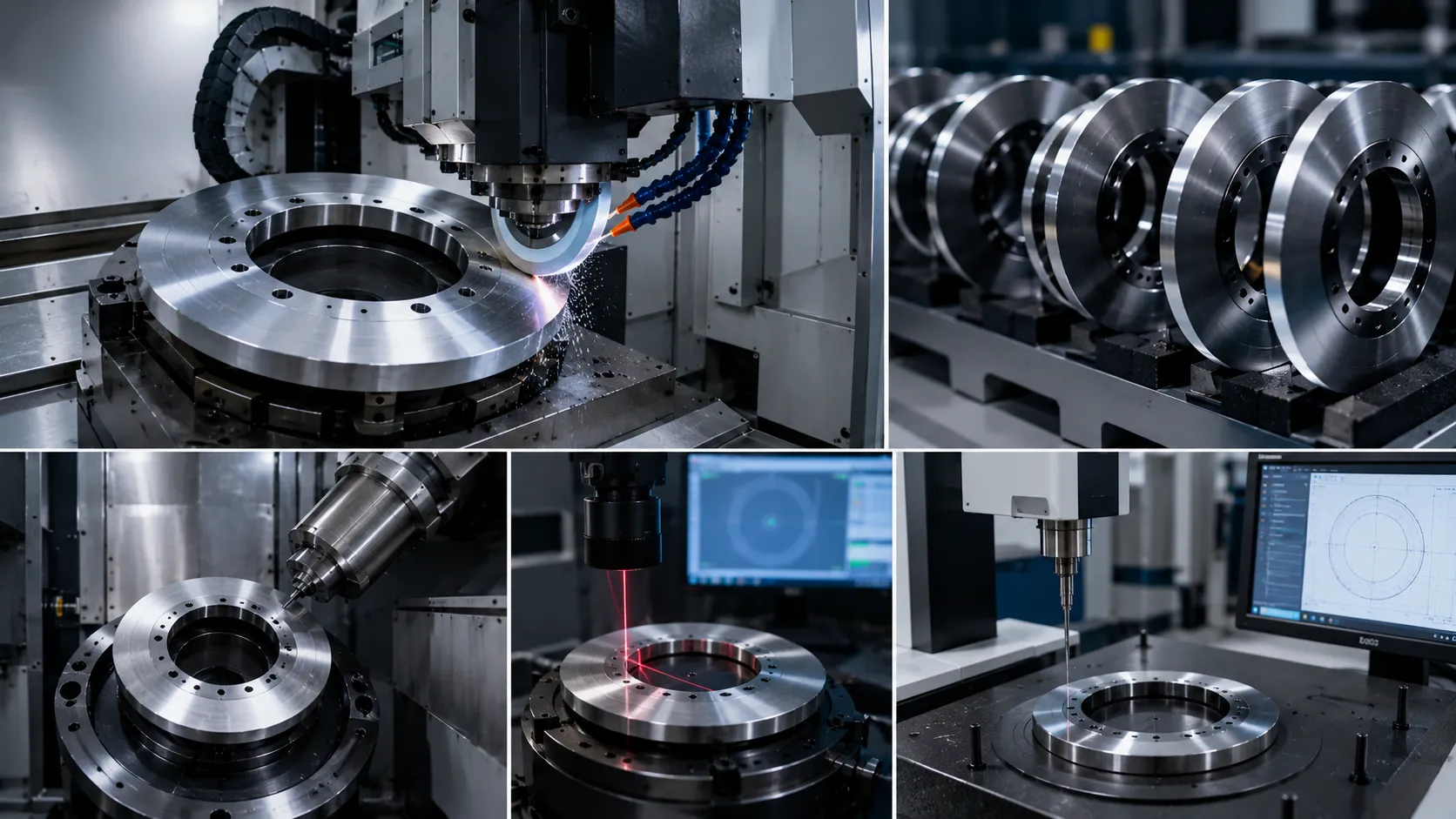
Micro-Ground Edge Precision
Every custom blade undergoes multi-axis CNC grinding to deliver mirror surface finishes down to Ra 0.05. This eliminates micro-serrations, drastically lowers web friction, and prevents edge fraying during high-speed BOPP, PET, and metallized film conversion.
Engineered Carbide Metallurgy
We formulate premium submicron tungsten carbide specifically balanced for polymer shear dynamics. By pairing high hardness (up to 92 HRA) with superior edge retention, Sharkcutting carbide film blades deliver 30%+ extended operational lifespans between changeovers.
Full Quality Assurance & CMM Inspection
Every production batch undergoes 100% dimensional, axial runout, and concentricity verification using high-magnification optical comparators and CMM equipment. Strict ISO compliance ensures flawless drop-in fitment for every repeat order.
Film Slitting Troubleshooting & Technical FAQ
Resolve complex flexible film converting issues, maximize blade wear resistance, and dramatically extend slitter knife lifetime with expert technical guidance from the application engineering team at Sharkcutting. Explore our full range of high-performance slitting knives for custom converting solutions.
How can I eliminate film dusting, flaking, and edge fraying during high-speed BOPP slitting?
Edge micro-chipping on standard tool steel blades is the primary cause of polymer film dusting, edge fraying, and static flaking. During high-speed BOPP, PET, and barrier web converting, friction and abrasive mineral fillers degrade low-grade cutting edges. This creates micro-serrations that tear polymer chains rather than shearing them cleanly.
Recommended Film Slitting Troubleshooting Steps:
- Switch to Ra 0.05 Mirror-Ground Facets: Micro-ground polished bevel facets reduce friction, prevent resin build-up, and lower static generation, eliminating polymer drag.
- Upgrade to Solid Tungsten Carbide Film Blades: Sub-micron carbide grades (88–92 HRA) maintain ultra-sharp cutting geometries up to 30 times longer than conventional carbon or stainless steel tool blades.
- Optimize Bevel Profile & Angle Geometry: Transitioning to acute double-bevel profiles (18°–22°) balances cutting pressure evenly across both sides of the slit channel.
- Control Lateral Clearance & Cant Angle: Maintain precise lateral blade clearances under 0.002 mm to prevent web deformation or pinched, frayed film edges.
When should I choose Solid Tungsten Carbide over High-Speed Steel (HSS) film blades?
Deciding between solid tungsten carbide film blades and high-speed steel (HSS/M2/D2) requires analyzing continuous operational run times, web abrasiveness, machine shaft rigidity, and total cost of ownership (TCO).
| Technical Metric | Solid Tungsten Carbide Blades | High-Speed Steel (HSS / D2) |
|---|---|---|
| Hardness Rating | 88 – 92 HRA (Extreme hardness) | 62 – 65 HRC (High toughness) |
| Blade Wear Resistance | 10x to 30x slitter knife lifetime | Standard operational baseline |
| Best Substrate Suitability | BOPP, PET, lithium battery separators, rigid optical films | Thick PE laminates, heavy foil packaging, flexible vinyls |
| Impact & Shock Resistance | Moderate (Requires rigid, low-runout arbors) | High impact shock tolerance |
Engineering Verdict: Choose Solid Carbide for long continuous production runs on abrasive thin-film materials where downtime and blade replacement costs far exceed tooling expenditure. Choose HSS for converting lines with mechanical shaft vibration, heavy foil-laminated stocks, or frequent job changes.
How does adjusting bevel angles affect slitter knife lifetime and cut quality?
Bevel angle geometry dictates shear forces, frictional heat buildup, and cutting edge stability. Matching blade geometry directly to substrate ductility prevents material stretching, necking, and premature blade dulling:
- Ductile & Elastic Polymer Films (PE, LLDPE, EVA): Require narrow, acute bevel angles (14° to 18°). Premium razor slitting knives with acute angles slice elastic webs cleanly without stretching or creating rolled edge profiles.
- Abrasive & Rigid Films (PET, BOPP, Optical Polyimides): Benefit from compound double-bevel designs (such as an 18° primary bevel with a 24° micro-bevel). This structural backing reinforces blade wear resistance against micro-chipping.
- Single vs. Double Bevel Shear Mechanics: Single bevel knives create a flat reference cut on one side of the slit line (ideal for score slitting), while double bevel blades distribute lateral forces symmetrically to maximize slitter knife lifetime when utilizing high-precision shear slitting knives.
What are the minimum order quantities (MOQs) and production lead times for custom film knives?
Sharkcutting works directly with OEM equipment builders and flexible packaging converters to manufacture custom film cutting knives tailored to exact mechanical specifications and machine brands (e.g., Kampf, Atlas, Titan, Dusenbery, Goebel).
CAD engineering & steel alloy selection
MOQs as low as 10–25 pieces
Full batch production & 100% QC inspection
Expedited production programs are available for processing plants experiencing emergency shutdowns or commissioning urgent OEM machine slitting retrofits.
Are trial sample blades available for testing on our production converting lines?
Yes. Sharkcutting provides sample trial sets to qualified flexible packaging plants, film extruders, and OEM machinery integrators seeking to benchmark edge quality, dust reduction, and blade longevity.
Sample Testing Protocol: Provide our engineering team with your substrate details, web gauge, target line speed, and current knife dimensions. Our metallurgists will recommend or custom-grind sample sets of thin-film slitting blades or circular cutters for live evaluation on your slitter-rewinders.
Ready to Improve Film Slitting Precision and Extend Blade Life?
Send us your blade drawings, worn samples, machine model, or cutting requirements. Sharkcutting engineers will evaluate the optimal blade geometry, material, edge profile, and coating for your film converting line.
Drawings, STEP/DXF files and physical samples accepted.