

Why Standard Blades Fail in Modern Plastic Recycling Lines
If your recycling line keeps stalling out for premature knife changes, the culprit usually comes down to mismatched shredder blade material. Off-the-shelf industrial knives simply are not built for the punishing mix of contaminants, heat, and heavy torque found in modern size-reduction lines. When we troubleshoot failing rotor fly knives and bed stator blades on the shop floor, the root cause almost always traces back to three failure modes.
Abrasive Wear vs. Thermal Friction
Post-consumer polymers, dirty film reclaim, and municipal waste carry grit and abrasives that act like sandpaper on standard cutting edges. At the same time, high-speed granulation builds up intense localized heat at the cutting zone.
- Rapid Edge Rounding: Abrasive contaminants quickly strip away the keen bevel on standard steel alloys, turning a clean shear into a blunt tear.
- Thermal Softening: Without proper red hardness and thermal edge stability, high-friction loads overheat inferior steels, softening the cutting edge and accelerating wear.
Mechanical Shock and Contaminant Impact
Real-world waste streams are unpredictable. Even with upstream sorting, unexpected contaminants like dense purge lumps, thick-walled pipes, or stray metal in electronic scrap still enter the cutting chamber.
- Micro-Chipping: Standard high-hardness alloys that lack core fracture toughness develop jagged micro-chips along the cutting bevel upon impact.
- Catastrophic Blade Fracturing: When an overly brittle plastic shredder blade material absorbs a severe shock load, the blade can snap outright—causing dangerous downtime and damaging adjacent rotor seats or stator beds.
Downstream Consequences of Dull Edges
Running blades past their prime does more than slow down throughput; it degrades your final regrind and strains your machinery:
- Increased Drive-Motor Power Draw: Blunt knives force your motors to work harder to tear through material instead of slicing cleanly, spiking amp draw and energy costs.
- Excessive Dust and Fines: Instead of uniform, burr-free cuts, worn rotor-to-stator clearances pulverize the plastic, driving up unusable fines and dust.
- Smeared Polymer Edges: Excess friction from dull blades melts thin films and plastics along the cut line, causing clumping and screen blinding inside the granulator.
Breakdown of Top Shredder Blade Materials by Alloy and Hardness
Choosing the right shredder blade material comes down to balancing edge wear against impact shock. When we manufacture knives for global recycling plants, we match four proven metallurgical grades to the exact mechanical stress inside your cutting chamber.
D2 / SKD11 and Modified D2 (Cr12MoV) Cold Work Tool Steel (58–62 HRC)
If you are running clean post-industrial scrap or rigid containers, high-carbon, high-chromium tool steels are the industry benchmark. D2, SKD11, and Modified D2 (Cr12MoV) deliver deep hardenability, strong compressive strength, and reliable edge retention across long production runs.
Best Applications: Rigid plastic granulators (HDPE, PP, PVC), PET bottle shredding lines, and clean regrind operations.
Shop-Floor Advantage: Delivers up to 3x longer service life compared to standard alloy steels while resisting micro-chipping on high-speed rotor and stator sets.
S7 Shock-Resistant Tool Steel (54–58 HRC)
When dense chunks or unexpected contaminants hit the cutting chamber, overly hard blades snap. We use S7 shock-resistant tool steel when maximum impact energy absorption and fracture toughness matter more than pure abrasion resistance.
Best Applications: Heavy-duty single-shaft shredder teeth, thick-walled pipe crushers, and rigid purge or lump reduction.
Shop-Floor Advantage: Prevents catastrophic blade fracturing and large edge breakouts under sudden shock loads.
55SiCr and Hardfaced Alloy Steel
Low-speed, high-torque shredders put massive twisting and bending forces on the blade body. Pairing an anti-cracking 55SiCr or alloy steel core with a wear-resistant cutting edge gives you structural durability without sacrificing bite.
Best Applications: Twin-shaft and quad-shaft shredder block teeth processing bulky municipal solid waste, tires, and mixed commercial scrap.
Shop-Floor Advantage: Keeps the blade core from cracking under extreme torque while maintaining a tough, rebuildable cutting profile.
High-Chrome Carbide Inlaid and Solid Tungsten Carbide (88–92 HRA)
When abrasive fillers or ultra-thin films round off tool steel in hours, carbide is the clear upgrade. Both solid tungsten carbide and high-chrome carbide inlaid blades offer extreme hardness and surface stability. For a closer look at how tooth geometry pairs with these alloys, check out our guide on plastic shredder blade design for high performance.
Best Applications: High-speed thin film and sheet granulation, abrasive glass-fiber-reinforced polymers, and precision pelletizing lines.
Shop-Floor Advantage: Extends blade lifespan up to 10x over conventional tool steels and produces clean shear cuts with minimal dust and fines.
Plastic Shredder Blade Material Selection Matrix
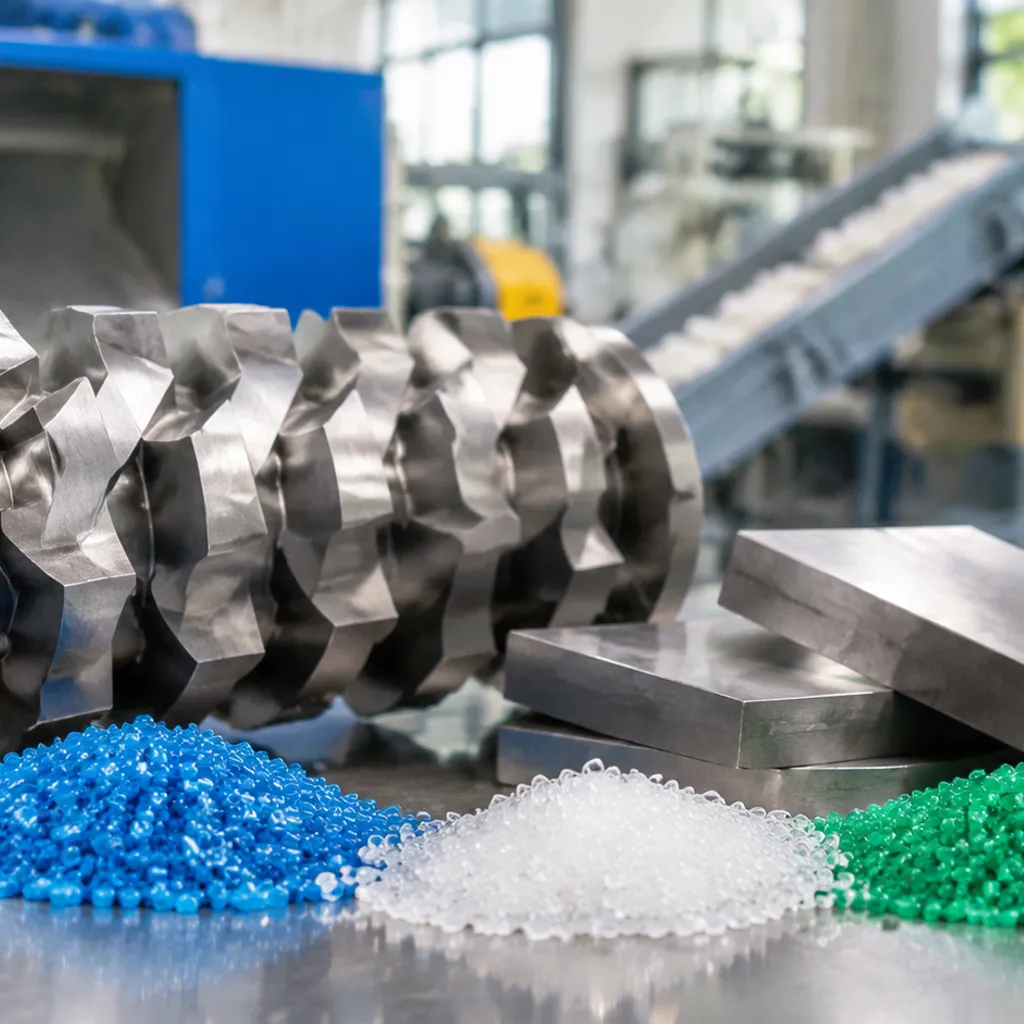
Selecting the right plastic shredder blade material comes down to matching the metal's toughness and wear resistance to what you are actually feeding into the hopper. I always recommend looking at the specific feedstock first so you don't end up with shattered edges on heavy purgings or premature dulling on abrasive films.
| Shredding / Recycling Feedstock | Recommended Shredder Blade Material | Hardness Range | Primary Shop-Floor Benefit |
|---|---|---|---|
| PET Bottles & Rigid Containers | D2 / SKD11 / Modified D2 (Cr12MoV) | 58–62 HRC | Delivers up to 3x extended wear life with strong chipping resistance |
| Thin Film, Stretch Wrap & Sheet Granulation | High-Cr Carbide Inlaid / Solid Tungsten Carbide | 88–92 HRA | Extends blade lifespan up to 10x while maintaining clean shear cuts with minimal fines |
| Thick Purge Lumps, Heavy Pipe & Contaminant-Prone Waste | S7 Shock-Resistant Tool Steel | 54–58 HRC | Maximizes impact absorption to prevent catastrophic blade fracturing |
| Bulky Mixed Waste & High-Torque Destruction | 55SiCr / Hardfaced Alloy Steel | 54–58 HRC Core | Provides anti-cracking structural integrity under extreme rotational torque |
Quick Takeaways for Your Line
- Prioritize abrasion resistance for clean, high-speed runs: When running thin films or clean PET bottles, harder grades like D2 tool steel or carbide inlays hold a keen edge longer, keeping fines low and motor amp draw steady.
- Prioritize impact toughness for unpredictable scrap: If your line regularly hits thick purge lumps, heavy-walled pipes, or stray metal contaminants, stepping down slightly in hardness to S7 or hardfaced 55SiCr protects your rotor from expensive, sudden fractures.
- Source matched sets for consistent gaps: Pairing the right alloy with durable plastic shredder blade sets engineered to exact tolerances keeps your rotor-to-stator clearance tight across every shift.
Matching Shredder Blade Material to Machine Configuration
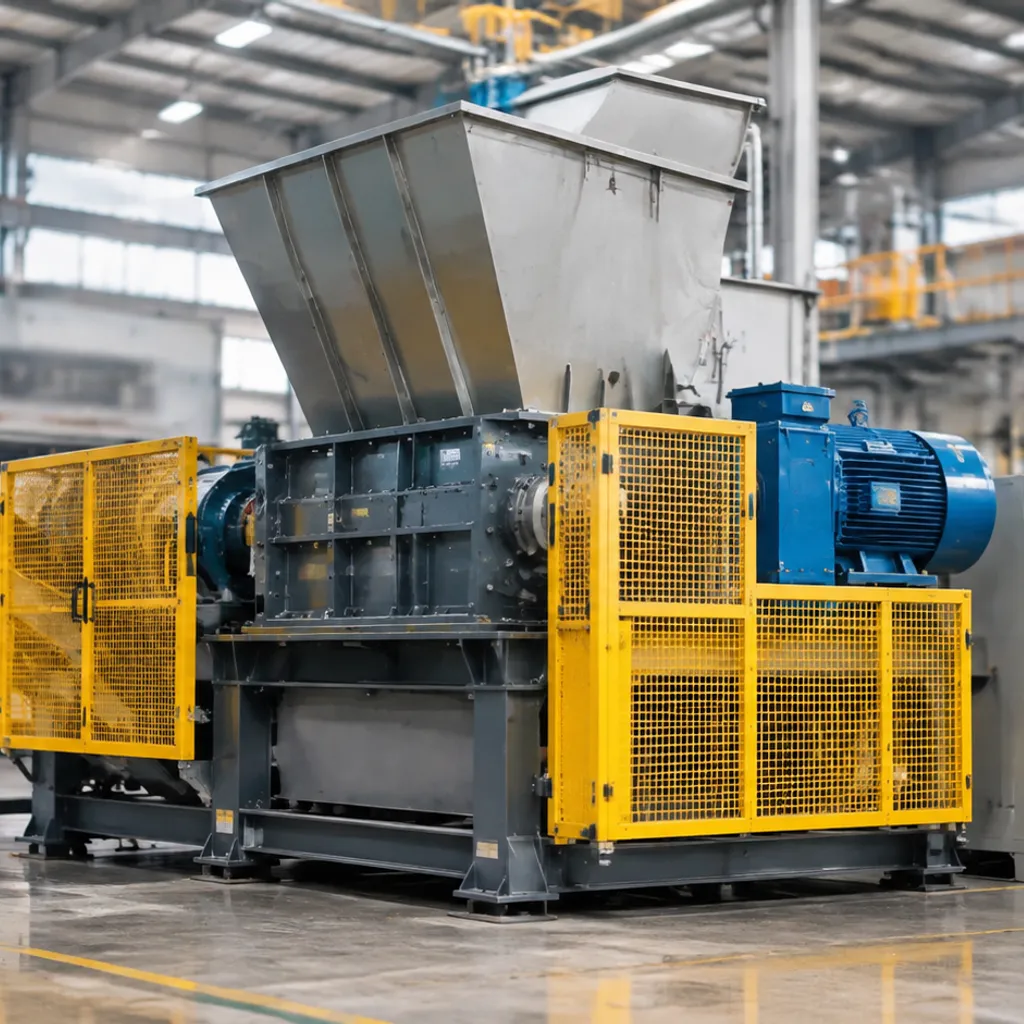
Even the best alloy on paper will fail fast if you put it into the wrong machine setup. On the shop floor, the biggest mistake I see buyers make is treating low-speed shredders and high-speed granulators the same way. Picking the right shredder blade material comes down to how your machine applies force to the plastic.
Single-Shaft, Twin-Shaft & Quad-Shaft Shredders
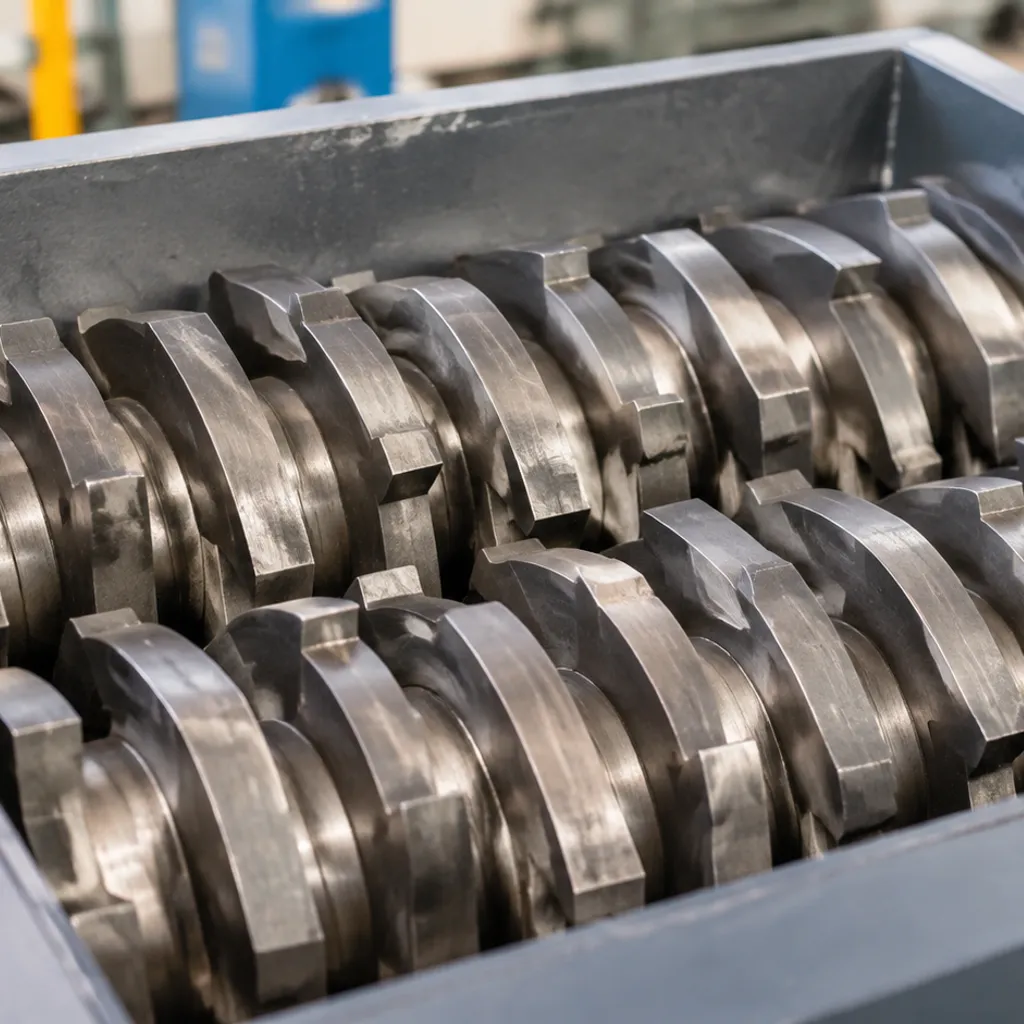
Low-RPM, high-torque shredders rely on brute tearing and shearing force rather than high-speed slicing. When your rotor hits a dense purge lump or hidden tramp metal at low speeds, the shock load goes straight into the blade body.
- Prioritize core toughness over max hardness: Pushing Rockwell hardness too high here invites catastrophic blade fracturing and snapped teeth.
- Best alloys for the job: Use 55SiCr alloy steel (often paired with hardfacing on the cutting teeth) or S7 shock-resistant tool steel (54–58 HRC).
- Why they win: Both grades absorb massive impact energy and deliver anti-cracking stability across single-shaft shredder blades and heavy block teeth on double-shaft shredder blades without shattering under torque spikes.
High-Speed Granulators & Crushers
High-RPM granulators and heavy-duty crushers use a rapid scissor-action between rotor fly knives and bed stator blades. Here, speed generates intense localized friction, and tight rotor-to-stator clearances are non-negotiable for clean cuts.
- Prioritize compressive strength and edge stability: If a blade edge rolls or expands slightly under heat, you get smeared plastic, dust, and motor amp spikes.
- Best alloys for the job: Step up to D2 / SKD11 cold work tool steel (58–62 HRC) for rigid plastics, or High-Chrome Carbide Inlaid / Solid Tungsten Carbide (88–92 HRA) for thin film and abrasive polymers.
- Why they win: These grades hold tight dimensional stability and keen cutting bevels at high speeds, giving your plastic crusher machine blades up to 3x to 10x longer wear life with minimal fines.
Beyond Raw Steel: How Manufacturing Quality Dictates Shredder Blade Lifespan
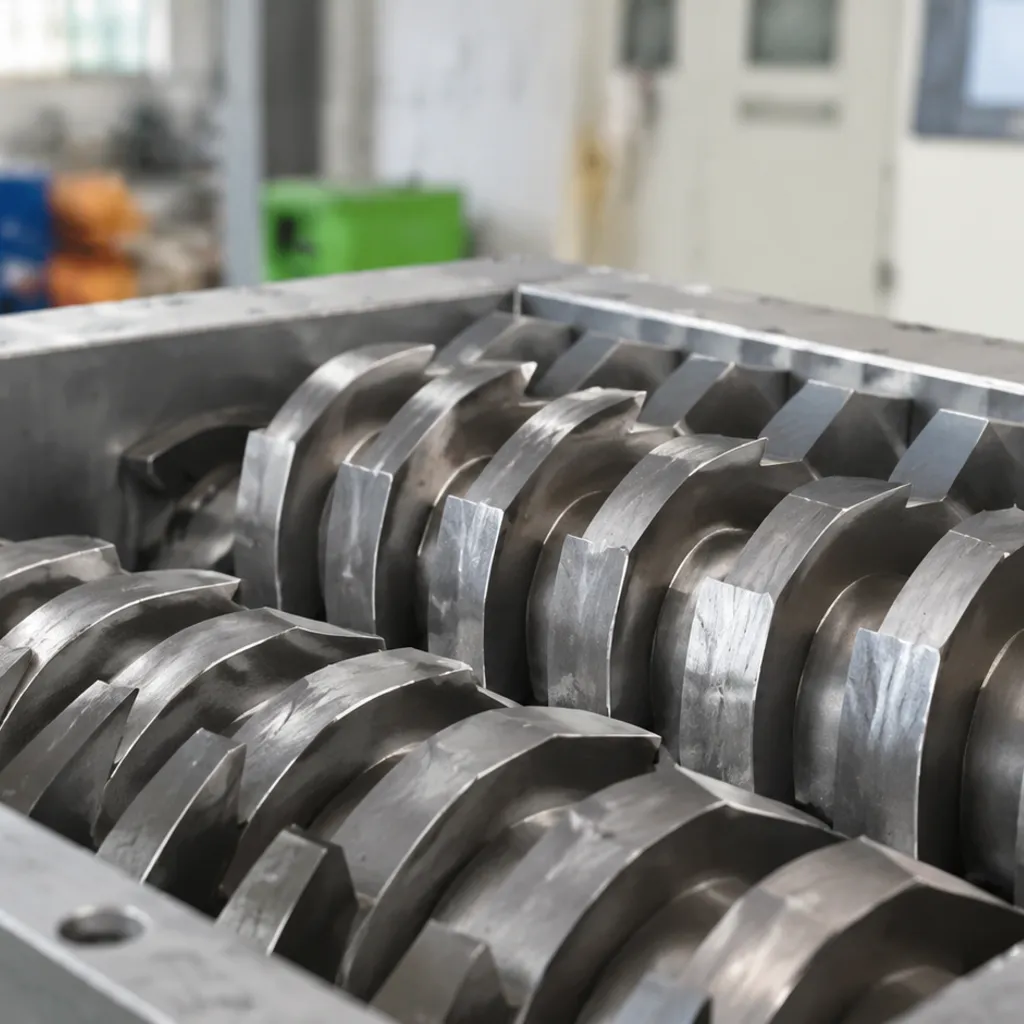
Vacuum Heat Treatment & Deep Cryogenic Stress Relief
Standard atmosphere furnaces leave a soft, carbon-depleted skin on tool steel that rounds off within hours of startup. In our shop, we eliminate that risk using controlled metallurgical processing:
- Precision Vacuum Heat Treatment: Hardens the shredder blade material in an oxygen-free chamber to prevent decarburization and surface scaling, locking in full working hardness right at the cutting edge.
- Deep Cryogenic Stress Relief: Sub-zero cooling converts unstable retained austenite into dense, uniform martensite. This refines the grain structure so every blade in a multi-knife rotor wears at the exact same rate.
Differential Core-to-Edge Engineering
A great recycling knife needs two opposing traits at once: a tough body that flexes under shock and a razor-keen edge that resists abrasion. We achieve this by pairing high-shock-absorbent steel cores with custom shredder blade design and geometry tailored to your specific feedstock—whether you are slicing stretchy film, rigid HDPE, or dense purge lumps.
Precision CNC Grinding & Tight Rotor-Stator Clearances
In high-speed granulators and shredders, gap control dictates cut quality and energy consumption. Multi-axis CNC grinding holds dimensional tolerances within ±0.001 mm to ±0.002 mm, backed by 100% Rockwell hardness and dimensional inspection before any blade ships.
| Manufacturing Step | Shop-Floor Specification | Operational Benefit on Your Line |
|---|---|---|
| Vacuum Hardening | Oxygen-free thermal cycle | Eliminates soft outer skin and prevents early edge rolling |
| Cryogenic Treatment | Deep sub-zero stress relief | Creates uniform grain density for predictable, even wear |
| CNC Surface Grinding | ±0.001 mm to ±0.002 mm tolerance | Maintains tight rotor-stator gaps, cutting dust, fines, and motor amp draw |
| 100% QC Verification | Full dimensional & Rockwell testing | Guarantees balanced rotor loads with zero vibration or fitment issues |
How to Source Custom & OEM Replacement Shredder Blades
Buying the cheapest set of knives off a catalog sheet usually ends up being the most expensive move on the shop floor. When we help plant managers evaluate shredder blade material and supplier options, the real metric isn't the sticker price on the invoice—it's what every processed ton costs your operation.
Evaluating True Cost-Per-Ton
A lower-grade steel blade might save 20% upfront, but if it forces your maintenance crew to pull the rotor shaft twice as often, your margins vanish fast. Before locking in a supplier for plastic shredder blade material, run the numbers against your actual line output:
- Total Blade Investment: Initial purchase price plus shipping and duties.
- Regrind & Swap Labor: Technician hours spent tearing down the cutting chamber, resetting rotor-stator gaps, and re-torquing bolts.
- Unplanned Downtime: Lost production revenue every hour the line sits idle waiting on a blade change.
- Total Tonnage Processed: Divide your combined blade and maintenance costs by the total tons run before the knives hit their minimum regrind limit.
Upgrading from standard stock to properly heat-treated D2 or carbide-inlaid alloys often cuts cost-per-ton in half simply by stretching out maintenance intervals and keeping drive-motor amp draw steady.
Custom Engineering & Reverse Engineering with Sharkcutting
You shouldn't have to settle for off-the-shelf OEM specs if your feedstock is chewing through standard factory knives. At Sharkcutting, we manufacture direct OEM replacements and custom-engineered upgrades tailored to your exact machine model and material stream.
- Print-to-Part Precision: Send over your DWG or 3D CAD blueprints, and we match every bore, keyway, and bevel angle to ±0.001 mm – ±0.002 mm tolerances.
- CMM Reverse Engineering: Missing original drawings? Ship us a worn physical sample. Our metrology team maps the exact geometry using coordinate measuring machines (CMM) to build accurate custom OEM replacement shredder blades with improved metallurgy.
- Verified Quality & Turnaround: Every batch undergoes ISO 9001 quality control, including 100% dimensional checks and Rockwell hardness testing, backed by a 100% fit guarantee and 24-hour direct factory quotes.
Frequently Asked Questions About Shredder Blade Materials
What is the best HRC hardness for plastic shredder blades?
There is no single "best" Rockwell hardness—it comes down to whether your line is fighting impact or abrasion. In my experience helping plants troubleshoot premature edge failure, picking the wrong hardness zone is the quickest way to burn through your maintenance budget.
| Hardness Zone | Recommended Alloy | Best Application | Primary Benefit |
|---|---|---|---|
| 54–58 HRC (Impact Zone) | S7 Shock-Resistant Steel, 55SiCr | Heavy purge lumps, thick pipe, high-torque shredders | Absorbs heavy shock without chipping or cracking |
| 58–62 HRC (Wear Zone) | D2 / SKD11, Modified D2 (Cr12MoV) | Clean rigid plastics (HDPE, PP, PVC), PET bottles | High compressive strength and up to 3x longer edge life |
If your operators are constantly pulling chunks of dense purge or tramp contaminants out of the hopper, stay in the 54–58 HRC impact zone. If your feedstock is sorted and clean, step up to 58–62 HRC so you aren't pulling knives for resharpening every other shift.
D2 vs. S7 steel: Which should I choose for contaminated plastic waste?
Go with S7 shock-resistant tool steel whenever your plastic waste stream contains unpredictable contaminants. While OEM D2/SKD11 industrial shredder knife blades deliver unbeatable wear resistance on clean post-industrial scrap, that higher hardness makes D2 more vulnerable to edge chipping if a stray bolt or dense purge lump hits the rotor at speed.
S7 is engineered specifically for fracture toughness at 54–58 HRC. When a heavy contaminant strikes an S7 cutting edge, the steel absorbs the impact energy rather than snapping—saving you from catastrophic blade fractures and hours of unplanned tear-down time.
Are tungsten carbide shredder blades worth the higher upfront cost?
Yes—if you are running high-speed thin film, stretch wrap, or abrasive polymers where standard steel dulls out fast. Both High-Cr Carbide Inlaid and Solid Tungsten Carbide sit at 88–92 HRA, giving you extreme abrasion resistance that extends blade life up to 10x longer than conventional tool steel.
Here is where the ROI pays off on the shop floor:
Fewer line changeovers: You slash maintenance labor and lost production hours spent swapping dull rotor and stator sets.
Cleaner cuts with less dust: Carbide holds a razor-sharp edge under friction, preventing film smearing and keeping fines out of your regrind.
Lower amp draw: Sharp edges slice cleanly instead of tearing, keeping drive-motor power requirements steady.
For lines processing dirty film or abrasive sheet stock, upgrading to carbide-inlaid heavy-duty recycling and shredder blades almost always lowers your true cost-per-ton compared to replacing cheaper steel knives repeatedly.
Can hardened alloy and carbide-inlaid shredder knives be resharpened?
Yes, both hardened alloy tool steels and carbide-inlaid shredder blades can be resharpened multiple times—provided they are ground properly to maintain original geometry and rotor-to-stator clearances.
Keep two shop-floor rules in mind when regrinding:
Control grinding heat: Always use flood coolant during surface grinding. Overheating a D2, S7, or M2 edge draws back the temper, softening the steel and ruining its wear life.
Use the right wheel for carbide: Standard aluminum oxide wheels will not cut 88–92 HRA tungsten carbide effectively—use diamond grinding wheels to restore a clean bevel without micro-cracking the carbide insert.