
Core Shredder Blade Dimensions Explained (Anatomy of a Cutter)
When a shredder stalls, jams, or spits out oversized strips instead of clean chips, the issue almost always traces back to four critical shredder blade dimensions. Getting these measurements right is the difference between smooth, continuous throughput and unscheduled downtime on the shop floor.
| Core Dimension | Typical Industrial Range | Primary Operational Impact |
|---|---|---|
| Outer Diameter (OD) | 100mm – 800mm (4" – 32") | Sets cutting circle, bite depth, and max feed size |
| Inner Bore (ID) | Application-specific | Transfers torque and prevents shaft galling |
| Blade Thickness | 10mm – 50mm (0.4" – 2") | Dictates final output particle width |
| Hook & Tooth Profile | 1 to 6+ teeth | Controls material grab vs. clean shear |
Outer Diameter (OD)
Outer Diameter (OD) is the full distance across the blade from one tooth tip to the opposite tip. It defines your cutting circle and directly controls bite depth—how aggressively the cutter pulls bulky material into the chamber.
- Typical Ranges: Industrial rotary shear cutters generally span from 100mm to 800mm (4" to 32").
- Throughput Impact: A larger OD handles larger feed items like whole tires or 55-gallon drums without bridging. However, increasing OD without adjusting gear ratios reduces cutting force at the tooth tip.
Inner Bore Diameter (ID) & Shaft Fitment
The Inner Bore Diameter (ID) connects the cutter to the drive shaft, where massive rotational torque is transferred. A loose fit causes micro-movement under load, leading to shaft galling that can weld a blade onto the arbor.
- Round Bores with Keyways: Common in lighter-duty machines; relies on a machined key to prevent spinning, though heavy shock loads can eventually deform the keyway.
- Hexagonal Bores: The industry standard for heavy-duty dual-shaft shredders, distributing torque evenly across six flat surfaces without relying on separate keys.
- Splined Shafts: Used in extreme-torque applications, offering maximum surface contact and zero backlash during frequent shaft reversals.
Blade Thickness & Spacer Alignment
Blade thickness is your primary control over final output size—narrower blades produce finer strips, while wider blades yield larger chunks. Standard industrial cutters range from 10mm to 50mm (0.4" to 2") thick.
Because rotary shredders stack dozens of blades and spacer rings along a single shaft, individual thickness tolerances must be held tight. Even a tiny variation per blade multiplies across a 40-blade stack, throwing off spacer alignment and causing destructive side-loading against adjacent cutters.
Tooth Count, Hook Profile, and Bevel Angles
The cutting edge geometry dictates how the blade interacts with your specific waste stream:
- Single-Hook & 2-Hook Profiles: Feature deep gullets and tall hooks designed to grab, puncture, and pull bulky, bouncy items like tires, purgings, and drums into the cutting zone.
- Multi-Hook Profiles (3, 4, 6+ Teeth): Feature shallower hooks and higher tooth counts that deliver rapid, continuous shearing action for dense, thin-walled materials like plastic film, paper, and light e-waste.
- Rake & Bevel Angles: An aggressive positive rake angle slices cleanly through soft plastics without melting, whereas a flatter, reinforced bevel resists chipping when impacting hard wood or light metals.
Standard Shredder Blade Dimensions by Machine Type

| Machine Class | Primary Cutter Style | Typical Outer Diameter / Length | Thickness Range | Common Bore / Mounting |
|---|---|---|---|---|
| Dual-Shaft & Quad-Shaft | Rotary shear disc | 200mm – 650mm (8" – 25.6") | 15mm – 50mm (0.6" – 2.0") | Hexagonal, splined, or keyed round bore |
| Single-Shaft Shredder | Indexable rotor block | 40x40mm – 80x80mm (1.57" – 3.15") | 20mm – 40mm (0.79" – 1.57") | Center countersunk bolt (M12 – M24) |
| Granulator / Crusher | Flat rotor & bed knives | 250mm – 1200mm (10" – 47") | 12mm – 25mm (0.47" – 1.0") | Slotted or threaded through-holes |
Dual-Shaft & Quad-Shaft Shear Shredder Blades
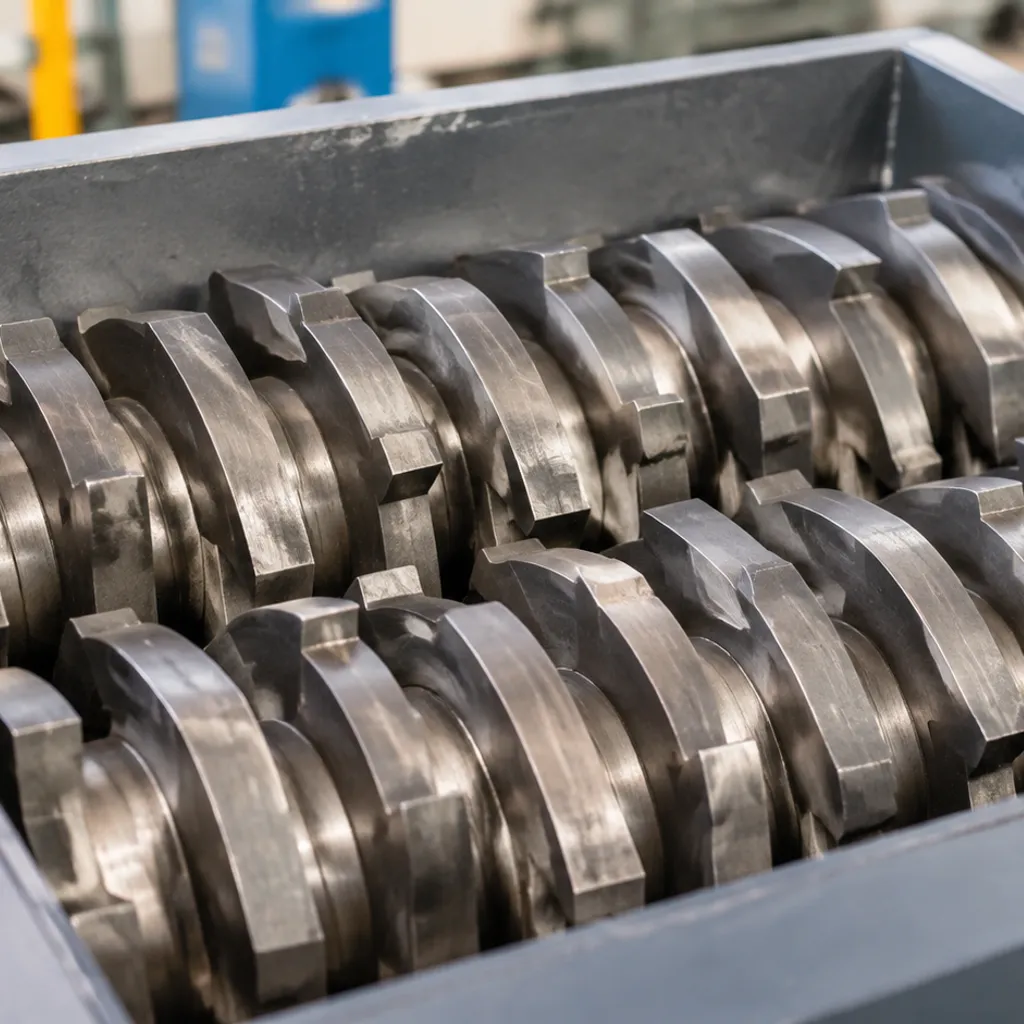
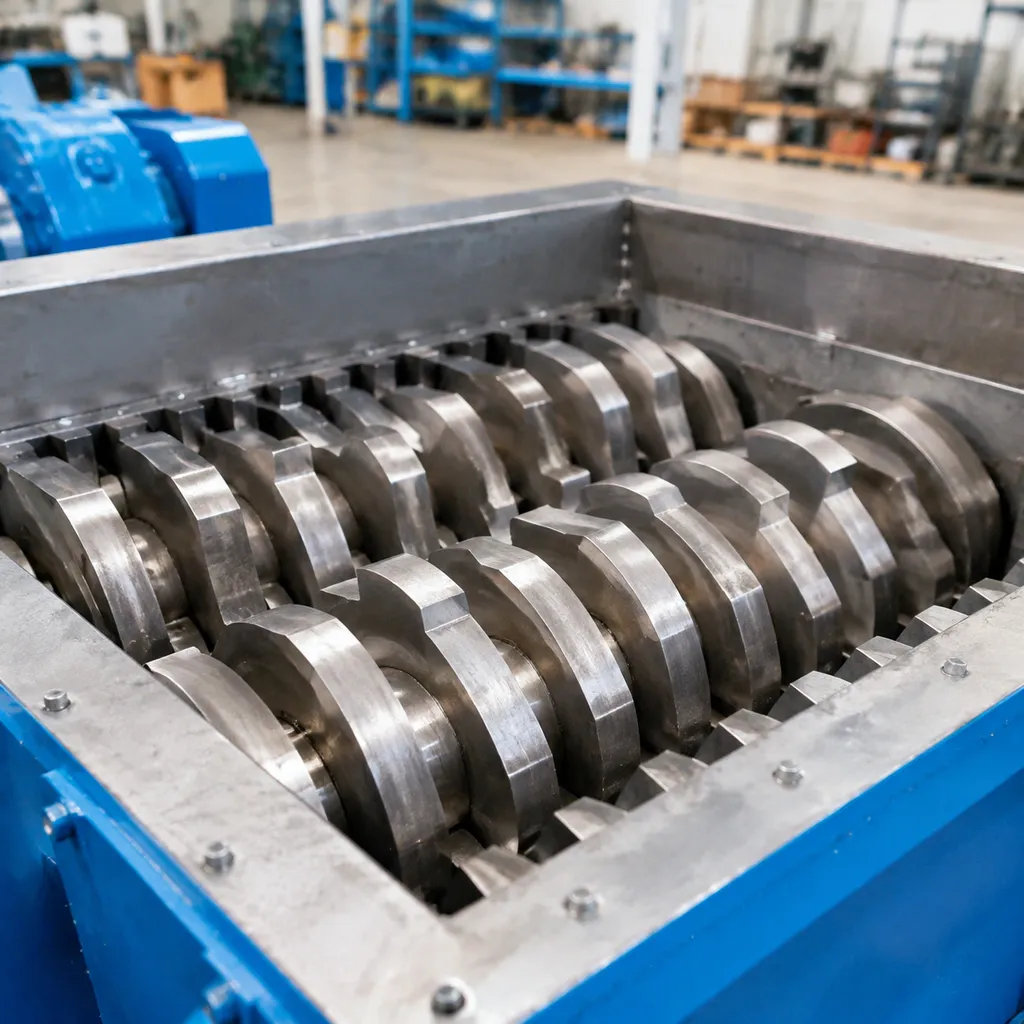
High-torque, low-speed rotary shear shredders rely on interlocking discs that slice material rather than smashing it. Because these cutters transfer massive radial loads directly from the drive shaft, bore geometry and disc thickness are your primary concerns.
- Outer Diameter (OD): Light-duty municipal or e-waste units usually run 200mm to 300mm (8" to 12") discs, while heavy-duty tire and scrap metal shredders scale up to 450mm to 650mm+ (18" to 25.6"+).
- Blade Thickness: Standard widths range from 15mm to 50mm (0.6" to 2.0"). Thinner discs produce narrower strips, while thicker discs resist deflection under heavy shock loads.
- Bore Types: Hexagonal bores are the industry standard for transmitting extreme torque without stripping, though splined and double-keyed round bores remain common on older European and North American frames.
- Hook Counts: Configurations range from 1-hook and 2-hook profiles (for grabbing bulky drums and tires) to 6-hook or 12-hook designs for continuous, high-throughput volume reduction.
Single-Shaft Shredder Rotor Knives (Square & Crown Cutters)
Unlike rotary shear discs, single-shaft shredders use small, replaceable cutting blocks bolted into pockets along a spinning rotor, shearing material against stationary counter-knives. If you are sizing replacements for plastics or wood, reviewing specific https://sharkcutting.com/plastic-shredderhttps://sharkcutting.com/plastic-shredder-blade-dimensions-guide-and-specifications/">plastic shredder blade dimensions and specifications helps ensure proper pocket fitment.
- Standard Block Footprint: The vast majority of industrial rotors accept square blocks measuring 40x40mm (1.57" x 1.57"), 60x60mm (2.36" x 2.36"), or 80x80mm (3.15" x 3.15").
- Face Geometry: Concave-ground faces bite aggressively into slippery films and purgings, whereas flat-ground faces offer stronger edge support for rigid plastics, wood, and copper wire.
- Mounting Hardware: Most square cutters feature a single center countersunk hole sized for M12, M16, M20, or M24 high-tensile bolts, letting you rotate the block four times to expose fresh cutting edges before replacement.
Granulator & Hammermill Blades (Secondary Size Reduction)
Once primary shredding is done, secondary size reduction machines take over to produce uniform flakes or granules. Understanding the differences across https://sharkcutting.com/blade-crusher-machinehttps://sharkcutting.com/blade-crusher-machine-types-and-key-features/">blade crusher machine types and key features makes it much easier to match knife geometry to your rotor speed.
- Granulator Rotor & Bed Knives: These long, straight blades typically span 250mm to 1200mm (10" to 47") in length, 60mm to 120mm (2.36" to 4.72") in width, and 12mm to 25mm (0.47" to 1.0") in thickness. Pay close attention to bolt-hole spacing (center-to-center pitch) and elongated adjustment slots, which allow technicians to dial in tight blade-to-bed clearances after sharpening.
- Hammermill Swing Hammers: Rather than slicing, these rectangular bars pulverize material via blunt impact. Standard flat or notched hammers measure 100mm to 250mm (4" to 10") long, 40mm to 80mm (1.5" to 3.15") wide, and 6mm to 20mm (0.25" to 0.8") thick, with a single pin hole at one or both ends for reversible wear.
How to Measure Existing Shredder Blade Dimensions for Replacement
When it comes to ordering replacement cutters, precision is everything. If you are relying on a standard tape measure, you are likely to end up with parts that don't fit the shaft or provide the necessary clearance. To ensure your custom shredder knife manufacturing order is accurate, we recommend using professional shop-floor tools, including digital calipers, micrometers, radius gauges, and thread pitch gauges.
Follow this 5-step checklist to capture the exact shredder blade dimensions required for a perfect fit:
- Step 1: Outer Diameter (OD): Measure across opposing hook tips. If the blade is heavily used, note the degree of tip wear, as this will help us determine the original "as-new" diameter.
- Step 2: Inner Bore & Fitment: Measure the inner bore diameter precisely. For non-round designs, capture the exact flat-to-flat dimensions of the hexagonal bore or splines to prevent micro-movement on the shaft.
- Step 3: Keyway & Orientation: Record the keyway width, depth, and its specific angular position relative to the tooth tips. This ensures your replacement blades align correctly within the shredder stack.
- Step 4: Blade Thickness & Flatness: Use a micrometer to check blade thickness at multiple points around the circumference. This identifies uneven wear or "cupping," which can cause significant issues with durable rubber shredder blade alignment.
- Step 5: Bolt Hole Patterns: If the blade uses a mounting pattern, document the Bolt Circle Diameter (BCD), the number of holes, and the specific countersink angles to ensure flush mounting.
By recording these specs accurately, you provide the data needed to maintain tight tolerances and optimal shearing efficiency. If you are dealing with severely damaged parts, our team can assist with reverse-engineering based on the remaining geometry to get your machine back to its original performance standards.
Machining Tolerances, Flatness, and Wear Limits for Shredder Blade Dimensions
Even when your nominal shredder blade dimensions look right on paper, sloppy machining tolerances will wreck a shaft assembly fast. On the shop floor, we see plenty of premature bearing failures and jammed rotors caused entirely by tiny variations across a multi-blade stack.
Why Tight Tolerances Matter in Multi-Blade Stacks
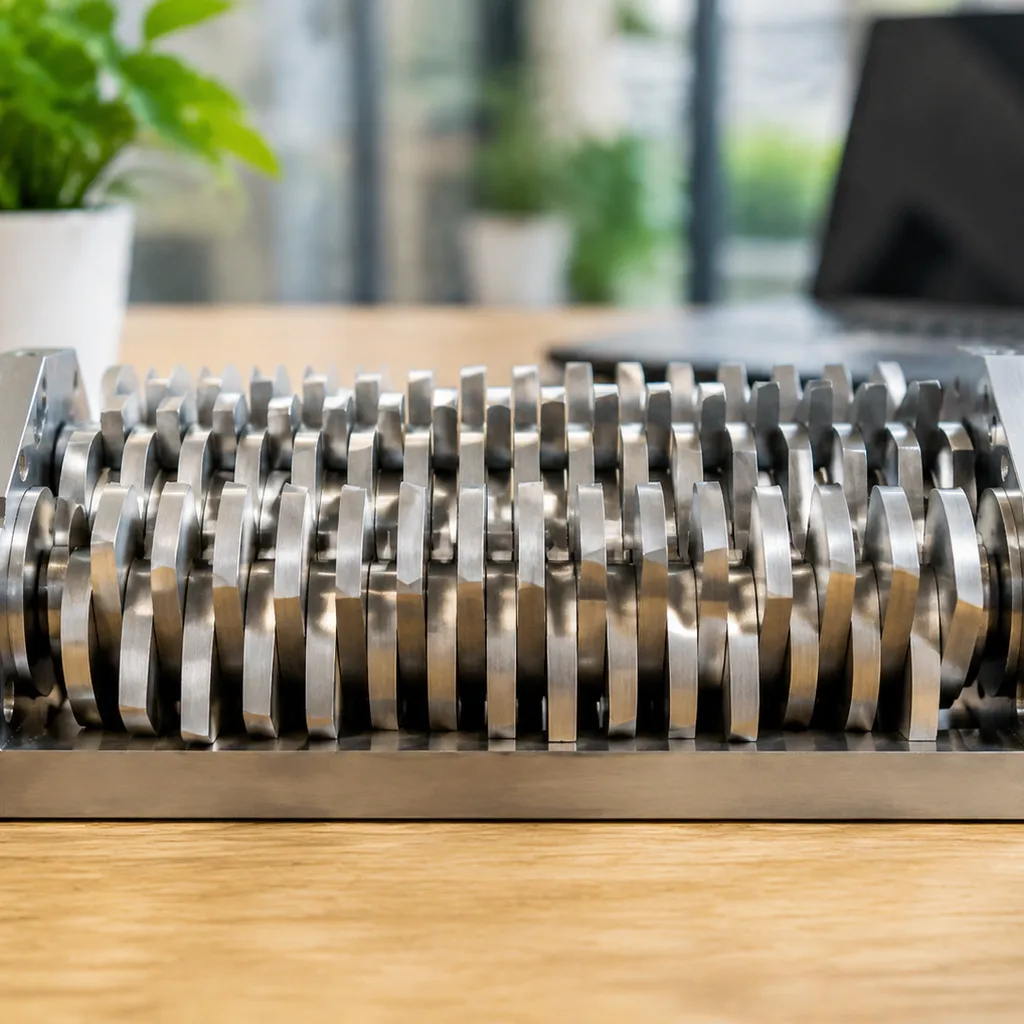
In a dual-shaft or quad-shaft shredder, dozens of cutters and spacers are compressed tightly onto a single drive shaft. If each blade is off by even a fraction of a millimeter, those tiny errors add up across the length of the rotor.
- Cumulative Stack-Up Error: On a 40-blade shaft, an individual thickness error of 0.10 mm (0.004") creates a 4.0 mm (0.157") total stack-up discrepancy. That throws off the axial alignment between opposing cutters, forcing blades to rub side-to-side.
- Side-Loading and Overheating: When blades rub laterally, friction spikes. This generates excessive heat, burns out shaft seals, and puts destructive side-loads on your gearbox bearings.
- Precision Grinding Benchmarks: At Sharkcutting, we hold standard shredder blade thickness tolerances to ±0.01 mm to ±0.02 mm (±0.0004" to ±0.0008") via precision CNC surface grinding.
- Flatness and Parallelism: Both faces of the cutter must remain dead flat and parallel. Any cupping or warping creates uneven clearance gaps as the shaft rotates, leading to material wrapping and inconsistent particle sizing.
| Precision Benchmark | Standard Tolerance (Metric) | Standard Tolerance (Imperial) | Operational Impact on Shaft |
|---|---|---|---|
| Blade Thickness | ±0.01 mm – 0.02 mm | ±0.0004" – 0.0008" | Eliminates axial stack-up error across 40+ cutters |
| Face Parallelism | ≤ 0.015 mm | ≤ 0.0006" | Maintains consistent blade-to-blade shearing clearance |
| Surface Flatness | ≤ 0.02 mm | ≤ 0.0008" | Prevents wobbling, lateral rubbing, and heat buildup |
Re-Grinding Limits: When to Sharpen vs. Replace
Sharpening dull cutters saves money, but every pass on the grinder reduces your outer diameter (OD). Eventually, removing more steel costs you more in lost throughput and motor amp spikes than buying new https://sharkcutting.com/https://sharkcutting.com/product/shredder-knife-box-precision-replacement-blades/">precision replacement shredder blades.
To know when a blade has hit its wear limit, calculate your minimum usable OD using the centerline distance between your two shafts:
- Measure Shaft Center Distance: Find the fixed center-to-center distance between your opposing shredder shafts.
- Check Radial Overlap: Opposing blades need sufficient radial overlap to shear material cleanly rather than folding or chewing it.
- Calculate the Shearing Threshold: Once re-grinding reduces the OD to the point where the radial gap between opposing cutters exceeds your material thickness—typically when OD drops by 3% to 5% depending on hook depth—the blades can no longer shear thin plastics or fibrous scrap.
If your operators are noticing stringy, uncut material passing through or your amps are climbing right after a fresh sharpen, the blades have dropped below their minimum usable OD and need to be retired.
Matching Shredder Blade Dimensions to Your Shredding Application
Plastics & Packaging Film (LDPE, HDPE, Purgings)
Thin films and dense plastic purgings require precision shearing rather than brute crushing force. If your blade-to-blade clearance is too wide, stretch film simply folds between the discs and wraps tightly around the rotor shaft, causing friction heat that melts the polymer onto your cutters.
- Thinner Blade Profiles: Narrower cross-sections slice cleanly through flexible polymers and produce uniform, manageable strips without bogging down your motor.
- Tighter Axial Clearances: Keeping the side-to-side gap strictly controlled acts like a sharp pair of scissors, preventing film from slipping between opposing cutters.
- Sharper Shear & Rake Angles: Acute cutting edges slice through tough LDPE and HDPE purgings cleanly on the first pass instead of tearing or generating excess heat. For lines processing continuous plastic rolls or thin films, precision-ground https://sharkcutting.com/multiblade-slitter-knifehttps://sharkcutting.com/multiblade-slitter-knife-on-nylon-for-precise-cutting/">multiblade slitter knives for nylon and polymers deliver the clean, burr-free cuts needed to avoid material wrap-up.
Tires, Rubber, & Heavy Elastomers
Whole tires and thick industrial rubber bounce away from shallow teeth and absorb massive amounts of energy before tearing. Your industrial shredder blade sizing needs extra mass and aggressive bite geometry to grab bulky elastomers and survive continuous shock loads.
- Thicker Cross-Sections: Heavy-duty blade widths resist sideways deflection when steel bead wires or dense tread blocks wedge between opposing hooks.
- Deep, Aggressive Hooks: Tall hook profiles reach out, grab round tires, and pull them firmly into the cutting zone instead of letting them bounce on top of the shafts.
- Reinforced Root Radii: Smooth, generous curves at the base of each tooth eliminate sharp stress corners where fatigue cracks typically start under heavy torque spikes.
E-Waste, Metals, & Wood Pallets
Mixed waste streams containing circuit boards, aluminum extrusions, or nail-embedded pallets destroy razor-sharp edges almost immediately. Here, edge durability and impact resistance matter far more than a fine slicing angle.
- Multi-Tooth Designs: Using 3, 4, or 6+ teeth per disc distributes impact forces across multiple contact points and keeps feed rates steady without jamming.
- Blunt, Durable Edge Geometry: Slightly wider, reinforced cutting edges crush and shear brittle e-waste, light scrap metal, and timber without chipping.
- Impact-Resistant Dimensions: Pairing sturdy blade thickness with tough, shock-absorbing tool steels ensures the cutter survives hidden tramp metal. Operations running heavy timber, demolition debris, or light ferrous scrap rely on https://sharkcutting.com/product/durable-wood-chipper-shredderhttps://sharkcutting.com/product/durable-wood-chipper-shredder-blade-replacement-blade/">durable wood chipper and shredder replacement blades and https://sharkcutting.com/product/https://sharkcutting.com/product/scrap-metal-shear-blades-durable-custom-cutting-solutions/">custom scrap metal shear blades engineered to handle high-impact workloads without premature edge failure.
| Material Stream | Blade Thickness | Hook & Tooth Profile | Key Dimensional Priority |
|---|---|---|---|
| Plastics & Film | Thinner (10mm–20mm / 0.4"–0.8") | Sharp shear angle, low hook height | Ultra-tight blade-to-blade clearance to stop wrapping |
| Tires & Rubber | Thick (30mm–50mm / 1.2"–2.0") | Deep, aggressive 1–2 hook design | Reinforced root radius and high cross-sectional strength |
| E-Waste, Metal & Wood | Medium-Thick (20mm–40mm / 0.8"–1.6") | Multi-tooth (3–6+ teeth), blunt edge | Impact-resistant body and durable edge geometry |
Ordering Custom and OEM Replacement Shredder Blades
Getting the right replacement parts starts with clear communication and accurate data. When we prepare to manufacture or source your shredder blade dimensions, we need precise details to ensure the final product fits your machine perfectly and performs under load.
Information Required for Your Quote
To expedite the process and ensure accuracy, please provide the following details:
OEM Data: Include the original manufacturer, machine model number, and part number if available.
Technical Drawings: Send over DXF or STEP CAD files. If you do not have digital files, a clear sketch with accurate measurements works.
Dimensional Units: Clearly specify whether the measurements are in metric (mm) or imperial (inches).
Material Selection: Confirm your preferred steel grade. We commonly work with high-wear materials like D2, SKD11, H13, and DC53 to meet specific toughness and hardness (HRC) requirements for your application.
Partnering with Sharkcutting
At Sharkcutting, we specialize in delivering precision-engineered components that match or exceed OEM standards. Whether you are looking for custom shredder knife manufacturing to handle unique material streams or need a reliable source for standard replacements, our team handles the heavy lifting.
We excel at reverse-engineering worn sample blades. By analyzing the wear patterns and original dimensions of your existing cutters, we can recreate the geometry necessary to restore your shredder to its peak efficiency. We prioritize tight manufacturing tolerances and fast turnaround times to minimize your facility's downtime. For specialized needs, explore our industrial shredder knife blades to see how we maintain the exact specs required for high-performance shredding environments.
Frequently Asked Questions (FAQ)
Can I use slightly thicker blades on my existing shredder shaft?
In almost every case, we advise against swapping in thicker blades without recalculating your entire shaft assembly. On a multi-blade shaft, even a 1mm (0.04") increase per knife compounds across 30 or 40 cutters, throwing off your spacer ring alignment and preventing the shaft end-nut from locking down properly. If you want to change output particle size using thicker industrial shredder blades, you must machine down your spacer rings by the exact same cumulative difference to keep the stack tight and aligned.
How much clearance should there be between rotary shredder blades?
For most dual-shaft and quad-shaft rotary shear shredders, the ideal radial and side-to-side blade-to-blade clearance falls between 0.05mm and 0.15mm (0.002" to 0.006").
Thin materials (films, paper, light plastics): Stick to the tighter end around 0.05mm (0.002") so the material shears cleanly instead of folding or wrapping around the shaft.
Heavy or bulky items (tires, wood pallets, thick scrap): Open the gap closer to 0.10mm–0.15mm (0.004"–0.006") to handle shock loads without the blades rubbing and overheating.
How do I find the original dimensions of a heavily worn shredder blade?
When hook tips are rounded off and faces are cupped from heavy wear, do not guess the original shredder blade dimensions from the worn cutting edge alone. Instead, measure the protected areas that never contact the feed material:
Inner Bore & Keyway: Measure the inside bore diameter, hex flat-to-flat width, and keyway slot, as these stay locked against the shaft.
Unworn Hub Thickness: Check thickness right next to the center bore where the spacer ring clamps down—this gives you the true factory shredder blade thickness.
Shaft Center-to-Center Distance: Measure the exact distance between your two shredder shafts to back-calculate the maximum safe Outer Diameter (OD) without causing blade collision.