
Formula details
Product Details
Overview
Types of Plastic Crusher Machine Blades
Rotating Rotor Blades vs. Stationary Bed Knives
Every standard cutting chamber uses a scissor-action shear system balancing moving and fixed edges:
- Rotary Crusher Blades: Mounted directly onto the spinning rotor. These knives carry the cutting kinetic energy, take the main impact force, and sweep the material down against the screen.
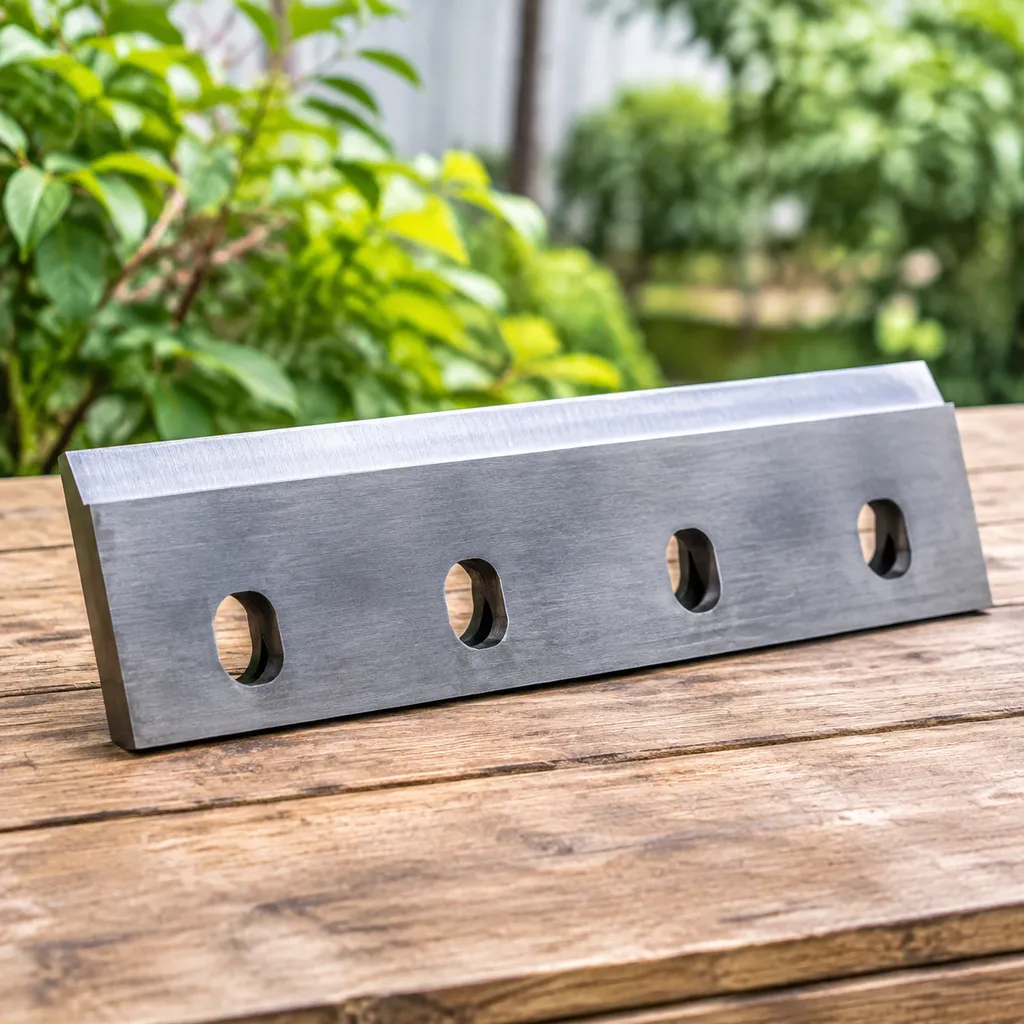
- Stationary Bed Knives: Bolted rigidly into the crusher housing (stator). They act as the anvil edge. Precise clearance between the bed knife and the rotor blade determines cut quality and prevents thin scrap from slipping through uncut.
Claw-Type Blades for Heavy Solids and Purgings
When processing dense injection lumps, purgings, pipe sections, and thick-walled engineering plastics (like POM, PC, or solid nylon), standard flat knives bounce off the material and spike motor amps.
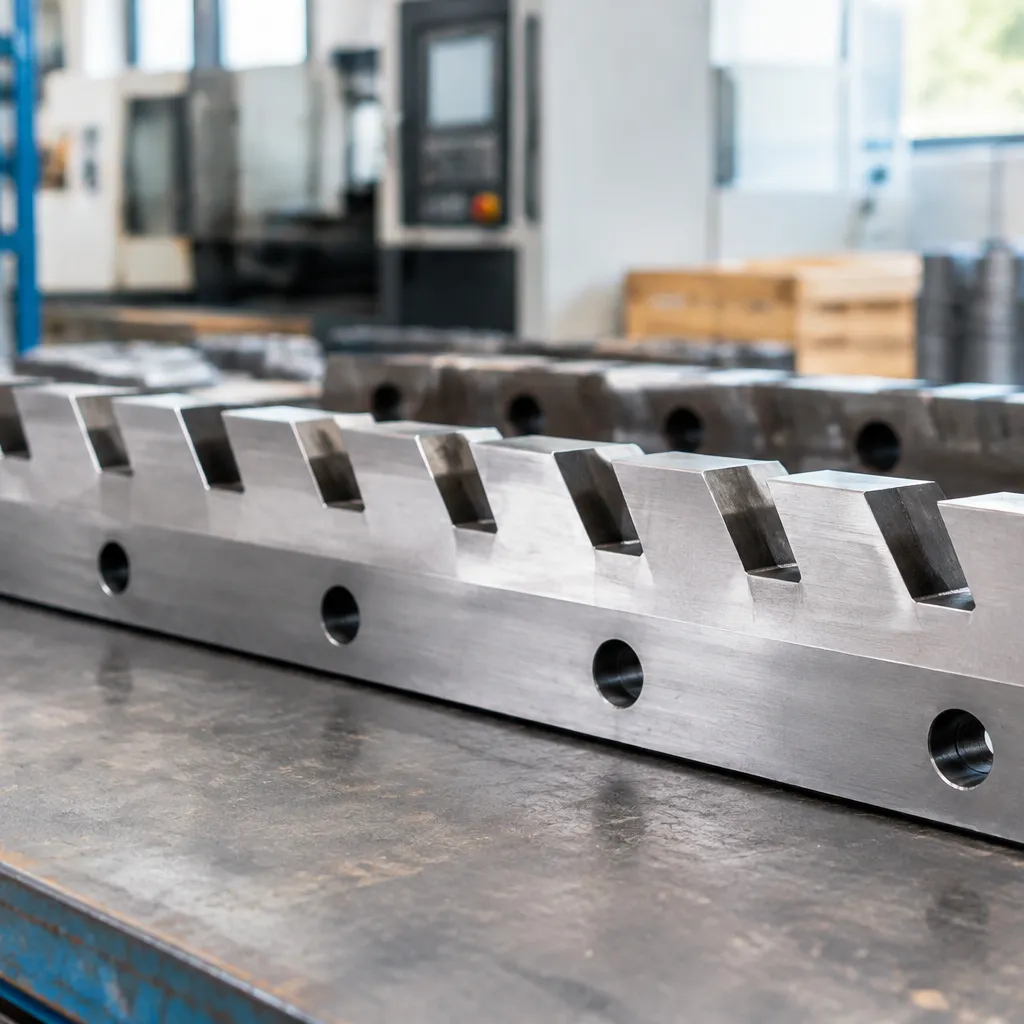
- Design: Multiple staggered teeth arranged spirally along the rotor.
- Action: Disperses cutting resistance by point-shearing. Only one or two teeth engage the block at any millisecond, biting directly into solid lumps instead of striking across a broad surface area.
- Best For: Injection molding purgings, thick runners, automotive scrap, and solid blocks.
Flat Paddle Knives for Thin Films and Hollow Containers
High-volume, low-density plastics tend to bunch, float, or wrap around standard rotors. Flat paddle knives provide the continuous, wide-edge sweep needed for high air-flow throughput.
- Design: Broad, straight cutting edge running parallel to the stationary knife.
- Action: Maximizes cutting length per revolution, pulling light materials into the cutting gap with high-velocity shearing.
- Best For: PE/PP agricultural films, blown stretch wrap, PET drink bottles, hollow blow-molded containers, and thermoforming skeletal waste.
Flake Cutter Blades for General Regrind
For operations recycling steady streams of medium-wall sprues, edge trims, and general consumer scrap, flake cutters deliver balanced durability and output.
- Design: Semi-paddle design with stepped or segmented edges.
- Action: Balances high-throughput shearing with decent resistance to minor structural shocks.
- Best For: Everyday factory sprues, small plastic containers, thin-walled profiles, and universal in-house regrind systems.
Staggered and Cross-Cutting Blade Configurations
Rotor geometry controls how the cutting load hits your drive motor:
| Rotor Configuration | Cutting Mechanism | Core Advantage | Recommended Scrap Types |
|---|---|---|---|
| Staggered Claw | Sequential single-point bite | Lowest motor shock load; prevents rotor jamming | Purge blocks, solid runners, thick sheets |
| Cross-Cutting (V-Type) | Dual-angled scissor shear inward | Pulls scrap to rotor center; reduces housing wear | PET bottle bales, woven bulk bags, films |
| Straight Paddle | Full-width single-stroke shear | Maximum sweep volume and air circulation | Thin film, blow-molded bottles, light plastics |
| Stepped Flake | Multi-plane stepped cutting edges | Balanced energy draw with clean, low-dust cuts | Crates, sprues, automotive trim, PP/HDPE parts |
Raw Material Selection for Granulator Blades

Tool Steel Comparison for Plastic Crusher Machine Blades
| Steel Grade | Hardness (HRC) | Primary Advantages | Best Material Applications |
|---|---|---|---|
| D2 / SKD-11 | 58–60 | Exceptional edge retention and wear resistance | General plastics, thick sprues, PET, rigid PVC |
| HSS / M2 | 60–62 | Red hardness, resists thermal softening | High-speed granulation, friction-heavy lines |
| 9CrSi | 54–56 | High shock resistance, low upfront cost | Clean PE/PP films, soft scrap, light-duty recycling |
| TCT (Inlaid) | 88–92 (HRA) | Extreme resistance to mineral and fiber abrasion | 30%+ glass-filled nylon, abrasive composites |
D2 / SKD-11 Cold-Work Tool Steel
D2 (equivalent to Japanese SKD-11) is our standard recommendation for heavy-duty granulator knives. With high carbon (1.5%) and high chromium (12%) content, it delivers the best balance between toughness and wear resistance. For plants comparing base metals across different feedstocks, our crusher blade materials guide outlines wear characteristics across different production volumes.
High-Speed Steel (HSS / M2)
Standard tool steels lose their temper when continuous, high-speed cutting chambers generate excessive friction. M2 high-speed steel maintains its cutting edge at temperatures up to 500°C. We equip high-friction lines with HSS knives to prevent microscopic edge roll when processing engineering polymers around the clock.
9CrSi Low-Alloy Tool Steel
When your budget takes priority and you process clean, non-abrasive scrap, 9CrSi provides dependable cutting performance. It lacks the deep-wear alloys of D2, making it easier to sharpen in-house while resisting impact fractures on light regrind, packaging film, and blow-molded bottles.
Tungsten Carbide-Tipped (TCT) Knives
Processing fiberglass-reinforced plastics or mineral-filled masterbatches destroys standard tool steel within shifts. Our TCT granulator blades braze a high-hardness tungsten carbide cutting edge onto an alloy steel body. This setup isolates extreme hardness at the shear point while retaining body elasticity against shock loads.
Vacuum Heat Treatment and Rockwell Hardness (HRC 56–62)
Steel composition means nothing without controlled heat treatment:
- Triple-cycle vacuum quenching: Prevents surface decarburization and internal stress pockets.
- Deep cryogenic treatment: Transforms retained austenite into stable martensite for consistent wear across the entire blade length.
- Targeted HRC ranges: We temper standard rotor blades to 58–60 HRC to stop chipping, and stationary bed knives to 56–58 HRC to safely handle continuous cutting shear.
Plastic Crusher Machine Blade Geometry and Engineering Specifications
When a plastic crusher machine blade loses its exact geometry, performance drops immediately. We see it every day in processing plants: motor amps spike, plastic fines build up in the screen, and cut edges look torn rather than cleanly sliced. Getting the blade profile, clearance, and weight right eliminates these issues before they turn into motor failures or downtime.
Single Bevel vs. Double Bevel Cutting Edges
The profile of your cutting edge determines whether your granulator cleanly shears polymer or smashes it by blunt force.
- Single Bevel Blades: The standard profile for rotary crusher blades. The flat face slides closely past the stationary bed knife, creating a true scissor-cut action. This setup yields high-throughput processing, clean granules, and minimal heat buildup.
- Double Bevel Blades: Feature an angled primary edge with a secondary relief angle. We use these on heavy purge blocks and thick molded sections to strengthen the cutting edge against catastrophic chipping under shock loads.
| Blade Geometry Factor | Single Bevel Edge | Double Bevel Edge |
|---|---|---|
| Primary Shear Action | Scissor shear (clean slice) | Wedge chop (impact fracture) |
| Edge Durability | Moderate (sensitive to metal scrap) | High (resists micro-chipping) |
| Fines & Dust Output | Extremely low | Moderate to high |
| Best Target Scrap | Film, PET bottles, runners, sheet | Solid purgings, thick sprues, pipe walls |
Optimal Shearing Angles
The angle ground into the blade face governs cutting resistance and motor amp draw:
- 30° to 45° Acute Angles: Ideal for soft plastics like LDPE, stretch film, and PP woven bags. The sharper wedge shears flexible strands instantly, eliminating wrapped rotors and heat buildup.
- 45° to 55° Heavy-Duty Angles: Built for rigid scrap such as ABS, polycarbonate, and glass-filled nylon. This blunt angle provides strong steel backup to absorb impact shock without dulling premature failure.
- Scissor-Cut Offsets: Aligning rotor knives at a 3° to 5° slant against stationary knives reduces motor peak load by up to 35% compared to parallel-impact setups.
Critical Dimensions and Bolt Patterns
A replacement plastic crusher machine blade must match OEM housing tolerances down to hundredths of a millimeter. We machine every knife to precise tolerances:
- Length, Width, and Thickness: Precision ground to ±0.02 mm across the entire profile to maintain uniform knife gap clearance along the full length of the rotor.
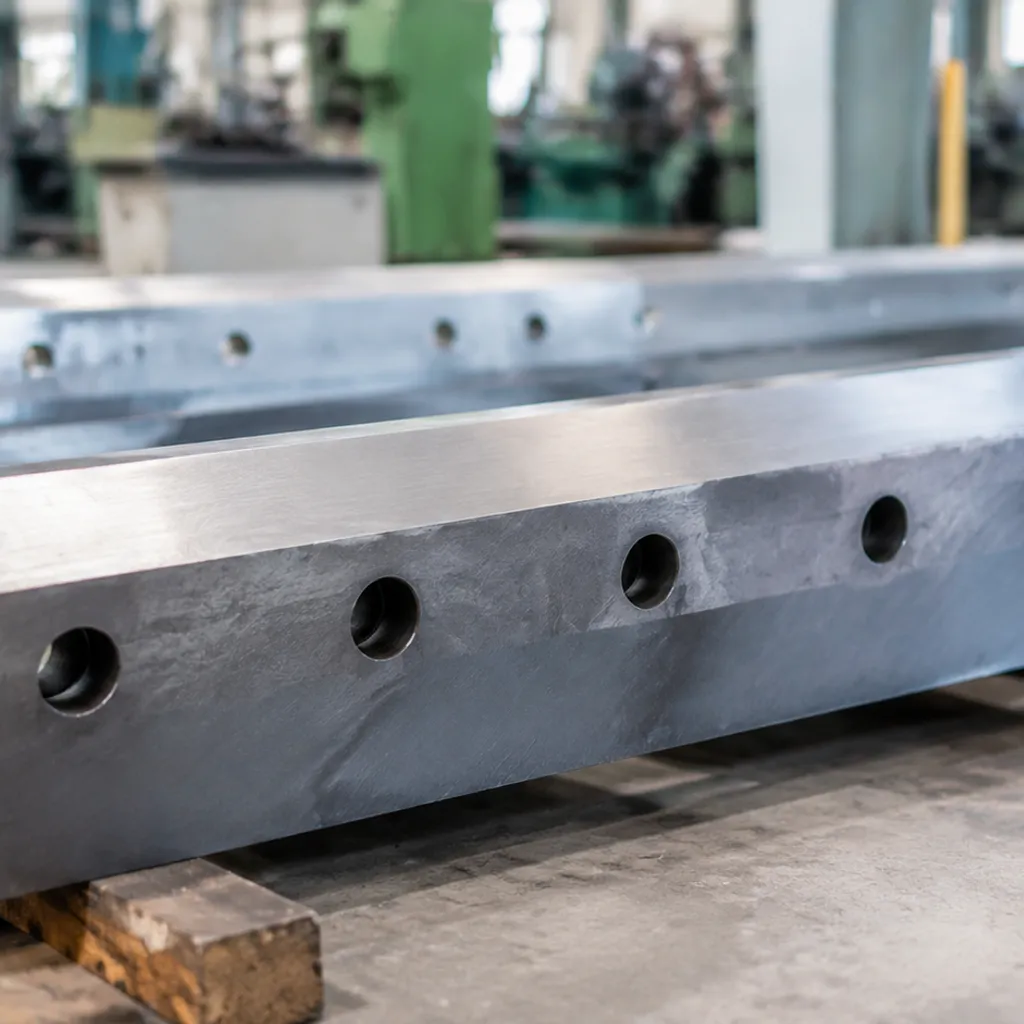
- Counterbore Bolt Holes: Must match OEM pitch and depth exactly. High-tensile socket-head cap screws require flat, burr-free seatings to prevent loosening under continuous vibration. For accurate specs and tracking batches across production runs, refer to our industrial knife markings and traceability guide.
- Slotted Adjustment Holes: Used on stationary bed knives to allow repeated forward adjustment after each edge regrind.
Dynamic Balancing Requirements
Rotor imbalance destroys main bearings and cracks granulator side walls. When replacing rotary blades, dynamic balance must be maintained across the assembly:
- Weight-Matching: We balance matched sets of rotating blades within ±1.5 grams of each other.
- Symmetrical Replacement: Always replace rotating blades in complete opposing sets, never as individual knives.
- Vibration Limits: Balanced blade sets keep radial runout below 0.03 mm, preventing blade-to-blade collisions and bearing race fatigue during continuous high-speed granulation.
How to Choose the Right Blade for Your Plastic Type

Feeding the wrong polymer into an improperly equipped cutting chamber destroys edges, spikes motor loads, and packs screens with melted plastic. We always spec each plastic crusher machine blade set according to polymer hardness, tensile strength, and contamination levels to maintain high throughput and clean regrind.
Matching Blades to Rigid Polymers: ABS, PC, POM, and Thick Nylon
Rigid, brittle, or high-impact plastics require heavy-duty crusher knives with high toughness and impact absorption. Thin or overly acute cutting edges will chip when tackling solid purgings or heavy wall runners.
- Recommended Steel: D2 / SKD-11 tool steel tempered to HRC 58–60.
- Edge Geometry: Steeper, single-bevel angles (around 45° to 50°) reinforce the cutting edge against fractures.
- Cutting Profile: Claw-type or staggered rotary crusher blades break solid blocks down progressively without jamming the drive motor.
When configuring a cutting setup for dense engineering plastics, the focus remains on edge stability under heavy mechanical stress—much like our design principles for a multiblade slitter knife on nylon for precise cutting to eliminate lateral deflection during high-load processing.
Optimizing Cuts for Flexible Materials: LDPE, HDPE Film, PP Woven Bags, and EVA
Flexible films and elastic polymers do not snap under blunt force; they stretch, wrap, and generate frictional heat that melts scrap inside the chamber.
- Scissor-Cut Shearing: Requires an aggressive, sharp angle (30° to 35°) on both rotary crusher blades and stationary bed knives to slice cleanly without pulling.
- Tight Tolerances: We set blade clearances strictly between 0.10 mm and 0.20 mm to stop thin plastic films from slipping between the knives.
- Paddle Rotors: Flat, high-airflow paddle configurations evacuate lightweight flakes instantly through the screen to prevent heat build-up.
Handling Contaminated Plastics: Dirt, Labels, and Metal Hazards
Post-consumer waste and agricultural plastics carry sand, labels, and foreign debris that rapidly degrade cutting faces.
- Sand and Soil Abrasion: Abrasive dirt rounds off standard tool steel edges rapidly. For washed or unwashed dirty streams, we utilize tungsten carbide-tipped (TCT) knives or surface-hardened tool steels.
- Paper and Adhesives: Generate friction fines that cake around blade pockets; frequent gap checks are necessary to stop knife rubbing.
- Tramp Metal Risks: Ferrous contaminants crack ultra-hard blades immediately. If metal separation isn't 100% guaranteed, we pull hardness down to HRC 54–56 on modified tool steels to favor edge deformation over catastrophic shattering.
Calculating Throughput Demands Against Blade Wear Rates
Balancing abrasive resistance with operating tonnage prevents unexpected downtime. The table below outlines how we pair blade selections with specific material streams:
| Material Type | Typical Plastics | Recommended Blade Steel | Knife Edge Angle | Expected Run-Time Before Regrind |
|---|---|---|---|---|
| Rigid / Engineering | ABS, PC, POM, Nylon purgings | D2 / SKD-11 | 45° – 50° | 120 – 160 Operating Hours |
| Film & Hollow Containers | LDPE, stretch film, PET bottles | High-Speed Steel (HSS) / D2 | 30° – 35° | 80 – 120 Operating Hours |
| Woven & Filament | PP jumbo bags, strapping | D2 / High-Speed Steel | 35° – 40° | 90 – 130 Operating Hours |
| Abrasive / Filled | Glass-filled Nylon, dirty ag films | Tungsten Carbide Tipped (TCT) | 40° – 45° | 300+ Operating Hours |
To keep production costs balanced, calculate blade wear rate using:
$Wear Rate Index = frac{Throughput (Tons)}{Total Service Hours before 0.5mm Edge Loss}$
When this index drops below normal operational thresholds, recheck blade gap clearance, screen hole sizing, and feed-stream purity immediately.
Installation and Blade Gap Calibration Guide
Improper knife clearance ruins cutting performance fast. If the gap between your rotary crusher blades and stationary bed knives is too wide, plastic wraps around the rotor, generates excessive heat, and turns regrind into stringy ribbons. Set it too tight, and thermal expansion or rotor deflection will cause metal-to-metal collision, destroying your cutting chamber. Setting up a plastic crusher machine blade correctly takes only a few deliberate steps, but precision is non-negotiable.
Step-by-Step Knife Gap Setting Using Standard Feeler Gauges
- Lock Out and Tag Out (LOTO): Cut the main breaker and mechanically lock the drive shaft. Never adjust a granulator knife on an unsecured machine.
- Clean the Mounting Surfaces: Scrape away polymer buildup, fines, and rust from both the rotor pocket and the bed knife seats. Any debris behind the knife creates runout.
- Mount the Stationary Bed Knives First: Set your stationary bed knives in place, lightly snugging the bolts so the blades remain movable via the rear jack bolts.
- Rotate and Gauge Each Position: Slowly rotate the rotor by hand to bring a rotary blade flush against the stationary bed knife.
- Insert the Feeler Gauge: Place a long-blade feeler gauge across both ends (left and right) and the center of the cutting edge.
- Adjust the Jack Bolts: Turn the rear push bolts evenly until the gauge slides with a slight, consistent drag across the entire length of the blade.
- Verify on Every Blade: Rotate through every single rotor knife against every stationary knife. The clearance must remain identical on all cutting edges.
Recommended Clearance Specs: The 0.15mm – 0.30mm Rule
The required cutting gap depends directly on the thickness and flexibility of the polymer being processed:
| Plastic Type & Form | Recommended Blade Gap | Primary Operational Risk |
|---|---|---|
| Thin Films, PET Bottles & Fibers (< 1 mm) | 0.15 mm – 0.20 mm | Material jamming, pulling, and uncut strands |
| Rigid Regrind, Sprues & Parts (1 mm – 5 mm) | 0.20 mm – 0.25 mm | High motor amps and excessive fines |
| Thick Purging Blocks & Solid Tops (> 5 mm) | 0.25 mm – 0.30 mm | Mechanical shock load and blade edge chipping |
For brittle materials like polystyrene, lean toward a tighter setting; for ductile plastics like LDPE film or PP woven sacks, maintaining under 0.20 mm is vital to achieve clean shearing rather than tearing. Following proven knife maintenance best practices prevents unnecessary wear while ensuring steady cutting performance across demanding shifts.
Proper Torque Patterns and Bolt Replacement Practices
Blade bolts take direct shearing impacts thousands of times per minute. Never reuse standard commercial hardware or stretched bolts during a plastic shredder blade replacement.
- Use Grade 12.9 Fasteners Only: Always secure heavy duty crusher knives using high-tensile, factory-specified grade 12.9 counterbore bolts.
- Never Reuse Deformed Bolts: Fasteners stretch under tension. Replace all knife bolts every 2 to 3 blade swaps, or immediately if any thread galling occurs.
- Follow an Inside-Out Torque Pattern: Fasten bolts progressively starting from the center out to both edges. This prevents warping the knife along its seat.
- Torque in Increments: Tighten fasteners in three passes (50%, 75%, and 100% of target spec) using a calibrated torque wrench. Re-check the feeler gauge clearance after the final torque pass.
Aligning the Cutting Circle to Prevent Rotor Housing Strikes
After mounting a new set of granulator blades, you must verify the true cutting circle. Uneven blade projection leads to localized friction, premature dulling, and housing gouging.
- Check Bed Knife Projection: Ensure the stationary blades do not project past the chamber wall liner beyond the manufacturer's maximum clearance limit.
- Perform a Full 360-Degree Hand Rotation: Rotate the rotor completely by hand for two full cycles before closing the hopper. Listen for any faint metal contact or scraping against the frame.
- Verify Chamber Side Clearance: Check side gaps between the outer rotor blade edges and the machine side walls using a feeler gauge; maintain equal spacing on both drive and non-drive ends.
- Re-Torque After Test Run: Run the granulator empty for 15 minutes. Shut down, lock out, and confirm that all bolts retain full torque and knife gaps have not shifted.
Sharpening, Maintenance, and Maximizing Plastic Crusher Machine Blade Lifespan
Keeping a sharp cutting edge is the single most effective way to protect your granulator drive motor and maintain uniform regrind. Running dull knives wastes energy, degrades polymer quality, and leads to premature fatigue across your rotor assembly.
Warning Signs of a Dull Plastic Crusher Machine Blade
When an edge begins to round over, your machine stops shearing cleanly and starts tearing the material. Watch for these daily operational indicators:
- Excessive Fines and Dust: Material gets crushed rather than sliced, choking downstream filters and creating air quality issues.
- Stringy Regrind ("Tails"): Incomplete cuts leave thin strips or angel hair, especially when processing thin PE film or PP woven sacks.
- Drive Motor Amp Spikes: As friction increases, the main drive motor pulls significantly higher continuous amperage to maintain throughput.
- Overheating in the Cutting Chamber: Heat buildup softens low-melting-point plastics, causing thermal agglomeration and gumming inside the rotor.
Edge Restoration: Wet Grinding vs. Dry Grinding
Restoring the profile on hardened tool steels (like D2 or SKD-11) requires strict thermal control during reconditioning.
| Feature | Wet Surface Grinding (Recommended) | Dry Grinding (Not Recommended) |
|---|---|---|
| Coolant Application | Continuous flood of soluble synthetic coolant | None or intermittent air blast |
| Thermal Shock Risk | Minimal; prevents micro-fracturing | High; localized surface heat builds fast |
| Hardness Retention | Preserves original HRC 56–60 temper | Causes surface annealing (softening) |
| Surface Finish | Smooth, mirror-like finish for clean shear | Rough, burred edges that dull rapidly |
Always maintain the original OEM blade sharpening angle (typically between 45° and 55° depending on rigid or film applications). Never skip deburring; stone the flat reverse face by hand after machine grinding to remove the wire edge.
Maximum Regrind Limits and Replacement Thresholds
Every plastic crusher machine blade can only be ground a specific number of times before structural safety is compromised.
- Elongated Bolt Holes: Check the counterbore slots. Once sharpening brings the cutting face too close to the bolt countersink, the clamping force drops, creating a severe shearing hazard.
- Width Loss Limit: As a rule of thumb, discard the knife once it has lost more than 10% to 15% of its original overall width.
- Rotor Clearance Deficits: If the knife can no longer reach the required clearance setting against the stationary bed knife via standard shimming or adjustment bolts, retire the set.
When knives reach their operational limit, swap them out with a matched plastic crusher blade set to keep rotor weight balanced and protect the cutting chamber from catastrophic strikes.
Corrosion Prevention and Safe Handling Protocols
- Rust Inhibitor Application: Coat stored knives with heavy-duty protective oil or industrial wax, especially when running washed post-consumer scrap lines with residual moisture.
- Paired Storage: Always store rotary crusher blades and stationary knives in matched, weight-balanced sets wrapped in oiled VCI paper.
- Handling Protection: Use magnetic lifting handles or puncture-resistant gloves during installation. An accidental drop onto a concrete shop floor will instantly chip hardened tool steel edges.
Plastic Crusher Machine Blade FAQs
How often do plastic crusher blades need to be sharpened?
Sharpening schedules depend entirely on the polymer being processed, filler content, and run hours. Clean, unfilled plastics cause gradual wear, while contaminated or abrasive scrap requires frequent edge dressing to maintain clean granulate.
| Material Processed | Operating Hours Before Resharpening | Wear Indicators to Watch |
|---|---|---|
| Clean Film / Hollows (LDPE, PP) | 150 – 300 hours | Stretched or torn scrap, dust buildup |
| Rigid Resins (ABS, PC, Nylon) | 80 – 150 hours | High motor amp draw, coarse particle size |
| Glass-Filled / Abrasive Polymers | 30 – 60 hours | Rapid edge rounding, chamber heat spikes |
Monitoring amp draw and regrind uniformity gives you an immediate indication of when your plastic crusher machine blade set needs maintenance.
What causes crusher blades to crack or chip unexpectedly?
Blades rarely fail without a direct physical or mechanical trigger. When we troubleshoot chipped or broken knives in the workshop, the root cause usually comes down to three factors:
- Foreign Contaminants: Tramp metal (bolts, nuts, washers) or heavy gravel entering the chamber instantly fractures hardened tool steel.
- Improper Knife Clearance: If the gap between rotor and stator knives is set too tight, thermal expansion during continuous runs causes blade collisions.
- Uneven Torque Loads: Skipping a star-pattern sequence or failing to use a calibrated torque wrench warps the knife seat, concentrating stress around the bolt holes.
- Thermal Shock During Grinding: Overheating the cutting edge during dry resharpening creates micro-cracks that fracture under mechanical shock.
For demanding recovery lines, switching to high-toughness crusher blades manufactured from premium D2 or modified tool steel drastically cuts down the risk of brittle chipping under heavy impact.
What is the ideal clearance between rotary and stationary blades?
The baseline clearance for most granulators falls between 0.15 mm and 0.30 mm (0.006 in to 0.012 in).
- Thin Films and PET Flakes: Set the gap tighter, between 0.10 mm and 0.15 mm, to prevent soft stock from wrapping around the rotor or pulling through uncut.
- Heavy Purge Blocks and Thick Profiles: Open the gap up to 0.25 mm to 0.35 mm to reduce extreme shearing loads on the motor drive and knife edges.
Always set clearances using precision feeler gauges across both knife ends and the center to verify total parallel alignment with the stationary bed knives.
Can I mix different blade materials on the same rotor?
Never mix different steel grades or brands on the same rotor assembly. Different tool steels—such as pairing D2 with high-speed steel or standard 9CrSi—have distinct densities, wear profiles, and total mass.
Mixing blade types causes two immediate problems:
- Dynamic Imbalance: Even a variance of a few grams will generate dangerous rotor vibrations at operational RPM, damaging bearings and housing walls.
- Uneven Edge Wear: Softer blades dull faster than harder ones, ruining the calibrated cutting circle and leaving uneven gaps across the rotor length.
Always replace and rotate industrial recycling blades as complete, matched, and balanced sets to protect machine tolerances and maintain high cutting efficiency.