
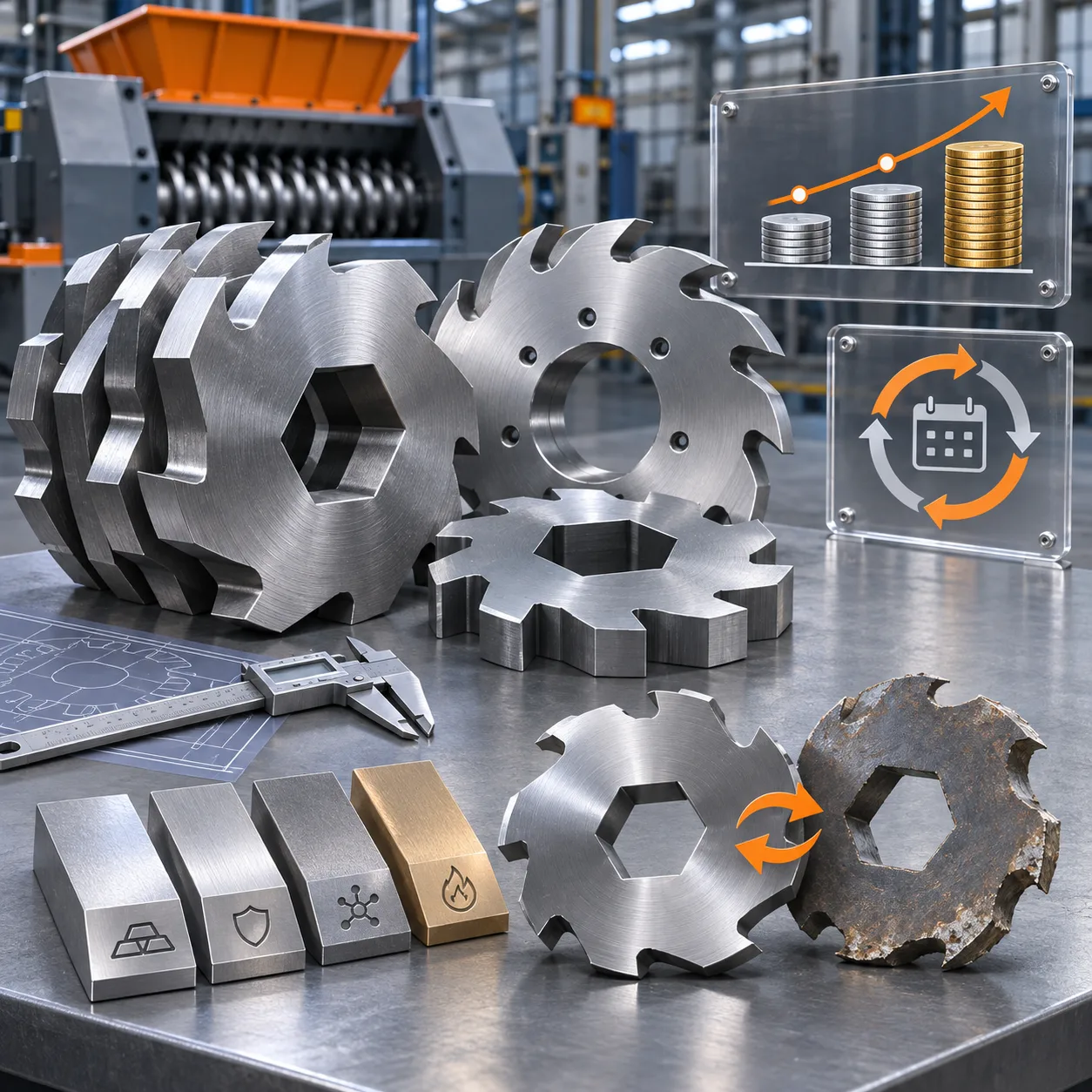
Average Shredder Blade Cost by Machine & Blade Type
If you are trying to budget for replacement shredder knives, you already know that quotes vary wildly depending on machine architecture and steel specs. Across the industrial cutting sector, shredder blade cost ranges anywhere from $30 for a small indexable rotor insert to over $800 per heavy-duty hook cutter.
When evaluating an industrial shredder blade price list, the machine type dictates the geometry, machining hours, and steel mass required.
| Machine & Blade Type | Typical Price Range | Key Design & Pricing Drivers |
|---|---|---|
| Single-Shaft Rotor & Counter Knives | $30 – $200+ per insert/block | High volume per rotor; square, concave, or crown-shaped indexable geometry. |
| Dual-Shaft & Four-Shaft Hook Blades | $150 – $800+ per cutter | Large outer diameters, custom spacer thicknesses, 1-to-12 hook counts, hex/keyed bores. |
| Granulator & Pelletizer Fly/Bed Knives | $100 – $600+ per set | Long flat blade profiles requiring strict parallelism and ultra-tight edge tolerances. |
| Wood Chipper & Demolition Blades | $50 – $400+ per knife | Heavy cross-sections engineered for high impact resistance against nails, rocks, and knots. |
Single-Shaft Shredder Rotor & Counter Knives
Single-shaft rotor inserts are the lowest-cost individual wear parts, typically running $30 to $200+ per block. Because a single rotor holds dozens of these square, concave, or crown-shaped indexable inserts, buyers usually purchase them in bulk sets. Stationary counter knives (bed knives) sit at the higher end of this bracket due to their longer bar length and mounting hole machining.
Dual-Shaft & Four-Shaft Hook Blades
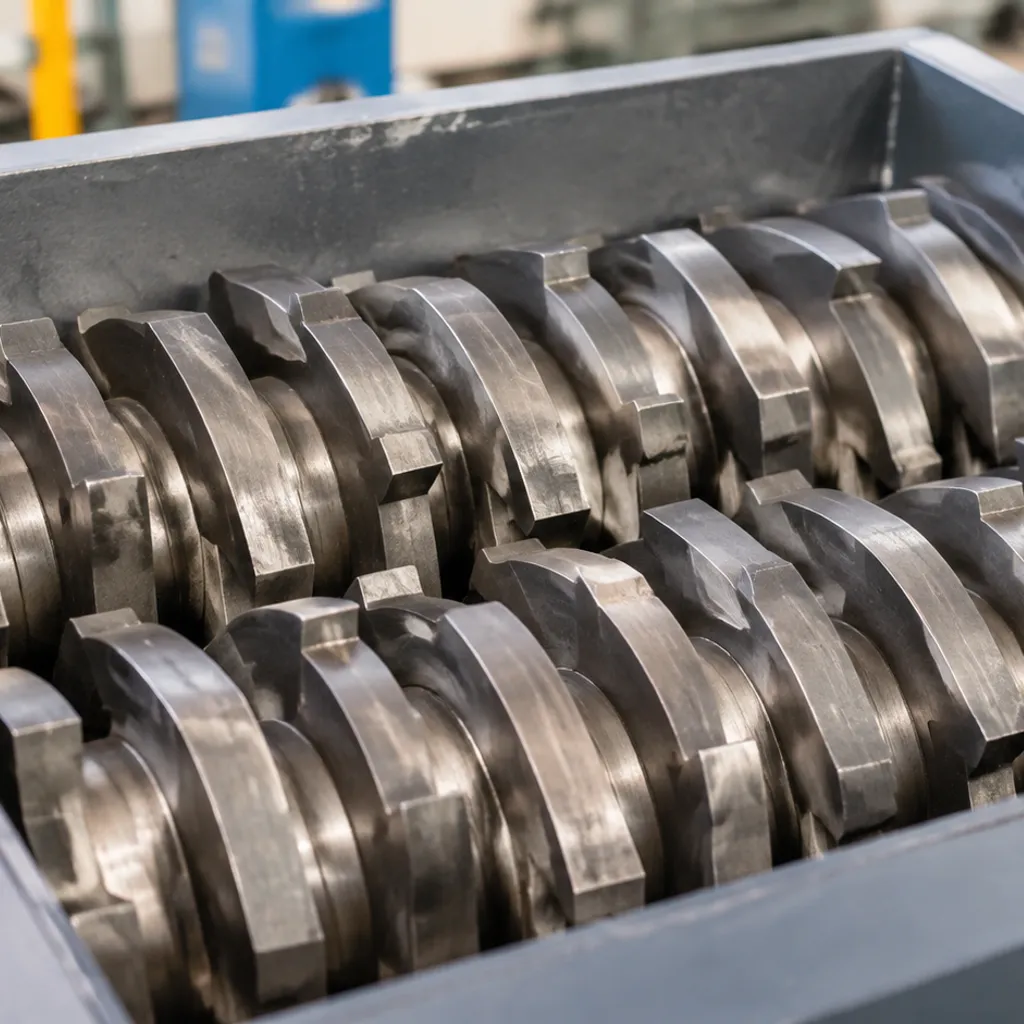
A dual shaft shredder blade cost sits between $150 and $800+ per cutter, making these the highest-ticket wear items in a recycling facility. Pricing scales directly with outer diameter (OD), custom spacer thicknesses, and tooth configuration—ranging from aggressive 1-hook or 2-hook designs for bulky scrap to 12-hook profiles for fine sizing. Heavy internal CNC broaching or wire EDM for hexagonal and keyed bores adds significant machining time.
Granulator & Pelletizer Fly/Bed Knives
Heavy duty granulator blades price out at $100 to $600+ per set depending on rotor width and blade count. Unlike thick hook cutters, fly knives and stationary bed knives are long, flat blades that rely on scissor-like shearing action. Achieving strict parallelism across the full length and holding tight edge tolerances drives the surface grinding cost.
Wood Chipper & Heavy-Duty Demolition Blades
Wood chipper knife replacement cost generally falls between $50 and $400+ per knife. While simpler in profile than multi-hook cutters, forestry and demolition blades require thick stock and specialized shock-resistant heat treatment. You are paying for structural toughness that prevents catastrophic edge chipping when the rotor strikes tramp metal, rocks, or dense hardwood knots.
6 Key Factors That Drive Industrial Shredder Blade Pricing
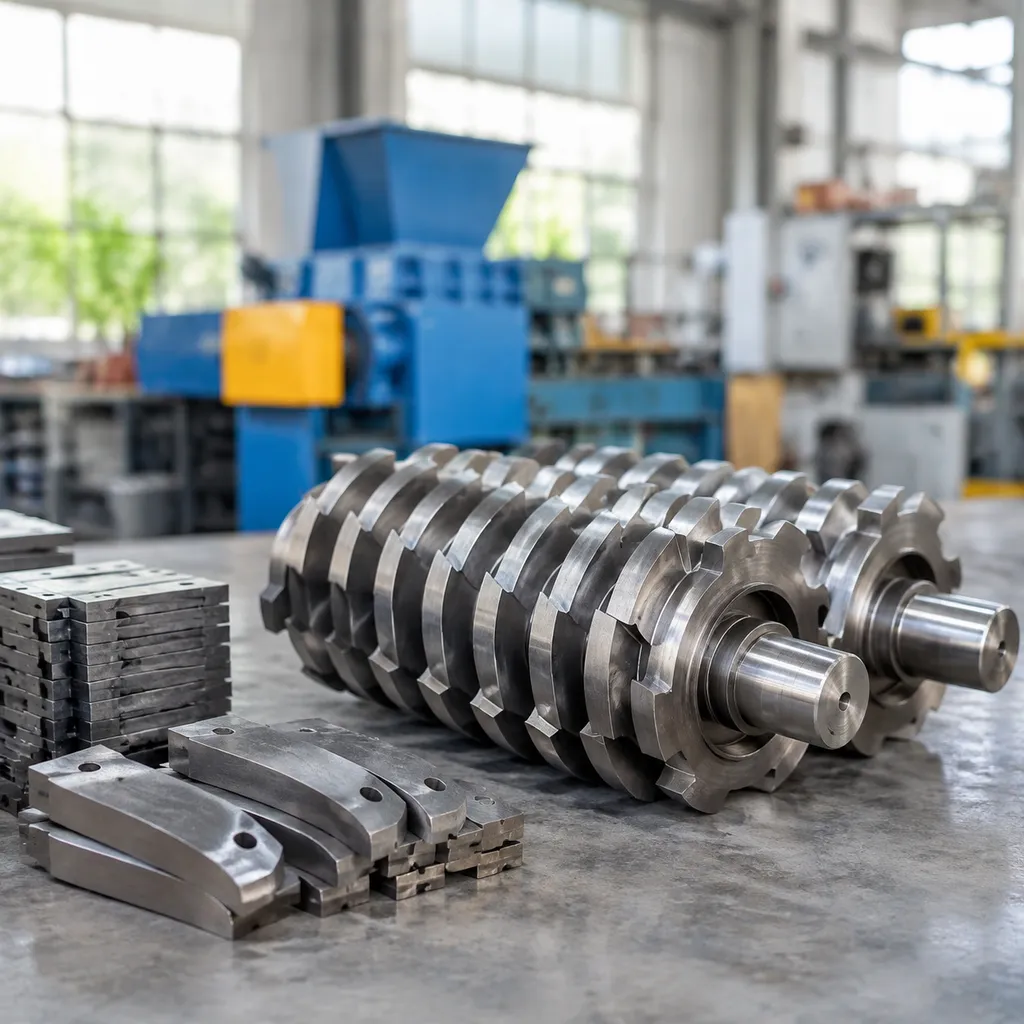
When buyers ask me why one replacement cutter costs $180 and another identical-looking one hits $650, the answer always comes down to raw material, machine hours, and tolerances. Understanding these six cost drivers helps you avoid overpaying for specs you do not need—or buying cheap steel that fails in a week.
1. Steel Grade & Metallurgy
Alloy selection is the biggest driver of your upfront industrial shredder blade price and long-term wear life. Choosing the right grade comes down to balancing impact resistance against abrasion resistance, which we break down further in our crusher blade materials comparison guide.
| Steel Grade | Key Characteristics | Relative Cost | Best Application |
|---|---|---|---|
| 4140 / 4340 Alloy Steel | High toughness, lower edge retention | $ (Base) | Soft wood, clean cardboard, low-abrasion waste |
| D2 / SKD11 Tool Steel | High carbon/chrome, top wear resistance | $$ (1.4x–1.8x) | General plastics, films, non-ferrous metals |
| H13 / S7 Shock-Resistant | Extreme impact toughness, resists chipping | $$ (1.5x–2.0x) | Heavy demolition, wood with nails, thick purgings |
| Powdered Metallurgy (PM) | Uniform carbides, superior toughness + wear | $$$ (2.5x–3.5x) | High-volume e-waste, abrasive polymers |
| Tungsten Carbide Inlays | Maximum abrasion resistance, brittle impact | $$$$ (3.5x–5.0x+) | Glass-filled plastics, tires, mineral-filled waste |
2. Blade Dimensions, Thickness & Geometry
You pay for raw steel by the pound and CNC machining by the hour. Larger outer diameters (OD) and thicker profiles immediately raise raw bar stock costs, while complex hook geometries require multi-axis milling.
- Bore Complexity: A simple round bore with a single keyway machines quickly. Hexagonal or splined bores require specialized broaching or wire EDM work, adding 15% to 30% to labor costs.
- Tooth & Hook Profiles: Multi-hook cutters (6-hook to 12-hook designs) require far more CNC cutter paths than single-hook or standard square rotor inserts. For exact sizing standards, review our plastic shredder blade dimensions and specifications guide.
3. Heat Treatment & Cryogenic Processing
Raw steel is soft; proper heat treatment gives it cutting life. Vacuum hardening combined with triple tempering ensures your blades hit the target HRC 55–62 window without turning brittle like glass.
- Vacuum Furnace vs. Salt Bath: Controlled vacuum hardening prevents surface decarburization and warping, costing more upfront than basic batch heat-treating.
- Cryogenic Sub-Zero Treatment: Cooling blades to -300°F (-185°C) converts retained austenite into hard martensite, boosting wear life by 15%–25% for a modest surcharge.
4. Machining Tolerances & Surface Grinding
Dual-shaft and four-shaft shredders rely on razor-thin clearance between opposing cutters to shear material cleanly instead of folding it.
- Strict Thickness Control: Holding thickness tolerances to ±0.001" (±0.025 mm) requires precision double-disc or rotary surface grinding.
- Flatness & Parallelism: If a stack of 50 blades varies by just a few thousandths of an inch per cutter, tolerance stack-up will bind your shafts or leave wide gaps that jam the machine.
5. Order Volume & Setup Costs
Machine setup, CNC programming, and custom heat-treatment fixtures carry fixed overhead costs.
- Full Rotor Sets vs. Spot Replacements: Ordering a full rotor set of 40 to 100+ blades spreads setup fees across the entire batch, dropping your per-unit price by 25% to 45%.
- Small-Batch Penalties: Ordering 2 or 3 replacement shredder knives forces the shop to absorb full programming and fixture setup time on a tiny run, driving up the single-piece price.
6. Application Material & Feedstock
What you feed into the hopper dictates the minimum metallurgy and edge geometry required to survive the shift.
- Clean, Soft Feedstock: Standard cardboard, HDPE bottles, and clean softwood allow cost-effective 4140 or standard D2 blades.
- Abrasive & Contaminated Waste: Shredding glass-filled nylon, e-waste circuit boards, steel-belted tires, or municipal solid waste (MSW) destroys standard edges fast, forcing an upgrade to PM tool steels or tungsten carbide-tipped cutters.
OEM vs. Custom Aftermarket Blades: Where Does Your Budget Go?
When you get hit with a steep quote for replacement wear parts, it is fair to wonder what you are actually paying for. In our experience working directly with plant managers and buyers, shredder blade cost comes down to two things: raw manufacturing value and middleman markups.
The OEM Markup Reality
Original equipment manufacturers rarely forge, heat-treat, and grind their own knives in-house. They outsource production to specialized knife factories, add a 30% to 50% brand margin, and pass the warehousing overhead straight to you. You end up paying a premium for a logo on the box rather than better steel on your rotor.
Precision Aftermarket Manufacturing
Going straight to a dedicated custom shredder blade manufacturer strips out that middleman tax while giving you tighter control over your wear parts:
- Identical or Upgraded Metallurgy: We match OEM steel specs (like D2/SKD11 or high-alloy tool steels) or upgrade the grade and heat treatment to handle tougher, more abrasive feedstocks.
- Exact OEM Fitment: Whether you send over factory blueprints or ship us a worn sample for reverse-engineering, our CNC and precision grinding processes hold tight bore and thickness tolerances so blades drop right onto your shaft.
- Shorter Lead Times: Direct factory production eliminates distributor bottlenecks, getting OEM replacement shredder cutters on your floor faster without rush-order surcharges.
| Buying Factor | OEM Replacement Parts | Direct Aftermarket Manufacturing |
|---|---|---|
| Pricing Structure | Includes 30%–50% brand & distributor markup | Factory-direct pricing based on steel & machining |
| Material Options | Locked into standard factory specs | Customizable steel grades & HRC hardness |
| Fitment & Specs | Built to original machine drawings | Built from drawings or reverse-engineered samples |
| Lead Times | Dependent on OEM stock & distribution | Direct production scheduling with faster turnaround |
Regrinding vs. Replacing: Calculating Your True Shredder Blade Cost Per Ton
Looking only at the upfront purchase price is the fastest way to blow your maintenance budget. To control your real shredder blade cost, I always tell plant managers to calculate total cost per ton processed—factoring in sharpening lifespans, downtime labor, and wear life.
Shredder Blade Sharpening & Resurfacing Costs
Professional surface grinding and sharpening typically runs $15 to $75 per blade, depending on outer diameter and hook complexity. Most industrial knives can survive 2 to 4 regrinds before losing critical diameter.
- Watch your clearance: Every grind removes material. Once the gap between opposing blades opens up past tolerance, your machine stops shearing cleanly and starts tearing, spiking amperage draw.
- Match grind frequency to rotor style: Understanding the clearance differences in single-shaft vs. double-shaft shredder blades helps you decide when regrinding pays off versus swapping in fresh steel.
Hardfacing & Weld Repair: Worth the Risk?
Rebuilding worn hook tips with hardfacing wire can extend the life of large, expensive low-alloy cutters on heavy scrap lines. However, welding introduces extreme localized heat.
- When it makes sense: Thick, slow-turning demolition or primary municipal solid waste cutters where minor dimensional drift will not cause interference.
- When to skip it: Precision, tight-tolerance rotors. Uneven weld heat warps the blade body, creating high spots that bind against spacers and risk catastrophic shaft or gearbox damage.
The Cost Per Ton Formula: Upfront Price vs. Total Cost of Ownership
A cheaper blade costs significantly more once you factor in maintenance crew hours and lost production during tear-downs. Use this simple baseline formula to compare your options:
True Cost Per Ton = (Blade Purchase Price + Total Regrind Costs + Changeout Labor/Downtime) ÷ Total Tons Processed
| Metric | Standard Alloy Blade (4140) | D2 Tool Steel Blade (SKD11) |
|---|---|---|
| Upfront Blade Price | $150 | $300 |
| Estimated Downtime & Labor | $200 (1 changeout) | $200 (1 changeout) |
| Total Output Before Scrap | 150 tons | 500 tons |
| True Cost Per Ton | $2.33 / ton | $1.00 / ton |
Even though the D2 blade costs double upfront, its superior edge retention cuts your actual shredder blade replacement cost by more than half per ton of material processed.
4 Practical Ways to Reduce Shredder Blade Costs Without Sacrificing Performance
Cutting your overall shredder blade cost isn’t about hunting for the cheapest replacement parts—it’s about stretching wear life and avoiding unplanned downtime. In my experience working with plant managers, small operational tweaks save far more money than switching to budget steel.
Here are four practical ways to drop your cost per ton immediately:
- Rotate and Index Reversible Inserts: If you run a single-shaft shredder with square cutter blocks, never toss an insert after one edge dulls. Most square rotor inserts are designed with 4 usable cutting edges. Indexing them on a strict schedule quadruples your cutting life before you spend a dime on new parts.
- Maintain Tight Blade-to-Blade Clearance: Loose gaps between stationary counter knives and rotating cutters cause material to fold rather than shear cleanly. That friction spikes motor amperage and rolls your cutting edges early. Checking and shimming your gaps regularly keeps cuts crisp and prevents premature wear.
- Match Steel Grade to Your Actual Feedstock: Over-specifying or under-specifying metallurgy burns through maintenance budgets fast. Don't pay extra for tungsten carbide inlays if you're only processing clean cardboard or soft wood. Conversely, running basic alloy steel on abrasive, glass-filled plastics or e-waste will force constant changeouts—investing in high-wear stainless steel shredder knives or upgraded tool steel pays off quickly when processing tough, corrosive, or abrasive streams.
- Use Blanket Orders and Inventory Forecasting: Ordering 3 emergency replacement cutters after a breakdown sticks you with high small-batch setup fees and expensive air freight. Forecasting your annual wear rate and placing a blanket order for a full rotor set locks in bulk manufacturing pricing and keeps spare parts on your shelf ready to drop in.
| Cost-Reduction Strategy | Primary Financial Benefit | Best Machine Fit |
|---|---|---|
| 4-Edge Indexing | Cuts insert replacement frequency by up to 75% | Single-shaft shredders |
| Clearance Maintenance | Prevents edge rolling and lowers power draw | Single, dual, and four-shaft shredders |
| Feedstock-Matched Steel | Eliminates overpaying for unnecessary alloys | All industrial granulators & shredders |
| Blanket Volume Orders | Lowers unit price and eliminates rush shipping | High-volume recycling operations |
How to Get an Accurate Quote for Replacement Shredder Blades
Checklist of Specs Needed for Custom Shredder Blade Manufacturing
Before reaching out to a custom shredder blade manufacturer, gather these core details so we can calculate raw steel weight and CNC machining hours right away:
- OEM Machine Make & Model: Tells us the shaft configuration, torque load, and standard housing clearances.
- Blade Dimensions: Exact outer diameter (OD), inner diameter (ID) or bore shape (hexagonal, keyed, or splined), and thickness down to ±0.001".
- Tooth & Hook Geometry: Number of hooks (e.g., 1-hook to 12-hook designs), hook depth, and cutting angle. Reviewing a comprehensive shredder blade design guide helps confirm whether your current tooth profile matches your throughput goals.
- Target Feedstock Material: Let us know if you are shredding clean cardboard, abrasive glass-filled plastics, steel-belted tires, or municipal solid waste. This dictates steel selection (such as D2 vs. S7) and target Rockwell hardness (HRC 55–62).
- Order Quantity: Specify whether you need a few emergency spares or a full rotor set (40 to 100+ knives), as volume directly drops your per-unit industrial shredder blade price.
The Reverse Engineering Option: No Blueprints? No Problem
Many facilities run older equipment or secondhand machines where original CAD drawings have long since disappeared. If you do not have blueprints on hand, you do not have to pay OEM markups just to get the right fit.
You can ship a single worn sample blade directly to our shop. Using precision CMM scanning and spectrometer material analysis, we map out the exact bore tolerances, thickness, and steel composition—even accounting for edge wear—to build a fresh production blueprint and quote your replacement set accurately.
Frequently Asked Questions (FAQ)
How often do industrial shredder blades need to be replaced?
Replacement intervals depend entirely on the material you run, daily throughput, and your maintenance schedule. In heavy recycling operations—such as processing e-waste, tires, or glass-filled plastics—blades typically need rotation or sharpening every 200 to 500 operating hours, with full replacement occurring after 1,500 to 3,000 hours. If you shred cleaner feedstock like cardboard or soft wood, a single set can last well over a year. You know it is time to swap or service your cutters when motor amperage spikes, throughput drops, or you see ragged tearing instead of clean shearing.
What is the best steel for industrial shredder blades?
There is no single "best" grade—the right metallurgy balances wear resistance against impact toughness for your specific material:
D2 / SKD11 Tool Steel (HRC 58–60): Our top recommendation for plastics, paper, and light e-waste where maximum edge retention against abrasion matters most.
H13 or S7 Shock-Resistant Steel (HRC 52–56): Best for demolition wood, tires, and scrap metal where tramp metal or rocks would chip harder tool steels.
4140 / 4340 Alloy Steel: A cost-effective option for lighter-duty applications or oversized rotor shafts requiring high core toughness.
Can dual-shaft shredder blades be sharpened, or do they have to be replaced?
Yes, double-shaft shredder blades can be professionally sharpened—usually 2 to 4 times before the outer diameter shrinks too much to maintain proper cutting clearance. However, keep in mind that grinding down the hook profile increases the gap between opposing cutters. Once that gap widens beyond spec, thin films or flexible plastics will wrap around the shaft instead of shearing, meaning it is time for a new set. (By contrast, indexable single-shaft shredder blades are designed to be rotated to fresh corners rather than reground.)
How long does it take to manufacture custom shredder blades?
Standard replacement knives kept in stock ship within 3 to 7 business days. For custom OEM-equivalent cutters built to your technical drawings or reverse-engineered from a worn sample, typical production lead time is 3 to 5 weeks, which covers precision CNC machining, vacuum heat treatment, triple tempering, and final surface grinding.