
Formula details
Product Details
Overview
Stainless Steel Shredder Knife Engineering & Performance Advantage
Precision Tooling for Wet and Sanitary Processing
Processing wet plastics, organic waste, and food-contact streams demands zero chemical breakdown between the blade edge and the process media. We grind rotary shredder knives and stationary bed counter knives to exact geometric tolerances, ensuring clean shear cuts without material binding or excessive heat buildup.
- Wet-line reliability: Designed specifically for float-sink tanks, wet granulators, wash plants, and steam-sterilized shredding operations.
- Dimensional precision: Tight seating tolerances eliminate blade drift, rotor friction, and unexpected clearance variations during wet operation.
- Sanitary compliance: Smooth profile transitions prevent organic material buildup and simplify clean-in-place (CIP) washdowns.
Martensitic Metallurgy Against Rust Spalling
Standard carbon tool steels like D2 or SKD11 rapidly oxidize in damp atmospheres, causing rust flakes to spall off and contaminate shredded output. We manufacture our corrosion-resistant shredder knives from specialized martensitic stainless alloys to stop oxidation at the microstructure level.
- Zero product contamination: Eliminates iron oxide flakes in cleanroom plastics, medical waste streams, and recycled PET flakes.
- Chemical resistance: Resists degradation from mild acids, detergents, caustic wash solutions, and process moisture.
- Extended service intervals: Maintains cutting edge integrity without surface pitting, preserving mechanical tolerances over thousands of continuous operating hours.
Balancing Edge Hardness with Impact Toughness
A shredder blade that is excessively hard will shatter under tramp material impact, while an overly soft blade loses its edge immediately. We optimize our heat-treatment cycle to balance surface wear resistance with deep core resilience.
| Mechanical Property | Engineering Standard | Operational Advantage |
|---|---|---|
| Edge Hardness | 54–58 HRC | Resists abrasive wear and keeps cutting faces sharp |
| Core Toughness | Tempered Martensitic Matrix | Absorbs peak shock loads without catastrophic blade fracture |
| Edge Stability | Cryogenically stabilized | Eliminates retained austenite to prevent micro-chipping under torque |
Technical Specifications & Martensitic Material Grades
Every stainless steel shredder knife we manufacture is machined to withstand aggressive operating conditions without pitting, micro-cracking, or premature edge dulling. Selecting the correct metallurgy is critical—for a side-by-side metallurgical breakdown against non-stainless alloys, reference our crusher blade materials guide to evaluate toughness and abrasion resistance.
Standard Stainless Steel Grades
- AISI 440C / DIN 1.4125: High-carbon martensitic stainless steel with maximum edge retention and superior wear resistance under corrosive friction.
- DIN 1.4112 (X90CrMoV18): Molybdenum-vanadium alloyed stainless steel delivering elevated impact strength and stable hardness under shock loads.
- AISI 420J2 / DIN 1.4028 & 1.4034: Economic corrosion-resistant grades optimized for high impact, resisting shock fractures in wet size-reduction setups.
- Custom Formulations: Tailored chemistry for extreme chemical exposure, low pH environments, and aggressive caustic washes.
Engineering & Machining Specifications
| Parameter | Manufacturing Standard | Operational Benefit |
|---|---|---|
| Working Hardness | 54 to 58 HRC | Deep core toughness paired with wear-resistant cutting edges |
| Heat Treatment | Vacuum hardening + sub-zero cryogenic soak | Eliminates retained austenite to prevent knife embrittlement |
| Parallelism & Flatness | Within ±0.005 mm | Ensures tight, zero-bind clearance across the cutting block |
| Surface Roughness | Ra 0.4 to Ra 0.8 µm | Reduces feedstock adhesion and friction-induced heat |
| Bore & Keyway Tolerances | H7 / js6 precision broached | Direct fit without shaft play or rotational slippage |
Available Blade Profiles & Tooling Configurations
We precision-grind corrosion-resistant rotary shredder knives and counter blades to standard OEM specs and custom drawings:
- Single-Hook & Multi-Claw Cutters: Designed for double-shaft shredders tackling bundled, wet, or elastic feedstocks.
- Indexable Square Rotor Inserts: 4-way rotatable concave or flat cutting blocks for single-shaft shredders.
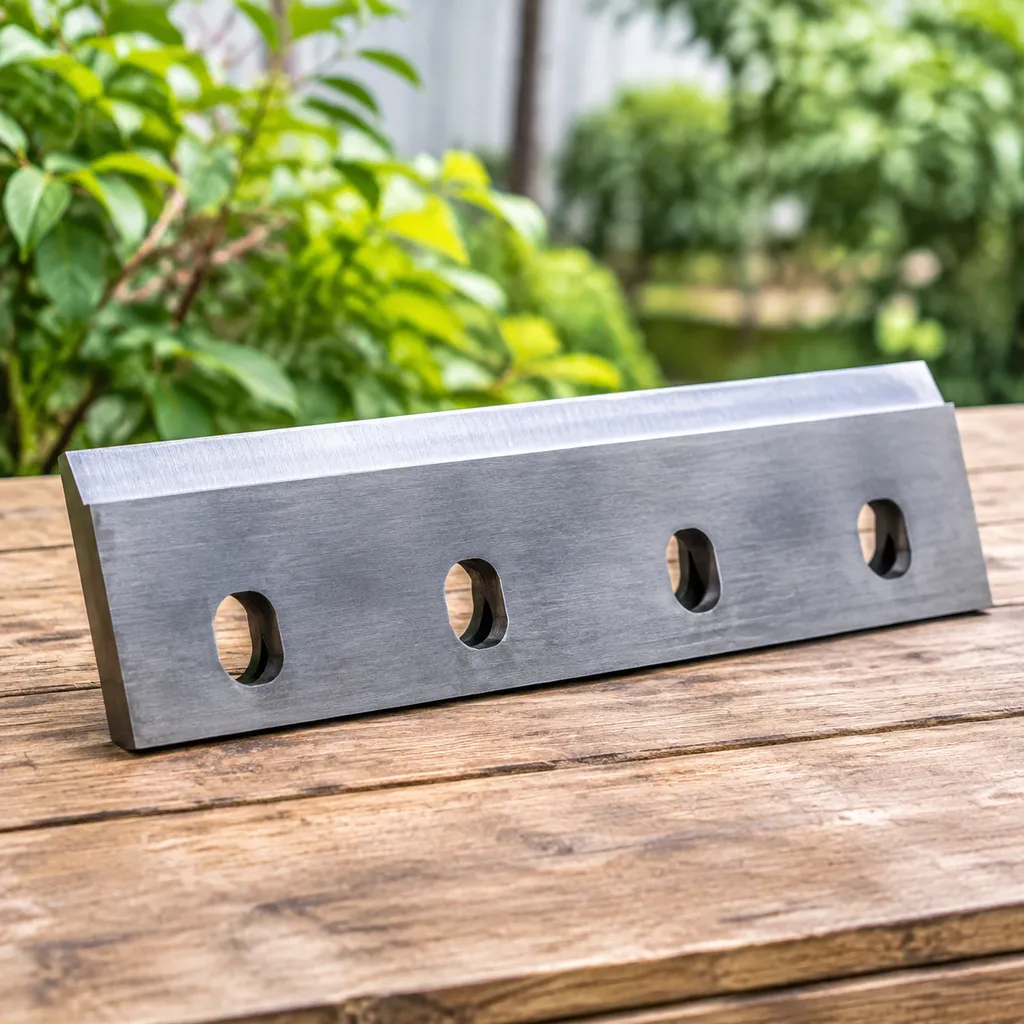
- Stationary Counter Bed Knives: Surface-ground counter blades with multi-edge utility for balanced shear action.
Blade Configurations & Machine Compatibility
We manufacture every stainless steel shredder knife to match exact rotor profiles, shaft geometries, and cutting chamber tolerances across single-shaft, two-shaft, and four-shaft systems.
Precision Rotor Tooling by Machine Type
- Single-Shaft Shredder Tooling: We grind indexable single shaft rotor inserts (flat, concave, and 4-way turnable blocks), matching knife holders, and stationary counter bed knives designed for tight cutting gaps.
- Twin-Shaft & Double-Shaft Setups: We supply multi-claw double shaft shredder cutters, single-hook to multi-hook rotary knives, hex-bore or keyed profiles, and hardened matching spacer rings to maintain side-clearance tolerances under lateral loads.
- Four-Shaft Shredder Systems: We cut heavy-duty quad-shaft shredder knives with aggressive tear-and-shear tooth designs, paired with precision-ground clearing spacers that prevent wet or fibrous material from wrapping around the shaft.
| Machine Configuration | Primary Knife Components | Key Design Features |
|---|---|---|
| Single-Shaft | Square inserts, concave cutters, bed knives | 4-sided indexable edges, threaded bolt seats, tight bed clearance |
| Double-Shaft | Hook blades, multi-tooth discs, spacers | Keyed/hexagonal drive bores, precision-ground side faces |
| Four-Shaft | Tear-and-shear hooks, sizing screens, scrapers | High-torque interlocking claws, integrated clearing spacers |
Direct Drop-In Replacement Compatibility
We precision-machine industrial shredder blades replacement tooling engineered as drop-in fits for major European and international recycling equipment brands:
- Vecoplan: VAZ series square rotor cutters, counter knives, and clamping bars
- Lindner: Micromat and Jupiter series indexable cutting crowns and scraper blades
- Untha: RS-series 4-shaft cutting discs, drive rings, and stationary clearing fingers
- Weima: WLK and Spider series concave inserts and profiled counter knives
- Zerma: ZSS, ZXS, and ZTS rotary knives and wear-resistant bed plates
Each stainless steel shredder knife matches the original mounting dimensions, keyways, and bolt holes, eliminating rotor modifications during maintenance changeouts.
Target Applications & Operating Environments for Stainless Steel Shredder Knives
Wet Plastic Recycling Lines
Water-flushed granulators and shredders face constant liquid abrasion. We engineer corrosion-resistant tooling to maintain cutting tolerances under high-volume wash cycles:
PET bottle washing systems: Knives withstand water spray, caustic wash solutions, and dirt abrasion without rust flakes contaminating plastic flakes.
Agricultural film processing: Our shredder blades for plastic recycling cut contaminated LDPE, mulch films, and woven bags without edge rounding caused by damp soils and water exposure.
Thin-gauge materials: We provide wear-resistant profiles optimized for wet film processing lines that prevent wet plastic from wrapping around the rotor shafts.
Food Waste and Organic Recovery
Acidic feedstocks rapidly destroy non-stainless alloys through acid etching and pitting corrosion:
Organic and wet waste: Handles high-liquid slurries, food scraps, and supermarket waste containing aggressive natural salts and organic acids.
Low pH processing: Blades resist corrosion caused by citric, acetic, and lactic acids found in fruit waste, spoiled dairy, and brewery by-products.
Clean-in-place (CIP) readiness: Surfaces tolerate direct washdowns with steam, detergents, and sanitizing chemicals without oxidation.
Medical and Hazardous Waste Destruction
Regulated waste facilities require total reliability and cross-contamination control:
Sharps and clinical waste: Cleanly shears thick polypropylene sharps containers, hypodermic needles, and medical plastics without edge micro-cracking.
Autoclaved materials: Operates continuously inside hot, moist post-autoclave streams where steam-induced corrosion destroys standard D2 tooling.
Cleanroom scrap: Guarantees zero iron oxide transfer or rust spalling onto cleanroom scrap plastics and medical packaging trims.
Chemical Processing and Battery Recycling
Aggressive chemical environments demand high-hardness martensitic alloys that survive extreme chemical exposure:
Battery casing size reduction: Cuts lithium-ion and lead-acid battery housings exposed to residual electrolytes and acidic residues.
Chemical slurries and wet scrap: Performs consistently in high-salinity baths, industrial sludges, and corrosive wet polymer filtration media.
Custom Manufacturing & Precision Machining Capabilities
When plant operations demand non-standard geometries or drop-in replacements for obsolete equipment, we engineer every stainless steel shredder knife to exact operating requirements. We handle production from custom prototypes to multi-ton replacement orders, ensuring exact dimensional fidelity and metallurgical integrity.
Reverse Engineering & Digital Tooling
If OEM technical prints are unavailable, we reverse-engineer from sample blades—even heavily worn, cracked, or deformed knives:
CAD File Compatibility: We work directly with native 2D and 3D files, including STEP, IGES, DXF, and DWG.
Optical & CMM Scanning: Worn profiles are digitally scanned to map hook curvature, counter-edge bevels, and exact bolt patterns.
Geometry Optimization: We adjust hook entry angles and cutting reliefs to resolve site-specific issues such as material wrapping, wet feedstock slippage, or premature edge chipping.
Shop-Floor Fabrication Processes
Manufacturing tight-tolerance shredder components from high-chromium stainless alloys demands dedicated equipment setups:
CNC Wire EDM: Used for cutting high-precision hex bores, splines, and complex keyway patterns without inducing thermal stress or micro-cracks in the steel.
Multi-Axis CNC Milling: Profiles heavy rotary hooks, pocket seats, and counter-knife clearance bevels in rigid single-setup cycles.
Reciprocating & Rotary Surface Grinding: Delivers edge parallelism within ±0.005 mm and smooth surface finishes (Ra 0.4 to 0.8 µm), eliminating material hang-up during wet processing. For intricate blade geometries, our dedicated precision machining processes guarantee complete dimensional consistency from the first blade to the last.
Material Verification & Integrity Testing
To prevent catastrophic blade failures under heavy shock loads, raw stock goes through strict metallurgical qualification before cutting:
Positive Material Identification (PMI): Optical emission spectrometry verifies precise chromium, molybdenum, and carbon contents against certified alloy grades.
Mill Test Certificates (MTC): Every production run is documented with traceable EN 10204 3.1 certification verifying chemical composition and mechanical properties.
Ultrasonic Flaw Detection: Forged billets undergo non-destructive ultrasonic testing to detect subsurface voids, inclusions, or porosity before rough machining and vacuum hardening.
Quality Control & Pre-Shipment Inspection
We do not dispatch a single stainless steel shredder knife until it clears our four-stage quality gate. In wet recycling and wash-line operations, an out-of-spec blade causes uneven face gaps, accelerates bearing wear, and leads to early mechanical failure. We test every production batch against strict metallurgical and dimensional standards.
CMM Dimensional Verification
Every critical dimension on our rotary shredder knives and counter blades is verified on multi-axis Coordinate Measuring Machines (CMM):
Bore & Keyway Fit: Verified against tight machine-spindle tolerances to eliminate backlash on hex and keyed shafts.
Thickness & Parallelism: Held within ±0.005 mm across the entire profile to prevent cutter binding and ensure zero axial runout when stacked with spacer rings.
Hook & Edge Profiles: Scanned directly against engineering CAD models to guarantee correct grab angles on wet plastics.
Calibrated Rockwell Hardness Mapping
Hardness testing must go beyond a single surface reading. We test multiple zones on every blade:
Cutting Edges: Tested via calibrated digital Rockwell testers to confirm a consistent 54–58 HRC rating for long-term wear resistance.
Core & Mounting Hubs: Tested to verify core structural resilience, ensuring the blade absorbs shock loads without fracturing during high-torque processing.
We apply these same rigorous testing protocols across our other industrial processing tools, including our rubber cutting knives, to maintain zero-defect field performance.
Dynamic Weight Balancing
Mismatched knife weights create severe harmonic vibrations that damage drive shafts and shredder gearboxes:
Individual blades are weight-sorted to gram-level tolerances.
Rotor knife sets are dynamically balanced as matched assemblies, drastically lowering bearing wear during high-RPM operation.
Heavy-Duty Export Packaging
To guarantee that precision-ground edges arrive in factory condition, our export packaging includes:
Edge Protection: Impact-resistant polymer channel guards fitted over all cutting edges and hook points.
Corrosion & Moisture Barrier: Heavy-duty vacuum-sealed barrier film packed with industrial desiccants to eliminate condensation during ocean transit.
Reinforced Enclosures: Custom-bolted, ISPM-15 certified fumigated wooden crates lined with dense foam cutouts to prevent any shifting during transit.
Stainless Steel Shredder Knife RFQ Checklist & Procurement Guide
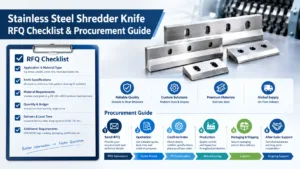
Ordering the correct replacement parts requires exact machine geometry and real plant operating data.
Essential Dimensional Parameters
To machine blades that drop directly onto your rotor or knife bed, we require:
- Outer Diameter (OD) & Tip Radius: Critical for setting rotor-to-bed knife clearances and preventing material wrap.
- Bore Diameter & Profile: Round bore, hexagonal, splined, or keyed shafts.
- Blade Thickness & Face Parallelism: Ground to tight tolerances to eliminate binding in multi-blade setups.
- Keyway Specifications: Width, depth, and corner radius matching DIN 6885 or ANSI standards.
- Hook & Claw Geometry: Hook count, tip angle, and tooth pitch. For granulating wet plastics, review our PET bottle crusher blade design guide for efficient cutting to match cutting profiles to line throughput.
| RFQ Parameter | Required Detail | Operational Impact |
|---|---|---|
| Bore & Keyway | Nominal diameter, key width/depth, tolerances | Rotor fitment, torque transfer, shaft galling prevention |
| Thickness (T) | Tolerance within ±0.005 mm | Spacer matching, axial clearance in multi-hook stacks |
| Material Grade | 440C, 1.4112, 420J2, custom martensitic | Wear life vs. impact resistance balance |
| Hardness Target | 54–58 HRC (core through edge) | Edge retention without catastrophic chipping |
Operational & Feedstock Data
Operating environment dictates whether we specify standard 420-series alloys or high-carbon 440C stainless steel:
- Moisture Content: Feeding dry scrap versus continuous water-spray wash lines.
- Chemical Exposure & pH: Feedstock acidity from food waste, citrus processing, silage film, or industrial battery wash chemicals.
- Thermal Range: Operating temperatures (ambient vs. hot-wash recycling systems up to 90°C).
- Abrasives & Contaminants: Presence of glass, silica, metal fasteners, or dirt in wet plastic streams.
Production Lead Times & Procurement Terms
- Standard Production: 3 to 4 weeks for custom batches and standard replacement profiles.
- Emergency Breakdown Support: 7 to 10 business days expedited turnaround for critical line shutdowns.
- Minimum Order Quantity (MOQ): Single replacement sets (individual knives or full rotor complements) up to full-scale container replenishment programs.
- Documentation Provided: Detailed dimensional inspection sheets, material test reports (MTR), and hardness verification logs shipped with every crate.
Frequently Asked Questions About Stainless Steel Shredder Knives
Why choose 440C stainless steel over standard D2 or SKD11 tool steels?
Standard cold-work tool steels like D2 and SKD11 offer high hardness, but they oxidize rapidly in wet, acidic, or wash-down environments. Moisture and wash line chemicals generate surface rust, leading to micro-pitting along the cutting edge. This dulls the blade prematurely and causes rust spalling that contaminates shredded materials like PET flakes or cleanroom plastics.
A 440C stainless steel shredder knife contains 16% to 18% chromium. This high chromium content forms a continuous, self-healing passive oxide layer that blocks corrosion from caustic detergents, water sprays, and acidic organic feedstocks while still achieving a working hardness of 56 to 58 HRC.
| Property | D2 / SKD11 Tool Steel | 440C Martensitic Stainless |
|---|---|---|
| Chromium Content | 11.0% – 13.0% | 16.0% – 18.0% |
| Corrosion Resistance | Low (rusts quickly in wet lines) | High (resists moisture and wash chemicals) |
| Typical Hardness | 58 – 60 HRC | 55 – 58 HRC |
| Contamination Risk | High (iron oxide flaking) | Zero (sanitary, no rust spalling) |
| Primary Applications | Dry scrap, tires, e-waste | PET wash lines, food waste, organics, cleanrooms |
How do stainless shredder knives maintain toughness without cracking under high torque?
Martensitic stainless steels can become brittle if heat-treated improperly. To deliver high impact resistance without edge fractures, we process our stainless steel shredder blades through specialized vacuum heat treatment cycles followed by controlled, multi-stage tempering:
- Vacuum austenitizing: Uniform heating prevents internal stresses and decarburization across thick blade sections.
- Targeted core tempering: We balance final hardness between 54 and 58 HRC. This keeps cutting edges wear-resistant while leaving sufficient core ductility to absorb sudden impact spikes from tramp metal or dense baled materials.
- Controlled grain refinement: Proper soaking times dissolve coarse chromium carbides evenly, eliminating weak structural planes that trigger chipping under high torsional loads.
Can cutting hook geometry be customized to stop wet plastic slippage?
Yes. Wet plastics—such as post-consumer film, wet agricultural sheeting, and washed PET bottle streams—create a lubricating film that causes material to slip off conventional flat cutting edges.
We machine custom multi-hook and modified rake profiles to solve this issue. Incorporating an aggressive forward-raked claw pulls wet material directly into the cutting zone rather than allowing it to ride over the rotor knives. For operations re-evaluating their tooling layouts, tailoring your plastic shredder blade design for high performance ensures smooth grab, lower motor amperage, and uniform fraction sizing even under high-moisture conditions.
What are the ideal operating clearances between rotary and stationary blades?
Setting the correct blade clearance prevents material jamming, heat buildup, and excessive blade dulling:
- Thin films and wet wash flakes: Maintain a tight clearance between 0.2 mm and 0.4 mm to ensure clean shearing instead of material pulling or stretching.
- Rigid plastics, purgings, and thick parts: Set clearance between 0.5 mm and 1.0 mm to accommodate core deflection and high shearing loads.
- Machining accuracy: We grind our stationary counter bed knives and rotary cutters to a parallelism tolerance within ±0.005 mm. This allows maintenance crews to align the knife gaps accurately across the full chamber width without localized rubbing or blade-to-blade collisions.
How does sub-zero cryogenic treatment increase blade longevity in wet plants?
Standard quenching leaves a percentage of untransformed, retained austenite in high-carbon stainless alloys. Austenite is relatively soft and unstable; under the mechanical shocks of continuous shredding, it can transform unevenly, leading to dimensional movement, internal stress cracks, and premature edge rounding.
By plunging our hardened stainless steel wear parts into deep cryogenic baths (-196°C) between tempering cycles, we convert virtually 100% of retained austenite into stable, wear-resistant martensite. This transformation triggers the precipitation of ultra-fine sub-microscopic carbides throughout the matrix. In wet shredding plants, this structural density prevents micro-wear, reduces cavitation pitting, and extends working sharp life by 30% to 50% between sharpening intervals.