
Formula details
Product Details
Overview
Standard Specifications & Tool Steel Metallurgy
Dimensional Parameters & Manufacturing Tolerances
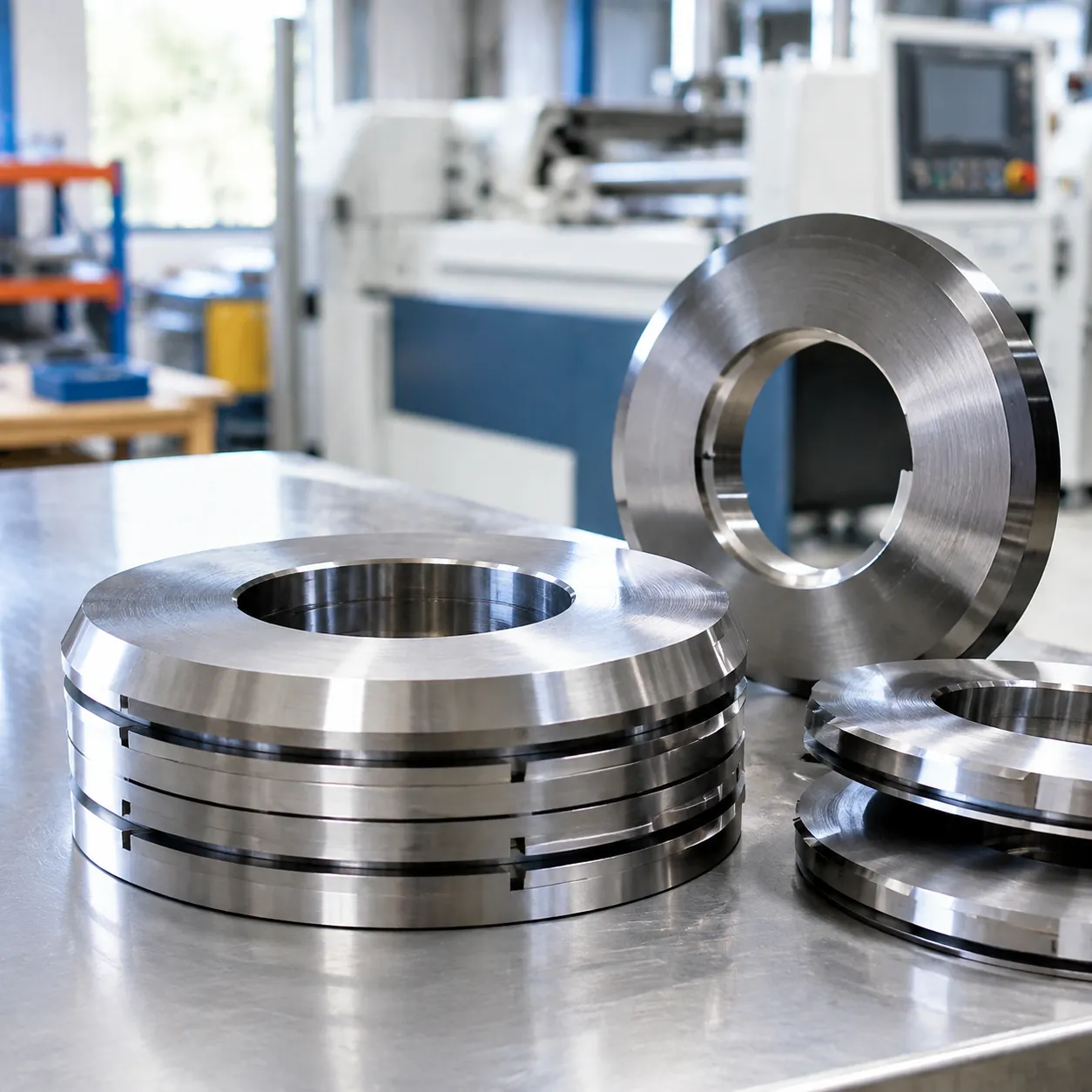
Our standard and custom rotary score slitting blades fit all standard pneumatic knife holders and mechanical slitter assemblies.
| Parameter | Standard Range | Precision Tolerance |
|---|---|---|
| Outer Diameter (OD) | 3.00" – 8.00" (76.2 mm – 203.2 mm) | ±0.0005" (±0.012 mm) |
| Bore / Inside Diameter (ID) | 0.748" – 1.250" (19 mm – 31.75 mm) Plain, Keyed, or Bearing Fit | +0.0002" / -0.0000" (+0.005 mm) |
| Thickness | 0.030" – 0.250" (0.76 mm – 6.35 mm) | ±0.0001" (±0.0025 mm) |
| Lateral Runout (Wobble) | Ultra-flat ground | ≤ 0.0002" (0.005 mm) |
| Edge Profiles | Double Bevel V-Edge (30°–90°), Radius Tip (0.002"–0.030" R), Single Bevel | ±0.5° / ±0.0005" R |
Tool Steel and Solid Tungsten Carbide Grades
Selecting the right alloy ensures maximum wear resistance while preserving your hardened anvil sleeve:
- 52100 High-Carbon Chrome Steel (60–62 HRC): The industry workhorse for standard score cutting. Delivers excellent toughness and predictable wear against 64–66 HRC anvil rolls.
- D2 / 1.2379 High-Carbon, High-Chrome Tool Steel (60–63 HRC): Elevated chromium content provides superior abrasion resistance for mildly abrasive papers, non-wovens, and coated stocks.
- M2 High-Speed Steel (62–65 HRC): High molybdenum and vanadium content resists frictional heat buildup during high-speed, continuous web slitting.
- Solid Tungsten Carbide (88–92 HRA): Micro-grain tungsten carbide designed for high-volume, abrasive converting (fiberglass, magnetic media, abrasive tapes). Yields up to 10–20x the run life of standard tool steel.
Cryogenic Vacuum Heat Treatment & Mirror-Polished Finishing
Our metallurgical processing guarantees structural stability and clean web separation:
- Multi-Stage Vacuum Hardening: Computer-controlled thermal cycling eliminates internal residual stresses, preventing blade warping under pneumatic load.
- Deep Cryogenic Treatment (-300°F): Sub-zero soaking converts retained austenite into stabilized martensite, significantly boosting edge retention and chipping resistance.
- Mirror-Polished Edge Lapping (Ra < 0.1 µm): Superfinished bevels eliminate microscopic grinding serrations and burrs. This friction-free surface minimizes slitting dust generation and prevents adhesive buildup on the knife profile.
Score Cutting Mechanics & Anvil Roll Hardness Matching
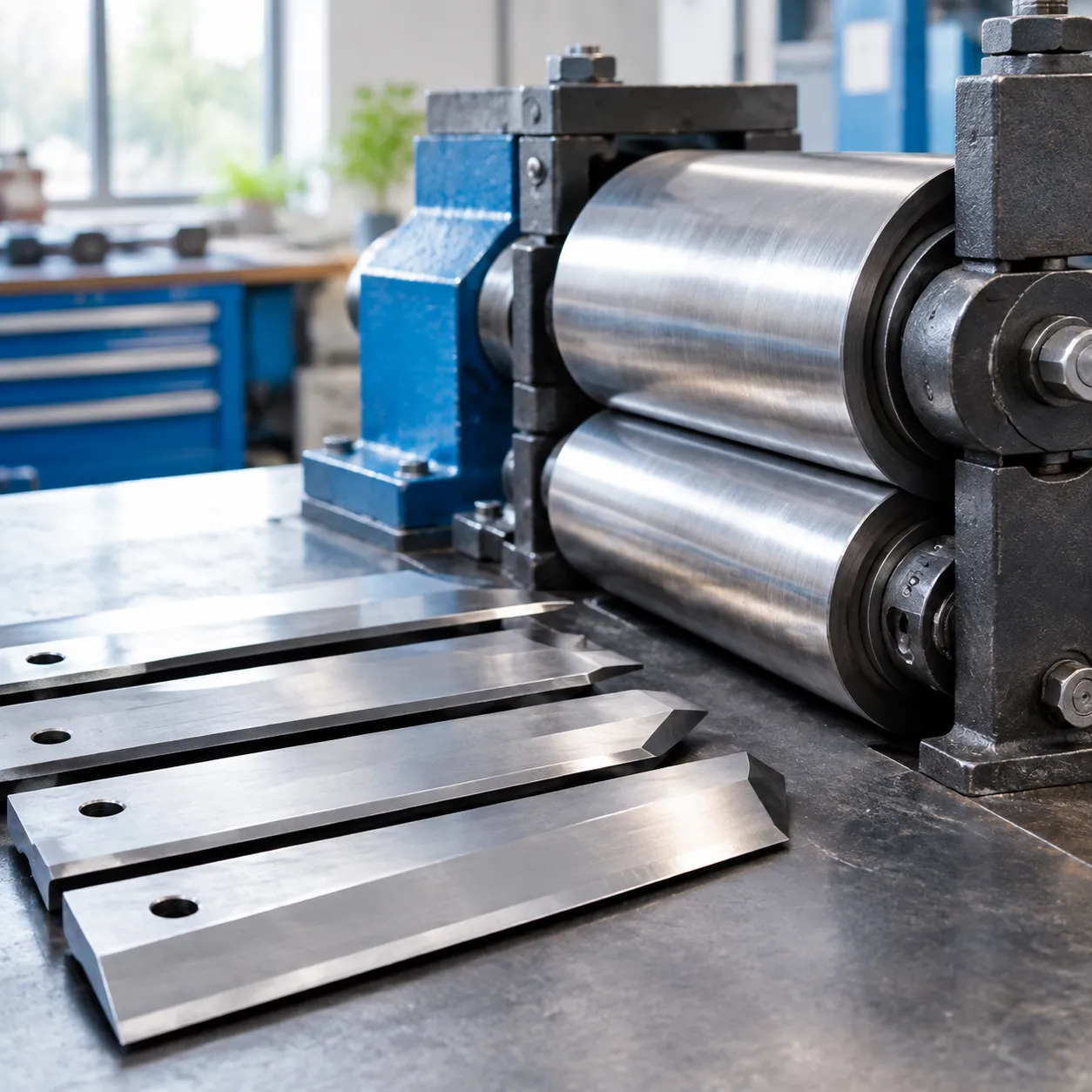
Crush slitting relies on controlled compressive force rather than a scissor-action shear. Our crush cut knives mount into pneumatic knife holders that drive the blade radially against a high-precision, hardened anvil roll. The calibrated air pressure pushes the blade edge through the continuous web, parting fibers, adhesives, or plastic films at the exact pinch line. To dive deeper into how this method compares with other rotary systems, read our comprehensive crush slitting guide.
Hardness Differential Rules to Protect Anvil Sleeves
Improper hardness matching between anvil roll score knives and the backing sleeve leads to rapid roll grooving, edge chipping, and web flutter. We apply strict hardness differential standards across all tooling configurations:
- Sacrificial Blade Principle: In standard steel operations, we temper the score blade 2 to 3 HRC points lower than the anvil sleeve (e.g., a 60–62 HRC blade against a 64–66 HRC sleeve). This preserves the expensive anvil roll while keeping blade replacement costs low.
- Zero-Deflection Carbide Pairing: For abrasive and high-speed synthetic webs, solid tungsten carbide crush slitter blades run against matched carbide sleeves. Both surfaces are micro-honed to prevent micro-welding and grooving under heavy continuous loads. Explore our slitter knife material guide for complete alloy specifications.
Edge Geometry Profiles & Selection
Blade bevel geometry dictates how pressure disperses across the web, directly impacting edge quality and dust creation:
| Profile Style | Typical Geometry | Ideal Substrates | Key Slitting Benefit |
|---|---|---|---|
| Sharp V-Edge (Double Bevel) | 30° to 45° angle, 0.002"–0.005" tip flat | Film, foil laminates, thin paper, release liners | Sharp, clean cut lines with minimal downward pneumatic pressure |
| Radius Ball Tip | 0.010" to 0.035" radius profile | Spunbond non-wovens, bulky textiles, lofted foam | Parts fiber matrices without shredding or creating airborne slitter dust |
| Single Bevel Edge | 45° single angle with flat face | Edge-trimming, multi-layer tape slitting | Allows direct alignment against roll shoulders with minimal lateral drift |
Substrate & Industry Applications for Crush Cut Knives
Non-Woven Fabrics & Medical Disposables
Non-woven webs require a clean parting action that bonds or compresses edges without leaving loose fiber strands or thread fraying.
Hygiene Products: Baby diapers, feminine care products, adult incontinence pads, and elastic waistband laminates.
Medical Disposables: Surgical gowns, masks, drape sheets, wound dressings, and sterile barrier wraps.
Filtration Media: Spunbond, meltblown, and needle-punched synthetic filter webs.
Tapes, Labels & Adhesive Laminates
Pressure-sensitive adhesives (PSA) and multilayer graphics often gum up conventional shear blades. Our score slitting knives part both face stock and adhesive layers cleanly:
Adhesive & Foam Tapes: Double-sided acrylic tapes, closed-cell polyethylene foam tapes, and masking substrates.
Vinyl Graphics & Decals: Cast and calendered vinyls, reflective films, and vehicle wrap films.
Kiss-Cutting Web Lines: Precision score slitting through the upper film or fabric layer while leaving the release liner completely intact.
Paper, Board & Abrasive Sheets
For abrasive, fibrous, or dense web grades, rotary score slitting blades resist high friction and edge chipping. In operations running alongside our specialized paper cutting knives, crush slitting provides rapid setup changes and edge consistency on:
Industrial Papers: Heavy kraft, silicone-coated release papers, asphalt saturated paper, and tube winding stock.
Corrugated & Solid Board: Fluted packaging board, chipboard, and edge-protector laminates.
Abrasives: Sandpaper, emery cloth rolls, and diamond-grit technical webs.
Films, Gaskets & Industrial Textiles
Elastomeric and dense technical materials deform under standard lateral shear pressure. We build heavy-duty score cutters tailored to match the performance of our rubber cutting knives to ensure uniform edge compression without tear-out.
Rubberized Webs & Gaskets: Neoprene, EPDM, silicone sheets, and reinforced rubber stripping.
Technical Foils & Films: Flexible packaging films, copper and aluminum barrier foils, and capacitor dielectric films.
Coated Textiles: Tarpaulins, geotextiles, conveyor belt plies, and fiberglass fabric rolls.
| Substrate Category | Typical Web Materials | Recommended Blade Edge Profile | Key Converting Benefit |
|---|---|---|---|
| Non-Wovens | Spunbond, Meltblown, Airlaid | 60°–90° Sharp V-Bevel | Zero loose filaments; sealed edges |
| Adhesive Tapes | PSA, Foam Tape, Vinyl | 45° Single Bevel / Non-Stick Coated | Prevents adhesive buildup & web drag |
| Paper & Board | Silicone Kraft, Abrasive Sheets | 60° Double Bevel (D2 / Carbide) | High wear life against abrasive coatings |
| Rubber & Gaskets | EPDM, Neoprene, Reinforced Rubber | Radius Ball Tip (0.010"–0.030") | Prevents tear-out and edge blowout |
Direct-Fit Replacements for OEM Slitting Systems
We manufacture direct-fit replacement crush cut knives engineered to drop seamlessly into major OEM slitting assemblies. Our blades match the exact dimensional profiles, mounting bores, and axial tolerances required by high-speed converting machinery, eliminating holder play, runout, and premature edge breakdown.
Compatibility with Tidland and Maxcess Knife Holders
Our Tidland style score cut blades are fully compatible with pneumatic and mechanical holders across all load classes:
- Class I Holders: Ultra-light score slitting knives optimized for narrow-web label, tape, and thin-film slitting.
- Class II Holders: Standard industrial crush cutters built for flexible packaging, paper, non-woven web converting, and general slitting.
- Class III Holders: Heavy-duty pneumatic knife holder blades designed for thick board, rubberized sheet, and high-density industrial laminates.
- Mounting Accuracy: Precision-machined bore seats and pin patterns ensure rapid blade changes without requiring holder recalibration.
Dienes and Mario Cotta Pneumatic Score Assemblies
We produce rotary score slitting blades matched to metric European specifications for both pneumatic and spring-loaded assemblies:
- Dienes Compatible Systems: Direct replacements for PQAS and DS pneumatic score assemblies, ground to sub-micron concentricity tolerances to ensure stable high-speed web tracking.
- Mario Cotta Assemblies: Replacement crush slitter knives tailored for Compact, Gold, and Platinum series holders, maintaining balanced radial loading against the anvil roll.
| OEM System / Brand | Compatible Holder Series | Common Blade Dimensions (OD x ID x THK) | Typical Substrates |
|---|---|---|---|
| Tidland / Maxcess | Class I, II, III Pneumatic | 3.00" x 0.866" x 0.250" / 76.2 x 22 x 6.35 mm | Film, paper, pressure-sensitive tape |
| Dienes | PQAS, DS-60, DS-80 | 76.2 mm x 19.05 mm x 6.35 mm | Non-wovens, silicone paper, foils |
| Mario Cotta | Compact, Platinum, Gold | 77 mm x 22 mm x 6.35 mm / Custom Metric | Textiles, medical non-wovens, laminates |
| Dusenbery / Cameron | Mechanical & Air-Loaded Slitters | 3.00" to 4.00" Custom Diameters | Heavy paperboard, coated stock, adhesives |
Custom Retrofit Blades for Industrial Slitter Rewinders
For converting plants operating mixed-fleet machinery, we engineer custom retrofit score cutting knives for both legacy and current-generation slitter rewinders, including:
- Kampf & Helios: High-speed score slitter knives dynamically balanced for wide-web converting lines.
- Cameron & Dusenbery: Heavy-duty retrofit blades built from wear-resistant tool steels and solid tungsten carbide to replace obsolete OEM part numbers.
- Optimized Assembly Fit: Follow our slitter knife setup guide for precise cutting to maintain correct holder alignment, bearing clearance, and pneumatic pressure settings during blade installation.
Why Converting Plants Trust Precision Crush Cut Knives
Sub-Micron Runout Uniformity and Consistency
Even tiny variations in blade concentricity cause uneven pressure pulses against the anvil shaft during high-speed rotation. This creates premature roll grooving and edge skipping across the web.
- Uniform OD Concentricity: We grind our circular score slitting knives to sub-micron tolerances, ensuring zero wobble and smooth rolling contact under pneumatic load.
- Matched Sets: Every replacement blade matches exact thickness and bore dimensions, allowing seamless integration across multi-gang slitter setups and OEM industrial knives assemblies.
- Stable Web Tracking: True-running rotary score slitting blades eliminate web deflection and chatter, giving you uniform slit edge geometry roll after roll.
Ultra-Fine Edge Honing to Eliminate Slitting Dust
Microscopic burrs and rough grinding marks act like tiny saws, generating unwanted dust and rough edges on non-wovens, films, and paper.
- Mirror-Polished Bevels: We apply multi-stage fine honing down to a mirror finish, removing all grinding serrations and micro-burrs.
- Clean Fiber Separation: Smooth edge radiuses and sharp V-profiles crush and burst substrates cleanly without tearing fibers or fracturing brittle coatings.
- Debris Reduction: Minimizing slitter dust keeps converting lines cleaner, prevents adhesive buildup, and protects print quality downstream.
Full Optical Inspection and Custom Blueprint Manufacturing
Every slitting application has distinct demands for edge angles, bore styles, and metallurgical hardness. We support converting plants with both standard catalog replacements and fully tailored custom machine knives made to exact specifications.
- 100% Non-Contact Optical Metrology: We verify all blade profiles, bevel angles, and radii using high-precision optical measurement systems before shipping.
- Print-to-Part Precision: Send us your CAD drawings, OEM part numbers, or worn samples, and we reproduce direct-fit industrial crush cutters with exact tolerances.
- Material Traceability: Every production lot is tracked from raw tool steel bar to heat treatment and final inspection, guaranteeing reliable cutting performance on every order.
Maximizing Score Knife & Anvil Sleeve Longevity
Premature tool failure during score slitting almost always boils down to excessive loading, improper sharpening, or adhesive contamination. To protect both your crush cut knives and expensive anvil shafts, we recommend standardizing operational maintenance across three critical areas.
Calibrate Pneumatic Downward Pressure
Over-pressurization is the leading cause of chipped knife edges and grooved anvil sleeves. Operators often increase air pressure on pneumatic knife holders to compensate for a dull edge, which accelerates mechanical wear on both contact surfaces.
- Set the minimum effective load: Start at low pressure (15–25 PSI / 1.0–1.7 bar) and incrementally increase force only until the web separates cleanly.
- Match pneumatic holders across the bar: Verify that all pneumatic knife holder blades receive uniform air supply to prevent uneven web tension and localized anvil wear.
- Dampen mechanical vibration: Ensure the knife holder guide bars and dovetail mounts remain rigid to eliminate high-frequency chatter that causes micro-fractures along the blade profile.
| Parameter | Recommended Operational Setting | Common Failure Risk If Exceeded |
|---|---|---|
| Pneumatic Pressure | 1.0 – 2.5 bar (15 – 35 PSI) depending on substrate | Blade edge flattening, anvil roll grooving |
| Hardness Differential | Blade should be 2–4 HRC softer than anvil sleeve | Rapid sleeve gouging and severe downtime |
| Radial Runout | Under 0.005 mm (0.0002") | Uneven cut depth, partial web perforation |
Precision Regrinding Without Temper Loss
Resharpening score cut circular knives requires maintaining the exact factory edge geometry—whether a sharp V-edge or a specific radius tip—without introducing thermal stress.
- Use flood coolant grinding: Dry grinding generates localized heat exceeding 200°C (392°F), drawing the temper out of 52100 or D2 steel and softening the cutting edge.
- Restore original profile dimensions: When regrinding tools like our industrial corrugator slitter scorer knife units and standard crush cutters, maintain precise bevel angles to ensure consistent crush-force distribution.
- Establish maximum OD reduction limits: Retire blades once repeated sharpening reduces the outer diameter past the adjustment stroke of your slitting assembly.
Cleaning, Lubrication, and Anti-Stick Maintenance
Converting adhesive tapes, label stock, and foam materials leads to adhesive transfer on the blade flanks. Sticky buildup increases friction, causes web drag, and pulls the material off-track.
- Install felt oiler wicks: Use lightweight mineral oil or food-grade silicone wicks on the knife holder to continuously lubricate the blade body during high-speed runs.
- Implement automated solvent baths: Soak dismounted blades in targeted non-chlorinated cleaners to dissolve glue, polymer residue, and dust without corroding the steel matrix.
- Apply non-stick surface treatments: For extreme tack substrates, specify PTFE, nickel-Teflon, or DLC-coated rotary score slitting blades to minimize cleaning downtime and web wrap-ups.
Frequently Asked Questions About Crush Cut Knives
What is the difference between crush slitting and shear slitting?
Crush slitting (also known as score slitting) presses a single rotating knife against a hardened anvil roll under controlled pneumatic pressure to fracture or part the web. In contrast, our shear slitting knives utilize an overlapping top and bottom blade setup that cuts material using a scissor-action mechanism.
| Feature | Crush Slitting (Score Cut) | Shear Slitting |
|---|---|---|
| Tooling Setup | Single knife pressed against an anvil sleeve | Interlocking male top knife & female bottom knife |
| Primary Mechanism | High-pressure compression & material parting | Scissor-like dual-edge shearing |
| Setup Time | Fast repositioning along a solid anvil roll | Precise clearance and overlap calibration required |
| Best Used For | Non-wovens, pressure-sensitive tape, asphalt, foams | Clean edge cuts on paper, thin foil, multi-layer films |
How to choose between a sharp V-point and a radius tip profile?
Selecting the right edge geometry depends directly on your material thickness, density, and backing:
- Sharp V-Point Blades (30° to 45° included angle): Best for pressure-sensitive tapes, thin films, silicone-coated release papers, and clean separation on lighter webs. They offer minimal penetration resistance and crisp slit lines.
- Radius Ball Tip Blades (0.005" to 0.040" radius): Designed for non-woven fabrics, heavy technical textiles, fiberglass, and fibrous materials. The rounded tip crushes the fiber structure without piercing the web prematurely or cutting grooves into your anvil sleeve. Refer to our comprehensive how to choose slitting knives guide for detailed substrate matching charts.
How do I prevent crush cut knives from damaging my anvil roll?
Premature anvil wear and grooving stem from mismatched hardness, excessive side runout, or excessive air pressure. We recommend following these three plant standards:
- Maintain Hardness Differential: Always ensure the anvil roll or sleeve is 2 to 4 HRC harder than the crush blade. For example, pair a 60–62 HRC 52100 chrome steel knife with a 64–66 HRC D2 or carbide anvil roll.
- Calibrate Minimum Pneumatic Pressure: Set knife holder regulators to the lowest pressure required to achieve a clean cut (typically 20 to 45 PSI), rather than running holders at maximum line pressure.
- Check Holder Alignment: Ensure pneumatic knife holders are mounted 100% perpendicular to the anvil surface to prevent side loading and point gouging.
Can replacement blades be produced directly from worn physical samples or CAD files?
Yes. We manufacture custom and standard crush cutters directly from CAD blueprints (.DXF, .DWG, .STEP) or physical samples sent to our facility. Our engineering team utilizes optical profile comparators, coordinate measuring machines (CMM), and metallurgical analysis to reverse-engineer exact bore geometries, bearing hub recesses, edge bevel profiles, and material compositions.
What surface coatings are recommended for slitting adhesive and sticky substrates?
When processing pressure-sensitive adhesives (PSA), foam tapes, or hot-melt coated substrates, adhesive buildup along the blade flank increases friction, causes edge tear-out, and forces line shutdowns. We apply several specialized coatings to prevent tack:
- PTFE / Fluoropolymer (Teflon-type): Excellent release properties against rubber-based and acrylic adhesives during continuous tape slitting.
- Titanium Nitride (TiN): Hard gold ceramic layer (approx. 2300 HV) that reduces friction, resists adhesive grab, and extends working edge life up to 3x over bare tool steel.
- Diamond-Like Carbon (DLC): Ultra-low friction coefficient with extreme surface hardness, ideal for abrasive adhesives and high-speed rotary converting.