
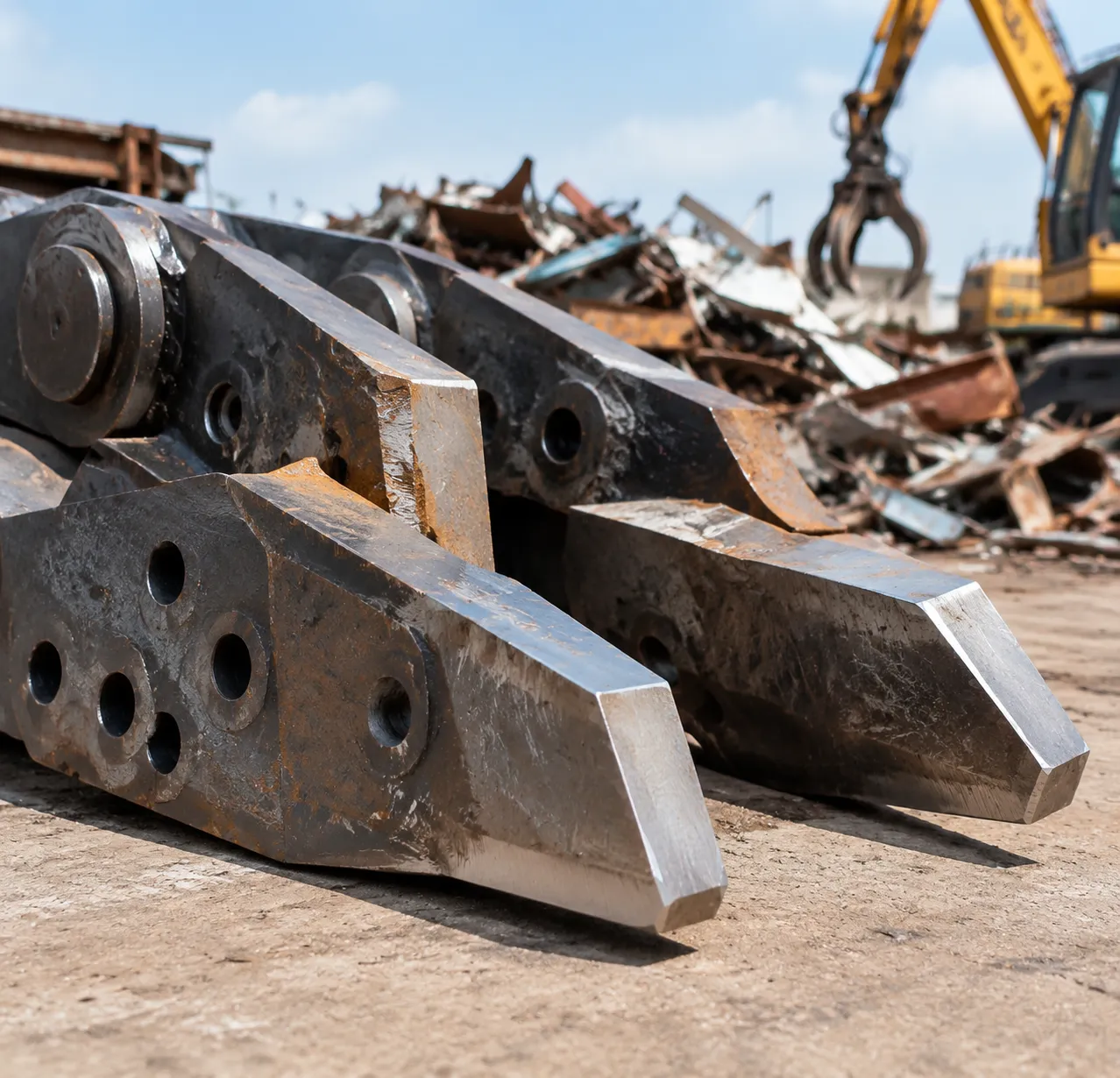
Formula details
Product Details
Overview
Scrap Shear Blade Types
Mobile Scrap Shear Blades
Designed for excavator-mounted hydraulic shears working in structural demolition, rebar processing, and mobile scrap processing. We supply complete blade configurations to restore cutting performance:
Primary and Secondary Cutting Blades: Main shearing edges engineered for high-shock plate and structural steel cutting.
Piercing Tips (Puncture Knives): High-impact front blades for initial metal penetration.
Guide Blades and Cross Blades: Stabilizing knives designed to maintain proper jaw alignment and clean material severance.
Stationary Scrap Shear Blades
Engineered for high-tonnage stationary scrap shears and container shears. These knives process continuous, high-volume streams of heavy scrap, mixed metal profiles, and heavy beams without edge deformation.
Guillotine Shear Knives
Heavy-duty straight knives built for guillotine-style scrap shears. Precision-ground cutting faces ensure exact clearance across long blade lengths, preventing material jamming and excessive machine wear during continuous cycles.
Baler Shear Blades
Replacement knives specifically designed for scrap metal baling machines. These blades pre-cut oversized scrap at the loading box threshold to allow efficient compression and dense bale formation.
Alligator Shear Blades
Robust blades engineered for mechanical and hydraulic alligator (crocodile) shears. Ideal for manual scrap sorting, rod cropping, cleaning non-ferrous materials, and breaking down long stock.
Wear Parts and Blade Fasteners
Proper blade performance relies on secure seating and correct alignment. We supply industrial-grade mounting hardware and protection components:
High-Tensile Blade Bolts & Nuts: Heavy-duty fasteners treated to resist vibration, high shearing forces, and loosening.
Precision Shims: Calibrated thickness shims for fine-tuning blade gap clearances.
Wear Plates & Liner Kits: Replaceable protection plates to prevent structural wear on shear jaws and blade housings.
Applications for Scrap Metal Shear Blades
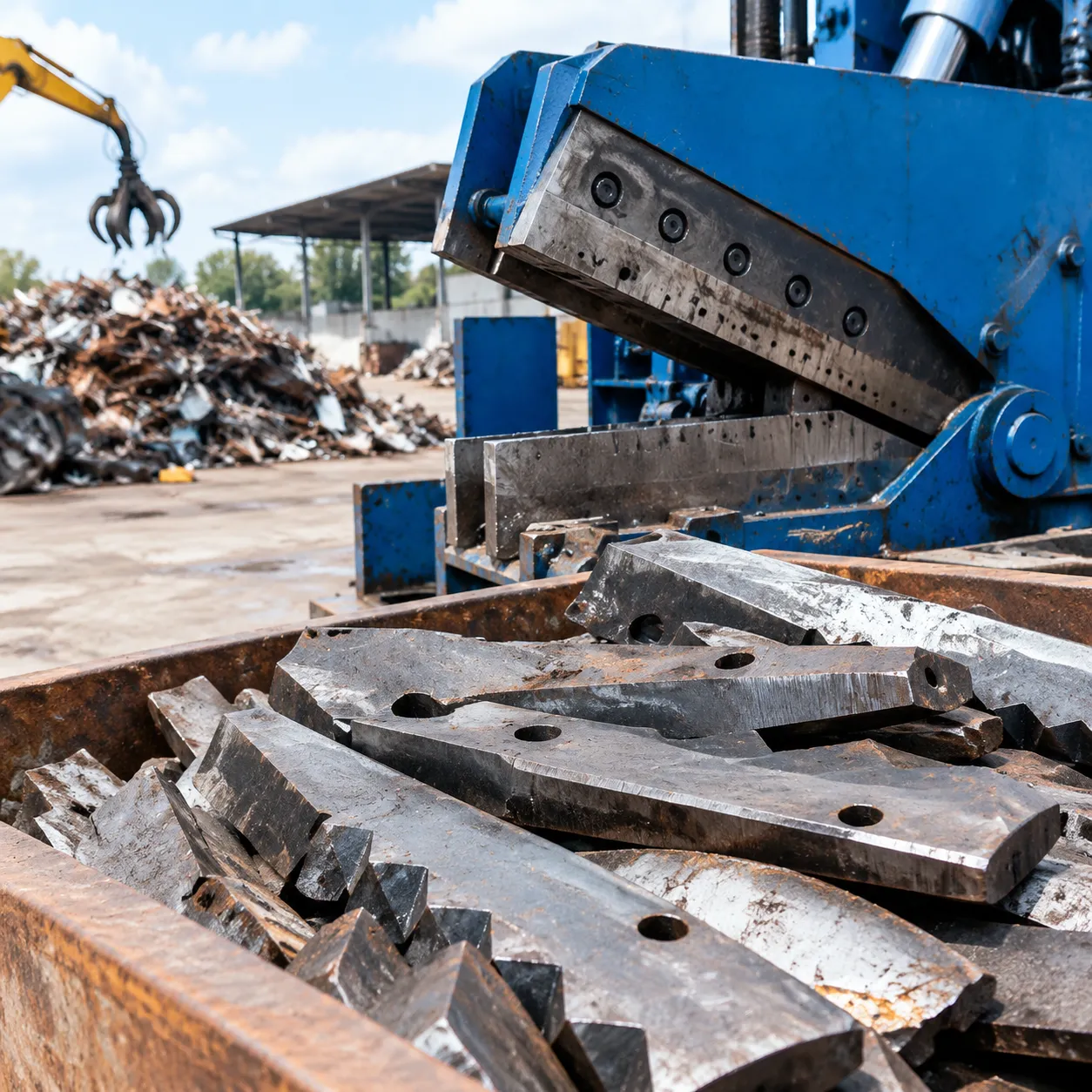
Metal Recycling
In high-volume recycling facilities, processing mixed metals quickly without edge rolling or premature chipping is critical. We manufacture metal recycling shear blades that handle:
- Ferrous scrap: Carbon steel plates, structural beams, rebar, pipes, and tubing.
- Non-ferrous materials: Heavy copper busbars, aluminum extrusions, brass, and alloy castings.
- Mixed metal bales: Compacted scrap requiring deep-penetration cutting power.
Demolition and Deconstruction
Demolition attachments encounter severe side loading, unpredictable materials, and high-shock conditions. Our demolition shear blades are built to survive extreme site tasks:
- Dismantling steel structures: Cutting I-beams, H-beams, channel iron, and angle steel on excavator-mounted shears.
- Infrastructure removal: Slicing through reinforced concrete rebar, steel bridge sections, and industrial framing.
- Decommissioning plants: Sectioning storage tanks, pipe racks, and heavy machinery chassis on-site.
Scrap Yard Processing
Scrap yards rely on stationary and mobile shears to prepare raw scrap for mill specifications. We provide durable scrap processing knives tailored for:
- Primary resizing: Sizing oversized plate steel and heavy structural sections into manageable furnace feed.
- Automotive dismantling: Shearing vehicle frames, axles, suspension assemblies, and body panels.
- Continuous baler shearing: Cleanly cropping scrap metal charges inside automatic balers and logging shears.
Industrial Steel Cutting
Heavy manufacturing, shipbreaking, and steel fabrication require rigid dimensional stability and wear resistance under steady production cycles. Our industrial metal cutting blades provide clean, repeatable cuts for:
- Shipbreaking yards: Sectioning heavy-gauge ship hull plates, bulkheads, and maritime structural members.
- Railroad processing: Cutting decommissioned rail tracks, railcar frames, and wheel axles.
- Plate and profile cutting: Cropping off-cuts, plate skeletons, and production overruns in steel service centers.
Compatible Shear Equipment and Replacement Fitment
We manufacture direct-fit scrap metal shear blades and replacement knives engineered to match original factory dimensions, bolt patterns, and seat tolerances across all major recycling machinery.
Supported Shear Equipment Types
Our tooling fits a full range of scrap processing and demolition machinery:
- Mobile Demolition & Scrap Shears: Primary cutting blades, secondary blades, piercing tips, guide blades, and cross blades for boom- and stick-mounted excavator attachments.
- Stationary & Guillotine Shears: Heavy-duty knives for stationary scrap shears and high-capacity container shears.
- Scrap Metal Balers: Shear knives for integrated baler-shear units and scrap compaction systems.
- Alligator Shears: High-impact replacement blades for crocodile shears used in metal yard sorting and pre-cutting.
Potential Equipment Brand Compatibility
We supply factory-direct replacement knives and wear parts fully compatible with leading industry equipment brands, including:
- Mobile Attachments: Genesis, LaBounty, Caterpillar, Rotar, Trevibenne, Arden, Okada, and Zato.
- Stationary & Baler Shears: Lindemann, Harris, Lefort, Copex, Sierra, and Vezzani.
Our precision-machined scrap shear blades ensure complete interchangeability with OEM assemblies, eliminating housing modification and reducing installation downtime.
Information Required for Compatibility Confirmation
To ensure a seamless fit for standard replacements or custom knife fabrications, provide the following specifications when requesting fitment verification:
- Machine Details: Equipment manufacturer, attachment model, and shear serial number.
- Blade Position: Primary blade, secondary blade, guide knife, piercing tip, or side wear liner.
- Dimensional Data: Overall length, width, thickness, bevel angle, bolt hole spacing (center-to-center), and countersink profile.
- Drawings or Samples: 2D/3D CAD drawings (PDF, DWG, STEP) or physical sample parts for reverse engineering.
- Application Demands: Target processing material (structural steel, rebar, plate, or mixed scrap) to fine-tune alloy selection and heat treatment.
Blade Materials and Steel Grades for Scrap Metal Shear Blades
The service life of scrap metal shear blades depends directly on alloy chemistry and structural toughness. We manufacture our replacement knives from certified tool steel grades selected to withstand extreme shock loads, prevent premature edge chipping, and resist abrasive wear during continuous scrap processing.
1.2746 / 45NiCrMoV16-6 Tool Steel
1.2746 is our primary alloy for heavy-duty metal recycling shear blades. This nickel-chrome-moly-vanadium tool steel provides maximum impact toughness, excellent core strength, and superior resistance to mechanical cracking when cutting structural steel profiles, rebar bundles, and heavy demolition beams.
1.2767 / 45NiCrMo16 High-Strength Steel
1.2767 delivers high shock resistance and through-hardenability. We utilize this alloy for scrap cutter blades operating in high-impact stationary and mobile shears where structural flex and sudden shock loads require superior fracture toughness.
H13 / 1.2344 Hot-Work Steel
H13 hot-work tool steel features balanced wear resistance and thermal fatigue strength. We use this grade for high-duty-cycle scrap processing knives that generate elevated cutting-zone friction temperatures, preventing edge softening during rapid shearing cycles.
D2 / 1.2379 High-Wear Tool Steel
D2 is a high-carbon, high-chromium tool steel engineered for severe abrasive wear. We apply D2 in cleaner, uniform scrap processing applications where maximizing edge retention is the primary goal. You can review our detailed D2 steel heat treatment process to see how precision thermal cycling enhances carbide distribution.
Material Selection Guidance for Scrap Processing
Matching the right steel grade to your scrap stream prevents premature blade failure and reduces operational downtime:
| Steel Grade | Hardness Range | Primary Strengths | Recommended Scrap Applications |
|---|---|---|---|
| 1.2746 | 54 – 58 HRC | Maximum impact toughness, anti-chipping | Heavy demolition, I-beams, mixed structural steel |
| 1.2767 | 52 – 56 HRC | High fracture toughness, shock absorption | Heavy mobile shear primary blades, thick plate |
| H13 / 1.2344 | 52 – 55 HRC | Thermal stability, balanced toughness | High-speed balers, continuous shear cycles |
| D2 / 1.2379 | 56 – 60 HRC | High abrasion resistance, edge retention | Sheet scrap, non-ferrous metals, uniform sizing |
Heat Treatment and Hardness for Scrap Metal Shear Blades
Thermal processing determines how scrap metal shear blades perform under extreme mechanical stress. We use advanced thermal cycling to ensure every blade withstands severe impact without premature cracking or rapid edge blunting.
Vacuum Heat Treatment Process
Our blades undergo a multi-stage vacuum heat treatment cycle designed for heavy-duty alloy tool steels:
- Vacuum Furnace Heating: Uniform heating prevents surface decarburization, scaling, and oxidation, preserving precise metallurgical integrity.
- Controlled Quenching: High-pressure gas quenching provides uniform through-hardening across thick-section demolition shear blades.
- Multi-Stage Deep Tempering: Repeated tempering cycles relieve internal stress, refine the microstructure, and stabilize the blade core against high shock loads.
Target Hardness Selection (52–58 HRC)
We engineer the hardness of our replacement shear blades specifically for the target cutting application:
| Hardness Range | Optimal Applications | Key Advantage |
|---|---|---|
| 52 – 54 HRC | Heavy demolition, I-beams, rebar, mixed scrap | Superior impact toughness; prevents catastrophic blade chipping under shock loads |
| 55 – 56 HRC | General scrap yard processing, mobile hydraulic shears | Balanced performance for versatile cutting and dependable edge retention |
| 57 – 58 HRC | Stationary guillotine shears, balers, sheet metal shearing | Maximum wear resistance and edge life in continuous, abrasive recycling cycles |
Balancing Edge Toughness and Wear Resistance
Scrap metal processing requires a precise balance between hardness and impact resistance:
- Preventing Edge Chipping: Excessively hard blades fracture when encountering hardened pins or structural cross-sections. Our heat treatment maintains core elasticity to absorb sudden lateral deflection.
- Preventing Mushrooming & Deformation: Insufficiently treated blades deform and roll over at the cutting edge, increasing cutting gap clearance and jamming the shear.
- Extended Wear Life: Controlled metallurgical grain refinement delivers uniform wear across all cutting faces, maximizing runtime before blade indexing or replacement is required.
Manufacturing Process for Scrap Metal Shear Blades
| Stage | Process Focus | Key Equipment / Method | Quality Objective |
|---|---|---|---|
| 1. Engineering Review | Drawing & sample verification | CAD modeling, coordinate measurement | 100% OEM fitment accuracy |
| 2. Primary Machining | Milling, profiling, and hole drilling | Multi-axis CNC milling centers | Precise bolt hole alignment and bevels |
| 3. Thermal Treatment | Hardening and multi-stage tempering | Vacuum atmospheric furnace | Uniform 52–58 HRC core toughness |
| 4. Precision Grinding | Face, edge, and seat finishing | CNC surface and profile grinders | Strict thickness & parallelism tolerances |
| 5. Final QC | Hardness, fit, and visual inspection | CMM, ultrasonic & hardness testers | Defect-free, direct drop-in replacement |
Technical Drawing and Sample Review
Every blade begins with detailed engineering verification. We review OEM part numbers, 2D/3D CAD drawings, or physical worn samples provided by clients. Our engineers map out critical dimensions, countersink angles, cutting edge reliefs, and bolt pitch patterns to ensure full compatibility with your mobile or stationary shear housing.
Precision CNC Machining and Hole Drilling
We mill raw tool steel blocks using advanced CNC centers to create exact blade profiles, accurate bevels, and countersunk mounting holes. Our precision machining processes maintain tight tolerances across every bolt hole, ensuring bolts seat securely to eliminate movement and vibration under high-load cutting conditions.
Controlled Vacuum Hardening and Tempering
Thermal processing defines the working life of industrial metal cutting blades. We utilize multi-stage vacuum heat treatment followed by repeated tempering cycles. This computer-controlled process hardens the steel cleanly without surface decarburization, yielding a balanced 52–58 HRC structure that resists chipping under severe shock loads.
Precision Surface and Edge Grinding
After heat treatment, our heavy-duty CNC surface grinders machine all flat surfaces and cutting edges. We grind mounting faces perfectly parallel to prevent high spots and uneven pressure inside the blade seat. Primary and secondary cutting edges are ground to exact rake angles for clean scrap processing and lower cutting resistance.
Quality Inspection and Dimensional Verification
Every batch undergoes strict inspection under our standard quality control protocols. We test surface and core hardness, verify all critical dimensions via precision gauges and coordinate measuring machines, and check surface finishes before coating the blades with rust preventative oil for secure transit.
Design Features for Longer Scrap Metal Shear Blades Service Life
Reversible and Multi-Edge Designs
To maximize wear life, we design our mobile and stationary scrap shear blades with indexable, multi-edge configurations:
Four-Edge Usability: Rectangular cutting knives feature four identical, sharp edges. Once an edge wears down, operators simply rotate the blade to expose a fresh cutting surface.
Two-Edge Profiles: Specialized profiles and secondary shear blades feature reversible cutting faces to double service life before replacement.
Quick Rotation: Uniform mounting hole centers and tapped patterns allow fast edge changes directly on-site, keeping downtime minimal.
Impact-Resistant Blade Geometry
Cutting heavy structural steel, rebar, and mixed scrap demands a balance between cutting ease and structural mass.
Optimized Rake and Relief Angles: Our edge geometry reduces cutting resistance and prevents scrap from binding or wedging in the shear jaw.
Reinforced Cutting Corners: Chamfered transitions and stress-relieved cutting edges prevent corner chipping under unpredictable shock loads.
Piercing Tip Contours: Heavy-duty demolition tips are shaped for deep plate penetration, distributing shock loads across the main jaw rather than concentrating stress on the fasteners.
Precision Seating and Flatness Control
Blade failure often starts at the seat, not the cutting edge. We finish all mounting surfaces with precision CNC surface grinding:
True Flatness Tolerances: Tight tolerances ensure 100% surface contact against the blade seat, eliminating micro-movements during the stroke.
Elimination of Bolt Shear: Proper seat contact stops blade flex, which is the primary reason mounting bolts loosen, stretch, or shear off under load.
Protection for Machine Jaws: Flush seating prevents scrap debris from migrating behind the blade, saving the shear arm housing from expensive wear and rework.
Application-Specific Configuration
| Component Type | Design Feature | Operational Benefit |
|---|---|---|
| Primary Cutting Blades | 4-edge reversible block design | Maximum tonnage per blade before disposal |
| Piercing Tips | High-mass, reinforced geometry | High-impact plate and structural penetration without shattering |
| Secondary & Guide Blades | Precision-ground parallel edges | Clean material shear alignment, preventing blade overlap friction |
| Cross / Nose Blades | Beveled relief angles | Clean shearing at the tip of the jaw without material wedging |
Sharkcutting Replacement and Custom Blade Services
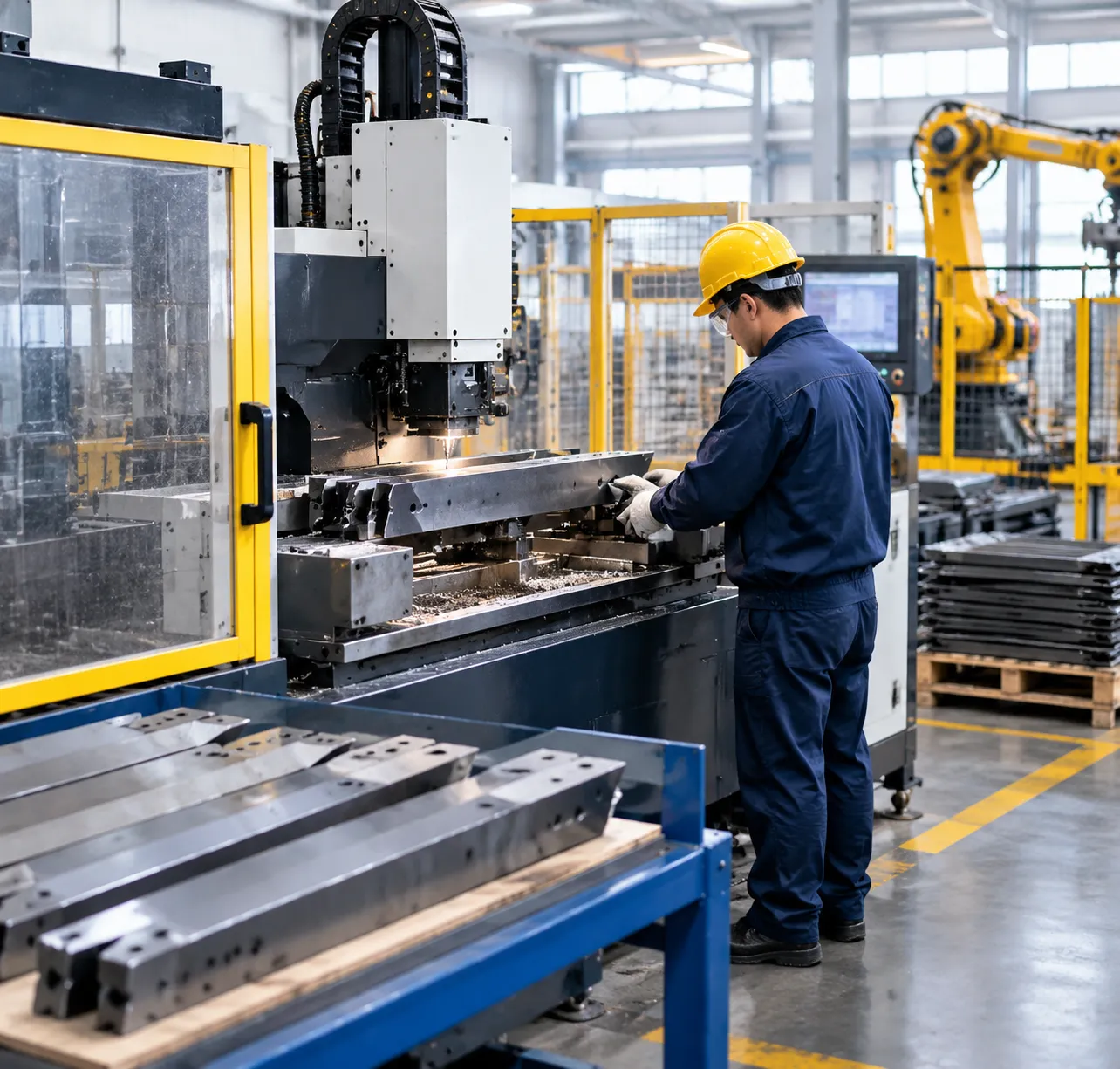
We provide comprehensive manufacturing services for scrap metal shear blades, supplying scrap yards, demolition contractors, and equipment dealers worldwide. Whether you need standard replacement knives or specialized cutting tooling, we handle the entire process from alloy selection and CNC machining to vacuum heat treatment and precision grinding.
OEM Replacement Blades
Our direct-fit replacement blades match the exact dimensions, bolt patterns, and tolerances of original scrap shear brands. We supply precision-engineered sets for:
- Mobile Excavator Shears: Primary and secondary cutting blades, piercing tips, guide blades, and cross blades.
- Stationary & Guillotine Shears: Heavy-duty upper and lower cutting knives.
- Balers & Alligator Shears: Reversible straight blades engineered for continuous high-cycle cutting.
Every replacement blade seats flush in the machine housing, preventing bolt shearing and premature pocket wear.
Custom Scrap Shear Blade Manufacturing
If your equipment requires non-standard tooling or modifications for extreme wear environments, we manufacture custom shear blades tailored to your operational demands.
- Production from Drawings: Send us your 2D/3D CAD files (.DWG, .DXF, .STEP) for exact production.
- Sample Replication: Provide a physical sample (new or worn), and our technical team will reverse-engineer the exact profile, hole pattern, and counterbore depths.
- Application-Specific Geometry: We adjust bevel angles, clearance profiles, and cutting-edge configurations to match your primary feed material.
Small-Batch and Repeat Orders
We support both one-off custom prototypes and full fleet production runs with consistent batch-to-batch repeatability.
- No Restrictive Minimums: Flexible order quantities tailored to single-machine operators and large processing yards.
- Archived Tooling Specs: We store your technical drawings and heat-treatment parameters in our system to ensure fast turnaround on repeat orders.
- Full Recycling Support: Alongside scrap shear tooling, we support facilities running multi-stage size reduction systems with heavy-duty shredder blades and related wear components.
Protective Packaging and International Delivery
Heavy industrial blades require secure handling to prevent edge damage and surface oxidation during transit. Every shipment undergoes a rigorous export-packing standard:
- Anti-Corrosion Coating: Heavy rust-preventative oil application on all ground surfaces.
- Edge Protection: High-impact edge guards to protect precision cutting bevels.
- Reinforced Wooden Crating: Custom, ISPM-15 compliant wooden cases built to withstand ocean, air, and freight transport directly to your facility or job site.
Why Choose Sharkcutting for Scrap Metal Shear Blades?
We engineer heavy-duty scrap metal shear blades that withstand severe impact loads, reduce machine downtime, and lower your overall processing cost per ton. By controlling every stage of production from raw alloy selection to precision grinding, we deliver industrial cutting tools that match or exceed OEM specifications. Discover more about why Sharkcutting is trusted by scrap yards, recycling facilities, and demolition contractors globally.
Factory-Direct Manufacturing
Dealing directly with our manufacturing facility eliminates distributor markups and communication delays.
Direct access to our engineering team for custom drawings and technical modifications
Complete production traceability from raw forged tool steel to finished blade
Fast turnaround on both standard replacement knives and custom fabrication orders
Application-Focused Material Selection
We do not use a one-size-fits-all approach. We select tool steel grades based specifically on your processing conditions, equipment type, and scrap profile:
1.2746 (45NiCrMoV16-6): High nickel-chrome-moly alloy offering maximum toughness for severe-impact demolition shearing.
1.2767 (45NiCrMo16): Exceptional shock resistance for heavy structural steel and mixed scrap cutting.
H13 & D2: Premium wear-resistant alloys engineered for abrasive scrap streams and stationary baler knives.
Precision Replacement Fit
Improper blade seating leads to loose bolts, uneven wear, and cracked knife seats. We utilize CNC milling and tight surface grinding tolerances to ensure every replacement shear blade fits flush into your machine's jaw or housing. This precise fitment protects your shear structure and extends fastener life.
Reduced Equipment Downtime
Blade failure halts processing lines and excavators. Our computer-controlled vacuum heat treatment and deep tempering cycle balance core toughness with edge hardness (typically 52–58 HRC). This prevents catastrophic blade fracturing, chipping, and premature edge rollover during heavy scrap shearing.
Lower Cost per Cutting Edge
We optimize blade profiles with reversible, multi-edge geometries (up to 4 cutting edges per blade). When an edge wears down, simply index the blade to a fresh cutting face. Combined with high-wear metallurgy, this maximizes total operating hours between replacements.
| Performance Feature | Standard Market Blades | Sharkcutting Scrap Shear Blades |
|---|---|---|
| Manufacturing Source | Third-party trading suppliers | 100% Factory-direct fabrication |
| Material Verification | Generic tool steel alloys | Certified 1.2746 / 1.2767 / H13 tool steels |
| Heat Treatment | Conventional batch hardening | Controlled multi-stage vacuum heat treatment |
| Hardness Control | Broad hardness variations | Targeted 52–58 HRC core-to-edge balance |
| Dimensional Tolerance | Standard machining tolerances | CNC precision ground for flush housing seat |
| Cutting Economy | Single-edge or rapid wear edges | Indexable multi-edge designs for lowest cost-per-cut |
How to Order Scrap Metal Shear Blades
Ordering custom or replacement scrap metal shear blades directly from our factory is a straightforward process. We work closely with scrap yard managers, demolition teams, and equipment operators worldwide to deliver precise fitment and fast turnaround times.
| Step | Phase | Action Required | Key Deliverables |
|---|---|---|---|
| 01 | Machine Details | Share shear brand, model, and blade position | Fitment validation |
| 02 | Technical Data | Provide 2D/3D drawings, OEM part numbers, or dimensions | Engineering review |
| 03 | Material Selection | Match alloy steel (1.2746, 1.2767, H13) and hardness | Optimized wear life |
| 04 | Commercial Quote | Review pricing, lead times, and terms | Direct factory quotation |
| 05 | Manufacturing | CNC machining, vacuum heat treatment, grinding | Full QC inspection report |
| 06 | Logistics | Export packaging and international dispatch | Tracking & installation support |
Step 1: Provide Machine and Blade Details
Start by sharing your equipment type and blade requirements:
Equipment brand and model (mobile demolition shear, baler, guillotine, or alligator shear).
Blade position on the jaw (primary cutting blade, piercing tip, guide knife, or secondary blade).
Current processing challenges, such as premature chipping or abrasive edge wear.
Step 2: Submit Technical Drawings or Measurements
To guarantee an exact seat fitment, we accept several specification formats:
CAD/2D Drawings: Detailed dimension prints showing hole spacing, bevel angles, and counterbore profiles.
OEM Part Numbers: Direct cross-referencing for standard shear knives and fasteners.
Physical Samples or Hand Measurements: Critical lengths, widths, thicknesses, and hole center-to-center distances.
Step 3: Confirm Material and Hardness Specifications
We help you configure the optimal metallurgy based on your typical scrap feed:
1.2746 / 45NiCrMoV16-6: High-toughness alloy for heavy-impact structural steel cutting.
1.2767 / 45NiCrMo16: High-shock alloy suited for mixed demolition debris.
H13 / 1.2344 & D2 / 1.2379: Tool steels for abrasive or standard-duty scrap processing.
Hardness Profile: Vacuum-tempered between 52–58 HRC to balance core toughness against edge cracking.
Step 4: Receive a Factory-Direct Quotation
Once technical parameters are confirmed, we issue an itemized quotation detailing:
Factory-direct unit pricing based on order volume.
Available matching hardware (high-tensile blade bolts, nuts, and shims).
Manufacturing lead time and express or sea freight delivery estimates.
Step 5: Production and Quality Inspection
Upon order confirmation, your knives enter our precision manufacturing line:
CNC milling and hole drilling to ensure exact bolt alignment.
Multi-stage vacuum furnace hardening and deep tempering.
Surface grinding for flat seating and strict thickness tolerances.
Final dimensional quality control checks before packaging.
Step 6: Global Delivery and After-Sales Support
All replacement knives and industrial recycling blades undergo protective rust-inhibiting treatment and heavy-duty wooden crate packaging for safe transit. We provide complete dispatch tracking, clearance documentation, and ongoing technical guidance for rotation schedules, torque settings, and blade gap calibration.
Scrap Metal Shear Blade RFQ Checklist
To get an accurate, factory-direct quotation for your replacement scrap metal shear blades, provide the core technical specifications using our checklist below. Having these details ready helps us confirm fitment, recommend the proper alloy, and deliver a fast turnaround.
| Technical Parameter | Critical Details to Include | Purpose |
|---|---|---|
| Blade Dimensions | Length, width, thickness, bevel angle, countersink depth | Ensures flush seating and exact fitment in the blade seat |
| Hole Configuration | Bolt hole quantity, spacing (center-to-center), thread type, hole shape | Guarantees proper alignment with high-tensile fasteners |
| Machine Data | Equipment make, model, serial number, shear position (primary, secondary, tip) | Identifies compatible OEM profiles and blade geometry |
| Processing Material | Structural steel, mixed HMS scrap, rebar, plate, non-ferrous | Dictates the ideal tool steel grade and edge configuration |
| Hardness Target | Specified HRC range (typically 52–58 HRC) | Balances wear resistance with high-impact core toughness |
Required Blade Dimensions and Hole Patterns
Accurate measurements prevent blade movement and housing wear under heavy cutting loads. Provide the following:
- Overall Dimensions: Measure total length, width, and thickness across several points to account for wear on used blades.
- Bevel Angles & Reversible Edges: Note whether the blade uses a standard single-edge, double-edge, or 4-way indexable design.
- Hole Specs: Detail the center-to-center hole spacing, bolt diameter, and whether holes are straight-drilled, tapped, or counter-bored for specific shear bolts.
- Drawings or Samples: If available, submit 2D/3D CAD drawings (PDF, DXF, STEP) or physical samples for custom machining.
Machine Model and Application Details
Matching the blade to your specific carrier and cutting cycle ensures maximum uptime:
- Shear Identification: Specify the brand and model of your mobile demolition shear, stationary guillotine, or scrap baler.
- Blade Position: Clarify the exact position needed—piercing tips, primary cutting blades, secondary blades, guide blades, or cross-cutting knives.
- Operating Conditions: Note the types of scrap cut daily (heavy structural beams, automotive scrap, pipe, or sheet metal) to determine shock-load requirements.
Target Material and Hardness Requirements
We manufacture our heavy-duty shear knives from premium alloy tool steels tailored to your processing demands:
- Steel Grade Selection: Specify your preferred material, such as high-toughness 1.2746 (45NiCrMoV16-6), shock-resistant 1.2767, or wear-resistant H13 and D2. If unsure, our engineering team will recommend the optimal alloy based on your scrap feed.
- Vacuum Heat Treatment: All blades undergo controlled vacuum hardening and deep tempering. Standard scrap processing blades are heat-treated to 52–58 HRC to eliminate brittle chipping while maintaining sharp, wear-resistant cutting edges.
Frequently Asked Questions
What are scrap metal shear blades used for?
Scrap metal shear blades cut, size, and process heavy industrial metals, including structural I-beams, rebar, pipe, wire, automotive scrap, and mixed demolition debris. They install directly onto mobile hydraulic excavator shears, stationary guillotine shears, balers, and alligator shears to increase recycling throughput.
Can Sharkcutting manufacture custom shear blades?
Yes. We engineer and machine built-to-print replacement knives through our custom machine knives fabrication capabilities. We produce custom scrap shear blades based on your CAD drawings, technical sketches, or physical worn samples with exact bolt-hole spacing and tolerances.
How do I choose the correct blade material?
Material choice depends on your cutting application and impact levels:
| Steel Grade | Key Characteristics | Best Scrap Application |
|---|---|---|
| 1.2746 (45NiCrMoV16-6) | High nickel content, extreme toughness | Heavy demolition, mixed structural steel |
| 1.2767 (45NiCrMo16) | High shock resistance, deep hardening | Thick plate shearing, high-impact processing |
| H13 (1.2344) | High thermal stability and wear resistance | Hot shearing and standard recycling shears |
| D2 (1.2379) | High carbon/chromium wear resistance | Abrasive, uniform light-gauge scrap cutting |
What hardness is suitable for scrap shear blades?
We vacuum-harden our metal recycling shear blades between 52 and 58 HRC. This target hardness range maintains a tough inner core to withstand extreme shock loads while providing an abrasion-resistant cutting edge that resists chipping and premature deformation.
Are reversible scrap shear blades available?
Yes. We design primary, secondary, and guide blades with indexable profiles (2-edge or 4-edge reversible configurations). Once an edge wears down, you rotate the blade to a fresh edge, multiplying the service life and significantly lowering your total cost per cut.
Can you supply replacement blades for my machine brand?
We manufacture precision-matched replacement shear blades fully compatible with major attachment and equipment brands, including:
Genesis
LaBounty
Caterpillar
Rotar
Trevibenne
Arden
Okada
Zato
Lindemann
Lefort
Harris
Copex
Sierra
Vezzani
What information is needed for a quotation?
To provide a fast factory-direct quote, share:
Equipment brand and shear model number
Blade type (primary, secondary, guide blade, cross blade, piercing tip)
Dimensions (length, width, thickness, bolt-hole diameters, and pitch) or CAD drawings
Steel grade preference (or description of the scrap material being cut)
Order quantity
How can I reduce blade wear?
- Maintain Tight Tolerances: Check blade clearance daily and use precision shims to eliminate excess gaps.
- Torque Fasteners Regularly: Ensure blade bolts remain torqued to manufacturer specifications to avoid housing seat damage.
- Match Steel to Material: Use high-toughness nickel alloys like 1.2746 when shearing heavy structural scrap to prevent edge cracking.
- Rotate on Schedule: Index reversible blades before extreme edge rounding occurs to preserve the shear seat and reduce hydraulic strain.