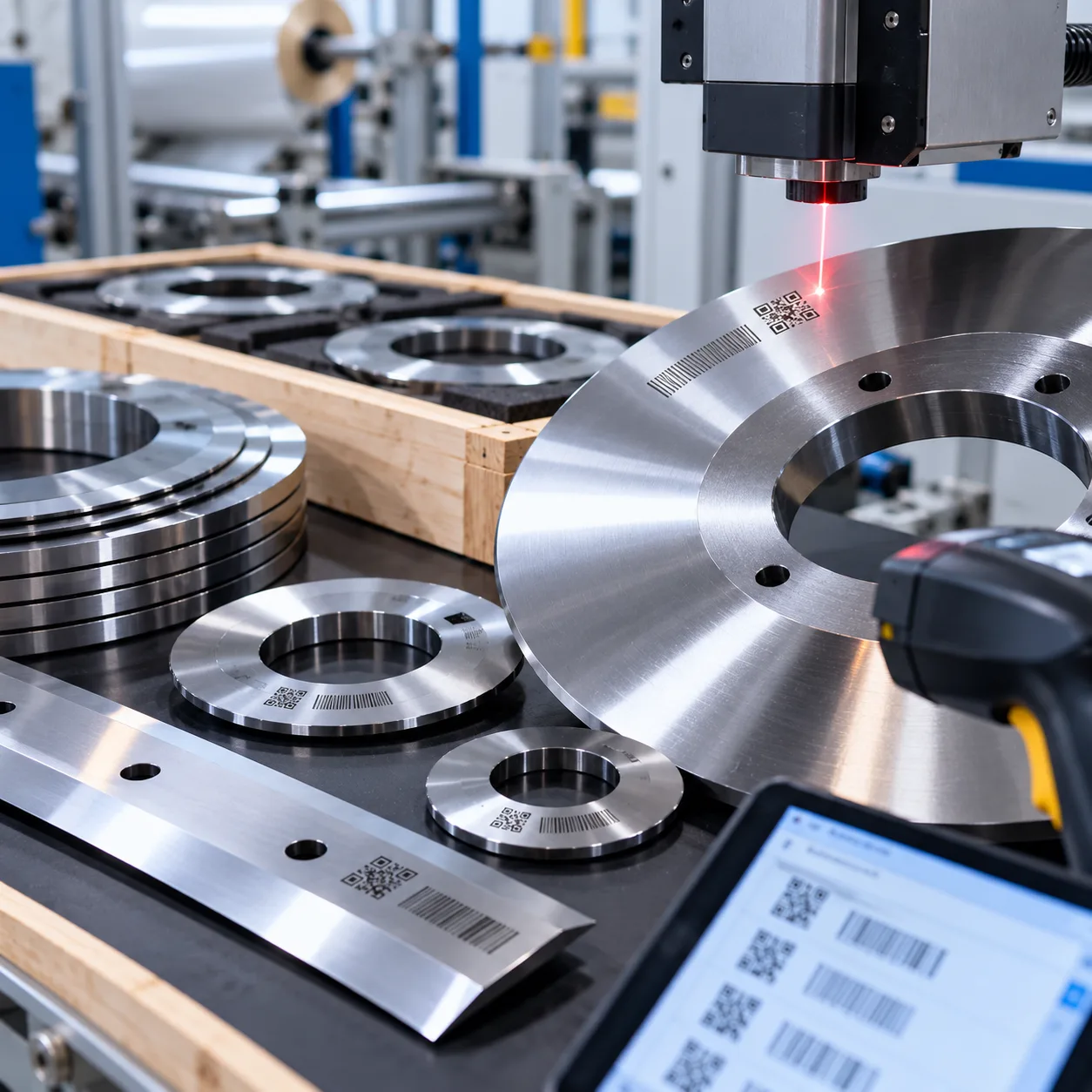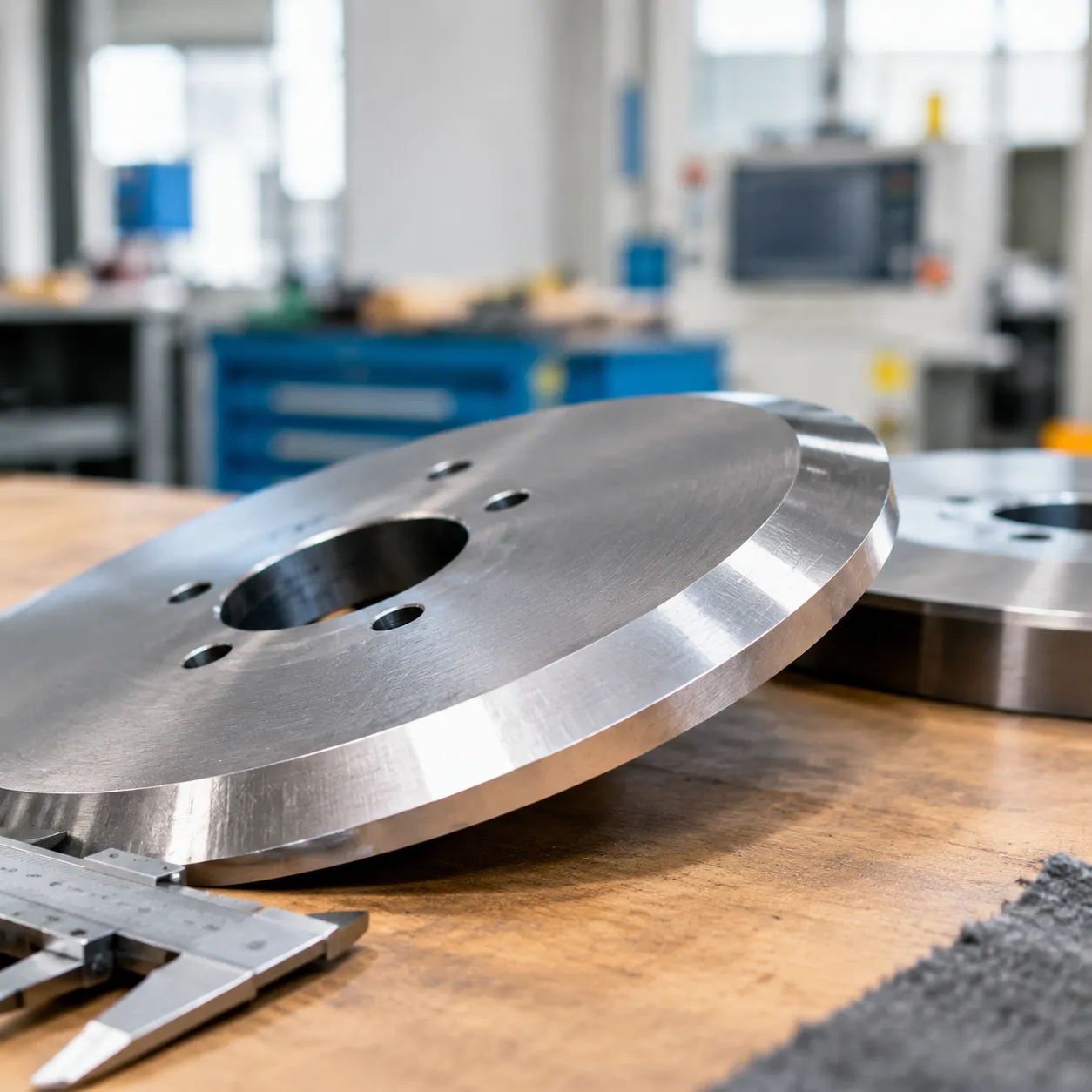


The Fundamental Metallurgy Triad: Hardness, Toughness, and Wear Resistance
Hardness (HRC/HRA): Resisting Plastic Deformation
Hardness measures the alloy matrix's ability to withstand compressive yield and structural deformation under heavy shear stress.
- Rockwell Scale Precision: High Rockwell HRC ratings ensure the knife edge holds its geometry under tight side-load pressure.
- Deformation Control: Prevents the cutting tip from rolling over or mushrooming during continuous operation.
Toughness: Preventing Edge Chipping
Toughness is the material's ductility and ability to absorb kinetic impact without fracturing.
- Impact Absorption: Absorbs shock loads caused by web splices, line speed spikes, and thick substrate transitions.
- Micro-Chipping Prevention: High matrix toughness keeps the razor-sharp apex intact during interrupted slitting cuts.
Abrasive and Adhesive Wear Resistance
Wear resistance defines how long the blade maintains its fine cutting edge against frictional contact and material bonding.
- Hard Alloy Carbides: Vanadium and tungsten carbides act as microscopic armor points, defeating aggressive abrasive wear.
- Matrix Synergy: Chromium and molybdenum strengthen the matrix structure to reduce adhesive wear and galling.
Metallurgy Trade-Off Matrix
Choosing an industrial cutting alloy always involves a wear resistance vs. toughness trade-off. Increasing hardness naturally reduces impact resistance, making alloy selection critical to your operational success.
| Performance Vector | Extreme Hardness Priority | High Toughness Priority | Balanced Alloy Matrix |
|---|---|---|---|
| Primary Advantage | Maximum abrasion resistance & edge life | Resists severe impact and heavy shock | All-around durability and edge stability |
| Ideal Target Substrate | Abrasive paper, thin films, foils | Heavy metallic coils, thick board | General packaging, multi-layer films |
| Main Failure Risk | Micro-chipping under shock load | Accelerated edge blunting | Moderate wear on ultra-abrasive lines |
Deep-Dive Comparison of Industrial Slitter Blade Materials
Selecting the right slitter blade material directly dictates edge retention, burr quality, and machine uptime. We manufacture high-precision circular slitter knives across five core alloy categories to match specific web speeds, mechanical shocks, and substrate abrasion levels.
| Slitter Knife Material | Hardness Range | Core Metallurgy Benefit | Ideal Substrate Applications |
|---|---|---|---|
| D2 / SKD-11 / D3 | 58–62 HRC | Economical, solid baseline wear resistance | Paper, standard films, light metal packaging |
| M2 / M42 Cobalt HSS | 62–68 HRC | High red hardness and thermal stability | High-speed converting, non-wovens, textiles |
| Powder Metallurgy (CPM / ASP) | 60–66 HRC | Micro-fine carbide structure, high wear life | Abrasive papers, heavily filled polymers |
| Tungsten Carbide (WC-Co) | 88–92 HRA | Extreme edge retention, submicron tolerances | EV battery foils (Li, Cu, Al), BOPP, thin PET |
| 440C Stainless / S7 Steel | 54–60 HRC | Impact shock absorption, corrosion resistance | Food packaging, heavy metal coils, rubber |
High-Carbon, High-Chromium Tool Steels (D2 / SKD-11 / D3)
High-carbon, high-chromium tool steel is the reliable industry workhorse. D2 tool steel (SKD-11) offers strong compressive strength and deep hardening characteristics at an accessible price point. It performs reliably on standard paper, paperboard, and un-filled plastic films under low-to-medium line speeds.
High-Speed Steels (M2 / M42 Cobalt HSS)
Friction generates heat that rapidly softens standard slitter knife material during high-speed shear slitting. M2 high-speed steel (HSS) and M42 cobalt alloy maintain their Rockwell HRC hardness at elevated temperatures up to 500°C. These alloys prevent edge rolling and material galling on fast-moving non-woven and flexible packaging lines.
Powder Metallurgy Steels (CPM 10V / ASP 23 / ASP 60)
Powder metallurgy steel (CPM/ASP23) breaks through the traditional metallurgy trade-off between hardness and toughness. Rapid gas atomization forms extremely uniform alloy carbides, eliminating micro-chipping on hard inclusions. Upgrading your rotary slitter knives to CPM 10V yields up to triple the service life of D2 on abrasive filled films.
Solid & Tipped Tungsten Carbide (WC-Co Alloys)
When cutting zero-burr substrates like EV battery lithium foil or thin copper collectors, tungsten carbide slitter blades provide unmatched edge sharpness and rigid axial tolerances. Review our technical guide on carbide vs steel knives to determine if your machine setup supports carbide's low impact tolerance.
Specialty Stainless & Shock-Resistant Steels (440C / S7)
For high-impact slitting or sanitary environments, standard carbon alloys fall short. S7 shock-resistant steel flexes under sudden impact loads to prevent catastrophic blade breakage when cutting heavy metal coils or dense rubber. 440C stainless steel provides full corrosion resistance in wet, food-grade, or chemical converting operations.
Material Selection Framework by Target Substrate
Matching the right slitter blade material to your target substrate is the single most critical factor in preventing premature wear, reducing line downtime, and maintaining clean cut quality.
Flexible Packaging & Thin Plastic Films (BOPP, PET, PE)
Slitting ultra-thin polymer films requires smooth material flow and extreme sharpness to prevent tearing, stretch marks, or static cling.
- Ideal Material: Powder metallurgy steel (CPM 10V) or submicron tungsten carbide.
- Key Requirement: Low friction setup.
- Performance Impact: Installing high-precision film cutting knives coated with PVD or DLC treatment drastically reduces heat friction, eliminating sticky film buildup and web stretching.
Paper, Cardboard & Corrugated Board
Paper substrates contain abrasive mineral fillers like titanium dioxide and calcium carbonate that rapidly dull standard tooling edges. Dull edges create paper dust, causing web contamination and bad roll formation.
- Ideal Material: High-chromium D2 tool steel or ASP 23 powder metallurgy steel.
- Key Requirement: High abrasive wear resistance with edge-retention toughness.
- Performance Impact: Premium paper cutting knives engineered with high vanadium carbide content suppress dust accumulation and extend regrind intervals by up to 3x compared to standard tool steel.
Metallic Coils (Steel, Stainless, Aluminum)
Slitting metal coils generates intense shock loads and demands tight axial runout tolerances to avoid edge deformation. Choosing the correct slitter knife material requires balancing impact resistance with compressive strength.
| Substrate Type | Recommended Material | Core Benefit |
|---|---|---|
| Thick / High-Tensile Steel | Shock-Resistant S7 Steel | Prevents edge chipping under severe impact loads |
| Standard Coil Stock | D2 / SKD-11 Tool Steel | Balanced wear life and cost efficiency for continuous lines |
| Precision Aluminum & Thin Foils | Solid Tungsten Carbide | Ultra-tight runout tolerances; eliminates edge burrs |
EV Battery Electrodes (Lithium Foil, Copper/Aluminum Substrates)
Slitting lithium-ion battery cathode and anode foils demands zero-burr tolerances. Any micro-burr or particulate shedding can pierce the separator film, causing short circuits or cell fires.
- Ideal Material: Ultra-fine grain Tungsten Carbide (WC-Co alloy).
- Key Requirement: Submicron grinding tolerances and mirror-polished cutting bevels.
- Performance Impact: Maintains microscopic edge sharpness across millions of cut cycles without shedding particles.
Non-Wovens & Textiles
High friction heat generated during textile slitting can melt synthetic fibers, leading to fused edges and material waste.
- Ideal Material: M42 High-Speed Steel (Cobalt HSS) or TiAlN-coated D2 steel.
- Key Requirement: Thermal hardness retention and heat dissipation.
- Performance Impact: M42 retains its cutting hardness at elevated operating temperatures, keeping high-speed converting lines running cleanly without edge fraying.
Advanced Surface Coatings and Metallurgical Treatments
Upgrading your slitter blade material is only half the battle. To maximize edge retention, cut down on line friction, and stop material buildup, we apply specialized physical vapor deposition (PVD) coatings and deep cryogenic treatments directly to our metal matrix.
PVD Coatings: TiN, TiAlN, and CrN
Thin-film PVD coatings drastically lower the surface friction coefficient while pushing outer surface hardness to extreme levels. This prevents micro-welding and galling when running high-speed lines or abrasive web substrates.
- Titanium Nitride (TiN): A classic gold multi-purpose coating that boosts surface hardness (up to ~2,300 HV) and reduces friction on standard paper and film converting lines.
- Titanium Aluminum Nitride (TiAlN): Engineered for intense thermal loads. It forms a protective aluminum oxide layer at elevated temperatures, making it ideal for high-speed continuous slitting.
- Chromium Nitride (CrN): Offers superior corrosion resistance and anti-galling properties, making it our top choice for non-ferrous metal slitting and high-moisture processing.
Pairing PVD treatments with heavy-duty shear slitting knives gives you significantly longer production runs between regrind cycles.
Diamond-Like Carbon (DLC) Coatings
Adhesive buildup from sticky films, pressure-sensitive tapes, or EV battery slurries can ruin cut quality fast. Our DLC coatings combine the hardness of diamond with the slickness of graphite.
- Zero Adhesive Sticking: Keeps pressure-sensitive adhesives and gummy polymers from clinging to the blade flank.
- Ultra-Low Friction: Drops the friction coefficient below 0.1, eliminating web drag and localized heat buildup.
- Clean Edge Profile: Prevents film stretching, tearing, and burr formation on ultra-thin flexible packaging substrates.
Deep Cryogenic Processing
Surface coatings require a rock-solid metallurgical foundation. After standard heat treatment protocols, we freeze our steel slitter knife material down to liquid nitrogen temperatures (-300°F / -196°C).
- Austenite Transformation: Converts soft retained austenite into stable, ultra-hard martensite.
- Fine Carbide Dispersion: Promotes micro-carbide precipitation throughout the alloy structure, boosting toughness and wear resistance simultaneously.
- Dimensional Stability: Relieves internal residual stresses, ensuring our precision slitting knives hold strict axial runout and thickness tolerances without warping under load.
Total Cost of Ownership & Slitter Blade ROI

When choosing a slitter blade material, looking only at the purchase price is a costly mistake. Cheap knives often cost far more in line downtime, frequent sharpening, and scrap.
Cost-Per-Slit-Meter vs. Upfront Investment
To get an accurate ROI, measure tool value using cost-per-slit-meter rather than the initial purchase price.
| Slitter Blade Material | Upfront Cost | Wear Resistance & Edge Life | Regrind Frequency | Total Operational Cost |
|---|---|---|---|---|
| D2 Tool Steel | Low | Baseline (1x) | High | High (Due to labor & downtime) |
| Powder Metallurgy (CPM/ASP) | Medium | High (3x - 5x) | Moderate | Medium-Low |
| Tungsten Carbide | High | Extreme (10x - 20x) | Very Low | Lowest long-term cost |
Upgrading from standard steel to premium carbide or powder metallurgy slitter knives drastically reduces line stoppages on high-speed converting lines, quickly recovering the higher initial investment.
Hidden Operational Factors in TCO
Calculating the real lifetime cost of your slitter knife material requires tracking key indirect expenses:
- Labor & Line Changeovers: Every knife swap requires paid operator hours and halts active production.
- Regrind Frequency & Tooling Wear: Softer steels require frequent resharpening, accelerating grinding wheel consumption and labor costs.
- Scrap Rate & Material Defects: Worn edges create slitting dust, micro-burrs, and rejected material rolls.
If your plant also operates heavy inline scrap choppers or guillotine stations alongside high-speed web slitting, utilizing wear-resistant shear blades helps maintain uniform tool life and simplifies your overall tooling maintenance schedule.
Mathematical Formula for Slitter Blade ROI
We use a simple equation to calculate the financial return of upgrading your slitter blade material:
- Total Slitting Cost = Purchase Price + (Number of Regrinds * Cost per Regrind) + (Downtime Hours * Hourly Line Rate) + Scrap Loss Cost
- Cost-per-Slit-Meter = Total Slitting Cost / Total Meters Cut
By switching to high-wear alloys, high-volume converting facilities regularly reduce total line downtime by over 60%, achieving full payback on premium tooling within months.
Manufacturing Precision & Quality Control at Sharkcutting
Precision Machining and Thermal Processing
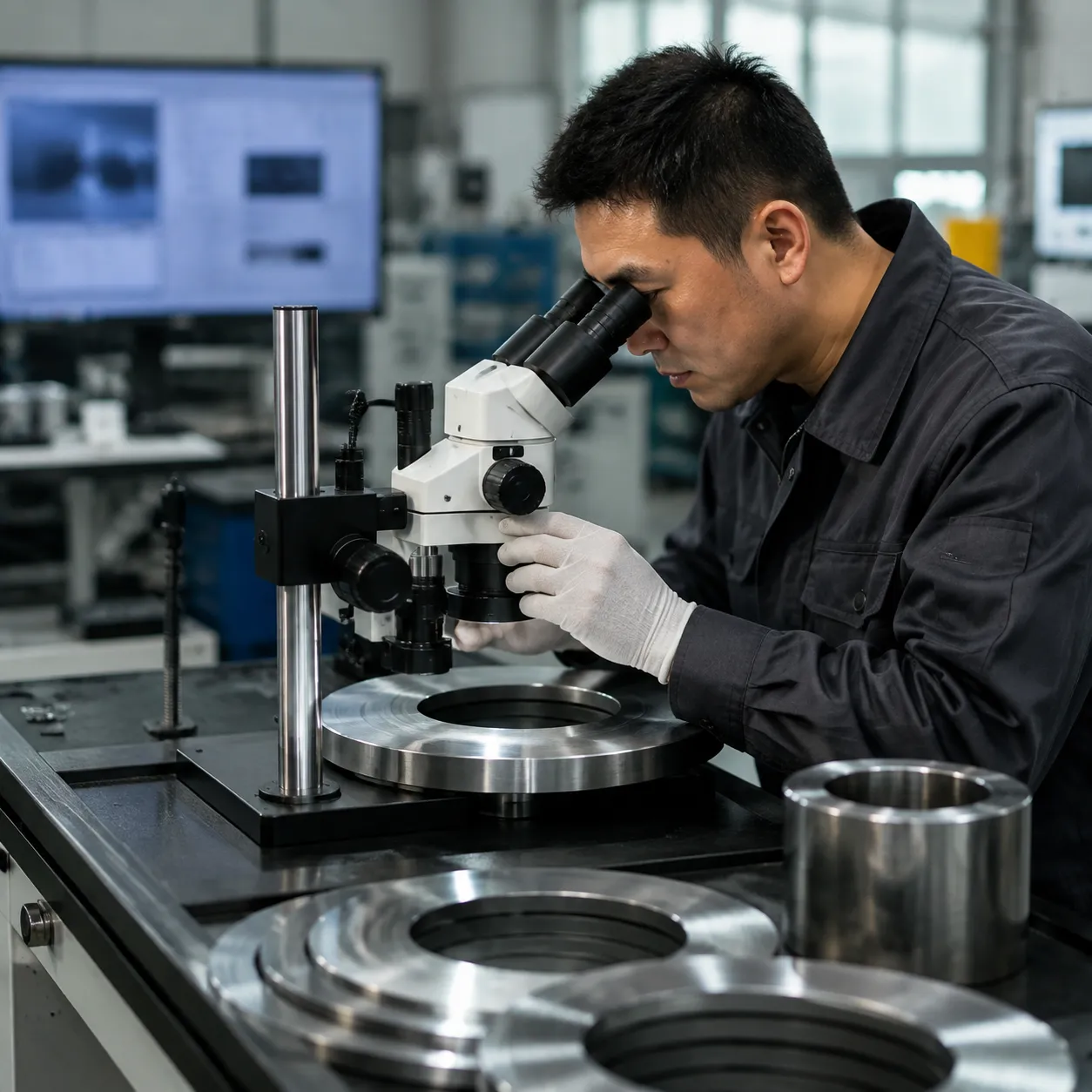
Even the highest-grade slitter blade material fails if machining tolerances or thermal cycles miss the mark. We execute multi-axis CNC grinding to maintain sub-micron dimensional tolerances and eliminate lateral runout on every rotary knife. Our computer-controlled vacuum heat treatment relieves internal stress, delivering uniform hardness across the entire cutting edge. Through our advanced precision machining process, we ensure that every knife achieves the mechanical stability needed for high-speed converting lines.
Tailored Alloy Selection
Choosing the proper slitter knife material requires matching metallurgy directly to your operational physics. We evaluate your web tension, shear angle, line speed, and substrate friction to select or custom-tailor the ideal steel grade:
- High-Tension Web Setups: Optimized tough alloy matrix to prevent micro-chipping under shock loads.
- Abrasive Substrates: High-carbide tool steel formulations engineered for maximum wear resistance.
- Ultra-Thin Films & Foils: Low-friction, high-homogeneity alloys for burr-free shear cuts.
Rigorous Quality Assurance
We enforce strict inspection standards to guarantee zero-defect performance on your production floor:
- Ultrasonic Crack Testing: Scans the internal matrix to eliminate subterranean flaws and micro-voids before final grinding.
- Optical Profile Inspection: Validates bevel geometry, concentricity, and edge radius down to the micron.
- HRC Micro-Hardness Testing: Verifies consistent hardness from the core to the outer cutting edge.
Through these end-to-end quality control procedures, we eliminate catastrophic blade failure and maximize run-time on every production cycle.
Troubleshooting Slitter Knife Material Failures: FAQs
Why are my slitter knives wearing rapidly, and which higher-carbide alloy should I upgrade to?
Fast edge degradation usually means your current slitter blade material lacks sufficient abrasive wear resistance for your substrate. If standard D2 steel loses its cutting edge too quickly, upgrade to a powder metallurgy steel like CPM 10V or a solid tungsten carbide slitter knife material. These higher-carbide alloys drastically increase edge retention during high-speed converting runs. Explore our engineered rotary slitting knives to match the ideal carbide density to your production line.
How do I fix micro-chipping on slitter knife edges during heavy operation?
Micro-chipping occurs when your blade material is too brittle for the operational shock load or shear stress. To stop edge cracking:
- Optimize hardness: Lower the hardness rating by 1–2 Rockwell (HRC) points to gain critical matrix ductility.
- Upgrade steel grade: Transition from brittle high-hardness steels to ASP 23 powder steel or shock-resistant S7 steel for uniform carbide distribution.
- Check side pressure: Ensure knife holders and axial clearance aren't applying excessive side loads to the cutting bevel.
What slitter blade material prevents slitting dust accumulation and edge burrs?
Slitting dust and burred edges happen when a dulling blade tears the substrate instead of slicing it cleanly. Maintaining a razor-sharp shear angle depends heavily on your material selection:
- EV Battery Foil & Thin Films: Solid tungsten carbide maintains submicron edge tolerances to eliminate burring.
- Paper & Packaging: M2 or M42 High-Speed Steel (HSS) retains hardness under continuous frictional heat, cutting down fine paper dust.
- Tailored Manufacturing: Choosing the right slitter knife material options based on web tension prevents the rounded edges that ruin cut quality.
How can PVD or DLC coatings eliminate material galling and adhesive buildup?
Adhesive buildup on pressure-sensitive labels, sticky tapes, or soft films creates friction drag and ruins cut tolerances. Applying thin-film surface treatments prevents adhesion at the atomic level:
- Diamond-Like Carbon (DLC): Provides an ultra-low friction coefficient that stops adhesives, glues, and molten polymers from sticking to the blade face.
- TiAlN / CrN PVD Coatings: Form an inert, wear-resistant thermal barrier that prevents metallic galling when shearing soft non-ferrous foils or aluminum substrates.