
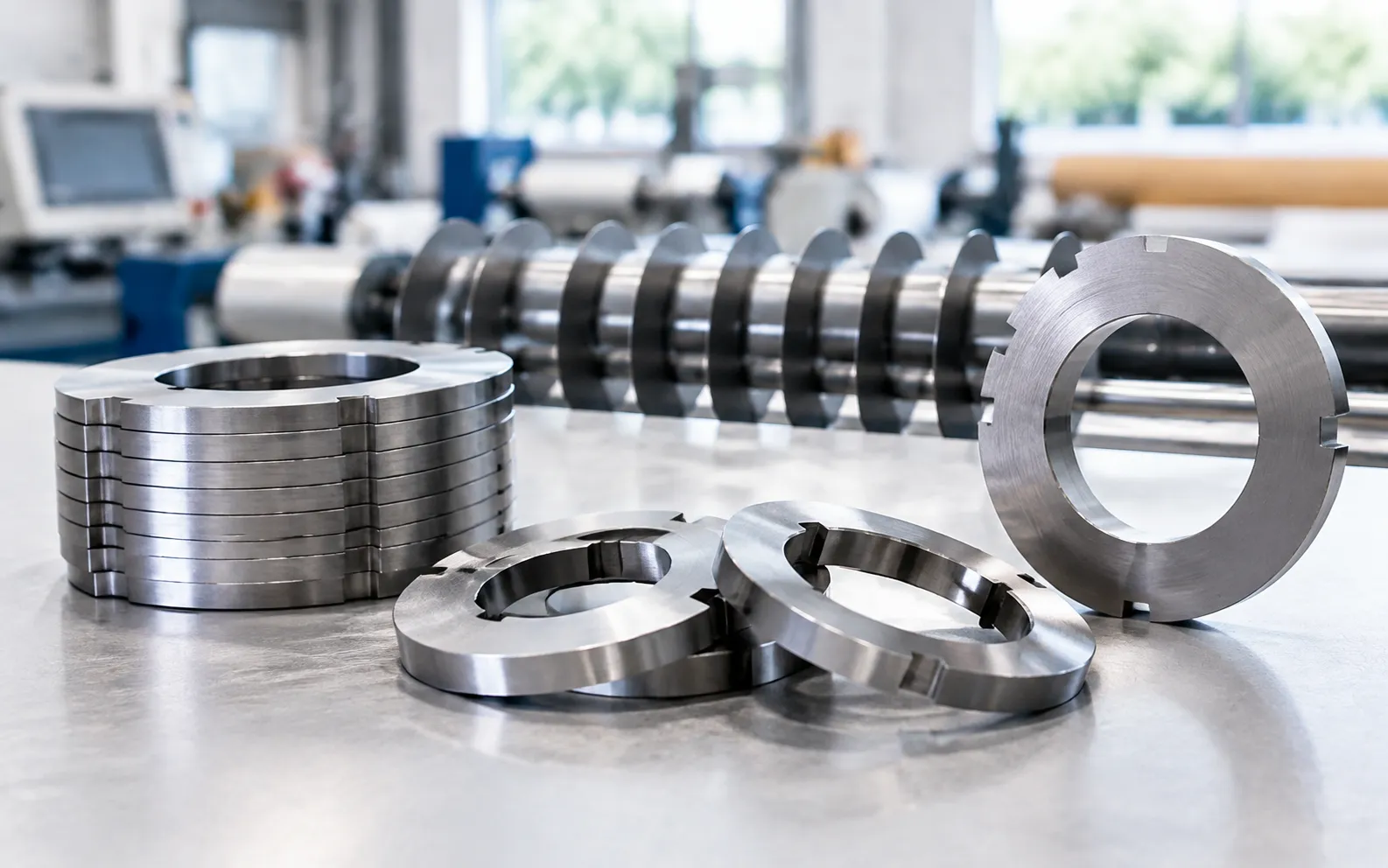
Formula details
Product Details
Overview
Core Slitter Knife Spacer Types and Configurations
Hardened Tool Steel Spacers (52100 & D2) for High-Tonnage Coil Processing
Our hardened steel slitting spacers are engineered for maximum wear resistance, high compressive strength, and continuous heavy-gauge coil slitting.
- Material Grades: Premium 52100 (GCr15) bearing steel and D2 (SKD11) cold-work tool steel.
- Core Hardness: Through-hardened to 58–64 HRC to resist arbor clamping pressure and eliminate face deformation.
- Surface Precision: Precision lapped and mirror-ground to Ra 0.1–0.2 µm to prevent cumulative error buildup across the slitter arbor.
- Primary Application: High-tonnage processing of hot-rolled, cold-rolled, and high-strength structural steel coils.
Ultra-Lightweight Aluminum Alloy Spacers (7075-T6)
Designed to cut setup times and reduce total arbor load, our lightweight aluminum spacers provide dimensional stability at roughly one-third the weight of steel tooling.
- Deflection Control: Substantially reduces arbor deflection on wide-span slitting lines, maintaining consistent blade penetration depth.
- Ergonomics & Safety: Lowers physical strain on setup operators during manual knife and spacer changeovers.
- Surface Hardening: Optional hard-anodized coatings provide enhanced surface wear and scratch resistance during routine handling.
Rubber-Bonded Stripper Rings (PU & NBR) for Scratch-Free Strip Ejection
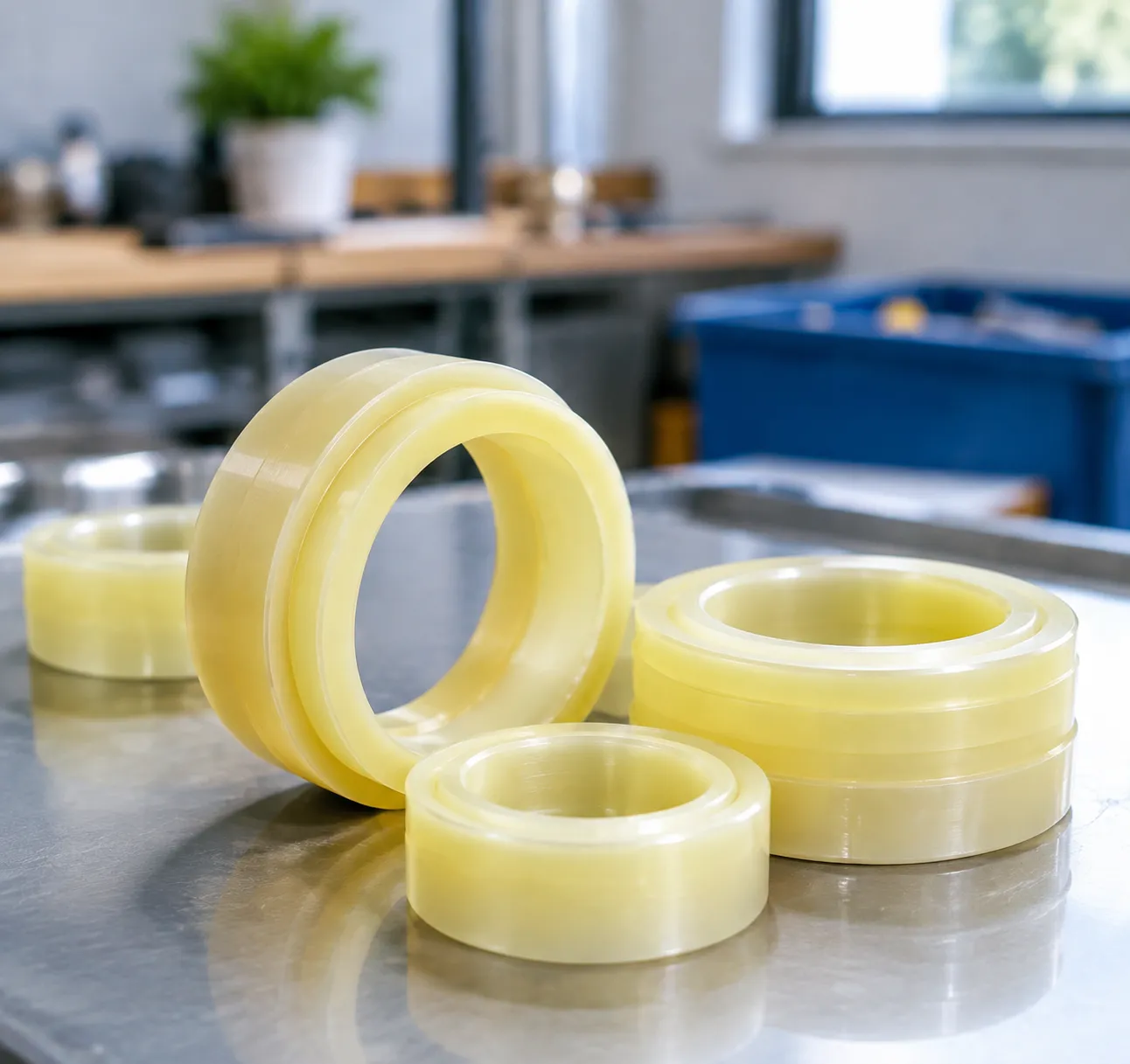
We vulcanize high-grade elastomers directly onto precision steel or aluminum cores to deliver clean strip ejection without marking sensitive coil surfaces.
- Elastomer Options: High-durability Polyurethane (PU) and oil-resistant Nitrile Butadiene Rubber (NBR).
- Durometer Range: Available in 50 to 95 Shore A to match material thickness, yield strength, and line speed.
- Color-Coded Identification: Visual durometer indexing enables quick verification during tooling setup to prevent operator error.
- Surface Protection: Ideal for automotive-grade cold-rolled coils, stainless steel, painted metals, and polished aluminum sheets.
Modular Rotary Slitter Knife Shims and Intermediate Rings
To dial in knife clearances to exact engineering tolerances, we produce precision shims and intermediate slitter spacer rings for ultra-fine arbor adjustments.
- Thickness Range: Precision shims machined from 0.05 mm to 1.0 mm for exact horizontal knife gap tuning.
- Parallel Tolerance: Parallelism maintained within ±0.001 mm (±0.00004") to prevent knife edge tipping and premature blade chipping.
- Fitment: Standard and custom bore sizes with keyways or drive slots for complete compatibility across standard and high-speed rotary slitting arbors.
Technical Specifications and Tolerance Standards
Standard Dimensional Matrix
Our slitter knife spacers and intermediate rings are produced to fit all standard and custom slitter arbor setups:
| Parameter | Standard Range / Specification | Custom Options Available |
|---|---|---|
| Inside Diameter (ID) | 50 mm to 300 mm (2.0" to 12.0") | Any custom bore size |
| Outside Diameter (OD) | 80 mm to 500 mm (3.15" to 20.0") | Matched to blade OD |
| Thickness Range | 0.5 mm to 150 mm (0.020" to 6.0") | Ultra-thin shims down to 0.05 mm |
| Thickness Tolerance | ±0.001 mm (±0.00004") | Precision lapped |
| Parallelism & Flatness | Within 0.002 mm (0.00008") | Ultra-precision lapping |
| Surface Finish (Ra) | Ra 0.1 µm – 0.2 µm (Mirror ground) | Superfinished faces |
| Core Hardness | 58–64 HRC (Hardened Steel) | Through-hardened |
| Bore Tolerance | ISO H6 / H7 | Custom keyway / spline fits |
Micro-Level Thickness, Parallelism, and Surface Flatness Tolerances
Thickness variation across an arbor pack creates cumulative stack-up errors. We grind and lap both parallel faces of our steel slitting spacers to micro-tolerances:
Thickness Consistency: Controlled down to ±0.001 mm (±0.00004") across the full diameter.
Face Parallelism: Kept within 0.002 mm to prevent arbor runout and uneven knife contact pressure.
Surface Roughness: Precision lapped to Ra 0.1–0.2 µm, preventing debris accumulation and ensuring clean, direct face-to-face contact.
These micro-tolerances are essential for a dependable slitter knife setup that protects your tooling and delivers uniform slit edges.
Bore Tolerance Standards (H6/H7) for Tight Arbor Fitment
Loose spacer bores cause eccentric rotation and vibration, while overly tight bores cause arbor galling. We machine all arbor spacers to strict ISO H6 and H7 bore classes:
H6 Bore Fit: Recommended for precision light-gauge slitting lines requiring minimal clearance.
H7 Bore Fit: Standard fitment for rapid tooling changeovers on medium and heavy-gauge slitting arbors.
Keyway Geometry: CNC-broached single, double, or custom splined keyways with radiused corners to prevent stress cracking under heavy torque.
Laser-Etched Thickness Markings and Durometer Identification
Quick tooling identification keeps slitter setup times short and reduces operator error:
Permanent Laser Marking: Every spacer is laser-etched with its exact thickness, inside diameter, outside diameter, and production batch number on the outer rim.
Color-Coded Rubber Rings: Our rubber-bonded slitter spacers and stripper rings use standardized color coding based on Shore A durometer hardness:
* Green / Red: 70–75 Shore A (Light-gauge non-ferrous and delicate strip)
* Brown / Black: 80–85 Shore A (Standard cold-rolled and stainless steel)
* White / Blue: 90–95 Shore A (Heavy-gauge sheet and high-tonnage coil processing)
Engineering Advantages on Slitting Line Performance
Eliminating Cumulative Tolerance Stack-Up and Arbor Axial Runout
When stacking 30 or more tools across a wide slitter arbor, minor thickness deviations compound rapidly. A variation of just a few microns per piece can create massive axial runout at the end of the shaft.
- Uniform Thickness Control: We lap our slitter spacers to micro-tolerances down to ±0.001 mm (±0.00004").
- Parallel Faces: Ultra-precise surface parallelism prevents arbor bowing when high hydraulic clamping force is applied.
- True Dynamic Runout: Eliminates wobble across the entire knife pack, ensuring every blade tracks along a true vertical plane.
Maintaining Precise Horizontal Blade Clearance
Proper horizontal clearance between male and female knives is the single most critical factor for slit edge quality.
- Zero Blade Deflection: Perfectly flat spacer faces provide rigid, full-surface support to prevent blade tilt under continuous load.
- Defect Prevention: Stable blade positioning prevents slit edge burrs, edge roll-over, deep fractures, and strip camber.
- Consistent Slit Widths: Maintains stable strip dimensions from the outer edges to the center of wide mother coils.
Mitigating Knife Edge Chipping and Extending Tool Life
Unstable or non-parallel spacers allow rotary knives to flex sideways into each other during slitting, causing severe blade scuffing and catastrophic edge chipping.
Using mirror-ground arbor spacers eliminates dynamic vibration, evenly distributes cutting forces, and protects your tooling investment. Combining high-parallelism spacers with precision blades—such as tools manufactured with advanced D2 steel heat treatment—dramatically lowers tooling wear and maximizes uptime between regrinds.
Strict Inspection and Material Certification
Every slitting spacer we ship undergoes multi-stage quality control to ensure zero defects before installation on your slitter:
- CMM Multi-Point Inspection: High-precision coordinate measuring machines verify bore concentricity, outside diameter, and face perpendicularity.
- Laser Micrometer Verification: Contactless digital scanning checks thickness uniformity and surface flatness across multiple radial points.
- Certified Quality Standards: Complete material traceability and EN 10204 3.1 inspection certificates are provided to verify chemical composition and core hardness.
Industrial Applications and Coil Processing Compatibility
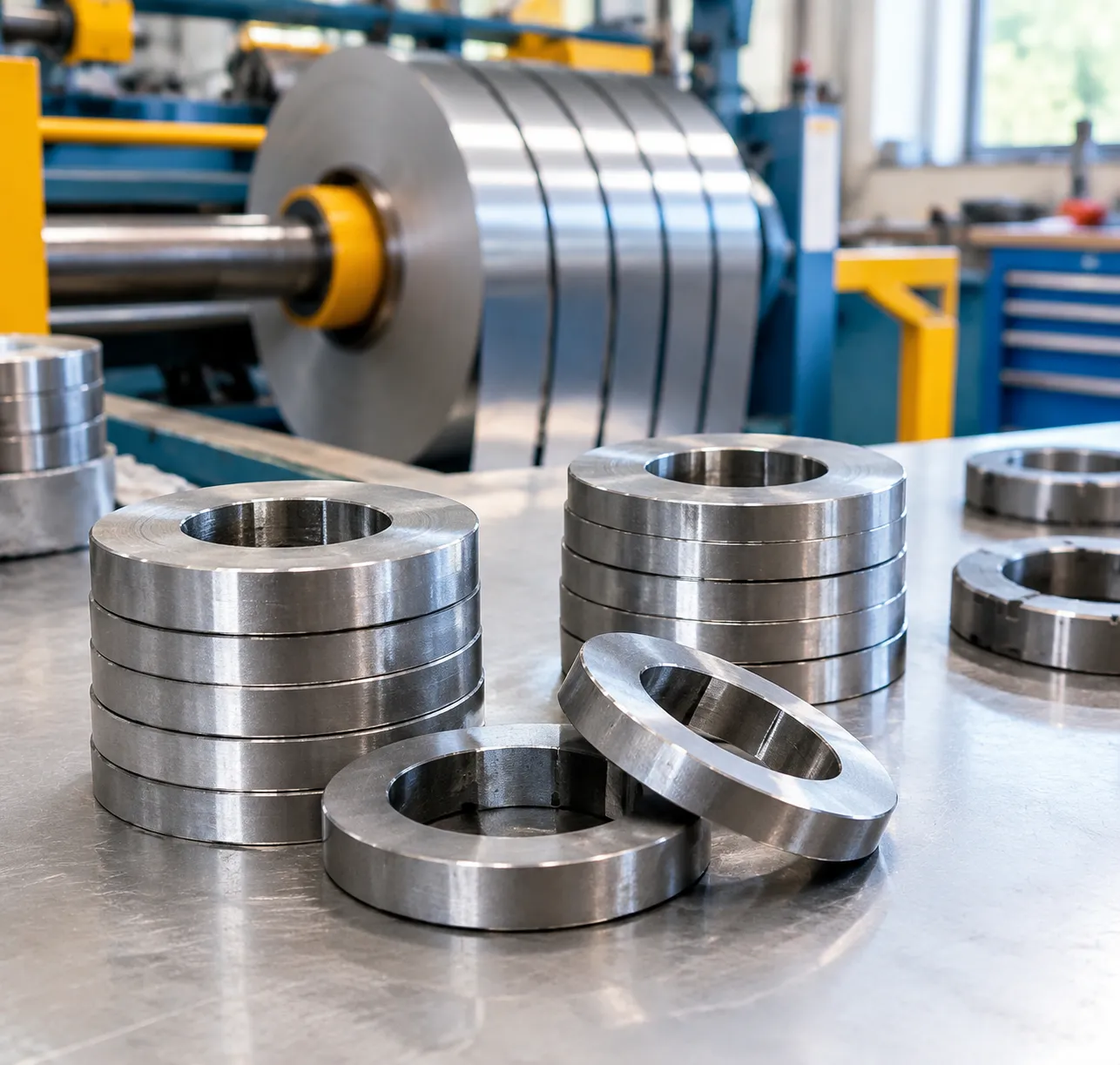
Ferrous Coil Processing: Hot-Rolled, Cold-Rolled, and Electrical Steel
High-tonnage ferrous slitting demands tooling that withstands intense clamping forces and continuous axial load. We build hardened steel slitting spacers to maintain parallel knife alignment in demanding operations:
Hot-Rolled & Pickled/Oiled Steel: Absorbs heavy cutting shock without face deformation or arbor galling.
Cold-Rolled Carbon Steel: Maintains precise horizontal clearance when paired with high-performance sheet metal slitter knives to eliminate edge burrs.
Silicon & Grain-Oriented Electrical Steel: Keeps strip camber minimal and protects magnetic performance through uniform knife spacing.
Non-Ferrous Strip Slitting: Stainless Steel, Aluminum, Brass, and Copper
Surface-critical non-ferrous materials require strict strip tracking and scratch-free handling:
Stainless Steel (300/400 Series): Eliminates knife deflection under extreme shearing resistance.
Aluminum & Copper Alloys: Polyurethane and NBR rubber-bonded slitter spacers provide clean strip ejection while preventing surface marring.
Brass & Specialty Alloys: Delivers accurate strip widths on high-speed slitting lines without edge rollover.
Converting Lines: Packaging, Plastic Films, and Metal Foils
For light-gauge web converting, our precision rotary slitter knife shims and lightweight aluminum spacers reduce rotational mass and arbor deflection. Understanding how rotary knife cutters work in metal slitting and foil converting allows us to lap spacers to sub-micron flatness, preventing web weaving, tear-outs, and edge stretching in ultra-thin materials.
OEM Slitting Line Compatibility and Custom Arbors
We produce arbor spacers engineered to fit all major slitting line brands as well as custom-built lines:
Bore Formats: Precision-machined H6/H7 bore tolerances for single-key, double-key, splined, or smooth arbors.
Dimensional Matching: Engineered to exact arbor diameter, outside diameter, and knife-collar ratios to match existing slitter tooling setups.
Custom Engineering and Tooling Reconditioning Services
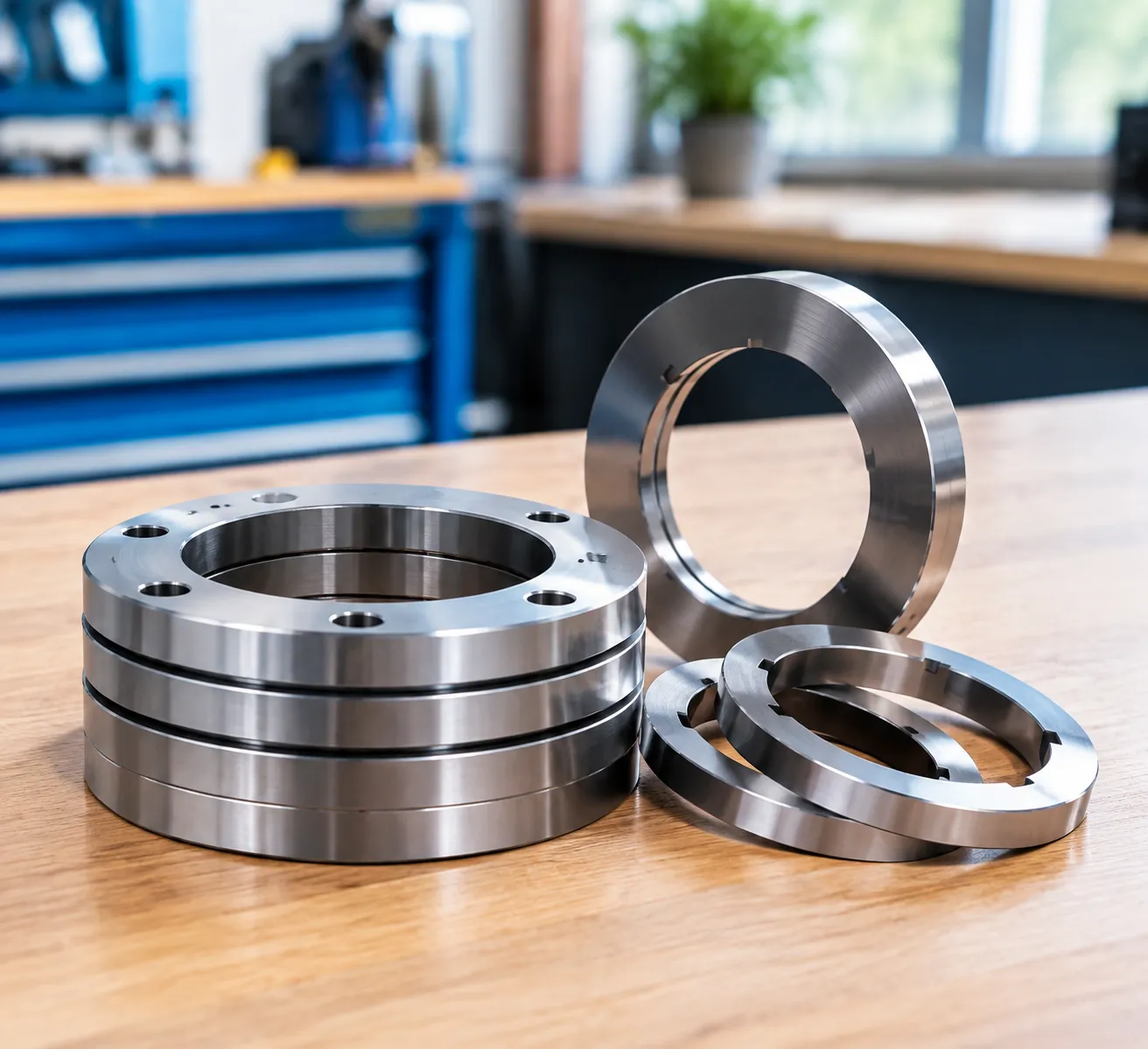
We manufacture standard and bespoke slitter knife spacers to match unique arbor profiles, high-speed lines, and aggressive slitting environments. Through our custom engineering and CNC machining capabilities, we produce tailored tooling that integrates seamlessly with your slitter shafts while extending tooling life.
Custom Bore Geometry and Drive Systems
Every slitting line uses distinct arbor locking and drive mechanisms. We machine custom bores to exact clearance tolerances, ensuring zero slippage and vibration-free rotation:
Single & Dual Keyway Bores: Standard square, broached, or radiused keyways for secure torque transmission.
Splined & Polygon Arbors: High-torque drive geometries for heavy-gauge coil slitting lines.
Drive Pin & Dowel Holes: Precision pin-hole patterns for indexed locking and synchronized rotation.
Weight-Reduction Machining
Handling heavy tooling on large arbors increases operator fatigue and accelerates arbor deflection. To solve this, we engineer lightweight aluminum spacers and tool-steel spacers featuring:
Perimeter Lightening Holes: Precision-drilled through-holes removing non-structural mass.
Pocket Milling & Webbed Cores: CNC-milled recesses that shed up to 50% of the spacer weight without compromising axial rigidity or face parallelism.
Protective Surface Treatments and Coatings
To prevent corrosion, fretting, and chemical degradation during continuous coil processing, we apply specialized surface finishes:
Hard Chrome Plating: Adds extreme surface hardness and superior scratch resistance.
Electroless Nickel (ENP): Delivers uniform, pore-free corrosion resistance across all complex bore contours and faces.
Black Oxide Treatment: Provides cost-effective corrosion resistance and anti-glare properties for quick size verification.
Precision Re-Lapping and Regrinding Services
Worn, scratched, or out-of-parallel spacers cause knife deflection and edge burrs. Our tooling reconditioning program restores worn arbor tooling back to factory-new performance:
Dual-Face Precision Lapping: Restores face parallelism and thickness uniformity down to ±0.001 mm.
Mirror Grinding: Re-establishes an ultra-smooth surface finish (Ra 0.1 µm – 0.2 µm) to eliminate dirt buildup.
Inspection & Recalibration: Complete dimensional inspection and laser re-etching of thickness markings before return delivery.
For specialized arbor designs or branded line upgrades, explore our complete OEM/ODM manufacturing services to build custom slitting tooling tailored to your exact drawings.
Sourcing Guide and Modular Tooling Pack Selection
Selecting the right slitter knife spacers is critical to minimizing changeover downtime and maintaining tight strip width tolerances across every slitting run. We design and manufacture fully customized tooling packages and pre-calculated modular spacer sets matched to your exact slitter arbor specifications.
Pre-Calculated Modular Spacer Packs for Rapid Strip Width Changeovers
To eliminate operator guesswork and reduce setup time on the slitting line, we supply organized, pre-calculated modular spacer packs. These sets allow your setup operators to achieve any required cut width quickly by combining standard stepped thickness increments.
- Standard Stepped Increments: Sets include calibrated thicknesses ranging from 0.500 mm up to 100.000 mm (or 0.020" to 4.000").
- Fine-Tuning Precision Shims: Micro-shims from 0.050 mm to 0.400 mm for ultra-precise horizontal clearance adjustments.
- Storage & Organization: Packaged in heavy-duty, labeled wooden cases or steel racks organized by thickness for rapid retrieval.
- Matched Sets: Every piece is ground to identical thickness tolerances (down to ±0.001 mm) to ensure uniform clamping across the entire arbor tooling setup.
Essential RFQ Technical Parameters and CAD Drawing Requirements
When requesting a quotation for custom arbor spacers or replacement tooling, providing complete dimensional data ensures a seamless fit. Pair your precision spacers with our high-performance coil slitter knife for precise metal cutting to maintain optimal knife clearance and prevent slit edge burrs.
| Parameter | Required Specification | Common Industry Values |
|---|---|---|
| Bore Diameter (ID) | Precise arbor shaft diameter + fit tolerance | Fit Class H6 or H7 (e.g., 100 mm, 150 mm, 200 mm) |
| Outside Diameter (OD) | Sized to match knife OD and stripper ring support | Clear of knife cutting depth (e.g., 160 mm to 350 mm) |
| Thickness Range | Individual dimensions or full set requirements | 0.500 mm to 150.000 mm |
| Material Grade | Application-specific alloy | Hardened 52100 / D2, Lightweight Aluminum, or PU-bonded |
| Hardness Target | Heat treatment specification | 58–64 HRC (Steel) or 70–95 Shore A (Polyurethane) |
| Keyway / Pin Spec | Drive configuration details | Single key, dual 180° keys, spline, or smooth bore |
| Surface Finish | Lapping and ground finish requirements | Ra 0.1 µm – 0.2 µm mirror ground |
Determining Optimal Spacer Combinations for Tight Coil Slitting Setups
Building an efficient arbor setup requires balancing spacer thickness against cumulative tolerance build-up. We recommend these core setup practices:
- Use Fewer, Thicker Spacers: Always build your target width using the fewest number of thick spacers rather than stacking multiple thin shims. This minimizes joint interfaces and prevents cumulative face runout.
- Symmetrical Arbor Loading: Mirror your spacer distribution across top and bottom arbors to equalize axial clamping pressure across both shafts.
- Weight Management on Long Arbors: For setups requiring wide spacer spans over 50 mm, select lightweight 7075 aluminum spacers to cut overall arbor load by over 60% and prevent shaft sagging.
- Send Technical Drawings: Upload your 2D PDF or 3D CAD files (STEP/DWG) with your RFQ for direct engineering review and manufacturing verification.
Frequently Asked Questions About Slitter Knife Spacers
How do precision slitter spacers eliminate cumulative tolerance stack-up?
Cumulative tolerance stack-up happens when slight thickness inconsistencies in individual spacers multiply across an arbor setup. When stacking 20 to 50 tooling components, standard-grade spacers cause significant axial runout, throwing rotary knives out of alignment.
We grind and lap our slitter knife spacers to micro-tolerances within +/- 0.001 mm with mirror-flat parallelism. This extreme precision ensures that total pack deviation across the entire arbor width stays near zero, locking in consistent horizontal blade clearances from the first cut to the last.
When should operators use aluminum spacers instead of hardened steel spacers?
Choosing between lightweight aluminum and hardened tool steel comes down to arbor load limits, coil thickness, and changeover ergonomics:
- Lightweight Aluminum Spacers: Best for wide-span slitter arbors, medium-to-light gauge processing, and rapid tooling changeovers. Aluminum reduces arbor tooling weight by roughly 60% to 65%, significantly reducing arbor deflection, bearing wear, and operator fatigue.
- Hardened Tool Steel Spacers (52100 / D2): Essential for heavy-gauge, high-tonnage coil slitting lines. Hardened to 58–64 HRC, steel slitting spacers deliver the compressive yield strength and surface hardness required to resist deformation under intense clamping pressure.
How do you select the correct rubber durometer for stripper rings?
Rubber-bonded slitter spacers and stripper rings rely on the correct polyurethane (PU) or nitrile (NBR) durometer (Shore A hardness) to eject strips cleanly without scuffing the material surface:
- 60–70 Shore A (Soft): Recommended for polished aluminum, bright-annealed stainless, coated strips, and light-gauge materials paired with high-precision tooling or a tungsten carbide slitter knife to prevent surface marking.
- 75–85 Shore A (Medium): The industry standard for cold-rolled steel, non-ferrous sheet metal, and general coil slitting operations.
- 90–95 Shore A (Hard): Designed for heavy-gauge hot-rolled steel and thick strip slitting where maximum push-out force is required to prevent strip jamming.
What is the recommended cleaning and maintenance routine to prevent spacer corrosion?
Maintaining precision arbor tooling requires a structured shop floor protocol:
- De-greasing and Cleaning: Clean spacer faces immediately after teardown using a residue-free industrial solvent to strip away coolants, metal fines, and slitting oils.
- Surface Inspection: Inspect faces under bright lighting for fine burrs, chips, or galling. Never stone precision ground faces aggressively, as this destroys face parallelism.
- Corrosion Protection: Apply a light layer of non-staining anti-corrosion oil before staging.
- Organized Storage: Store precision thickness shims and spacer rings on horizontal modular racks or covered tooling carts rather than stacking them loosely in bins.
How does spacer face parallelism directly impact coil slit edge quality?
Spacer face parallelism directly governs the stability of the rotary slitter blade. If an intermediate spacer has uneven face thickness, clamping pressure forces the adjacent slitter knife to tilt at a microscopic angle.
This angular deviation creates dynamic axial wobble during arbor rotation. An arbor runout of just 0.003 mm can alter the knife clearance during cutting, leading directly to edge burrs, sheet camber, edge roll-over, and premature blade chipping. Maintaining strict face parallelism ensures clean shear lines and extends tooling life.