
Formula details
Product Details
Overview
Precision Foil Slitter Blade Engineering
Technical Performance Specifications
| Performance Feature | Engineering Metric | Production Value |
|---|---|---|
| Micron-Level Tolerances | CNC grinding held to ±0.001 mm – ±0.002 mm | Eliminates web weave and high-speed runout wobble |
| Extended Operating Lifespan | Premium Solid Tungsten Carbide grades | Delivers up to 10× wear life over standard tool steel |
| Zero-Burr Edge Geometry | Micro-polished precision cutting edge | Stops foil tearing, flaking, and slitting dust formation |
| Ultra-Low Friction Finish | Mirror polish Ra < 0.1 µm + anti-stick coatings | Prevents adhesive buildup and material drag |
Core Operational Advantages
- Runout Elimination: CNC precision grinding guarantees extreme concentricity to preserve web alignment during rapid converting cycles.
- Superior Durability: Solid tungsten carbide cutting edges maintain sharpness through tough metallic, polymer, and battery foil materials.
- Dust-Free Edge Quality: Micro-polished zero-burr edges protect downstream cleanroom processes and battery electrode slitting integrity.
- Reduced Material Friction: Ultra-smooth surface coatings prevent high-speed foil drag, surface scratching, and tension spikes.
Foil Slitter Blade Material Grade & Technical Selection Matrix
We manufacture every foil slitter blade using targeted alloy grades engineered for your specific line speed, substrate abrasiveness, and slitting environment. Selecting the correct metallurgical profile prevents edge chipping, controls thermal expansion, and drastically extends run time. For a deeper breakdown of raw material chemistry, review our detailed slitter blade material guide.
| Material Grade | Hardness | Primary Applications | Core Performance Advantage |
|---|---|---|---|
| Solid Tungsten Carbide | 88–92 HRA | Battery cathodes/anodes, abrasive metallic foils, composite web lines | Maximum abrasion resistance; up to 10× operational wear life vs. tool steel |
| M2 / SKH51 High-Speed Steel | 62–66 HRC | High-speed rotary foil slitting, flexible packaging laminates | Superior red hardness and thermal stability under high friction |
| D2 / SKD11 Cold Work Tool Steel | 58–62 HRC | General non-ferrous foil converting, light-duty web processing | High compressive strength with balanced wear resistance |
| Stainless Steel 440C | 56–60 HRC | Food-grade packaging foil, medical cleanroom converting | High corrosion resistance and full sanitary processing compatibility |
- Solid Tungsten Carbide (88–92 HRA): Provides unmatched durability for severe web wear. Compare operational costs and lifespan metrics in our carbide vs. steel knives guide before upgrading your slitter lines.
- M2 / SKH51 High-Speed Steel (62–66 HRC): Maintains a sharp cutting edge under continuous high-rpm operation where friction heat destroys standard tooling steel.
- D2 / SKD11 Cold Work Tool Steel (58–62 HRC): Delivers a dependable, cost-effective balance of toughness and edge retention for standard non-ferrous foil slitting.
- Stainless Steel 440C (56–60 HRC): Prevents oxidation and contamination during washdowns on regulated food and pharmaceutical foil packaging lines.
Foil Slitter Blade Geometries & Slitting Configurations
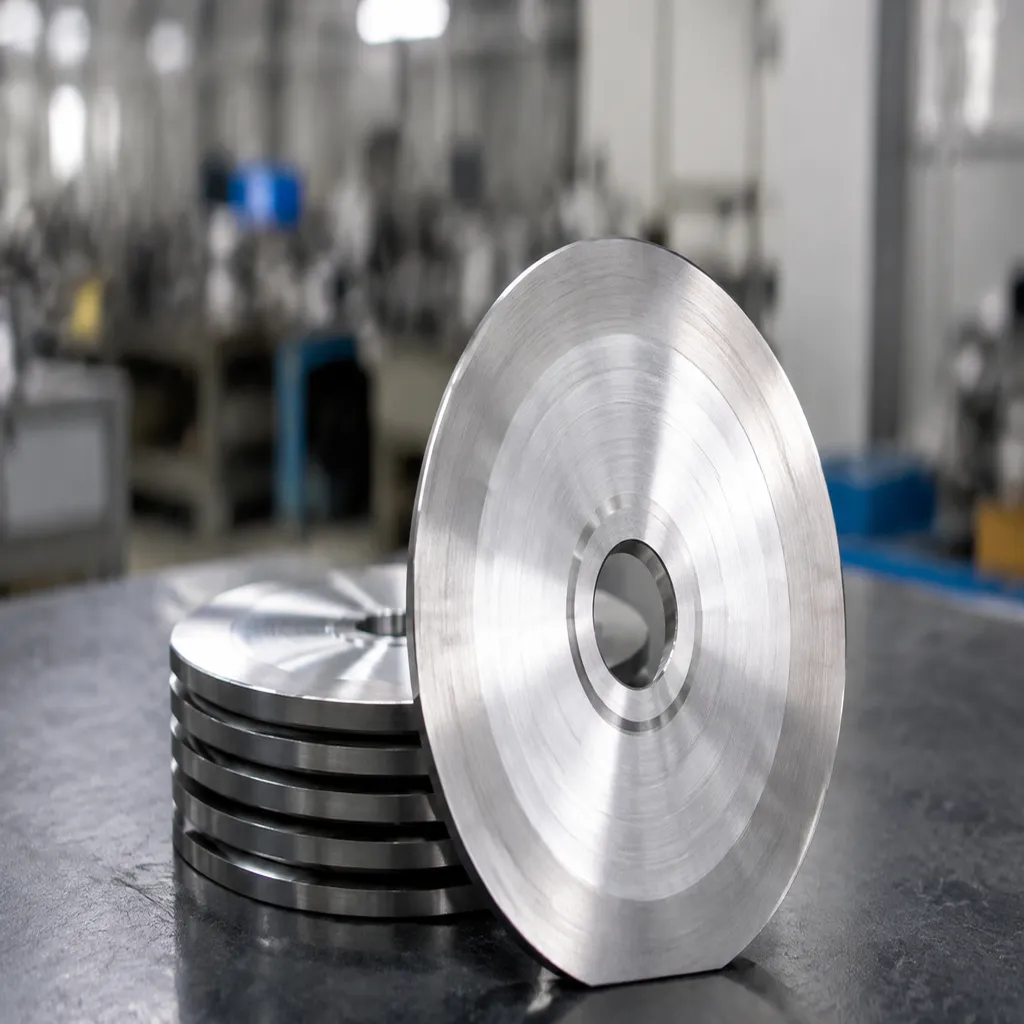
Choosing the right foil slitter blade geometry depends directly on your material thickness, line speed, and core slitting method. We manufacture top and bottom circular knives, industrial razors, and heavy-duty crush assemblies engineered to eliminate edge deformation across all converting setups.
| Slitting Configuration | Blade Geometry | Ideal Foil Applications | Technical Highlights |
|---|---|---|---|
| Rotary Shear Slitting | Top & bottom circular knives | Thick gauge aluminum & copper foils | Scissor-cutting action, zero edge turn-down, precise overlap control |
| Industrial Razor Slitting | 3-hole, slotted & rectangular razors | Ultra-thin web foils & polymer laminates | Low drag, fast changeouts, micro-polished razor edges |
| Pneumatic / Crush Slitting | Radiused circular blades | High-impact continuous web lines | Heavy shock resistance, uniform compression cutting, long edge retention |
Precision Shear & Razor Blade Setups
We manufacture high-precision shear slitting knives designed for exact scissor cutting on heavy non-ferrous foils, ensuring tight width tolerances without web distortion. For ultra-thin barrier foils and foil-polymer films, our industrial razor slitter blades deliver clean, drag-free web separation to eliminate tearing and dust formation at high line speeds.
Advanced Surface Coating Options
To stop aluminum transfer, adhesive drag, and rapid abrasive wear, we apply specialized anti-friction surface treatments:
- Titanium Nitride (TiN): High-hardness PVD coating that extends edge life during continuous long-run foil converting.
- Zero-Friction Ceramic: Heat-dissipating surface finish that prevents metal galling on high-speed rotary slitting operations.
- Diamond-Like Carbon (DLC): Extremely hard, low-friction coating (Ra < 0.1 µm) engineered for abrasive battery cathodes and anodes.
- Teflon Anti-Stick: Non-stick barrier that prevents resin and polymer adhesive buildup on sticky laminated packaging foils.
Application-Specific Foil Slitter Blade Solutions
We tailor every foil slitter blade profile and material grade to solve the exact edge-quality challenges of your converting process.
Battery Electrode Foil Slitters
- Target Materials: Ultra-thin copper anode (6–9 µm) and aluminum cathode (10–15 µm) current collector foils.
- Performance: Delivers zero-burr edge geometry that eliminates micro-slivers and short-circuit risks during battery cell assembly.
Aluminum Packaging Foil Converting
- Target Materials: Pure aluminum converter foils and light-gauge flexible rolls.
- Performance: Maintains continuous high-speed roll-to-roll slitting without web deformation, tearing, or metallic dust accumulation across high-volume packaging manufacturing operations.
Abrasive Flexible Laminates
- Target Materials: Multi-layer foil/polymer barrier films, paper-foil structures, and abrasive composite webs.
- Performance: Prevents blade nicking and premature edge dulling, ensuring clean shear lines when integrated alongside heavy-duty packaging machine knives.
Medical & Pharmaceutical Packaging
- Target Materials: Cold-form blister pack foils, push-through aluminum lids, and sterile barrier pouches.
- Performance: Manufactured from cleanroom-compatible, corrosion-resistant stainless steel and fine-grain carbides to guarantee zero particulate contamination and total sanitary compliance.
Custom OEM Engineering for Foil Slitter Blades
We manufacture high-precision replacement blades and custom tooling engineered to your exact slitting specs. Whether you need to modify existing bevel geometry or replace obsolete production components, our team delivers fast turnarounds without sacrificing dimensional accuracy.
- 24-Hour Blueprint Production: We convert your CAD/DWG and 3D files into production-ready foil slitter blade profiles within 24 hours.
- CMM Reverse Engineering: Send us your worn or damaged physical samples. We use multi-axis CMM inspection to measure and replicate original factory tolerances down to the micron.
- 100% OEM Machinery Compatibility: We supply direct-fit drop-in parts and specialized slitter rewinder replacement blades engineered to match major converting equipment brands, including Kampf, Atlas, Titan, and Dusenbery.
- Custom Edge Angles & Bevel Profiles: Through our specialized custom engineering services, we tailor single-bevel, double-bevel, compound bevel, and hollow-ground edge profiles directly to your web line speed and material density.
Quality Assurance for Every Foil Slitter Blade
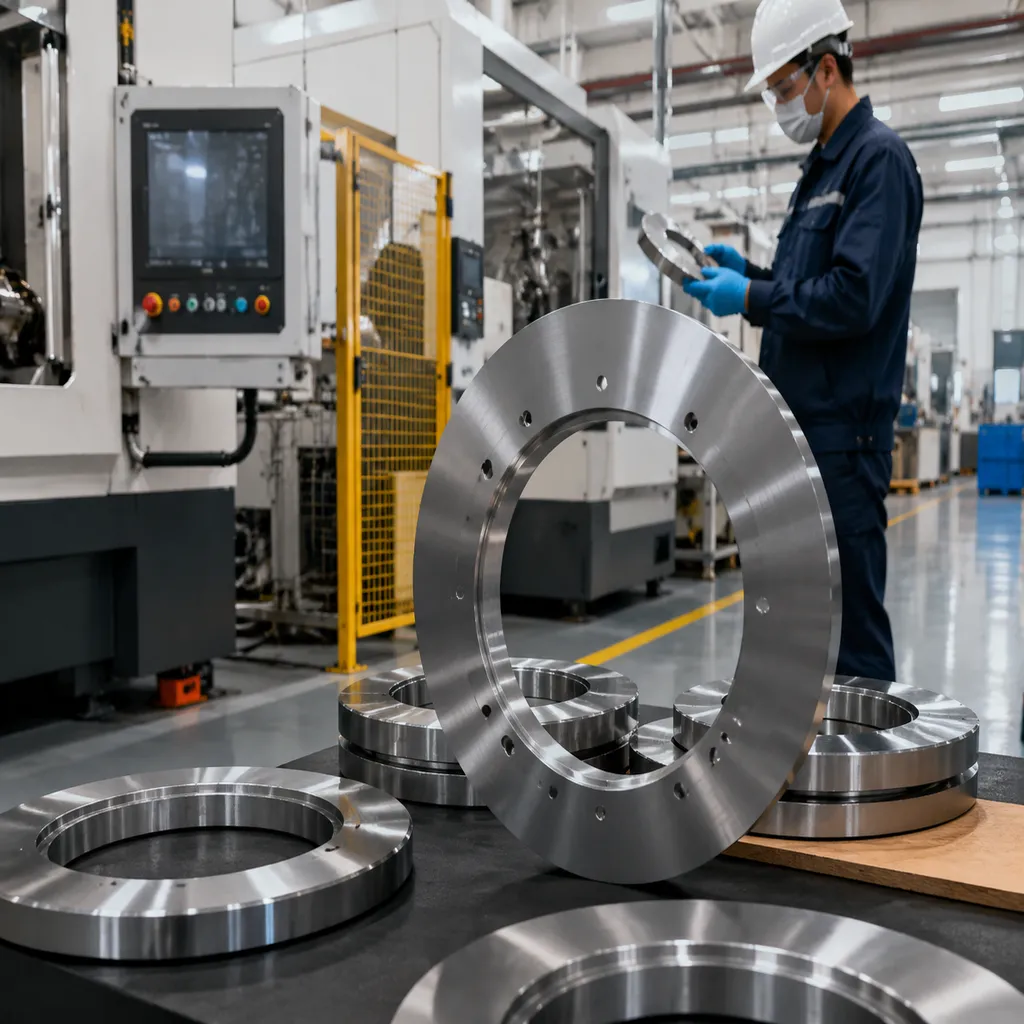
- Multi-Axis CNC Grinding: Machined on 5-axis CNC grinders through advanced precision machining to guarantee absolute slitter blade concentricity and eliminate total indicator runout.
- Vacuum Heat Treatment & Cryogenic Relief: Standardized thermal processing optimizes grain structure and relieves stress for long-term dimensional stability under continuous mechanical load.
- 100% Quality Verification: We inspect every production batch using our full quality control protocol:
- Optical CMM Measurement: Verifies critical bevel geometries and complex edge dimensions.
- Surface Profilometry: Validates mirror-finish roughness levels down to Ra < 0.1 µm.
- Rockwell Hardness Testing: Guarantees precise hardness metrics across both solid carbide and high-speed steel grades.
Technical & Procurement FAQs
Tungsten Carbide vs. HSS Foil Slitter Blades
Choosing between solid tungsten carbide and high-speed steel (HSS) for your foil slitter blade depends on material aggressiveness and machine arbor rigidity:
| Feature | Solid Tungsten Carbide | HSS (M2 / SKH51) |
|---|---|---|
| Best Application | High-abrasion metallic foils & battery electrodes | Flexible packaging laminates & variable tension lines |
| Wear Lifespan | Up to 10× longer than conventional steel | Moderate wear resistance with superior fracture toughness |
| Vibration Resistance | Low (requires zero-play arbors & high precision) | High (absorbs mechanical shock and side-load forces) |
We recommend custom engineered tungsten carbide slitting knives for high-volume runs where minimizing maintenance downtime delivers maximum overall value.
Edge Bevel Geometry for Zero "Angel Hair" & Foil Dust
To eliminate edge flaking, web tearing, and "angel hair" slivers on high-speed foil lines, we utilize a double-compound bevel geometry paired with a micro-polished cutting surface (Ra < 0.1 µm).
- Double-Compound Bevel: Balances shearing forces evenly along the cut zone, preventing burr formation on soft aluminum foil.
- Single-Bevel Configuration: Tends to push thin metallic web laterally, leading to micro-cracking and excessive dust accumulation.
Custom OEM Slitter Blade Production Lead Times
- Standard Replacement Blades: In-stock orders ship within 24 to 48 hours.
- Custom Blueprint & Reverse-Engineered Blades: Standard manufacturing turn-around is 2 to 3 weeks following CAD approval.
- Emergency Expedited Orders: Rush production available within 7 business days to minimize unexpected plant downtime.
Precision Slitter Blade Sharpening Services
We provide full-service re-sharpening and re-conditioning for top and bottom circular shear blades and custom industrial knives. Every blade goes through multi-axis CNC re-grinding to restore concentricity to within ±0.001 mm and reinstate original mirror-polished edge geometry.
Related Sources
- https://hardedgetool.com/the-solid-tungsten-carb
- https://kedelcarbide.com/lithium-battery-industry-blade/
- https://www.sollex.com/blog/post/how-to-optimize-shear-slitting-for-flexible-foils
- https://edgemills.com/material-used-for-slitting-knives/
- https://hardedgetool.com/the-solid-tungsten-carbide-slotted-slitter-blade/