

Why Nylon Challenges Multiblade Slitter Knives
Slitting polyamide webs pushes cutting tooling harder than almost any standard polyolefin. When you run a multiblade slitter knife on nylon, you deal with a tough, elastic polymer that fights shear forces, generates extreme friction, and punishes dull edges instantly.
Cast versus BOPA film cutting behavior
Nylon films do not shear alike. Their molecular orientation dictates how they interact with multiple rotary slitter blades:
- Cast Nylon (Unoriented): Highly ductile and pliable. It tends to stretch under dull tooling rather than shear cleanly, resulting in tensile necking, heavy web elongation, and uneven slit widths across the shaft.
- Biaxially Oriented Polyamide (BOPA): Exceptionally tough with high tensile strength. BOPA resists blade penetration, generating massive side-load pressure against male and female slitter knives. Any micro-flaw on the edge leads to film splitting, micro-tears, or web snap.
| Film Type | Primary Slitting Hurdle | Edge Defect Risk |
|---|---|---|
| Cast Nylon | High elongation under shear load | Edge stretching and neck-in |
| BOPA Film | High puncture resistance & stiffness | Slit line cracking and web breaks |
Woven nylon fraying and yarn pull-out
Woven nylon fabrics, ballistic cloth, and industrial webbing present mechanical shear hazards. A standard multiblade slitter knife must cleanly sever both warp and weft yarns simultaneously without snagging:
- Yarn Pull-Out: Insufficient sharpness causes the blade edge to drag filaments out of the weave structure before severing them.
- Frayed Edges: Inconsistent overlap or incorrect blade clearance leaves loose filament tails along the cut lane.
- Edge Raveling: Tensile stress during downstream winding quickly unravels poorly cut woven edges.
Thermal sensitivity and edge bead buildup
Polyamide has a sharp melting point combined with high frictional drag against steel blade flanks. When multiblade slitter knives run at continuous production speeds:
- Frictional Heat Surge: Blade flanks generate immediate friction against the slitted nylon strip.
- Edge Smearing: Localized temperatures reach the polymer softening threshold, causing edge melting instead of clean shearing.
- Bead Formation: Melted nylon accumulates along the blade bevel and transfers back onto the roll edge as an irregular, hardened bead that disrupts downstream tension and roll geometry.
Abrasive filler wear on cutting edges
Industrial nylon formulations often incorporate mineral fillers, flame retardants, or glass fiber reinforcements. These additives drastically increase abrasive wear:
- Micro-Chipping: Hard inclusions strike the acute cutting edge, knocking out micro-fragments.
- Hone Erosion: Abrasive particles quickly strip away polished hone finishes, blunting the tip.
- Friction Escalation: Once the initial razor edge degrades, localized cutting friction spikes, accelerating thermal edge deformation across all slitter lanes simultaneously.
Multiblade Slitter Knife Configurations for Nylon
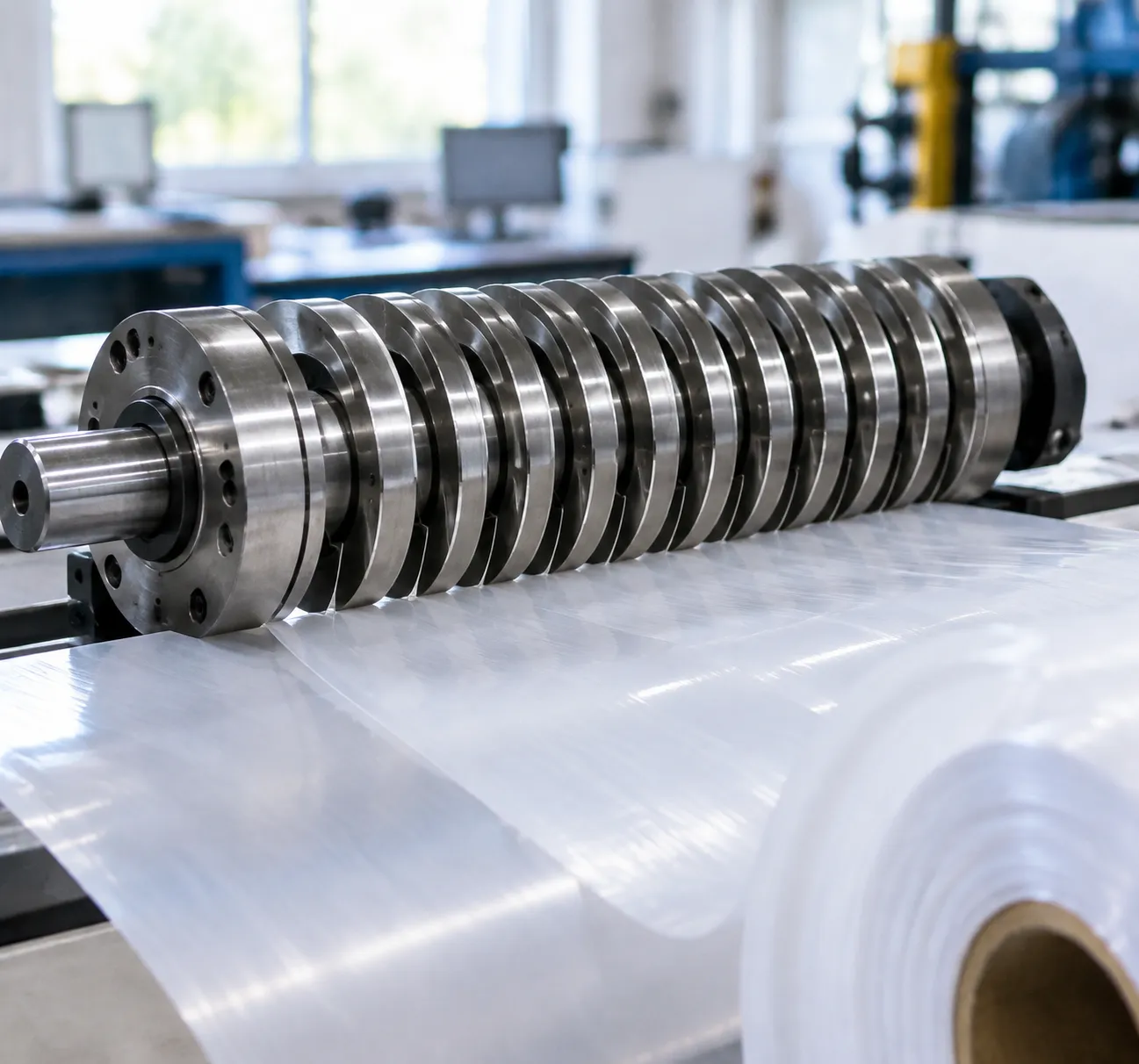
Stacked Gang Slitting Knives with Precision Spacers
For most nylon converting operations, we set up gang slitting knives stacked along a common arbor separated by precision-ground spacers.
- Width Flexibility: Adjust slit strip widths simply by changing the thickness of the slitter knife spacers.
- Tolerances: Spacers must feature parallel tolerances within ±0.002 mm to prevent accumulated axial runout across wide shafts.
- Clamping Force: Uniform hydraulic or mechanical arbor clamping locks the pack together to prevent individual blade slip under high web tensions.
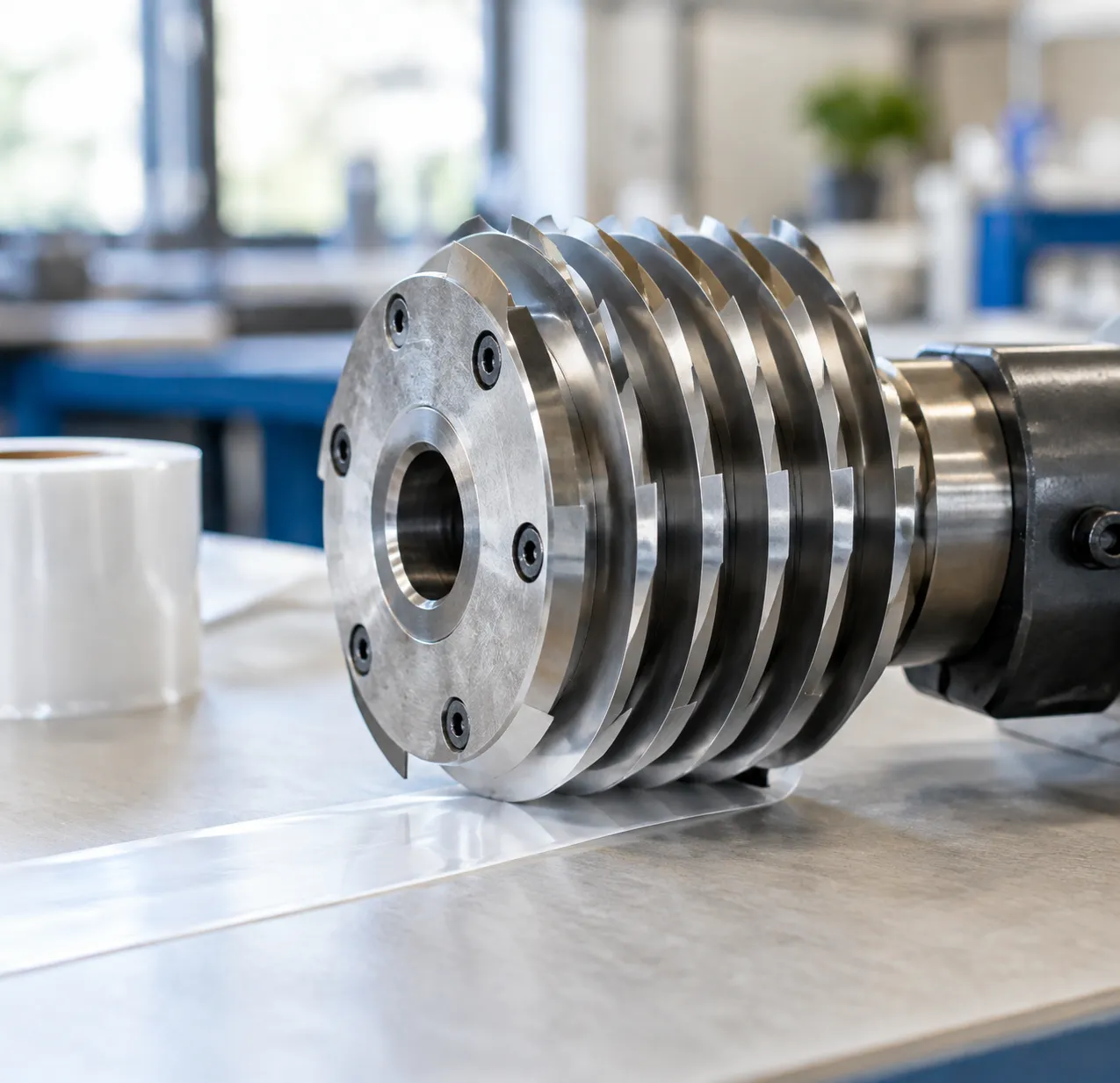
Solid Multi-Edge Knife Blocks
When converting ultra-narrow nylon tapes or micro-ribbons below 3 mm wide, standard stacked blades flex under lateral load. In these operations, solid multi-edge knife blocks provide unmatched rigidity.
We grind multiple cutting edges directly into a single solid tool block. This eliminates spacer tolerance stack-up entirely, resists side-deflection from tough polyamide fibers, and guarantees identical slitting widths from edge to edge.
Rotary Shear Slitting Mechanics
Shear cutting delivers the cleanest results on both cast nylon film and woven nylon fabrics. The process pairs male upper knives with driven female lower rings:
- Scissor Action: Male and female slitter knives intersect at an exact cut point, shearing tough nylon fibers rather than tearing them.
- Edge Integrity: Unlike metal slitting, nylon requires razor-true shear lines to avoid high friction. Proper mechanical alignment mirrors the fundamentals found in shear slitting top knife bevel angle setups, keeping frictional heat below the melting point of the polymer.
| Configuration Type | Best Web Application | Slit Width Limit | Primary Advantage |
|---|---|---|---|
| Stacked Gang Knives | Cast nylon, BOPA film, woven goods | Down to 5 mm | Quick width adjustments with ground spacers |
| Solid Knife Blocks | High-tensile nylon tape, technical ties | Down to 1 mm | Zero blade flex, maximum dimensional precision |
| Rotary Shear Gangs | Multi-lane industrial nylon films | Variable | High cutting speeds without edge melting |
Crush Cut vs. Razor Gang Slitting Limits
Operators frequently attempt razor slitting or crush cutting on nylon to save setup time, but both methods encounter strict mechanical limits:
- Razor Slitting Limitations: While thin razor setups work on standard polyolefins, abrasive nylon rapidly rounds the razor edge. The resulting drag stretches the web, causing edge necking, flutter, and uneven split widths.
- Crush Cutting Limitations: Crush cutting traps tough nylon against an anvil roll. The blunt mechanical force bruises the slit edge, causes severe micro-cracking in rigid films, and frays the edges of woven nylon webbing.
Rotary shear slitting remains the standard production method for nylon web processing.
Controlling Axial and Radial Runout
Knife shaft runout is the primary cause of ragged edges and melted polymer bead buildup when running a multiblade slitter knife on nylon. High-speed polyamide slitting tolerates virtually zero mechanical play:
- Radial Runout Limits: Keep radial runout below 0.005 mm across the entire knife pack. Any eccentric high spot causes the knife to chop the web intermittently rather than shear smoothly.
- Axial Runout Control: Keep axial wobble under 0.003 mm. Lateral movement alters the clearance gap between the male and female edges dynamically, alternating between edge pinch and edge tear.
- Arbor Maintenance: Inspect arbors for debris and burrs prior to loading spacers and knives; a single speck of dust behind a spacer tilts every downstream blade on the shaft.
Best Tool Steels and Coatings for Nylon Slitting
Slitting nylon puts cutting edges through intense friction, localized heat, and abrasive wear. Choosing the wrong blade material leads to fast dulling, melted edge beads, or severe blade chipping. When configuring a multiblade slitter knife on nylon, we match the knife metallurgy and surface treatment directly to the material formulation and slitter line speed.
| Material Grade | Hardness | Primary Advantage | Best Nylon Application |
|---|---|---|---|
| D2 Tool Steel | 58–60 HRC | Low initial cost, decent abrasion resistance | Low-speed unreinforced film and thin sheet slitting |
| M2 / M42 High-Speed Steel | 62–64 HRC | Superior red-hardness under continuous friction | High-speed BOPA converting and synthetic webbing |
| Powder Metallurgy (CPM 10V / M4) | 60–63 HRC | High carbide volume without micro-chipping | Heavy-gauge nylon and continuous gang slitting |
| Micro-Grain Tungsten Carbide | 88–92 HRA | Extreme wear resistance against abrasive fillers | Glass-filled polyamide and non-stop production runs |
High-carbon D2 tool steel performance
D2 is a common baseline steel for light-duty nylon slitting. It handles standard, unfilled nylon films at modest web speeds without issue. However, D2 loses edge temper when continuous slitting temps climb. When friction heats the blade face past its threshold, the cutting edge rounds off, creating pinched edges instead of clean cuts.
High-speed steel for thermal resistance
For high-speed rotary slitting, we prefer high-speed steels like M2 or M42. These alloys feature superior "red-hardness," maintaining edge geometry even under heavy frictional heating. M2 high-speed steel resists thermal softening, preventing premature dulling and keeping the slit line clean across high-velocity nylon webs.
Powder metallurgy tool steel benefits
Powder metallurgy (PM) tool steels solve the micro-chipping problems common with conventional ingot steels. The fine, uniform carbide distribution of PM steels like CPM 10V gives our top and bottom slitter knives up to three times the service life of D2. You get razor sharpness combined with enough toughness to handle web tension spikes without edge fractures.
Micro-grain tungsten carbide slitter knives
When cutting glass-filled or mineral-loaded nylon, steel knives dull in a matter of hours. Solid micro-grain tungsten carbide provides the abrasion resistance needed to keep slitting cleanly for weeks. Carbide requires a rigid machine setup with zero shaft vibration to avoid edge breakage. For a detailed breakdown of tool life versus setup requirements, explore our carbide vs steel knives guide to choose the right material for your slitting line.
Anti-stick coatings and PVD surface treatments
Molten nylon buildup on the knife flanks causes drag, web wander, and edge fraying. Applying physical vapor deposition (PVD) coatings creates a hard, slick barrier that prevents molten polyamide from sticking:
- Titanium Nitride (TiN): Hard baseline coating that lowers friction and improves basic wear life.
- Titanium Aluminum Nitride (TiAlN): Builds an aluminum oxide layer under heat, making it an excellent choice for dry, high-friction nylon slitting.
- Diamond-Like Carbon (DLC): Provides an ultra-low friction coefficient, stopping polymer transfer and static edge cling dead in their tracks.
Blade Geometry and Edge Profiles for Polyamide
Single Bevel vs. Double Bevel Selection
Choosing the wrong edge profile instantly shows up on your finished rolls as edge curl or excessive dust. Here is how we break down the selection on the floor:
- Single Bevel: Best for shear-cut gang slitting where one knife runs flat against a female bottom anvil ring. It creates a flush cutline, pushing the trim away on only one side without distorting the web.
- Double Bevel: Ideal for center-cut razor setups and unsupported slicing. It balances lateral forces on both sides of the blade, though the wedge effect can push against thicker nylon webs if the angle is too blunt.
Optimal Included Bevel Angles
Nylon is tough, flexible, and abrasive. If your edge is too steep, it acts like a wedge and generates friction. If it is too acute, the edge chips or rolls over within hours.
| Application | Recommended Bevel Angle | Key Operating Benefit |
|---|---|---|
| Thin BOPA Films | 22° to 30° included | Eliminates web stretch and edge bead |
| Thick Cast Nylon / Extrusions | 35° to 45° included | Prevents edge chipping under high lateral load |
| Heavy Woven Nylon Webbing | 30° compound bevel | Balances yarn shear strength with tool life |
Selecting the correct profile follows similar rules to balancing edge durability in circular slitter knife bevel angle setups, where excess friction rapidly drives up thermal wear.
Mirror-Polished Blade Flanks
Rough grind marks on the knife flanks drag against synthetic polymers and cause heat buildup. We run mirror-polished flanks (surface finish of Ra 0.1 to 0.2 µm) on multiblade slitter tooling handling nylon. A high-luster finish stops molten polyamide from grabbing the blade face, keeping friction low and slitting tracks clear.
Controlled Edge Hone vs. Razor Sharpness
A razor-sharp, zero-radius edge sounds great until it touches high-tensile nylon. A feather-thin edge micro-chips almost immediately against abrasive synthetic resins.
Instead of an untreated microscopic wire edge, we use a light, controlled edge hone (a micro-radiused cutting edge of 2 to 5 microns). This small radius reinforces the cutting apex, distributes high shear loads, and keeps your rotary slitter blades cutting consistently without dulling prematurely.
Setup Parameters for Multiblade Slitter Knives on Nylon
Dialing in a multiblade slitter knife on nylon requires tighter setup tolerances than almost any other synthetic substrate. Nylon is forgiving when pulled, but unforgiving when cut under improper geometry. If your blade interference or web line tension drifts even slightly, you run straight into edge curl, melted beads, or immediate blade binding. We use precise shop-floor targets to set up our gang slitting assemblies and keep our slitting lines running clean. For a broader baseline across different substrates, check out our slitter knife setup guide for precise cutting to see standard mechanical baselines before tuning for polyamide.
Cant angle adjustment for shear cutting
The cant angle—the toe-in pitch of the upper male blade relative to the lower female anvil—controls the contact point between cutting edges. With nylon, getting this angle wrong creates instant friction problems.
- Target setting: Maintain a cant angle between 0.25° and 0.5° (15 to 30 minutes of arc).
- Angle too aggressive (>0.75°): Generates extreme point-pressure, causing rapid carbide edge micro-chipping, excessive frictional heat, and blade rub that melts the nylon edge.
- Angle too flat (<0.15°): Causes broad contact across the blade faces, creating pinching rather than a clean shear cut slitting action. This pinches the web and pulls un-slit fibers through the nip.
Setting optimal blade overlap depth
Blade overlap depth dictates how deep the upper knife penetrates the female knife ring. Nylon stretches under load, so operators often make the mistake of setting excessive overlap to "guarantee" a cut. That just adds unnecessary drag.
- Thin BOPA and barrier films: Keep overlap between 0.015 in and 0.025 in (0.38 mm to 0.64 mm). This minimizes the contact arc and eliminates heat-induced bead formation on the film borders.
- Heavy woven nylon and webbing: Set overlap between 0.030 in and 0.050 in (0.76 mm to 1.27 mm) to ensure complete fiber penetration through thick yarn bundles without allowing structural yarn slippage.
- The baseline rule: Always run the minimum overlap required to sever the web cleanly. Excess overlap accelerates blade wear and causes scallop-shaped edge defects.
Axial side-load pressure regulation
Side-load force holds the male and female rotary slitter knives together at the shear point. Because polyamide possesses high shear resistance, holding steady side pressure without creating metal-to-metal galling is critical.
- Light, consistent loading: We set pneumatic side-pressure between 2.0 and 3.5 bar (30 to 50 psi), depending on blade diameter and web thickness.
- Spring-loaded holders: Calibrate spring preload to deliver roughly 3 to 5 lbs (1.4 to 2.3 kg) of axial force at the contact point.
- Watch the heat: If your blade shafts feel hot to the touch after 20 minutes of running, your side pressure is too high. High side load acts as a friction brake, welding melted nylon debris straight onto the knife faces.
Web tension control to stop edge curl
Nylon has distinct elastic recovery. If you pull the web too hard while the multiblade knife assembly splits it, the slit edges stretch, snap back, and permanently curl upward.
- Infeed tension: Keep entry web tension at the lowest level that still maintains a flat, wrinkle-free sheet over the slitter backup roll. Aim for 0.15 to 0.25 pli (pounds per linear inch) on thin cast nylon films.
- Differential rewind tension: When running narrow multiblade slit strands, use differential air shafts to prevent tension variation between adjacent cuts.
- Wrap angle: Wrap the web securely over a grooved or hardened anvil roll right at the slitting zone. Never let nylon float unsupported through a gang slitting setup, or blade deflection will pull uneven lanes.
| Setup Parameter | Target Range for Nylon | Risk of Low Setting | Risk of High Setting |
|---|---|---|---|
| Cant Angle | 0.25° to 0.50° | Slits pull, uncut filaments, web slip | Rapid edge dulling, edge melting |
| Blade Overlap | 0.015" – 0.035" (Film) 0.030" – 0.050" (Woven) | Incomplete cuts, pinched web | Edge scalloping, heavy blade drag |
| Side-Load Force | 3.0 to 5.0 lbs (axial force) | Slit separation, burrs, yarn fray | Blade galling, friction heat, blade wear |
| Web Infeed Tension | 0.15 to 0.35 pli | Wandering cut lines, web wrinkling | Elastic stretch, severe edge curl |
Troubleshooting Nylon Edge Quality Issues with Multiblade Slitter Knives
Running a multiblade slitter knife on nylon puts tooling through extreme mechanical and thermal stress. When slitting quality degrades, you do not always need to replace the entire gang setup immediately. Most defects stem from misaligned knife geometry, excessive friction, or runout across the arbor.
Here is how we diagnose and fix the four most common slitting defects on nylon production lines.
Fixing Melted or Glazed Slit Edges
Polyamide edge melting is almost always caused by localized friction heat generated during shear cut slitting. When nylon heats past its glass transition temperature, it leaves a hard, glassy bead along the slit edge that prevents uniform rewinding.
- Back off the side-load pressure: Excessive axial force between the male and female rotary slitter blades generates severe friction. Reduce side load to the minimum required for a clean separation.
- Reduce knife overlap depth: Plunging the upper blade too deep into the lower knife increases the contact surface area and friction. Lower your overlap to between 0.015" and 0.030" (0.4 mm to 0.8 mm).
- Verify blade cant angle: A misaligned shear angle traps web material against the knife body, dragging the nylon along the blade flank.
Eliminating Edge Fraying on Woven Nylon
Woven nylon fabrics and high-tenacity strapping tear rather than shear cleanly if the cutting edge cannot immediately part the synthetic fibers.
- Check for micro-chipping: Even sub-micron nicks on the cutting edge grab individual yarn filaments, pulling them out of the weave rather than shearing them cleanly.
- Eliminate blade deflection: When slitting dense woven material, cutting resistance can push upper blades away from the lower anvils. Tighten your gang assembly lockup to prevent axial deflection under load.
- Tighten shear clearance: Any gap between the male and female shearing faces allows tensile-tough nylon strands to pinch and fray instead of cutting crisply.
| Edge Defect | Primary Root Cause | Shop-Floor Correction |
|---|---|---|
| Glazed/Melted Bead | Friction from excessive side load or overlap | Reduce blade penetration depth; verify arbor cooling |
| Frayed Yarn Strands | Dull blade radius or blade deflection under load | Resharpen to a fine edge; eliminate blade gap |
| Wavy Slit Line | Axial wobble or contaminated arbor spacers | Clean shaft; inspect tooling with a dial indicator |
| Rapid Micro-Chipping | Abrasive fillers or excessive cant angle | Switch to micro-grain carbide; ease side pressure |
Resolving Wavy Cuts and Slitter Runout
A wavy edge along the web indicates knife shaft runout or blade flutter. On high-density gang slitting setups, cumulative thickness deviations multiply across the shaft.
- Inspect shaft and tooling cleanliness: Even microscopic debris or polymer dust trapped between knives and spacers induces axial wobble.
- Use high-accuracy spacing: Always assemble shafts using ground slitter knife spacers for precise material cutting to maintain parallel alignment and keep total axial runout under 0.0002" (0.005 mm).
- Check bearing clearances: Worn slitter arbor bearings allow shafts to flex radially under web tension, creating recurring width variations across the finished rolls.
Stopping Premature Knife Edge Dulling
Abrasive additives like titanium dioxide, silica, or glass fibers in polyamide quickly round off conventional tool steel edges.
- Upgrade blade metallurgy: If standard D2 steel dulls within hours on filled nylon, upgrade your multiblade slitter knife set to powder metallurgy (PM) steels or micro-grain tungsten carbide slitter knives.
- Prevent over-penetration: Deeper knife penetration accelerates flank wear without improving cut quality. Keep engagement shallow to extend edge life.
- Balance side loading: Running excessive cant angles concentrates stress on the very tip of the blade, causing rapid abrasive breakdown and premature dulling.
Knife Maintenance and Regrinding Best Practices
Running a multiblade slitter knife on nylon pushes edge metallurgy to its limit. Friction, heat, and synthetic fiber drag mean edge wear happens fast. If you don't stay on top of blade reconditioning, edge melt and web tear-outs will stall your line. Following established knife maintenance best practices keeps your tooling sharp, predictable, and production-ready.
Matched-Diameter Regrinding Across Multiblade Sets
When we regrind a gang slitting setup, grinding knives individually is a massive mistake. Stacking multiblade sets demands absolute consistency across the entire arbor.
- Uniform OD matching: All rotary shear slitter blades in a gang must share the exact same outer diameter within ±0.002 mm (±0.0001 in). Even minor diameter variations cause unequal peripheral speeds, dragging on nylon web surfaces and creating tension spikes.
- Batch sharpening: We clamp and grind knife packs together on precision mandrels. This keeps edge profiles identical and preserves steady blade overlap depth across every slit channel.
- Side-runout verification: We inspect both axial and radial runout immediately after sharpening to avoid wobble that shreds delicate polyamide film.
| Regrind Parameter | Tolerance Target | Impact on Nylon Slitting |
|---|---|---|
| Outer Diameter (OD) | ±0.002 mm | Stops web speed mismatches and edge stretching |
| Axial Runout | < 0.003 mm | Prevents blade rub, heat buildup, and edge glazed beads |
| Edge Roughness (Ra) | < 0.1 µm | Prevents yarn snagging on woven polyamide fabrics |
Demagnetizing Knives After Sharpening
Grinding tables rely on magnetic chucks, leaving tool steel packed with residual magnetism. If you mount a magnetized multiblade slitter knife on nylon lines, you create immediate processing problems:
- Attracting metallic dust: Magnetic blades pull in microscopic grinding grit and airborne steel dust, which directly abrades the razor-sharp edge during high-speed runs.
- Static web interaction: Nylon builds aggressive electrostatic charges. Magnetized steel worsens web cling, causing thin BOPA films to wrap shafts and drag through slitter knives.
- The fix: We run every single blade through an industrial demagnetizer post-grind, checking that residual field strength drops below 2 Gauss before packaging or mounting. Tracking these tolerances using an industrial knife markings and traceability guide ensures serialized blade sets stay grouped correctly throughout their service life.
Ultrasonic Cleaning for Melted Polymer Buildup
Nylon scrap clings to cutting flanks when shear friction spikes. Never use brass scrapers, razor scrapers, or harsh wire brushes to chip off cooked polyamide residue, as mechanical scraping rolls honed edges and ruins mirror-polished flanks.
- Immersion degreasing: We place knife sets into heated ultrasonic cleaning tanks filled with a specialized alkaline wash.
- Cavitation stripping: Ultrasonic micro-bubbles strip baked-on polymer glaze and synthetic sizing agents from knife bevels without contacting cutting edges.
- Inspection routine: Once clean, we inspect the edge under optical magnification to detect micro-chipping before reinstalling the multiblade pack on the slitter arbor.
FAQs About Multiblade Slitter Knife on Nylon
Running a multiblade slitter knife on nylon brings up the same recurring headaches on the converting floor. Here are the direct answers we give operators dealing with heat buildup, blade wear, and frayed edges.
Why does nylon stick and melt on slitter blades?
Nylon has a low thermal conductivity, meaning heat stays right at the cut zone instead of dissipating into the web. When you run high-speed gang slitting knives, friction between the metal flanks and the material causes polyamide edge melting.
- Dull cutting edges: A worn edge rubs and stretches the polymer instead of shearing it cleanly.
- Excessive blade overlap: Too much steel-to-steel contact builds instant friction heat.
- Rough surface finishes: Standard ground blades create drag; we always recommend mirror-polished flanks or low-friction PVD coatings.
- Resin buildup: If melted polymer accumulates on the tool, follow proper slitter blade cleaning tips to strip the residue without damaging the cutting edge.
What blade material lasts longest on abrasive nylon?
Nylon loaded with TiO2 (titanium dioxide) delustrants or glass fibers will chew through standard carbon steel in hours. To maximize blade wear resistance and extend time between regrinds, material selection has to match your run length.
| Industrial Blade Material | Best Nylon Application | Wear Life Rating |
|---|---|---|
| D2 Tool Steel | Unfilled cast nylon film and short converting runs | Moderate |
| Powder Metallurgy Steel (PM) | High-speed BOPA film slitting requiring high toughness | High |
| Micro-Grain Tungsten Carbide | Abrasive woven nylon, glass-filled sheets, 24/7 operations | Maximum |
For non-stop production lines, upgrading to carbide options for precision cutting gives you the longest run times and keeps cutting edges crisp across multi-shift jobs.
How do I stop edge fraying on woven nylon webbing?
Cold-cutting woven nylon without pulling yarns requires pristine shear cut slitting mechanics. If your rotary slitter blades are slightly off, the tough synthetic fibers will fold over the anvil ring and tear rather than shear.
- Lock in the cant angle: Keep the upper male knife canted precisely between 0.25 and 0.5 degrees against the female bottom ring.
- Maintain crisp edges: Swap out blades at the first sign of rounding; synthetic fiber cutting demands a sharp shear point.
- Eliminate shaft deflection: Check your slitter knife spacers for trapped dust or burrs that cause axial wobble.
- Stabilize web tension: Keep tension tight across the nip point so the woven fabric cannot shift mid-cut.
What is the ideal blade overlap depth for nylon film?
When setting up male and female slitter knives for thin nylon or BOPA film, less overlap is always better. Deep penetration increases rubbing velocity, heats the blade tip, and causes edge curl.
- Target overlap depth: Set your blade overlap depth between 0.5 mm and 0.8 mm (0.020" to 0.030").
- Speed matching: Ensure the overspeed ratio of the rotary shear blades matches your web speed to prevent dragging or micro-tearing on the film edge.