
Fundamentals of Top Knife Bevel Geometry in Paper Shear Slitting
Excessive paper dust, ragged slit edges, and constant blade changeouts are daily frustrations on the converter floor. When slit quality degrades, operators often blame side-load tension or web speed, but the true culprit is usually blade geometry. Optimizing the shear slitting top knife bevel angle paper mills use is the single most critical factor in achieving clean web separation and maximizing tool life.
The Rotary Shear Mechanism
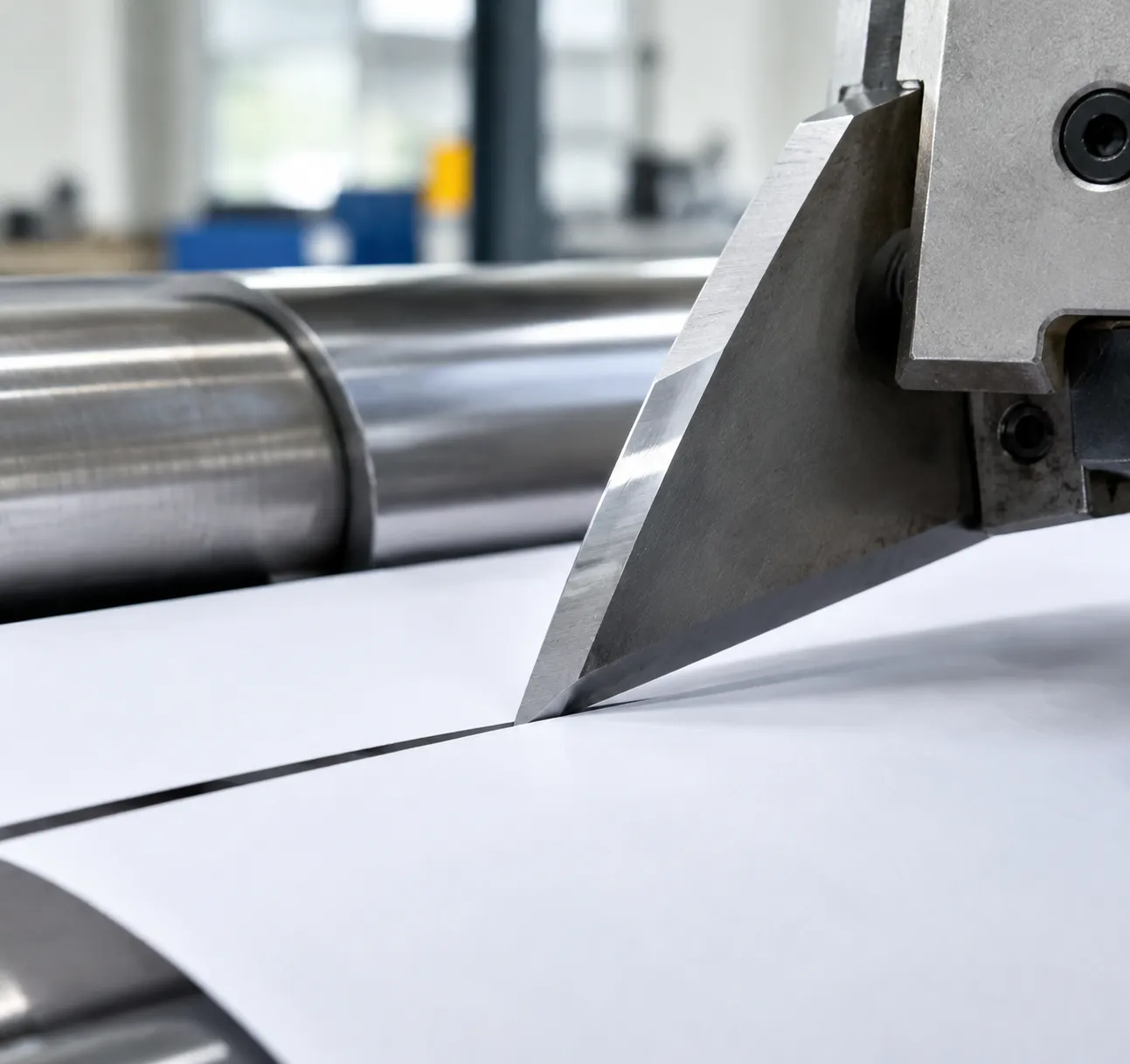
In paper converting, rotary shear slitting relies on a precise scissor-action cut created by the intersection of a top male slitter blade and a bottom female anvil knife. Rather than crushing the paper sheet, the two blades meet at a progressive point of contact.
As the paper web passes through this nip, the top knife's sharpened edge shears paper fibers along a focused shear plane. Achieving this clean action requires balanced interaction between:
- Blade Overlap Depth: The vertical penetration of the top knife into the bottom female knife channel.
- Cant Angle: The microscopic angular axial tilt that ensures single-point contact at the cutting shear point.
- Side-Load Pressure: The lateral spring force keeping the male blade face biased against the female anvil wall.
Why Bevel Angle Matters
The primary and secondary bevel angles on the top knife dictate how shear force vectors pass through the paper substrate. Blade geometry directly influences cutting dynamics, friction levels, and web stability.
- Force Distribution: A properly engineered bevel angle directs cutting force cleanly through the web thickness, minimizing the lateral pressure required to sever paper fibers.
- Friction & Heat Reduction: Correct clearance angles minimize contact area between the blade body and the slitted paper edge, reducing thermal expansion and preventing adhesive or coating melt.
- Preventing Web Deformation: Optimized knife angles shear fibers instantaneously, preventing paper stretching, edge roll-over, and web rim collapse at high line speeds.
Cost Impact of Incorrect Geometry
Using an improper bevel angle severely impacts plant profitability through hidden process inefficiencies and scrap generation.
| Slitting Defect / Issue | Root Geometry Failure | Operational & Financial Impact |
|---|---|---|
| Excessive Paper Dust | Bevel angle too blunt; crushes fibers instead of shearing | Downstream printing press contamination, frequent cleanings, print defect claims |
| Premature Edge Chipping | Bevel angle too acute; tip mass is too thin for gsm load | Unscheduled slitter stops, higher blade regrind/replacement frequency |
| High Web Break Rates | Inadequate clearance angle causing edge pinch and dragging | Severe production downtime, excessive scrap paper waste |
| Frayed / Rolled Slit Edges | Incorrect primary angle causing blade deflection | Rejected finish rolls, customer chargebacks, compromised roll integrity |
Breakdown of Top Knife Bevel Configurations
Single Bevel Knives: Sharpness for Thin Paper Grades
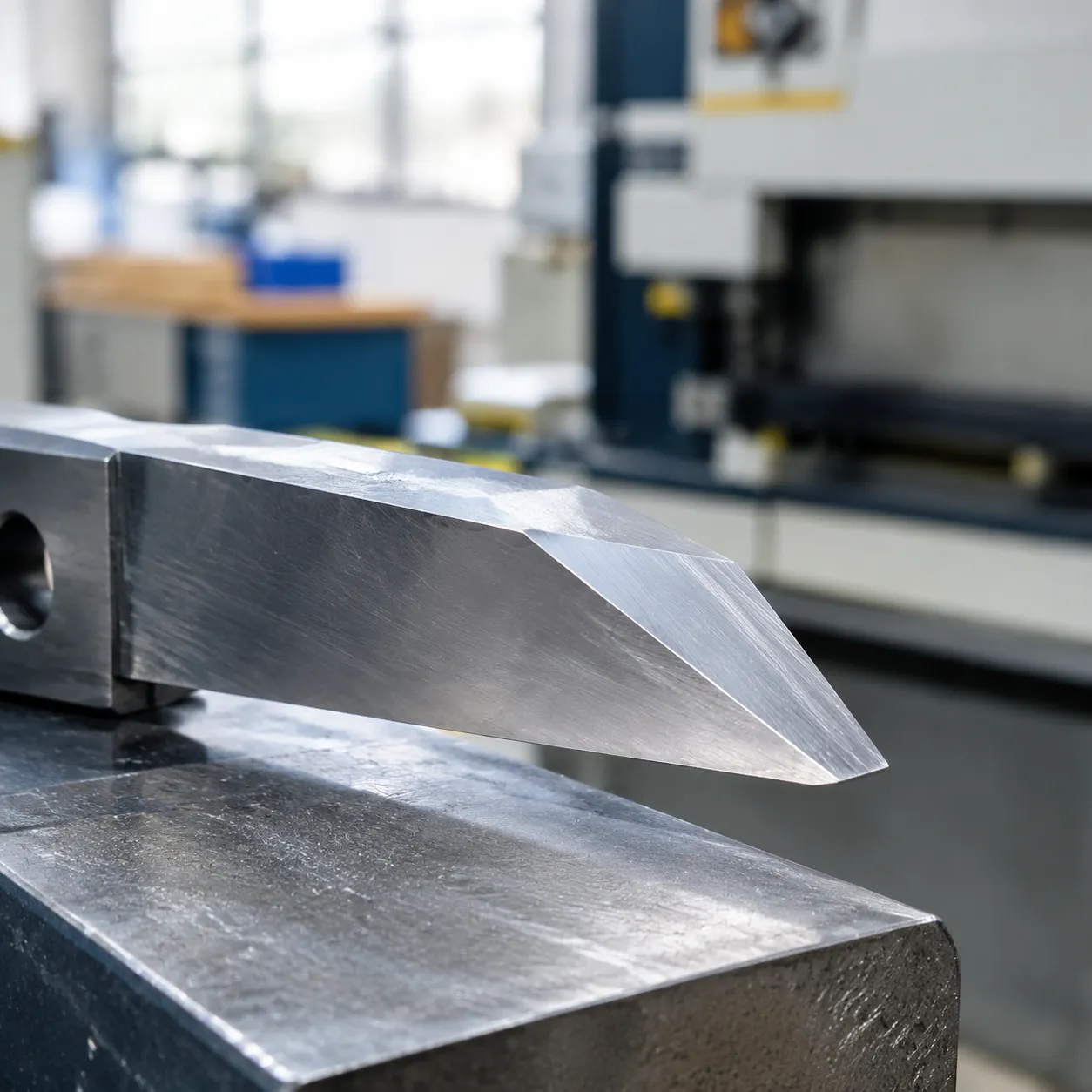
A single bevel top knife features a single angled ground face—typically ground between 30° and 45°—that meets a completely flat back face. This design forms an asymmetric, razor-sharp edge with zero back relief.
- Geometric Profile: Single sloped face intersecting a flat side face.
- Key Advantages: Ultra-low penetration force, minimal web displacement, and crisp, clean slitting lines.
- Best Applications: Lightweight tissue, fine paper (30–70 gsm), and delicate coated sheets where any web drag leads to tearing.
Double Bevel Knives: Strength for Heavy Kraft and Paperboard
Double bevel knives split the cutting angle symmetrically across both sides of the blade, forming a centered apex (such as two 20° angles creating a 40° included angle). This structure places maximum steel mass directly behind the cutting tip.
- Geometric Profile: Two opposing ground faces meeting at a central point.
- Key Advantages: Maximum edge durability, high resistance to chipping, and superior shock absorption under heavy radial loads.
- Best Applications: Heavy Kraft paper, rigid tube-winding core stock, and thick paperboard (>200 gsm).
Compound Bevel Knives: Precision for High-Speed Paper Converting
Compound (dual-bevel) geometry combines a sharp primary cutting angle (30° to 35°) at the extreme tip with a secondary clearance bevel (45° to 50°) along the blade shoulder. This stepped design offers high tip sharpness while reinforcing the blade body.
- Geometric Profile: Two-step ground bevel optimizing edge sharpness and shoulder strength.
- Key Advantages: Low friction, optimal heat dissipation, and precise fiber shearing at elevated web speeds. Utilizing this geometry on high-volume production lines with our specialized paper converting slitter blades keeps slit edges clean and free of web debris.
- Best Applications: High-speed continuous converting lines, abrasive coated stocks, and medium-weight printing papers (80–200 gsm).
Flat Top vs. Dished Top Knife Profiles
Beyond the tip bevel angle, the body geometry of the top male blade determines how shear force transfers across the bottom female anvil knife.
| Profile Type | Structural Mechanics | Primary Advantage | Best Usage |
|---|---|---|---|
| Flat Top Profile | Solid, rigid cross-section across the entire disc. | High rigid force transfer with zero axial deflection under load. | Heavy-duty paperboard, core stock, and low-speed high-caliper slitting. |
| Dished Top Profile | Slightly cupped (concave) geometric disc profile. | Flex-yield capability provides consistent spring-loaded shear contact across varying line speeds. | High-speed paper converting where web speed fluctuations require forgiving blade contact. |
Matching blade mass to paper grade preserves cut quality and extends tool life. Implementing correct knife maintenance best practices ensures these custom ground angles remain precise across repetitive production cycles.
Selecting the Right Shear Slitting Top Knife Bevel Angle for Your Paper Grade
Matching your shear slitting top knife bevel angle paper setup to your web density prevents edge tearing, heat buildup, and premature edge chipping. We recommend specific bevel configurations based on paper weight and material abrasiveness to maximize knife life and slit edge quality.
| Paper Grade & Basis Weight | Bevel Profile | Primary Bevel Angle | Clearance / Secondary Angle | Key Operational Benefit |
|---|---|---|---|---|
| Lightweight / Fine Paper (30–70 gsm) | Single or Compound Bevel | 30°–35° | 5°–10° | Prevents fiber tearing and web distortion |
| Medium Kraft & Printing Stock (80–200 gsm) | Compound Bevel | 40°–45° | 12°–15° | Balances razor sharpness with heat dissipation |
| Heavy Paperboard & Core Stock (>200 gsm) | Double Bevel | 45°–60° (Combined) | N/A | Resists blade chipping under heavy radial load |
| Abrasive / Coated Papers | Compound or Carbide-Inlaid | 30° Primary | 45° Edge Reinforcement | Fights abrasive mineral wear along the cut line |
Grade-Specific Geometry Guidelines
- Lightweight & Fine Paper (30–70 gsm): Thin tissue and fine papers require an ultra-sharp edge. A 30°–35° primary angle paired with a 5°–10° clearance angle slices clean without pinching fibers. When equipping converting lines with our engineered paper cutting knives, this tight angle eliminates edge dust and web tension spikes.
- Medium Kraft & Printing Stock (80–200 gsm): Mid-weight webs generate noticeable friction and heat. A compound bevel featuring a 40°–45° primary angle and a 12°–15° clearance relief adds enough blade mass to absorb friction without losing point sharpness.
- Heavy Paperboard & Core Stock (>200 gsm): Rigid board stock subjects male slitters to high side-load forces. We utilize a sturdy double bevel with a 45°–60° combined angle to support the cutting edge against deflection and micro-chipping.
- Abrasive & Coated Papers: Clay coatings and kaolin quickly dull conventional tool steel. Combining a 30° primary angle with a 45° reinforced edge on a tungsten carbide knife profile protects the cutting point against mineral erosion.
Machine Setup Synergy: Interdependent Slitting Parameters
Selecting the correct shear slitting top knife bevel angle paper converters require is only half the battle; we must also align that geometry with three core machine setup parameters. If blade bevels, cant angle, overlap depth, and web speeds operate out of sync, web drag, edge dusting, and accelerated wear are guaranteed.
Cant Angle Integration (0.5° to 2.0°)
The top blade bevel profile directly dictates your cant angle (toe-in angle). Proper integration ensures single-point contact with the bottom anvil knife without blade binding.
- Sharp / Thin Bevels (30°–35°): Require a conservative 0.5° to 1.0° cant angle. Excessive cant angles on acute bevels cause edge deflection, friction heat, and premature micro-chipping.
- Blunt / Thick Bevels (45°–60°): Perform reliably at 1.5° to 2.0° cant angles on heavy paperboard, establishing sufficient shear side-pressure without pinching the web.
Overlap Depth Adjustment
Blade overlap (penetration depth) determines how deep the top male blade enters the bottom female anvil ring. Over-penetration increases friction and alters the effective shear angle.
- Standard Target Range: Maintain penetration between 0.015" and 0.030" (0.4 mm to 0.8 mm).
- Profile Matching: Single-bevel knives require shallow penetration (0.4 mm) to avoid pushing the paper web sideways. Compound bevels handle deeper penetration (up to 0.8 mm) because the secondary angle provides immediate clearance behind the cut point.
- To avoid frequent re-adjustments caused by blade deformation, we often utilize premium tungsten carbide slitter knives that hold their precise bevel tolerances and overlap settings under continuous web loads.
Over-Speed Ratios
To pull paper cleanly through the shear point without gathering or dragging, top blade rim speeds must run slightly faster than web speed.
- Optimal Range: Maintain an over-speed ratio between 3% and 5%.
- Bevel Correlation: Sharper primary bevels slice cleanly with minimal pull, working best at 3% over-speed. Less aggressive, broader bevel angles require 5% over-speed to shear tough fibers cleanly without tearing the web edge.
| Parameter | Recommended Setup | Bevel Profile Interdependence |
|---|---|---|
| Cant Angle | 0.5° to 2.0° | Steeper bevels demand lower cant angles to prevent blade friction and binding. |
| Overlap Depth | 0.015" to 0.030" (0.4 to 0.8 mm) | Sharper single-bevel edges require shallow overlap to avoid web edge deflection. |
| Over-Speed Ratio | 3% to 5% faster than web | Acute bevel angles operate cleanly at 3%; blunt profiles need 5% to prevent web drag. |
Diagnostic Guide: Solving Paper Slitting Defects via Blade Geometry
1. Excessive Paper Dust Accumulation
- Root Cause: An oversized or dull primary bevel angle crushes paper fibers against the female anvil knife rather than slicing them clean. This high paper web shear force tears micro-fibers, sending dust floating across your line and clogging sensors.
- Blade Geometry Fix: Switch to a compound bevel angle featuring a 30° primary cutting edge backed by a secondary clearance relief. This secondary relief zone gives cut fibers immediate space to drop free, achieving reliable paper dust elimination. For persistent debris builds on your line, reference our proven slitter blade jam troubleshooting steps to keep slitting heads running clear.
2. Ragged or Rolled Slit Edges
- Root Cause: The blade forces the web to bend or roll over the bottom anvil edge before scissor action engages. This happens when the primary bevel angle is too blunt, lateral side load pressure is weak, or vertical knife overlap depth is off.
- Blade Geometry Fix:
- Reduce Primary Bevel: Drop your primary bevel angle by 5° to 10° to create a sharper initial wedge point.
- Reset Overlap Depth: Dial knife penetration depth strictly back into the 0.015" to 0.030" (0.4 mm to 0.8 mm) sweet spot.
- Calibrate Side Load: Increase lateral spring tension just enough to maintain single-point contact without causing blade flex.
3. Rapid Blade Wear or Edge Chipping
- Root Cause: Thin, single-bevel profiles lack the structural mass to withstand heavy radial loads on dense paperboard or abrasive coated stock, causing rapid micro-chipping at the point of cut.
- Blade Geometry Fix: Transition to a rugged double bevel top knife design to support the cutting edge with additional steel mass. If abrasive friction continues wearing out edges prematurely, upgrade your blade metallurgy from standard D2 tool steel to M2 high-speed steel or tungsten carbide inserts.
| Slitting Defect | Primary Root Cause | Targeted Geometry & Setup Solution |
|---|---|---|
| Excessive Dust | Blunt bevel crushing fibers against female anvil | Shift to compound bevel angle with secondary clearance relief |
| Ragged / Rolled Edges | Primary angle too blunt or improper overlap depth | Reduce primary bevel angle 5°–10°; reset overlap to 0.4–0.8 mm |
| Edge Chipping / Fast Wear | Edge profile too thin under heavy radial load | Switch to double bevel top knife profile and higher-HRC alloy |
Material Selection & Manufacturing Precision for Peak Performance
Tooling Metallurgy Selection
| Material Grade | Hardness Rating | Wear Resistance | Target Paper Applications |
|---|---|---|---|
| SKD11 / D2 Tool Steel | 58–62 HRC | Standard | Standard uncoated paper, medium Kraft, short-to-medium runs |
| M2 / SKH51 High-Speed Steel | 62–66 HRC | High | High-speed paper converting, coated stock, abrasive fibers |
| Tungsten Carbide (Solid/Inlaid) | 88–92 HRA | Extreme | Abrasive mineral-coated paper, high-volume continuous mill lines |
Achieving the right D2 tool steel blade hardness provides excellent toughness at a practical price point for general converting setups. Upgrading to an M2 high-speed steel slitter delivers superior thermal resistance against high-speed web friction. For extreme wear caused by mineral fillers and clay coatings, a tungsten carbide top knife retains razor-sharp bevel geometry up to ten times longer than steel. Evaluating carbide vs steel knives helps match tool strength directly to your paper web tension and production speeds.
The Importance of Grinding Precision
Even the most accurate bevel profile fails if manufacturing tolerances drift. We utilize 5-axis CNC precision grinding to hold critical blade dimensions within micro-tolerances of ±0.001 mm to ±0.002 mm, eliminating side-to-side wobble on the arbor.
- Surface Finish (Ra < 0.1 µm): Mirror-finish bevel faces prevent paper dust accumulation and minimize blade friction heat.
- Bevel Angle Consistency: Tight grinding controls keep primary and secondary clearance angles uniform around the entire circumference.
- Dynamic Balance: Precision tolerances prevent knife deflection at high production speeds, ensuring consistent side-load contact against the bottom anvil.
Our specialized precision machining techniques remove micro-burrs and edge irregularities, allowing your paper converting slitter blades to deliver clean, slit-edge quality straight out of the box.
Resharpening Protocols & Custom OEM Engineering
Preserving Factory Geometry During Regrinding
When you send slitter blades out for routine regrinding, standard sharpening services frequently alter the precise shear slitting top knife bevel angle paper mills depend on. Changing the primary or secondary bevel by even 0.5° shifts the contact point, increases necessary side-load pressure, and causes premature blade wear or web dusting.
- Primary Angle Retention: We lock in original factory profiles to maintain exact scissor-action engagement without changing the contact patch.
- Minimal Stock Removal: Precision CNC grinding removes only the material needed to restore the edge, maximizing total sharpenings per knife.
- Thermal Control: Continuous coolant flushing prevents localized overheating and loss of edge hardness during regrinding.
Custom Spec Mapping via CMM Measurement
When original engineering drawings are lost or blades are worn past recognition, guessing geometric profiles creates line instability. Through our custom engineering processes, we reverse engineer worn blades to recreate exact OEM specifications.
- CMM Optical Scanning: Maps complex single, double, and compound bevel angles with precise 3D coordinate tracking.
- Edge Profile Reconstruction: Calculates original outer diameters and bevel transitions directly from baseline wear patterns.
- Surface Polish Verification: Guarantees ultra-smooth bevel faces (Ra < 0.1 µm) to minimize paper friction and web drag.
The Sharkcutting Manufacturing Advantage
We engineer and recondition high-performance slitting tooling built to withstand aggressive continuous web production. Our specialized OEM industrial knives deliver long-term run-time stability through precise metallurgical processing:
| Process | Technical Specification | Result on the Slitting Line |
|---|---|---|
| Cryogenic Stress Relief | Sub-zero thermal treatment below -150°C | Prevents blade warping under high side-load pressure |
| Micro-Honing | Removal of microscopic grinding burrs | Eliminates immediate edge chipping during initial startup |
| 100% Inspection | Optical comparator & runout verification | Guarantees zero-defect installation on your slitter-rewinders |
Frequently Asked Questions on Shear Slitting Top Knife Bevel Angles
What is the ideal shear slitting top knife bevel angle for paper converting?
There is no single angle for every setup. The optimal shear slitting top knife bevel angle paper converting lines require depends entirely on web weight, density, and abrasive coatings:
- Lightweight Fine Paper (30–70 gsm): 30° to 35° primary angle with a 5° to 10° secondary clearance angle to prevent fiber tearing.
- Medium Kraft & Printing Stock (80–200 gsm): 40° to 45° compound bevel to balance sharp shearing with heat dissipation.
- Heavy Paperboard & Core Stock (>200 gsm): 45° to 60° combined double bevel to withstand heavy radial loads without chipping.
Selecting the right blade geometry from our high-precision shear slitting knives ensures clean sheet separation and extended edge life across varying machine speeds.
How does a single bevel differ from a double bevel top knife in paper slitting?
A single bevel top knife features one angled edge face and one flat vertical side. This creates an extremely sharp cutting point ideal for light paper grades, tissue, and flexible films where material displacement and web drag must be minimized.
A double bevel top knife features symmetrical ground angles on both sides of the cutting tip. This profile adds steel mass directly behind the cutting edge, reinforcing the blade against extreme radial pressure when slitting heavy paperboard, rigid core stock, or thick multi-ply paper webs.
Why does improper top knife bevel geometry produce excessive paper dust?
Paper dust occurs when the blade crushes or fractures the sheet structure rather than shearing it cleanly through progressive scissor action.
- Bevel Too Dull or Wide: Pushes paper fibers apart through mechanical force and friction rather than cleanly cutting them, creating loose fiber debris.
- Bevel Too Sharp or Thin: Deflects under continuous web tension, causing micro-chipping along the cutting edge that generates micro-ragged edges and airborne dust.
For high-wear applications running abrasive filled or coated paper stocks, upgrading to a wear-resistant tungsten carbide slitter knife preserves edge sharpness and proper clearance angles, eliminating premature fiber pulverization.
How do cant angle settings interact with top knife bevel geometry?
The cant angle—typically calibrated between 0.5° and 2.0°—establishes the exact single-point intersection where the male top blade contacts the female bottom anvil knife.
- Sharper Bevel Profiles (30°–35°): Require lower cant angles (0.5° to 1.0°) to prevent the thin edge from binding, dulling, or grooving against the bottom anvil.
- Broader Bevel Profiles (45°–60°): Accommodate slightly higher cant angles (1.5° to 2.0°) to maintain constant spring-loaded side pressure across heavy-duty paper webs without flexing the knife body.