

Why the Rubber Slitting Knife Angle Matters
Getting a clean cut on rubber requires precise edge geometry. If the blade geometry is off by even a few degrees, the process immediately runs into tearing, excessive dust, edge gumming, and rapid blade dulling. We often see converters struggle with slit quality simply because they treat elastomeric materials like rigid sheet or paper. The rubber slitting knife angle directly dictates how the cutting edge enters, parts, and clears the rubber matrix without inducing lateral distortion or thermal breakdown.
Rubber Does Not Cut Like a Rigid Material
Elastomers present unique mechanical challenges during high-speed slitting:
Elastic Deformation: Rubber stretches and displaces under load before the blade initiates the cut. An improper angle increases pre-cut stretch, leading to necking and edge curl.
Frictional Drag: As the knife penetrates, the displaced rubber clamps down against the blade flanks. This creates intense surface friction and rapid heat generation.
Memory and Recovery: A dull or overly blunt knife crushes the web rather than cleanly slicing it. Once the slit strip exits the knife section, the material snaps back, leaving a concave, scalloped, or out-of-square edge profile.
Selecting the right rubber cutting blade angle ensures the cutting edge parts the polymer chains cleanly before excessive elastic stretch occurs.
How Knife Angle Influences Cutting Force
The knife bevel profile sets the balance between cutting efficiency and mechanical edge support:
| Edge Angle Configuration | Penetration Force | Structural Rigidity | Heat & Friction Level |
|---|---|---|---|
| Acute / Shallow Angle | Very Low | Lower (higher risk of deflection/rolling) | Minimal |
| Compound / Double Bevel | Balanced | High (reinforced apex) | Controlled |
| Obtuse / Heavy Angle | High (induces crushing) | Maximum | High (accelerates wear and melting) |
Optimizing the slitter knife bevel angle lowers the overall penetration force needed to part the material. Lower cutting forces reduce web displacement, prevent blade wander, and maintain a true perpendicular edge profile across continuous runs.
Effects on Productivity and Operating Cost
Using the correct rubber slitting blade geometry delivers immediate commercial and operational benefits across your converting lines:
Lower Scrap Rates: Prevents edge tearing, micro-cracking, and uneven roll widths, maximizing usable product yield per master roll.
Extended Tool Life: Balanced edge geometry eliminates micro-chipping and prevents premature edge dulling caused by excessive cutting resistance.
Faster Line Speeds: Clean material separation lets slitters run at target production speeds without risk of web wrap-ups or binding.
Reduced Machine Downtime: Less heat and friction mean fewer stops for blade changeouts, edge cleaning, and scrap removal.
Understanding Rubber Slitting Knife Geometry
Getting a clean, dust-free edge on elastomeric materials starts with dialing in the exact profile of your blade. When slitting rubber, edge geometry controls how the knife enters the web, how much material gets displaced, and how much heat builds up during continuous runs. We focus on four core geometric elements when optimizing our rotary slitting knives for rubber processing.
Bevel Angle
The slitter knife bevel angle is the slant ground onto one or both faces of the blade relative to its body. This angle dictates the entry resistance into the rubber:
- Shallow (acute) bevels: Offer effortless penetration and minimal drag, ideal for preventing soft rubber from bunching up.
- Steep (obtuse) bevels: Provide substantial mechanical support behind the edge, preventing blade deflection when cutting dense or cured sheets.
Included Angle
The included angle cutting edge is the total angle formed at the very tip where the opposing surfaces meet. On a single-bevel knife, it equals the primary bevel angle; on a double-bevel blade, it is the sum of both ground sides.
- Narrow included angles: Reduce radial cutting force and lower friction.
- Wider included angles: Increase blade mass directly at the edge, offering the structural integrity needed to prevent chipping against abrasive fillers like carbon black.
Single-Bevel Knives
Single-bevel blades feature one ground face and one completely flat face. We specify single-bevel profiles for operations requiring precision edge alignment.
- Primary Function: Shear slitting against a bottom band or anvil, as well as edge trimming.
- Key Advantage: Produces a straight, perpendicular reference edge along the flat side without distorting the finished roll.
- Operational Note: Material displacement occurs entirely on the beveled side, which requires proper tensioning to prevent web wander.
Double-Bevel Knives
Double-bevel blades feature identical grinds on both sides of the blade centerline.
- Primary Function: Score cutting, crush slitting, and center-web slicing.
- Key Advantage: Balances lateral cutting forces equally across both sides of the cut line, keeping the blade tracking straight through thick rubber stock.
- Operational Note: Material is pushed away equally in both directions, making double bevels the standard choice for dividing broad rubber webs.
Micro-Bevels and Compound Edges
A compound edge utilizes a two-stage grind: a slim primary bevel that extends back up the blade body, combined with a tiny, reinforced micro-bevel right at the cutting apex.
Compound Edge Profile:
\ <-- Primary Bevel (Reduces friction & drag)
| <-- Micro-Bevel (Reinforces edge tip against rolling)
- Friction Reduction: The slim primary angle clears a path through thick elastomeric slabs with minimal side-wall friction.
- Edge Retention: The steeper micro-bevel supports the delicate tip, stopping the cutting edge from rolling over or fracturing under heavy loads.
- Target Result: Optimized rubber slitting blade geometry that delivers clean separation without sacrificing blade wear life.
Important Setup Angles Beyond the Cutting Edge
Rubber stretches, recovers, and grips steel under pressure, setup angles dictate whether the web glides smoothly or binds against the blade body.
Rake Angle
The rake angle determines how the knife enters the material and manages cut displacement:
- Positive Rake: Sharpens the dynamic entry, cutting down penetration force on softer elastomers and preventing material bunching ahead of the cut.
- Neutral or Slightly Negative Rake: Supports the cutting edge during high-durometer or thick rubber slitting, guarding against edge chipping under heavy side deflection.
Clearance Angle
The clearance angle slitter knife setup creates necessary relief between the blade flank and the newly slit rubber wall:
- Friction Control: Rubber immediately expands after the cut. Adequate clearance prevents the wall from dragging against the spinning blade body.
- Heat Reduction: Without sufficient relief, continuous rubbing generates extreme heat, causing gummy edge buildup and accelerated edge dulling.
Blade Overlap and Side Pressure
When running rotary shear pairs, overlap and side loading directly influence cut quality:
- Overlap Depth: Setting the overlap too deep pinches and deforms thick rubber, while too shallow an overlap causes uncut strands and edge tearing.
- Side-Load Force: We balance spring or pneumatic side pressure to keep top and bottom blades kissing cleanly at the shear point without galling the tool steel. Following a strict slitter knife setup guide for precise cutting ensures cant angles and overlap tolerances remain stable across high-speed runs.
Runout, Concentricity, and Alignment
Mechanical slitter precision keeps your calculated cutting angles stable during operation:
- Radial Runout: Blade eccentricity causes varying cut depth per revolution, leaving scalloped or uneven edge profiles on rubber rolls.
- Axial Runout (Wobble): Side-to-side wobble changes the effective shear angle on every rotation, causing premature wear and edge burrs.
- Arbor Parallelism: Shafts must stay rigid and parallel under load so the primary rubber slitting knife angle engages consistently across the full web width.
Choosing the Angle for Different Rubber Materials
Because elastomers behave differently under compression, a universal bevel angle does not exist. We adjust blade geometry based on the compound's durometer, reinforcement layers, and web thickness to maintain clean separation and long run-times.
| Rubber Type / Durometer | Recommended Included Angle | Bevel Style | Primary Focus |
|---|---|---|---|
| Soft (< 50 Shore A) | 12° – 18° | Single Bevel or Acute Double | Minimizing push and deformation |
| Medium (50–75 Shore A) | 18° – 24° | Double Bevel / Compound | Balancing cut speed and blade life |
| Hard (> 75 Shore A) | 25° – 32° | Double Bevel (Heavy Edge) | Resisting chipping and tip deflection |
| Reinforced / Corded | 22° – 28° (with micro-bevel) | Compound Double Bevel | Penetrating steel/fabric fibers |
| Thick Stock / Bales | 15° – 22° (Asymmetric) | Single Bevel or Wide Bevel | Reducing lateral friction and wedging |
Soft and Low-Durometer Rubber
Soft compounds—like silicone, natural gum rubber, and soft EPDM (under 50 Shore A)—compress and deform easily under cutting pressure.
- The Challenge: Blunt or wide-angle knives push and drag the material instead of slicing it, creating dished or concave cut edges.
- Our Angle Setup: We use acute included angles between 12° and 18°. A razor-sharp, single-bevel or narrow double-bevel profile slices through soft polymers instantly before the material can bunch up in front of the blade.
Medium-Hardness Rubber
Standard industrial elastomers (50 to 75 Shore A), such as general-purpose neoprene, nitrile, and SBR sheeting, represent the bulk of rubber processing applications.
- The Challenge: The blade must balance sharpness with sufficient structural support to resist edge rollover during continuous slitting.
- Our Angle Setup: An included angle of 18° to 24° with a double-bevel geometry provides the optimal compromise. This profile delivers clean, vertical edge walls while dissipating heat and resisting premature wear.
Hard Rubber and High-Durometer Compounds
Dense compounds exceeding 75 Shore A, including hard urethanes and vulcanized industrial rubbers, place heavy mechanical loads on the blade tip.
- The Challenge: Acute cutting edges will micro-chip or dull rapidly under high-load contact with stiff polymers.
- Our Angle Setup: We specify broader included angles ranging from 25° to 32°. A sturdier double-bevel edge reinforces the cutting apex, preventing tip breakage and handling the compressive force of rigid compounds.
Reinforced Rubber
Materials with embedded structural plies—such as conveyor belting, fabric-reinforced diaphragms, and tire components—demand a specialized reinforced rubber slitting knife setup.
- The Challenge: High-tensile textile threads, nylon cords, or steel wires quickly destroy fine, acute edges.
- Our Angle Setup: We implement compound bevel geometries with an included angle of 22° to 28° paired with a secondary micro-bevel. The primary bevel reduces drag through the rubber matrix, while the micro-bevel strengthens the cutting edge against cord impact.
Rubber Rolls and Thick Rubber Stock
Log slitting and roll-converting thick rubber stock generate extreme lateral friction against the blade faces, creating wedging forces and thermal expansion.
- The Challenge: Thick stock pinches the knife body, leading to wandering cuts, burnt edges, and motor overload.
- Our Angle Setup: Single-bevel or asymmetric double-bevel knives with an entry angle of 15° to 22° work best for log slicing. Directing the bevel toward the trim side relieves lateral pressure on the roll face and prevents binding during deep penetration.
Laminated and Multi-Layer Rubber
Slitting multi-layer composites—such as foam bonded to solid rubber, or rubber laminated with films and adhesives—requires careful edge management to avoid layer separation.
- The Challenge: Varying durometers in a single stack can cause the blade to push the soft layer while bouncing off the hard layer, leading to delamination.
- Our Angle Setup: We rely on polished, acute double-bevel blades ground to 16° to 20° with zero axial runout. This geometry cuts through contrasting material densities in a single pass without generating shear stress between the bonded plies.
Selecting the Right Slitting Method
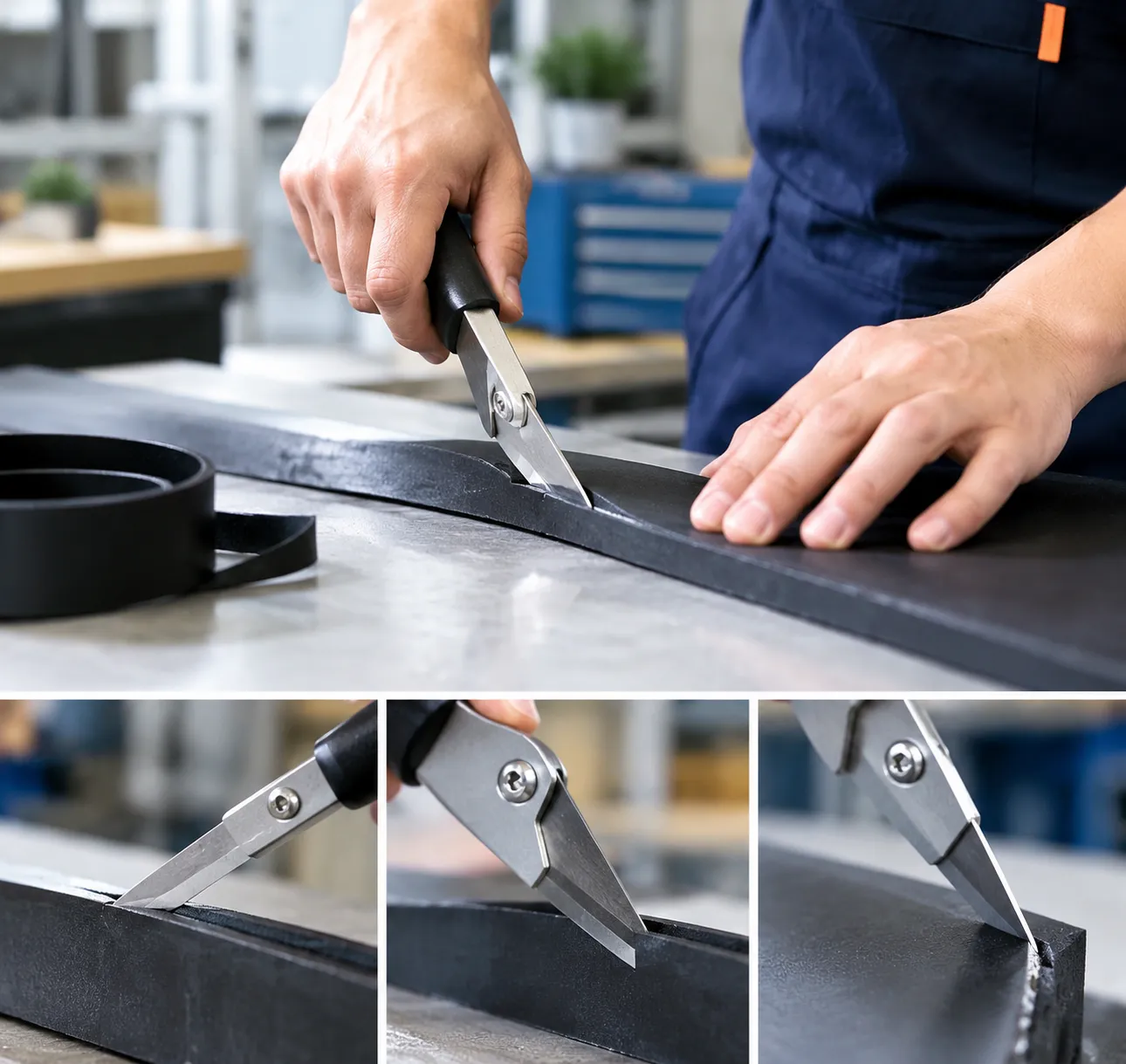
The slitting method you choose dictates the exact rubber slitting knife angle, blade profile, and machine setup required for your line.
| Slitting Method | Typical Blade Geometry / Angle | Best Suited For |
|---|---|---|
| Shear Slitting | Acute single or double bevel | Dense sheets, reinforced rubber |
| Razor Slitting | Ultra-sharp, very low included angle | Thin, non-reinforced films |
| Score / Crush Slitting | Heavy bevel with radiused tip | Quick setups, fiber blends |
| Rotary Knife Slitting | Symmetrical double bevel | Continuous web slitting |
| Single-Knife (Log) | Broad single bevel or compound | Master roll slicing, thick stock |
Shear Slitting
Shear slitting relies on two interacting blades—a top knife and a bottom anvil ring—acting like a heavy-duty pair of scissors.
- How it cuts: The top blade penetrates the rubber while the bottom blade supports the web, creating a clean mechanical shear plane.
- Angle requirements: We typically set the upper circular slitter knives with a refined slitter knife bevel angle (often a shallow bevel combined with a slight cant or overlap angle) to maintain clean shear without pinching or pulling the elastomer.
- Best applications: High-durometer sheet goods, fabric-reinforced conveyor belt covers, and high-speed web operations requiring zero edge rollover.
Razor Slitting
Razor slitting utilizes thin, high-precision razor edges positioned directly in the web path, either supported by a grooved roll or suspended in air.
- How it cuts: The process relies purely on razor sharpness and web tension to part the material with minimal displacement.
- Angle requirements: These blades feature ultra-low included angle cutting edge profiles (often under 15° to 20°) to slice cleanly through soft polymers with near-zero drag.
- Best applications: Thin, non-reinforced rubber membranes, silicone sheets, and unvulcanized elastomeric films. Note: Avoid razor slitting on thick or fiber-filled rubbers, as blade deflection and rapid edge rounding will ruin the cut.
Score or Crush Slitting
Score slitting cuts rubber by pressing a radius-edged blade directly against a hardened steel anvil roll.
- How it cuts: The blade compresses and pinches through the rubber under controlled pneumatic force rather than slicing with shear overlap.
- Angle requirements: Dedicated crush cut knives for precise industrial slitting require a much blunter, heavy-duty included angle—often between 45° and 60°—with a precision-honed micro-radius on the tip to resist chipping against the anvil.
- Best applications: Fast web setups, tacky unvulcanized stocks, and applications where fast knife repositioning takes priority over ultra-clean square edges.
Rotary Knife Slitting
Rotary knife cutting uses driven or free-wheeling circular knives to slit continuous webs against a backing roll or within open space.
- How it cuts: The continuous rotation of the circular knife reduces friction and heat generation compared to stationary blades during long, uninterrupted runs.
- Angle requirements: A balanced double-bevel profile is standard here. Choosing the right rubber cutting blade angle prevents the blade from wandering or pushing flexible rubber sideways off the centerline.
- Best applications: Continuous calendared rubber, industrial rubber sheeting, and high-line-speed slitter-rewinder machinery.
Single-Knife Slitting
Single-knife slitting—often called roll slicing or log slitting—drives a large-diameter circular knife into a fully wound master roll of rubber without rewinding.
- How it cuts: The spinning blade plunges axially or radially through the rotating rubber log while applying flood coolant or blade lubrication.
- Angle requirements: The rubber roll slitting blade requires an asymmetrical single bevel or a wide compound bevel. This profile pushes the cut slice away from the master roll without generating excessive lateral friction or burning the sidewall.
- Best applications: Converting solid rubber rolls, adhesive-backed gasket tapes, and foam or sponge rubber logs into clean, finished-width coils.
How Rubber Hardness and Thickness Affect Knife Angle Selection
Getting a clean, dust-free edge on rubber depends on how the material behaves under compressive load. Unlike rigid metals or plastics, rubber deforms, stretches, and grabs the sides of the blade before it separates. We always tune the rubber slitting knife angle to match the compound's durometer, gauge, and line operating conditions.
Shore A and Durometer
The hardness of the elastomer dictates how much the material yields before the cutting edge penetrates. In a standard durometer rubber cutting setup, the knife angle balances penetration force against edge stability:
- Soft Rubber (30–50 Shore A): Soft compounds displace easily, bunching up in front of the blade. We use an acute rubber slitting knife angle (often with an included angle of 14° to 18°) to slice through the matrix cleanly before it compresses and tears.
- Medium Rubber (55–75 Shore A): General-purpose compounds like standard EPDM, neoprene, and nitrile require a balanced edge (around 20° to 25° included angle) to prevent premature edge dulling while keeping side friction low.
- Hard Rubber (80–95+ Shore A / Shore D): High-durometer stocks act more like rigid polymers. They generate high cutting resistance, requiring a sturdier slitter knife bevel angle (28° to 35° included angle) to prevent micro-chipping and edge rollout.
| Durometer Range | Material Behavior | Recommended Knife Profile | Primary Objective |
|---|---|---|---|
| 30–50 Shore A | High stretch, squishing | Acute single or double bevel | Instant penetration, no drag |
| 55–75 Shore A | Moderate elasticity | Standard compound bevel | Balanced wear and edge clarity |
| 80+ Shore A | High resistance, rigid | Broad, reinforced edge | Chip resistance under high load |
Material Thickness
As rubber thickness increases, so does sidewall friction. Slitting thin gauge sheet (under 1.5 mm) generates minimal lateral pushback, allowing for slim, low-angle blades.
When converting thick rubber slabs, belting, or solid tire treads, a knife with a long, flat bevel wedges deep into the cut. This creates extreme sidewall drag, leading to concave edges and heavy heat buildup. For thick stock, we implement compound or multi-stage bevel geometries. A narrow primary entry angle pierces the top skin, while a broader secondary relief angle prevents the rubber from pinching the blade body.
Production Speed
Line velocity directly influences friction dynamics and heat dissipation. At high continuous slitting speeds:
- Friction between the blade flank and the moving rubber raises local temperatures rapidly.
- Excessive heat softens the rubber, leading to gummy residues, edge tearing, and accelerated blade wear.
- When optimizing machine lines, learning how to choose slitting knives based on speed and shear force helps prevent thermal degradation at the cut zone.
For high-speed conversion, slightly opening the clearance angle reduces the contact area between the knife body and the slit edge, keeping running temperatures manageable.
Temperature and Environmental Conditions
Ambient shop temperatures and inline processing heat directly alter the physical hardness of rubber:
- Cold Environments: Rubber becomes stiffer and less pliable, increasing the effective durometer and placing greater impact shock on the cutting edge.
- Warm / Post-Extrusion Slitting: Hot rubber drops in durometer, becoming tacky and prone to gumming up blade faces. This condition requires sharper cutting profiles with polished finishes or non-stick surface treatments to maintain smooth separation.
What Happens When the Rubber Slitting Knife Angle Is Wrong?
Unlike rigid plastics or metal, rubber deforms, stretches, and generates severe friction under incorrect tooling geometry. Using the wrong bevel or entry angle instantly compromises product tolerances, overheats the web, and accelerates tool failure.
Common Cutting Defects and Edge Failures
A mismatch between the slitter knife bevel angle and the rubber compound produces distinct physical defects across the slit edge:
- Tearing and Jagged Edges: An overly blunt or excessively obtuse included angle pushes and crushes the rubber instead of penetrating it cleanly, causing rough, torn slit walls.
- Edge Rolling and Dish-Shaped Edges: When the cutting angle is too steep or the bevel profile creates excessive side-displacement force, the elastomer stretches laterally before parting, resulting in concave or beveled edges.
- Excessive Rubber Dust and Debris: When the knife flanks rub continuously against the moving web due to poor clearance, abrasive friction grinds the cut surface into fine particulate dust.
- Premature Blade Edge Chipping: An overly acute, razor-thin edge lacks the mechanical strength required for dense or filled rubbers, leading to micro-chipping, rolled edges, and sudden blade failure.
- Thermal Gumming and Melted Edges: High friction from incorrect relief angles traps heat along the cut path, causing tacky edges, vulcanization breakdown, and residue buildup on the blade face.
Troubleshooting Angle and Alignment Mismatches
| Cutting Defect | Likely Angle / Setup Issue | Shop-Floor Inspection |
|---|---|---|
| Ragged, torn slit edge | Included angle is too obtuse or edge has lost its honed sharpness | Check bevel angle against compound durometer; regrind to correct primary bevel |
| Edge chipping / micro-cracking | Cutting angle is too acute for hard or reinforced rubber | Increase included angle or apply a secondary micro-bevel for added edge support |
| Beveled / non-perpendicular cut | Blade deflection or incorrect cant angle | Inspect blade axial runout and verify side loading pressure |
| Surface smearing / gumming | Insufficient clearance angle causing continuous flank rubbing | Increase clearance angle to ensure only the apex contacts the cut path |
Corrective Actions for Slitter Setup
To resolve recurring cut quality defects, we follow a systematic adjustment process on the machine:
- Re-match Bevel Geometry to Compound Hardness: Shift soft elastomers (below 50 Shore A) toward sharper, lower included angles (14° to 18°), and transition dense, filled rubbers (75+ Shore A) to reinforced compound bevels (22° to 30°).
- Eliminate Arbor Spacing Runout: Use high-tolerance slitter knife spacers for precise material cutting to maintain exact knife positioning across the shaft and prevent axial deflection under load.
- Optimize Knife Overlap and Side Pressure: Set blade overlap to the minimum depth required to achieve a clean cut. Excess overlap increases wedge friction and forces the material to bunch against the bevel face.
- Verify True Concentricity: Ensure industrial tools, such as a precision 170mm slitter blade for precision industrial cutting, are mounted with zero arbor play to eliminate cyclical cutting force variations.
Blade Material and Surface Finish Considerations
Selecting the proper rubber slitting knife angle only works when the blade material can maintain its edge geometry under intense friction. Rubber creates significant drag and thermal buildup, causing softer steels to deform or dull rapidly at acute bevels. Matching the correct substrate, coating, and surface finish to your edge angle keeps the cut clean and extends blade life.
Tool Steel Blades
Tool steels such as D2 provide a practical balance of wear resistance and shock toughness. We rely on D2 for standard, non-abrasive rubber compounds where minor mechanical vibrations could chip more brittle alloys. It supports moderate slitter knife bevel angle profiles without micro-chipping during high-volume converting runs.
High-Speed Steel (HSS)
HSS grades like M2 retain hardness at elevated operating temperatures. When running a continuous rotary knife for rubber at high web speeds, thermal friction degrades common carbon steels. HSS prevents edge softening, allowing tighter cutting bevels to stay sharp across extended production cycles.
Carbide or Carbide-Tipped Knives
Solid tungsten carbide and carbide-tipped blades offer maximum edge retention. Carbide maintains extremely sharp, low-angle cutting edges through abrasive, carbon-black-filled, or vulcanized rubber without rolling the tip. To evaluate whether carbide or tool steel fits your operating budget and material demands, review our in-depth carbide vs. steel slitter knife guide.
Stainless Steel Options
When slitting medical elastomers, food-grade seals, or rubber in washdown environments, martensitic stainless steels (such as 440C) prevent rust and contamination. While they have slightly lower wear resistance than D2 or carbide, they perform reliably when ground with stable, medium-bevel angles.
Coatings and Surface Treatments
Elastomers naturally grip polished steel flanks, causing drag, heat, and edge buildup. Surface treatments reduce this resistance:
- TiN (Titanium Nitride): Increases surface hardness and shields the cutting edge from abrasive fillers.
- DLC (Diamond-Like Carbon): Delivers an ultra-low friction coefficient to reduce heat generation and prevent rubber dust buildup.
- PTFE / Non-Stick Coatings: Stops uncured, warm, or tacky compounds from adhering to the blade bevel.
Edge Surface Finish
A rough grind leaves microscopic serrations on the blade edge. These ridges snag the rubber, causing micro-tearing along the slit edge and accelerating friction. We precision-grind and lap industrial rubber slitting knives to a mirror finish (Ra < 0.2 µm). A super-smooth surface finish preserves the rubber slitting blade geometry, lowers penetration resistance, and leaves a square, dust-free edge on the finished slit coil.
| Blade Material / Finish | Hardness Range | Angle Retention | Best Application |
|---|---|---|---|
| D2 Tool Steel | 58–62 HRC | Moderate to High | General rubber slitting, medium speeds |
| M2 HSS | 62–65 HRC | High (Heat Resistant) | High-speed rotary shear slitting |
| Tungsten Carbide | 88–92 HRA | Extreme | Abrasive compounds, reinforced rubber |
| 440C Stainless | 56–58 HRC | Moderate | Food-grade and medical elastomer cutting |
| DLC / Mirror Polish | N/A (Surface) | Prevents Drag | Tacky, soft, or high-friction rubber webs |
Sharpening and Maintaining a Rubber Slitting Knife
When to Sharpen the Blade
Do not wait for a catastrophic blade failure or heavy product tearing before pulling a knife from the line. We recommend setting a scheduled regrind cycle based on run hours or watching for these clear warning signs:
- Increased Dust and Debris: Accumulation of fine rubber particles along the slit line indicates edge rounding and abrasive dragging.
- Torn or Scalloped Edges: Visible edge distortion or a "chewed" cut path means the blade is stretching the elastomer rather than shearing it cleanly.
- Higher Motor Load: Spikes in drive torque or penetration force point to dulling and increased friction at the cut point.
- Heat Buildup: Noticeable temperature rises on the blade body or slitter arbor signal excessive rubbing against the material web.
- Visible Edge Wear: Micro-chipping, shiny wear flats, or burrs along the cutting edge visible under basic magnification.
Why Sharpening Must Preserve the Original Geometry
When reconditioning blades, the goal is not merely to create a sharp edge—it is to restore the exact rubber blade sharpening angle designed for the application.
Altering the slitter knife bevel angle during regrinding causes immediate operational headaches:
Flattening the angle (making it more obtuse): Increases displacement force, pushing rubber sideways and creating concave edge profiles.
Steepening the angle (making it overly acute): Weakens the cutting tip, causing rapid edge breakdown, roll-over, and micro-chipping under high-durometer compounds.
Altering compound bevels: Removing a micro-bevel completely eliminates edge support, drastically reducing blade life between sharpenings.
Manual Versus Precision Grinding
| Sharpening Method | Pros | Cons | Best Use Case |
|---|---|---|---|
| Manual / Offhand Sharpening | Low initial cost; fast touch-ups in emergencies. | Inconsistent bevel angles, facet waviness, uneven runout, and risk of heat-treating loss (annealing). | Emergency fixes only; not recommended for production slitting. |
| Precision CNC Grinding | Restores exact rubber slitting blade geometry, maintains uniform diameter across paired blades, and delivers low Ra surface finishes with flood coolant. | Requires specialized machinery or a professional sharpening partner. | Standard production maintenance, multi-knife slitter setups, and heavy-duty applications. |
When high-wear cutting applications—such as tire manufacturing or dense belt slitting—wear a blade beyond its regrind limits, installing a dedicated replacement like the Dayton tire slitter knife 542-95 replacement blade ensures factory-spec angle precision and reliable cut consistency right out of the box.
Inspection Checklist
Before putting any sharpened rubber cutting blade back into service, verify these key parameters:
- Angle Accuracy: Check primary and secondary bevels using an optical comparator or precision bevel gauge to confirm they match original engineering drawings.
- Edge Integrity: Inspect under 10x–20x magnification for grinding burns, micro-burrs, or tooth marks along the apex.
- Surface Finish: Ensure the ground faces have a smooth, cross-hatch-free finish to prevent elastomer adherence and drag.
- Concentricity and Runout: Mount the blade on a test arbor and measure total indicator reading (TIR). Keep axial and radial runout within shop tolerances (typically under 0.005 mm to 0.01 mm for high-speed slitting).
- Thickness and Diameter: Verify that paired blades match in outside diameter to maintain correct overlap and line speed synchronization.
Storage and Handling
A freshly sharpened cutting edge is extremely delicate before it contacts the web. Proper storage keeps your sharpened knives ready for production:
- Protective Coatings: Coat clean blades with a light layer of rust-preventative industrial oil or corrosion-inhibiting film.
- Individual Spacing: Never stack bare slitter knives face-to-face in a bin. Use slotted wooden racks, individual protective sleeves, or specialized blade trays with non-metallic dividers.
- Edge Guards: Apply vinyl edge protectors or magnetic edge covers whenever transporting blades between the grinding shop and the slitting machine.
- Climate Control: Store spare tooling in a temperature-controlled, dry room to prevent moisture condensation and corrosion pitting on the cutting tip.
A Practical Method for Finding the Best Rubber Slitting Knife Angle
Step 1: Identify the Rubber Compound
Start by checking the fundamental physical properties of your material:
Durometer: Note the exact Shore A or Shore D hardness rating.
Elasticity & Elongation: High-stretch polymers demand sharper, acute angles to prevent material dragging.
Fillers & Additives: Abrasive fillers like carbon black, silica, or clay require stronger, compound bevels to prevent micro-chipping.
Step 2: Record the Material Dimensions
Measure the exact thickness and format of the rubber web or roll stock:
Thin Sheets (under 1 mm): Benefit from low-angle single or double bevels that pierce without displacement.
Thick Gauges & Rubber Rolls: Cause severe side pressure; they require wider relief angles or secondary micro-bevels to eliminate binding.
Reinforcements: Note any embedded textile fabric, cord, or steel plies that demand higher structural edge strength.
Step 3: Identify the Machine and Slitting Method
Match your tool geometry to your machine type and cutting technique. Rigid setups utilizing rotary shear slitting knives allow tighter overlap and rake control, whereas free-running rotary or razor slitters need specific profiles to avoid web deflection. Machine arbor stability determines how fine an edge you can run without premature failure.
Step 4: Define the Quality Requirement
Establish clear acceptance benchmarks before testing:
Edge Squareness: True 90-degree cut face with zero concave dishing.
Surface Cleanliness: Clean cut with no burrs, stringing, or rubber particulate dust.
Tool Life Target: Minimum acceptable run time or tonnage between blade changes.
Step 5: Select a Test Geometry
Select two or three baseline profiles from standard slitting knives to run in controlled trials:
Option A (Acute Single Bevel): 14°–18° primary bevel for soft, unsupported elastomers.
Option B (Standard Double Bevel): 20°–24° included angle for balanced general-purpose rubber slitting.
Option C (Compound/Micro-Bevel Edge): 18° primary angle with a 28°–32° secondary bevel for reinforced or high-durometer compounds.
Step 6: Record the Results
Execute trial runs under actual operating speeds and record performance indicators:
Thermal Buildup: Check blade and web temperature directly after a cut cycle.
Penetration Resistance: Monitor motor load and cut stability during entry.
Edge Wear Pattern: Inspect the blade under magnification for rounding, chipping, or material adhesion.
Step 7: Confirm the Production Specification
Once you identify the setup that delivers clean cut quality with minimal friction, lock in the exact rubber slitting blade geometry. Document the primary bevel, secondary relief, overlap depth, and side-load settings on standard operational setup sheets to maintain consistent results across shifts.
How to Specify a Custom Rubber Slitting Knife
Ordering custom tooling requires precise technical specs so the finished blade performs reliably on your production line. When requesting a quote, defining your exact cutting conditions and geometry ensures you receive knives optimized for clean edges, minimal friction, and extended service life.
Information to Include in Your RFQ
Providing complete technical data upfront prevents production delays and eliminates guesswork during blade manufacturing:
- Material Details: Specify the rubber type (natural, EPDM, silicone, nitrile, neoprene), durometer (Shore A/D rating), thickness, and whether the stock includes fabric or wire reinforcement.
- Knife Dimensions: Provide outer diameter (OD), inner diameter/bore (ID), blade thickness, keyway dimensions, and pinhole patterns.
- Target Bevel & Edge Geometry: State the required rubber slitting knife angle, single vs. double bevel design, primary bevel angle, and any required secondary micro-bevels.
- Operational Setup: Note your machine type, cutting method (shear, crush, razor, or rotary single-knife), slitting speed, and whether the process runs dry or with liquid lubrication.
- Tolerances and Finish: Specify critical tolerances for thickness variation, lateral runout, concentricity, and surface roughness ($Ra$).
| RFQ Parameter | Why It Matters | Standard Specification Example |
|---|---|---|
| Rubber Hardness | Dictates blade angle sharpness vs. edge strength | 60 Shore A solid EPDM |
| Primary Bevel Angle | Controls penetration force and material displacement | 18 ° - 22 ° single bevel |
| Material Thickness | Determines required blade profile and stiffness | 3.0 mm continuous sheet |
| Lateral Runout | Prevents edge wobble and width variance | Within ± 0.005 mm |
Questions to Ask the Supplier
Before placing an order for custom tooling, verify that the manufacturer can meet your application requirements:
- Material Recommendations: What base steel (such as D2, M2 HSS, or solid tungsten carbide) delivers the best balance of wear resistance and edge retention for your specific rubber compound?
- Grinding Capabilities: Can the supplier grind precision compound angles and micro-bevels with mirror surface finishes to prevent gummy adhesion?
- Heat Treatment Protocols: What hardening and cryogenic treatment processes are used to achieve uniform Rockwell hardness (HRC) across the entire cutting profile?
- Quality Control: Does every production batch undergo optical or laser inspection for bevel angle consistency and edge concentricity?
Custom Blade Solutions and Ordering Support
Every slitting line has unique demands based on material density, web tension, and line speed. We design and manufacture custom rubber slitting knives tailored to your exact machinery specifications, slitter knife bevel angle requirements, and production goals. Whether you need single-bevel shear blades, heavy-gauge rubber roll slitting blades, or high-wear carbide rotary knives, our technical team reviews your drawings and operating parameters to supply durable, precision-ground tooling that delivers clean cuts and reduced machine downtime.
Frequently Asked Questions
What is the best angle for a rubber slitting knife?
There is no single universal angle because cutting performance depends directly on rubber durometer, material thickness, and web speed. In most standard converting operations:
Soft elastomers (30–50 Shore A): Require an acute slitter knife bevel angle (around 15° to 22°) to slice clean without bunching.
Medium-to-hard rubbers (60–85 Shore A): Run best with an included angle of 25° to 35° to maintain edge stability.
Reinforced or high-durometer compounds: Often require a primary bevel supported by a secondary micro-bevel up to 40°–45° to stop edge chipping.
| Rubber Type | Durometer Range | Recommended Bevel Type | Typical Included Angle |
|---|---|---|---|
| Soft / Sponge / Silicone | 20 – 45 Shore A | Single or Double Bevel | 14° – 22° |
| Standard Neoprene / EPDM | 50 – 75 Shore A | Double Bevel | 24° – 32° |
| Hard / Fiber-Reinforced | 80+ Shore A / Shore D | Compound / Micro-Bevel | 35° – 45° |
Is a sharper knife always better for rubber?
Not always. While an ultra-sharp, low-angle edge easily penetrates soft stock, it lacks mass behind the cutting tip. When running dense or abrasive compounds, an overly acute rubber slitting knife angle deflects under lateral pressure, leading to premature edge roll, chipping, and wavy slit edges. Balancing sharpness with structural edge support is the key to consistent cuts.
Should rubber slitting knives be single bevel or double bevel?
The choice comes down to how you need to manage material displacement:
Single-Bevel Knives: Best for edge trimming and operations where one side of the slit must remain perfectly flat and vertical with zero deflection against a anvil or support roll.
Double-Bevel Knives: Ideal for center slitting. They split material evenly across both sides, balancing cutting forces and preventing the blade from wandering inside thick cross-sections.
What angle is used for rubber roll cutting?
Log slitting and rubber roll cutting typically employ large-diameter circular blades with narrow, highly polished double-bevel profiles (often 12° to 18° primary bevels) combined with dedicated edge lubrication. For non-standard roll densities and high-friction synthetic polymers, using precision-engineered special cutting components ensures the blade penetrates straight to the core without thermal binding or dishing.
Why does rubber tear instead of cutting cleanly?
Rubber tears when cutting resistance exceeds the tensile strength of the compound before the blade can shear it. Common causes include:
An overly blunt or incorrectly matched rubber cutting blade angle that crushes rather than slices.
Insufficient blade overlap or improper side clearance on shear slitter setups.
Excessive friction causing the elastomer to stretch and pull downstream before snapping.
Operating without proper surface lubricants or non-stick blade coatings on tacky stock.
How often should a rubber slitting blade be sharpened?
We recommend setting regrind intervals based on linear footage, cut quality inspection, and dust accumulation rather than waiting for visual blade failure. When resharpening, it is critical to preserve the exact original rubber slitting blade geometry; altering the bevel angle by even a few degrees during manual grinding will dramatically increase cutting friction and accelerate edge wear.
Can one knife angle work for different rubber compounds?
A general-purpose double bevel of 25° to 30° can handle a moderate range of standard commercial rubbers (50–70 Shore A). However, switching between gummy low-durometer silicones and abrasive, fabric-reinforced belting on the same blade profile will compromise line speed, cut finish, and tool life. Customizing the rubber slitter blade angle to your primary product family remains the most reliable way to maximize uptime and maintain tight slit tolerances.