

Core Mechanics: Single-Shaft vs Double-Shaft Blade Action
Choosing between single-shaft shredder blades and double-shaft shredder knives comes down to how your processing line needs to fracture, shear, or rip incoming scrap. Each blade configuration applies force differently, dictating throughput capacity, particle uniformity, and power consumption.
Single-Shaft Action: High-Speed Rotor + Bed Knife (Precision Scissor Cut)
Double-Shaft Action: Dual Counter-Rotating Hook Discs (High-Torque Tear & Shear)
How Single-Shaft Rotary Inserts and Stationary Counter Knives Cut Material
Single-shaft cutting systems use a scissor-like shearing mechanism to produce clean, uniform particles:
- Rotary Inserts: Small, square cutting teeth bolt into welded or milled tool holders across a solid rotor.
- Stationary Counter Knives: Heavy-duty bed blades mount firmly along the base frame, set at a tight clearance (0.5 mm to 1.5 mm) from the rotating teeth.
- Precision Shearing: As the rotor turns, the inserts sweep past the stationary bed knife, executing a precise scissor-cut against the feed stock.
- Positive Feeding: A horizontal hydraulic ram forces bulky or dense purgings directly into the cutting radius, preventing material from simply bouncing on top of the rotor.
How Double-Shaft Interlocking Hook Blades Grab and Tear Bulk Feeds
Twin-shaft shredders eliminate the need for push-rams by utilizing aggressive, self-feeding geometry:
- Interlocking Claw Discs: Massive multi-hook blades stack alternately with precision spacers across two parallel hexagonal shafts.
- Opposing Rotation: The shafts rotate inward toward each other at staggered speeds.
- Grab and Tear Action: Hook tips pull hollow, high-volume items directly down into the cutting chamber, ripping the material apart between the overlapping blade faces and integrated cleaning fingers.
- Multi-Directional Fracture: Material experiences simultaneous tensile tearing, cross-shearing, and crushing forces.
Rotor Speed Dynamics: Hydraulic Push vs Low-Speed High-Torque Ripping
The mechanical performance differences between these two blade systems reflect directly in rotor RPM and drive torque profiles:
| Operational Metric | Single-Shaft Shredder Blades | Double-Shaft Shredder Knives |
|---|---|---|
| Rotor Speed (RPM) | 60 – 120 RPM (Medium-High) | 10 – 35 RPM (Low Speed) |
| Drive Dynamics | High kinetic energy + Hydraulic pusher ram | High-torque low-speed continuous bite |
| Cutting Force | Precision shear against stationary counter knife | Crushing, tearing, and scissor-action between twin shafts |
| Infeed Mechanism | Forced hydraulic feed required | Gravity-fed, self-drawing hook discs |
| Dust & Fines Generation | Moderate to high due to continuous shearing | Minimal due to low peripheral blade speed |
Blade Geometry and Design Differences
Blade geometry dictates how efficiently your machine bites, shears, and discharges scrap. Single-shaft and double-shaft setups approach cutting physics from completely different angles, using distinct cutter profiles, mounting styles, and tooth profiles to handle incoming scrap.
| Feature | Single-Shaft Shredder Blades | Double-Shaft Shredder Knives |
|---|---|---|
| Blade Profile | Square indexable insert blocks | Multi-claw interlocking hook discs |
| Cutting Edges per Blade | 4 rotatable edges | 1–5 integrated claw hooks |
| Mounting Style | Bolted into welded knife holders | Keyed / hex-bore stacked on shaft |
| Surface Geometry | Flat or concave face options | Flat-sided with radial relief |
| Gap Maintenance | Bed knife clearance adjustment | Precision shaft spacers & scrapers |
Square Indexable Inserts on Single-Shaft Rotors
Single-shaft rotors utilize replaceable, square indexable inserts mounted directly onto machined tool holders welded across the rotor body.
- 4-Way Indexing: Each square insert delivers four identical cutting edges. When one edge dulls, we simply loosen the countersunk retaining bolt, rotate the insert 90 degrees, and torque it back down without removing the entire rotor assembly.
- Counter Knife Interaction: These square inserts shear against an adjustable, stationary bed knife at tight clearances (typically 0.5 mm to 1.5 mm), creating a true scissor-cut action ideal for precision resizing.
Multi-Claw Hook Discs and Spacers on Dual Shafts
Double-shaft shredders rely on solid circular discs with integrated hook profiles arranged sequentially along dual hexagonal or splined shafts.
- Claw Configuration: We cut these blades with single-claw, double-claw, or multi-claw profiles depending on the feed stock. Single-claw designs deliver massive grabbing power for bulky items, while multi-claw profiles maximize cuts per revolution on thinner materials.
- Spacers and Scraper Fingers: Solid disc cutters alternate with high-tolerance knife spacers to maintain strict axial cutting clearances. Stationary comb scrapers fit between the discs to peel sheared material out of the blade pockets and prevent wrap-around jams.
Flat vs. Concave Cutting Surfaces
The face profile of the blade edge drastically alters shear force and energy draw:
- Concave Cutting Faces: Curved insert faces produce a sharper, more aggressive shearing angle. They pierce tough materials with less motor strain, significantly reducing amp draw and operating temperatures when processing dense plastics and synthetic rubbers.
- Flat Cutting Faces: Flat-faced inserts provide maximum mass and backing steel right at the cutting edge. While they demand slightly higher cutting pressure, flat profiles offer superior shock resistance against sudden impact shock and heavy contamination.
Material Grades and Tool Steel Selection for Shredder Blades
High-Carbon, High-Chromium Steels: D2, SKD-11, and DC53
For pure wear resistance against abrasive friction, cold-work tool steels are the industry standard:
- D2 and SKD-11: High carbon and chromium content delivers exceptional edge retention. These alloys excel in single-shaft indexable square shredder inserts cutting clean plastics, dense purgings, and dry timber.
- DC53: A modern upgrade over D2 that eliminates carbide segregation. It offers twice the toughness of D2 at 60–62 HRC, significantly reducing edge chipping on single-shaft bed blades and high-speed counter knives.
Tungsten Carbide Inserts for High-Abrasion Waste
For heavily abrasive feed streams like fiberglass composites, contaminated films, and electronics scrap, standard tool steels dull too quickly. In these aggressive setups, we utilize brazed or bolted carbide blade options on the cutting edges. Carbide maintains a sharp shearing edge up to 10 times longer than standard D2 tool steel shredder teeth, preventing thermal softening under continuous friction.
Shock-Resistant Alloys and Hardox for Heavy Impact
High-torque double-shaft shredder knives face massive bending and shock loads rather than pure shearing friction:
- 55SiCr and 6CrW2Si: Spring and tool steel alloys designed to flex under uncrushable tramp metal without snapping.
- Hardox 500/550 Faceplates: Quenched and tempered abrasion plates welded directly onto dual-shaft rotary claw discs to take the brunt of tire beads, steel drums, and mixed construction debris.
Hardness Ratings vs Chipping Resistance
Heat treatment requires balancing cutting life against catastrophic blade failure:
- HRC 60–62 (High Hardness): Maximum wear resistance for clean shearing in single-shaft setups, but prone to micro-chipping if foreign metal enters the chamber.
- HRC 55–58 (Balanced Toughness): The sweet spot for twin-shaft rotary hook cutters, absorbing violent torque spikes and heavy impact without cracking the blade body.
Particle Size Control: Single-Shaft vs Double-Shaft Shredder Blades
Controlling final discharge size comes down to how each blade setup handles material flow. We look at sizing control through two completely different mechanisms: fixed screening versus geometric cutter spacing.
Perforated Screen Meshes in Single-Shaft Systems
Single-shaft shredders rely on an interchangeable curved screen mounted beneath the rotor to guarantee uniform output.
- Precise Flake Sizing: Material stays inside the cutting chamber until it is sheared small enough to pass through the shredder screen mesh sizing (typically 10 mm to 50 mm).
- Controlled Cutting Action: The rotary inserts shear against the stationary counter knife continuously, delivering clean, repeatable regrind with tight dimensional tolerances.
- Secondary Granulation Prep: This setup is ideal when you need consistent feeding for downstream extruders, washing lines, or secondary granulators.
Hook Width and Claw Count in Screenless Dual-Shaft Systems
Double-shaft shredders do not use screens. Instead, output dimension is governed entirely by the physical dimensions of the twin shaft rotary hook cutters.
- Width Determines Strip Size: The thickness of the rotary disc hook sets the width of the shredded strip.
- Claw Count Dictates Length: Blades with multiple claws (e.g., 3-claw or 5-claw discs) cut shorter segments, while single-claw hooks produce longer, coarse strips.
- Non-Uniform Primary Shred: Because oversized, flexible items can slip between shafts without screen retention, output is variable and best suited for volume reduction or pre-shredding stages.
Recirculation and Dust Generation Comparison
The difference in blade mechanics directly impacts operating fines, heat buildup, and recirculation. In facilities handling delicate materials where contamination is critical, pairing secondary operations with a slitting knife dust removal system helps capture airborne debris generated by repeated shearing.
| Parameter | Single-Shaft Shredder Blades | Double-Shaft Shredder Knives |
|---|---|---|
| Sizing Mechanism | Perforated bed screen mesh | Hook disc width & claw geometry |
| Output Consistency | Highly uniform flakes/chips | Coarse, irregular strips and chunks |
| Internal Recirculation | High (retains material until sized) | None (single-pass gravity discharge) |
| Dust & Fines Generation | Higher (due to friction & continuous cutting) | Very low (clean shear and tear at low RPM) |
| Thermal Heat Buildup | Moderate to high on dense feeds | Minimal (low friction cut) |
Material Suitability and Processing Capabilities
Single-Shaft Blades: Dense, Rigid, and Solid Feedstocks
Single-shaft cutting geometry excels when processing dense, solid cross-sections that require continuous, controlled shearing against a fixed bed knife.
- Heavy Plastic Purgings & Lumps: Dense polymer lumps sit firmly against the rotor while square tool steel teeth plane the block layer by layer.
- Thick-Walled Pipes & Profiles: High-rigidity PVC, PE, and HDPE pipes feed smoothly against the cutting gap without bouncing out of the cutting chamber.
- Timber & Wood Waste: Pallets, lumber offcuts, and logs are cleanly chipped into consistent biomass flakes rather than stringy splinters.
- Baled or Skeined Films: Combined with specialized serrated counter knives, single-shaft rotors cleanly slice compacted plastic film and woven big-bags without wrapping.
Double-Shaft Hook Cutters: Bulky, Hollow, and Elastic Waste
Twin-shaft rotary hook cutters rely on opposing rotational draw to swallow high-volume, hollow, or high-tensile materials that cannot be pushed efficiently by a hydraulic ram.
- Tires and Rubber: Multi-claw hook discs slice through radial steel belts and high-elasticity rubber tread, tearing the casings apart through opposing shear forces.
- Bulky E-Waste & White Goods: Computer towers, circuit boards, washing machines, and electronic housings are pierced and dragged downward through the interlocking discs.
- Hollow Metal Drums & Cans: 55-gallon steel drums and sheet metal scrap collapse instantly under the high-torque pinch point of dual shafts.
- Mixed Municipal Solid Waste (MSW): Irregular garbage containing textiles, organics, packaging, and light metals gets ripped down without wrapping around a central screen basket.
Contaminant Handling and Automatic Jam-Reversal Behavior
Uncrushable tramp metal or oversized structural steel entering the shredder requires immediate mechanical and electronic protection:
| Operational Parameter | Single-Shaft Shredder Blades | Double-Shaft Hook Cutters |
|---|---|---|
| Primary Protection Mechanism | Hydraulic ram pressure-relief & reverse | PLC-triggered instant shaft counter-rotation |
| Contaminant Reaction | Pusher ram retracts when amp spikes occur | Shafts reverse for 2–3 cycles to reposition scrap |
| Impact on Cutting Edges | High risk of individual insert chip or shear pin snap | Distributed torque load across adjacent hook discs |
| Foreign Object Removal | Fast access via hinged hopper and screen cradle | Requires clearing the cutting chamber from above |
Shredder Blade Maintenance, Sharpening, and Downtime Comparison
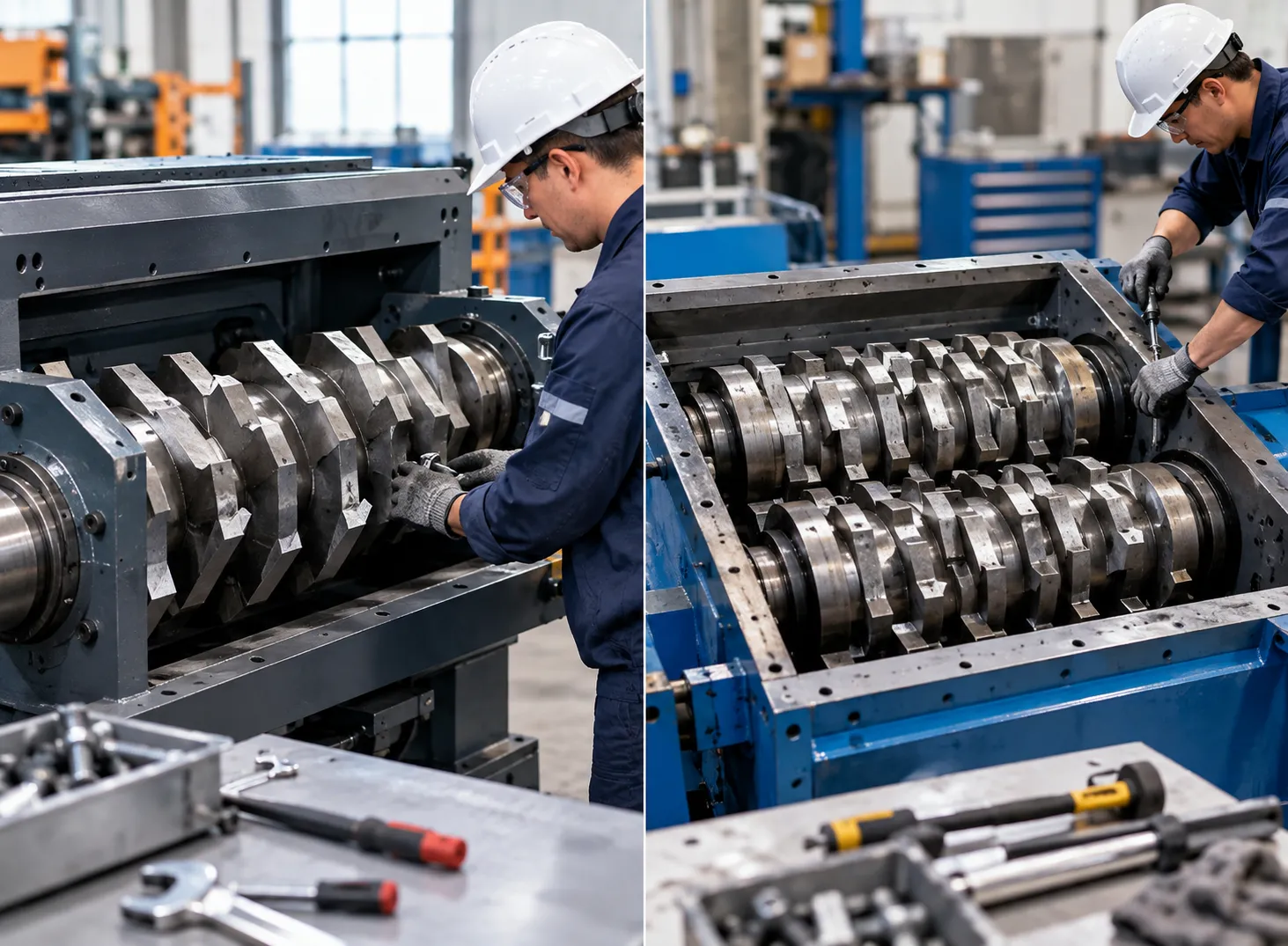
Maintaining cutting efficiency requires very different workflows depending on whether your equipment runs single-shaft or double-shaft rotor assemblies. Understanding these servicing demands helps us keep production lines running with minimal unplanned downtime.
Servicing Indexable Single-Shaft Teeth Directly on the Rotor
Single-shaft shredder blades offer fast maintenance turnaround. Using square, four-sided indexable inserts, we can quickly service worn cutters right inside the cutting chamber without pulling the main rotor.
- In-chamber rotation: When a cutting edge dulls, loosen the high-tensile countersunk bolt, clean the pocket seat, rotate the insert 90 degrees to expose a fresh edge, and torque it back down.
- Even wear distribution: Each square tooth provides four distinct cutting cycles before requiring replacement, significantly lowering tooling cost per operating hour.
- Bed knife clearance adjustments: You must regularly set the counter knife gap (typically 0.5 mm to 1.5 mm) using adjusting bolts to maintain clean shear action and prevent unneeded friction. Following proven knife maintenance best practices ensures bed blades don't drift and cause premature insert chipping.
Overhauling Double-Shaft Hook Cutters and Spacers
Twin-shaft shredder knives endure massive torsional forces and cannot be indexed. Servicing these units requires dedicated rebuild routines or full chamber teardowns:
- In-situ hardfacing and weld rebuilding: Instead of swapping discs every week, operators frequently build up worn hook tips using hardfacing welding rods directly on the machine, grinding them back to their original profile.
- Shaft disassembly requirements: Once heavy wear occurs across the disc body, you must drop the bearing blocks, strip the hex or splined shafts, and slide off the interlocking claw discs, drive collars, and spacers.
- Spacer gap calibration: Double-shaft units do not use stationary counter knives. Instead, cutting clearance depends entirely on precision-machined axial spacers and disc side-tolerances. Correct spacer thickness prevents side-rubbing and excessive friction while stopping thin films from jamming between blades.
| Maintenance Parameter | Single-Shaft Shredder Blades | Double-Shaft Shredder Knives |
|---|---|---|
| Edge Refresh Method | 4-way rotation on rotor | Hardface weld buildup or regrinding |
| Clearance Setting | Counter knife adjusting shims/bolts | Precision axial spacers between discs |
| Rotor Removal Needed? | Rarely (only for full rebuilds) | Yes, for full blade stack replacement |
| Routine Service Time | 1 to 2 hours per full rotation | 8 to 24+ hours for complete tear-down |
| Wear Part Replacement | Individual bolted inserts | Full interlocking discs and hook plates |
Cost Analysis and Operational Efficiency: Single-Shaft vs Double-Shaft Blades
Operating costs go beyond the price tag of the machine. The true bottom line comes down to blade replacement frequency, energy consumption per ton, and labor downtime during knife changeouts.
Initial Tooling Expenses: Replaceable Teeth vs Solid Rotary Discs
- Single-shaft shredder blades: Feature modular, bolt-on indexable square inserts. When an edge dulls, you only replace or rotate individual teeth rather than replacing an entire rotor assembly. This keeps initial spare tooling inventory affordable and maintenance cash flow predictable.
- Double-shaft shredder knives: Rely on heavy, solid alloy rotary claw discs and precision ground spacers keyed onto hexagonal shafts. Tooling up a full dual-shaft cutter block requires a significantly higher upfront capital outlay because every hook disc is a substantial piece of machined alloy steel.
| Cost & Efficiency Metric | Single-Shaft Shredder Blades | Double-Shaft Shredder Knives |
|---|---|---|
| Initial Blade Set Cost | Low to Moderate (Modular Inserts) | High (Full Set of Solid Hook Discs) |
| Replacement Granularity | Individual 4-way turnable teeth | Complete disc sets or weld overlay |
| Power Draw (kWh / Ton) | Higher on continuous fine sizing | Lower peak draw on bulk volume reduction |
| Wear Part Life (Average) | 800 – 1,500 hours (all 4 edges) | 1,500 – 3,500 hours (before rebuild/grind) |
Power Consumption: Energy Draw Per Ton
Single-shaft units run at higher RPMs and rely on a hydraulic pusher ram to force feedstock against the rotor. When sizing rigid plastics or dense purgings down through a screen, the continuous friction and recirculation increase the total kilowatt-hour (kWh) draw per ton.
In contrast, double-shaft shredders leverage low-speed, high-torque counter-rotation. The interlocking claw discs self-feed bulky materials like metal drums, tires, and e-waste without hydraulic assist, pulling significantly less continuous power per ton during primary volume reduction.
Long-Term ROI and Blade Life Expectancy
Maximizing your return on investment depends on matching knife metallurgy to your feed stream:
- Indexable Insert ROI: With 4 usable cutting edges per insert, single-shaft tooling gives you four full production runs per blade before scrap. Sourcing inserts manufactured with specialized D2 steel heat treatment ensures optimal edge retention and lowers wear costs on abrasive plastic purgings.
- Hook Disc ROI: While dual-shaft hook cutters carry high replacement costs, their mass allows multiple passes of hardface weld rebuilds and precision edge grinding before full disc retirement, delivering exceptional longevity in severe-duty recycling plants.
Decision Matrix: How to Choose the Right Blade Setup for Your Operation
Choosing between single-shaft and double-shaft shredder blades comes down to your material profile, target particle dimensions, and daily operational limits. We use this direct decision framework to match recycling facilities with the exact tooling setup they need.
Matching Blade Type to Feed Material Consistency
Your primary feedstock determines the cutting force required:
- Single-Shaft Indexable Inserts: Best for dense, rigid, and uniform solids such as thick plastic purgings, HDPE pipes, solid wood logs, and molded parts. The hydraulic ram pushes material steadily into square cutting teeth against fixed counter knives, delivering clean shear action without wrapping.
- Double-Shaft Rotary Hook Cutters: Essential for hollow, bulky, high-tensile, or mixed-stream waste like car tires, steel drums, electronic scrap, and municipal solid waste (MSW). The high-torque, counter-rotating hooks aggressively grab, pierce, and rip through heterogeneous materials that would stall a single rotor.
| Operational Factor | Single-Shaft Shredder Blades | Double-Shaft Shredder Blades |
|---|---|---|
| Primary Material | Rigid plastics, purgings, timber, film rolls | Tires, e-waste, metal drums, mixed MSW |
| Particle Size Control | High (controlled via interchangeable screen mesh) | Moderate (determined by hook width & claw count) |
| Contaminant Tolerance | Moderate (foreign metal can chip teeth) | High (high torque, auto-reverse protects drive) |
| Maintenance Profile | Fast indexation (rotate 4-edge teeth in-place) | Intensive rebuilds (weld hardfacing or shaft teardown) |
| Dust Generation | Higher (due to screen friction and recirculation) | Minimal (low-speed tearing action) |
Determining Target Output Size and Downstream Processing Needs
If your line requires a precise, uniform chip size in a single pass (such as 20 mm to 50 mm flakes ready for an extruder), single-shaft blades with an integrated screen mesh are the clear choice.
For multi-stage reduction lines where primary shred output feeds directly into secondary shredders or high-speed granulator blades for micro-granulation, double-shaft hook cutters provide the high-volume bulk breakdown needed without screen blinding or heat buildup.
Evaluating Throughput, Maintenance Budget, and Labor Capacity
- Labor & In-House Maintenance: Single-shaft rotors use bolt-on, 4-way indexable square inserts (D2 or DC53 tool steel). Machine operators can rotate dull edges directly on the rotor during routine shifts without disassembling the shaft assembly.
- Volume & Continuous Uptime: Dual-shaft shredders handle massive hourly tonnage with low power draw per ton. However, blade maintenance requires scheduled shaft removals or specialized on-site hardfacing to restore hook profiles.
Frequently Asked Questions
Can you run a single-shaft shredder without a screen mesh?
Technically, yes, but we advise against it unless you are using the machine strictly as a rough pre-shredder. The screen mesh acts as a sizing gate that forces material to recirculate until it matches your target dimension. Removing the screen lets oversized material drop through immediately after a single pass, destroying particle uniformity and bypassing the precise shear action of the counter knives.
How many times can you rotate or flip single-shaft shredder blades?
Standard square indexable inserts feature four cutting edges. You can index (rotate) them 90 degrees three times, giving you four complete operational lifecycles per insert. Once all four edges show rounding or wear beyond cutting tolerance, you replace the tooth. This four-way indexing design keeps replacement downtime and tooling costs to a minimum compared to solid rotary discs.
When should you resharpen double-shaft blades instead of replacing them?
You should resharpen or surface-grind dual-shaft hook blades when the cutting tips round off past 1.5 to 2 mm, leading to material slipping rather than tearing. If hook profiles show heavy wear, you can build them back up using specialized hardfacing weld wire and grind them back to profile. Replace the blades entirely when repeated grinding reduces the outer diameter too far to maintain cutting overlap, or if you spot micro-fractures near the keyway and drive hub. For plants upgrading worn cutting assemblies, selecting durable industrial shredder blades engineered from high-impact tool steel will significantly extend runs between rebuilds.
What causes premature blade chipping on high-torque dual-shaft units?
Premature chipping usually comes down to three main culprits:
Tramp metal contamination: Heavy uncrushables (like solid steel shafting or thick bolts) entering the cutting chamber.
Incorrect steel grade selection: Running high-hardness steels (HRC 60+) without adequate shock resistance on high-impact scrap streams.
Excessive axial play: Loose shaft locknuts or worn spacers that allow blades to wobble sideways and make direct steel-on-steel contact with adjacent cutters.
Which blade setup works best for high-abrasion composite materials?
For glass-filled plastics, carbon fiber composites, and abrasive electronic scrap, a single-shaft shredder fitted with tungsten carbide tipped inserts or DC53 cold-work tool steel blades delivers the longest service life. The single-shaft setup allows consistent ram pressure against abrasive feeds, while indexable inserts let you swap out worn localized teeth quickly without stripping the entire shaft assembly. Check out our high-durability recycling blades to match exact alloy grades to abrasive processing lines.