

Formula details
Product Details
Overview
Cutting Chamber Engineering and Blade Metallurgy
Wear-Resistant Blade Alloys
We match specific cutting tool steels to the abrasive profiles of your scrap stream, ensuring prolonged edge retention under severe shock loads:
- AISI D2 Tool Steel: The plant standard for high-carbon, high-chromium wear resistance. Delivers exceptional edge retention for general-purpose rigid plastics, sprues, and profiles.
- JIS SKD-11 Alloy: Engineered for heavy impact zones. Provides superior resistance against abrasive wear and micro-chipping during high-volume size reduction runs.
- Tungsten Carbide (TCT) Inlays: Brazed solid-carbide cutting edges engineered explicitly for highly abrasive polymers, such as 30% to 50% glass-filled nylon, reinforced composites, and mineral-filled compounds.
Vacuum Heat Treatment and Cryogenic Tempering
Standard case-hardening leaves soft cores and micro-cracks that cause knives to snap under continuous impact. We run all our granulator blades through a multi-stage thermal cycle:
- Computerized Vacuum Quenching: Eliminates surface decarburization and internal stress concentrations.
- Sub-Zero Cryogenic Tempering (-196°C): Converts residual austenite into stable martensite, maximizing core fracture toughness.
- Targeted Hardness Window: Finished blades achieve a calibrated hardness profile of 58–62 HRC, giving you hard cutting edges that withstand dulling without turning brittle.
Rotor Knife Configurations
Cutting efficiency relies on matching rotor dynamics to scrap bulk density. We configure every heavy-duty scrap crusher with one of three application-specific rotor geometries:
| Rotor Configuration | Knife Geometry | Primary Material Targets | Cutting Advantage |
|---|---|---|---|
| Staggered Claw | Offset multi-point knives | Thick-wall purgings, solid blocks, pipe heads | Concentrates machine tonnage onto single shear points to eliminate torque stall |
| Flat Paddle | Wide-face straight blades | Blow-molded bottles, thin-wall containers, films | Delivers high-volume sweeping action and instant material evacuation |
| V-Shear Array | Double-scissor angled knives | Sheets, thermoformed scrap, rubber profiles | Pulls material to the center of the chamber to stop sidewall friction and dust generation |
Reversible Counter-Knives with Micron-Level Gap Calibration
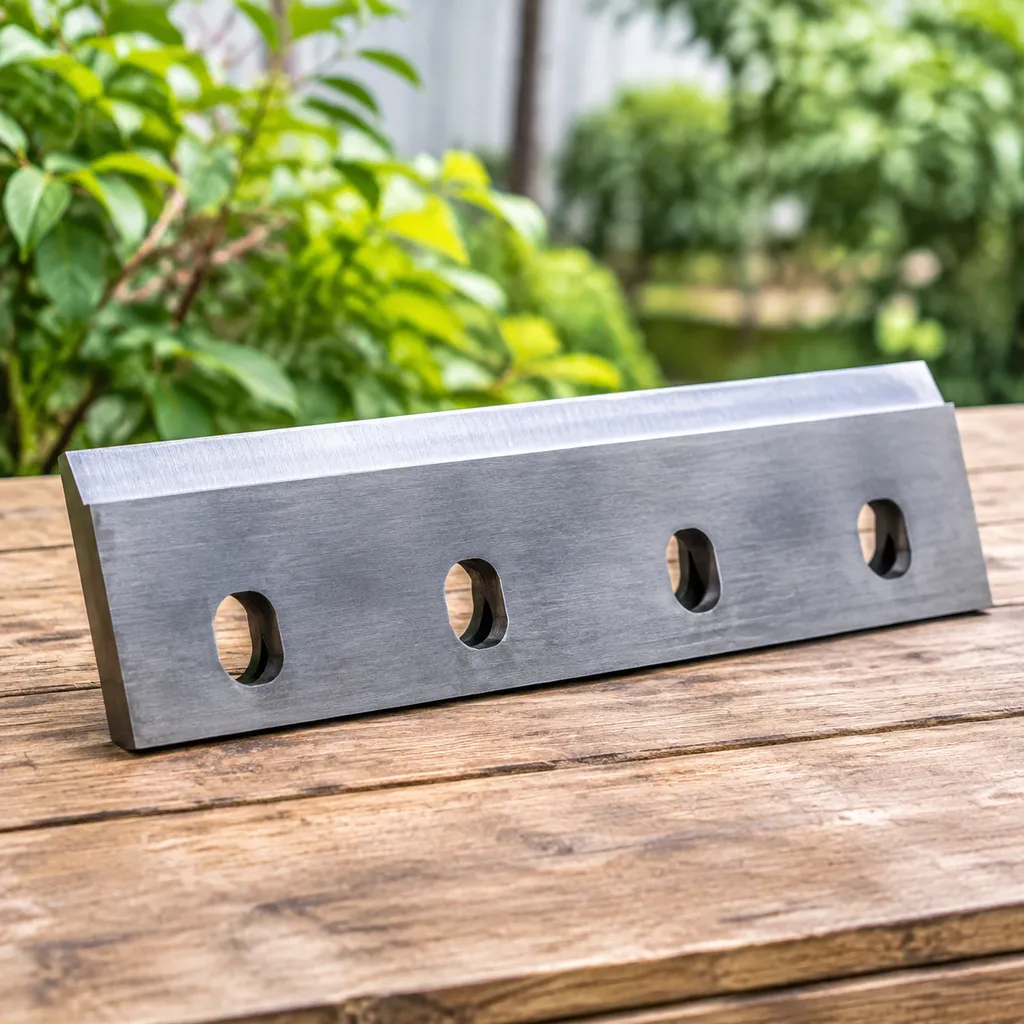
Consistent regrind with low fines requires a uniform cutting clearance between rotor and bed knives. Our counter-knife assembly incorporates four-edge reversible bed blades, allowing operators to rotate each knife four times before requiring resharpening.
To eliminate guesswork during maintenance shifts, we mount our bed knives on external calibration blocks. Operators dial in precision gaps down to 0.15 mm to 0.30 mm using external push-pull adjustment bolts—keeping your operators completely outside the cutting chamber during knife setups.
Heavy-Duty Drive and Frame Construction
A durable blade crusher is only as reliable as the frame holding it together. When processing thick purgings, solid rubber chunks, or high-density polymers, cutting chambers face extreme vibrational fatigue and impact loads. We engineer our machine chassis and drivetrains to eliminate structural flex, isolate mechanical components from contamination, and maintain smooth, uninterrupted torque through heavy shock loads.
Stress-Relieved Chamber with Hardox Liners
We fabricate the main cutting chamber from thick, stress-relieved solid steel weldments. Thermal stress relief after welding prevents frame warpage, ensuring the counter-knife seats stay parallel over years of harsh service.
- Replaceable Hardox Wear Liners: Bolted directly into high-abrasion zones inside the chamber, protecting structural walls from abrasive scrap.
- Rapid Changeout Design: Countersunk, through-hardened fasteners allow fast liner swaps during routine overhauls without cutting or re-welding the main housing.
- Extended Service Life: Pair the armored housing with optimized tooling found in our crusher blade materials guide to minimize downtime on abrasive runs.
Outboard Bearings and Dynamic Rotor Balancing
Bearing failure from fine plastic dust ingress is a common plant bottleneck. We mount our heavy-duty spherical roller bearings entirely outside the cutting chamber, separated by an open air gap and multi-stage labyrinth seals.
| Feature | Engineering Standard | Plant Floor Benefit |
|---|---|---|
| Bearing Placement | External outboard pedestal | Eliminates heat transfer and blocks polymer dust contamination |
| Rotor Balancing | Dynamic balance to ISO 1940 G2.5 | Eliminates destructive vibration and extends bearing service life |
| Shaft Material | High-tensile forged 42CrMo alloy | Prevents shaft deflection and snapping under sudden shock loads |
High-Inertia Flywheel and Powertrain Transmission
Chewing through heavy solid purgings demands consistent angular momentum. We equip each heavy-duty scrap crusher with a solid cast, high-inertia flywheel matched to an industrial-grade electric powertrain.
- Anti-Stall Inertia: The precision-machined flywheel stores rotational energy, carrying the rotor smoothly through thick cross-sections without stalling the motor or tripping breaker overloads.
- Shock-Absorbing V-Belt Drive: Heavy-duty, multi-strand V-belts dampen sudden impact loads before they can transfer to the motor gearbox, protecting mechanical components during unexpected chamber jams.
- Energy-Efficient Drive: High-torque, premium efficiency motors ensure maximum size reduction throughput per kilowatt-hour, keeping utility overhead low during continuous 24/7 processing shifts.
Target Material Processing and Industrial Applications
Rigid Polymer Processing: Purgings, Pipes, and Sprues
Solid thick-wall polymers require massive shear force and rigid knife positioning to prevent rotor jamming. We configure our cutting chambers to slice through solid mass smoothly instead of smashing it.
- Thick-wall HDPE/PP pipe: Handles heavy wall sections without splintering or thermal degradation.
- Solid purgings and startup lumps: High-inertia cutting action bites through dense polymer chunks without stalling the drive.
- Injection sprues and runners: Continuous closed-loop or beside-the-press size reduction with minimal dust.
- Engineering plastics: Cleanly cuts through POM, PA, and PBT while holding sharp cutting clearances.
Abrasive Materials: Glass-Filled Resins and Rubber Scrap
Abrasives destroy standard tooling fast. We equip these setups with premium wear-resistant granulator knives designed specifically for high-friction, wear-heavy environments like rubber processing applications.
| Scrap Material | Processing Challenge | Our Engineering Solution |
|---|---|---|
| Glass-Filled Polyamide (PA6/PA66-GF) | High gouging and rapid abrasive edge wear | D2/SKD-11 blades hardened to 58–60 HRC |
| Vulcanized Profiles & EPDM | Material elasticity and heat buildup | High-shear counter knives with razor knife gaps |
| Tire Treads and Conveyor Belt Offcuts | Extreme friction and blade deflection | Specialized rubber cutting knives for clean separation |
Post-Consumer Recycling: Bottles, Sheet Offcuts, and WEEE
Bulky, low-bulk-density waste calls for aggressive rotor grabbing and expansive chamber feed areas to maintain hourly volume.
- Blow-molded containers: Rapidly pulls in hollow HDPE jugs and PET bottles without fly-back or bridging above the rotor.
- Thermoforming sheet offcuts: Efficiently chews skeletal scrap, edge trim, and roll waste without winding around the rotor shaft.
- WEEE plastics: Crushes thick structural housings from electronics (ABS, PC/ABS, high-impact polystyrene) into clean, ready-to-melt regrind.
Durable Blade Crusher Model Specifications
Chamber Sizing, Rotor Diameters, and Throughput Metrics
We engineer our chambers from solid, CNC-machined steel to prevent frame distortion under high-shock loads. Rotor diameters directly dictate cutting leverage, while chamber width dictates bulk intake volume.
The baseline specifications for our core heavy-duty scrap crusher lineup include:
| Model | Chamber Size (mm) | Rotor Diameter (mm) | Motor Power (kW / HP) | Rotor Knives | Counter Knives | Throughput (kg/h) |
|---|---|---|---|---|---|---|
| DBC-400 | 400 × 300 | 320 | 11 kW / 15 HP | 6 | 2 | 200 – 350 |
| DBC-600 | 600 × 450 | 450 | 22 kW / 30 HP | 9 | 4 | 450 – 700 |
| DBC-800 | 800 × 600 | 560 | 37 kW / 50 HP | 12 | 4 | 800 – 1,400 |
| DBC-1000 | 1000 × 800 | 680 | 55 kW / 75 HP | 15 | 6 | 1,500 – 2,500 |
Motor Power Ratings, Knife Counts, and Rotor Cutting Speeds
High-capacity size reduction demands an exact balance between rotary momentum and torque. Running a rotor too fast melts heat-sensitive resins, while running too slow causes high-amp jamming on solid purgings.
- Controlled Rotor Speeds: Our rotary blade crusher machine systems operate at optimized speeds between 450 and 580 RPM. This maintains high shearing force while keeping mechanical friction heat well below polymer degradation thresholds.
- Balanced Knife Distributions: We distribute D2 and SKD-11 tool steel knives in staggered and V-shear configurations across the rotor face. Staggering ensures only one blade set engages the bed knife at any single millisecond, cutting continuous peak amp draw by up to 35%.
- Edge Retention Engineering: Much like the metallurgical rigor applied to a durable sharp iron slitter blade for precision cutting, our granulator knives feature deep-hardened tool steel to resist micro-chipping under constant operational stress.
Interchangeable Classification Screens for Uniform Regrind
Particle uniformity determines whether regrind feeds smoothly into your extruders and injection molding machines or bridges in your hoppers. Our classification screens regulate final regrind dimension and overall hourly throughput:
- Screen Aperture Selection: We supply standard screen perforations ranging from 5 mm to 14 mm. A 6 mm screen produces ultra-consistent feed for direct blending, while 10 mm to 12 mm screens optimize line speed for bulk central recycling.
- Heavy-Gauge Hardox Construction: Every screen is plasma-cut from abrasion-resistant steel plate to prevent warping, bowing, or hole elongation under continuous scrap impact.
- 180-Degree Chamber Wrap: The screen cradle wraps the lower half of the cutting chamber, providing an expansive discharge area that purges granules instantly to keep dust and fines generation under 2%.
Daily Maintenance, Blade Access, and Machine Safety
Hydraulic Chamber Opening for Rapid Rotor and Knife Access
Gaining access to the cutting chamber takes minutes rather than hours. A push-button hydraulic opening system tilts the upper hopper assembly back smoothly, exposing the complete rotor and counter knife array.
- Complete cutting zone visibility: Technicians inspect edge wear, check torque values, and swap rotor knives without working in cramped, hazardous positions.
- Streamlined knife gapping: The fully opened chamber allows unobstructed feeler gauge measurements between rotary and bed knives.
- Standardized service procedures: Following established knife maintenance best practices inside an open-access chamber eliminates guesswork and prevents accidental edge chipping during bolt torquing.
Drop-Down Quick-Release Screen Cradle
Color and resin changeovers demand clean chambers to avoid batch contamination. Our quick-release screen cradle drops down via mechanical levers without requiring hand tools.
| Feature | Design Specification | Operational Benefit |
|---|---|---|
| Cradle Mechanism | Drop-down split cradle with toggle clamps | Tool-free screen release in under 90 seconds |
| Screen Interchange | Slide-out curved classifier plates | Fast size changes from 6 mm to 12 mm |
| Cleanout Access | Drop-bottom chute design | Complete vacuum cleanout with zero resin hang-up |
CE-Compliant Dual Safety Interlocks and Zero-Speed Sensors
Operator safety is engineered directly into the machine control architecture:
- Active zero-speed rotor sensors: The hydraulic lift system will not engage until the heavy rotor assembly comes to a complete, monitored stop.
- Dual-channel safety interlocks: Hardwired mechanical and electrical limits cut motor power instantly if access panels loosen during operation.
- Positive mechanical lockouts: Heavy-duty safety pins physically lock the opened hopper in position, preventing accidental drops during routine blade maintenance.
Operational Cost Breakdown and Durable Blade Crusher ROI
Every hour your granulator sits idle for a knife swap directly cuts into your daily throughput. Standard steel blades dull fast under continuous loads, driving up maintenance labor and grinding wheel costs. Equipping our durable blade crusher with deep cryogenic-treated alloy knives triples wear life, limits downtime, and ensures uniform regrind quality that feeds straight back into your process.
Wear Life: Standard Steel vs. Cryo-Treated Alloy Knives
Standard carbon steel blades soften and roll their cutting edges quickly when processing abrasive polymers and dense purgings. Our cryo-tempered D2 and SKD-11 knives transform residual austenite into stable martensite, creating dense carbide structures that hold a razor edge significantly longer. To evaluate knife longevity across different tool compositions, see our technical breakdown on carbide vs steel knives.
| Performance Factor | Standard Tool Steel Knives | Cryo-Treated D2 / Alloy Knives | Operational Impact |
|---|---|---|---|
| Edge Retention Life | 120 – 160 operational hours | 450 – 600 operational hours | 3x to 4x longer runtime |
| Sharpening Frequency | Every 2 to 3 weeks | Every 2 to 3 months | 70% fewer blade changes |
| Annual Maintenance Labor | ~80 man-hours | ~22 man-hours | Direct payroll savings |
| Fines Generation Rate | 6% to 11% (as edge dulls) | Under 2% consistent | Minimal material loss |
Labor and Downtime Savings
Swapping dull rotor and bed knives takes an average of two to three hours per machine. Across a standard operating year, constant blade maintenance creates substantial hidden losses:
- Fewer Stoppages: Reducing knife change intervals from twice a month to once a quarter recovers up to 58 hours of lost production annually per line.
- Lower Resharpening Expenses: Tripling the operational run-time cuts commercial blade grinding bills by over 65%.
- Reduced Motor Load: Sharp, wear-resistant granulator knives draw less amperage, lowering energy consumption per ton processed.
Regrind Consistency and Fines Control
Dull blades smash and crush polymer instead of shearing it cleanly. This blunt impact generates excessive micro-dust and thermal deformation:
- Under 2% Fines: High-hardness, precision-gapped counter knives deliver a clean scissor cut that keeps fines generation consistently below 2%.
- Zero Sieve Blinding: Uniform pellet geometry eliminates air-conveyor clogs and prevents filter blinding in downstream material-handling systems.
- Direct Molding Integration: High-quality flake blends cleanly with virgin resin at higher ratios without causing melt inconsistency or burn marks in your extruders.
Frequently Asked Questions About Durable Blade Crusher Systems
What blade steel works best for glass-filled abrasive polymers?
For high-wear materials like 30% to 50% glass-filled polyamides or polycarbonates, standard carbon steel wears down within days. We equip our cutting chambers with cryogenically treated D2 tool steel or vacuum-hardened SKD-11 as the minimum baseline. For high-volume abrasive recycling lines, we recommend brazed tungsten carbide tips or our premium wear-resistant crusher blades. Carbide edges resist the gouging and micro-chipping caused by rigid fibers, extending operational runs between sharpenings by up to four times compared to conventional tool steels.
How often do heavy-duty crusher blades need resharpening under full loads?
Blade resharpening intervals depend strictly on resin abrasiveness and operating duty cycles:
- Standard rigid polymers (PE, PP, ABS): Resharpen every 400 to 600 operating hours.
- Abrasive or reinforced scrap (GF polymers, vulcanized rubber): Inspect every 150 to 250 operating hours.
- Tungsten carbide configurations: Run reliably for 1,000+ operating hours before profiling.
We design our counter-knife assemblies with reversible cutting edges, allowing operators to flip the bed knife quickly and double service intervals before pulling the knives off the machine for surface grinding.
How do I select the right screen size for targeted regrind throughput?
Screen selection determines the balance between particle size uniformity, throughput rate, and fines generation:
- 5 mm to 6 mm Hole Screens: Best for direct injection molding reintegration, runner salvage, and masterbatch compounding where oversized flakes cause feed throat bridging.
- 8 mm to 10 mm Hole Screens: The standard industrial baseline for blow molding, bottle preforms, and pipe recycling, maximizing volume while keeping fines under 2%.
- 12 mm and Larger Screens: Ideal for high-speed primary size reduction, thick-wall purgings, and pre-shredded scrap where high hourly mass flow matters more than flake uniformity.
Can the crusher hopper be customized for robotic or conveyor feeding?
Yes. We routinely fabricate application-specific feed hoppers to fit existing plant layouts. Options include:
- Robotic pick-and-place hoppers: Built with extended vertical chutes and anti-kickback curtains to receive sprues directly from the press without resin splash.
- Conveyor infeed hoppers: Engineered with low-profile incline hoods and integrated magnetic cross-belt separators to trap tramp metal before it contacts the rotor.
- Enclosed soundproofed enclosures: Double-walled with sound-dampening insulation to keep continuous operational noise below 85 dB(A) right next to press operators.