
What Are Industrial Knife Markings and Traceability?
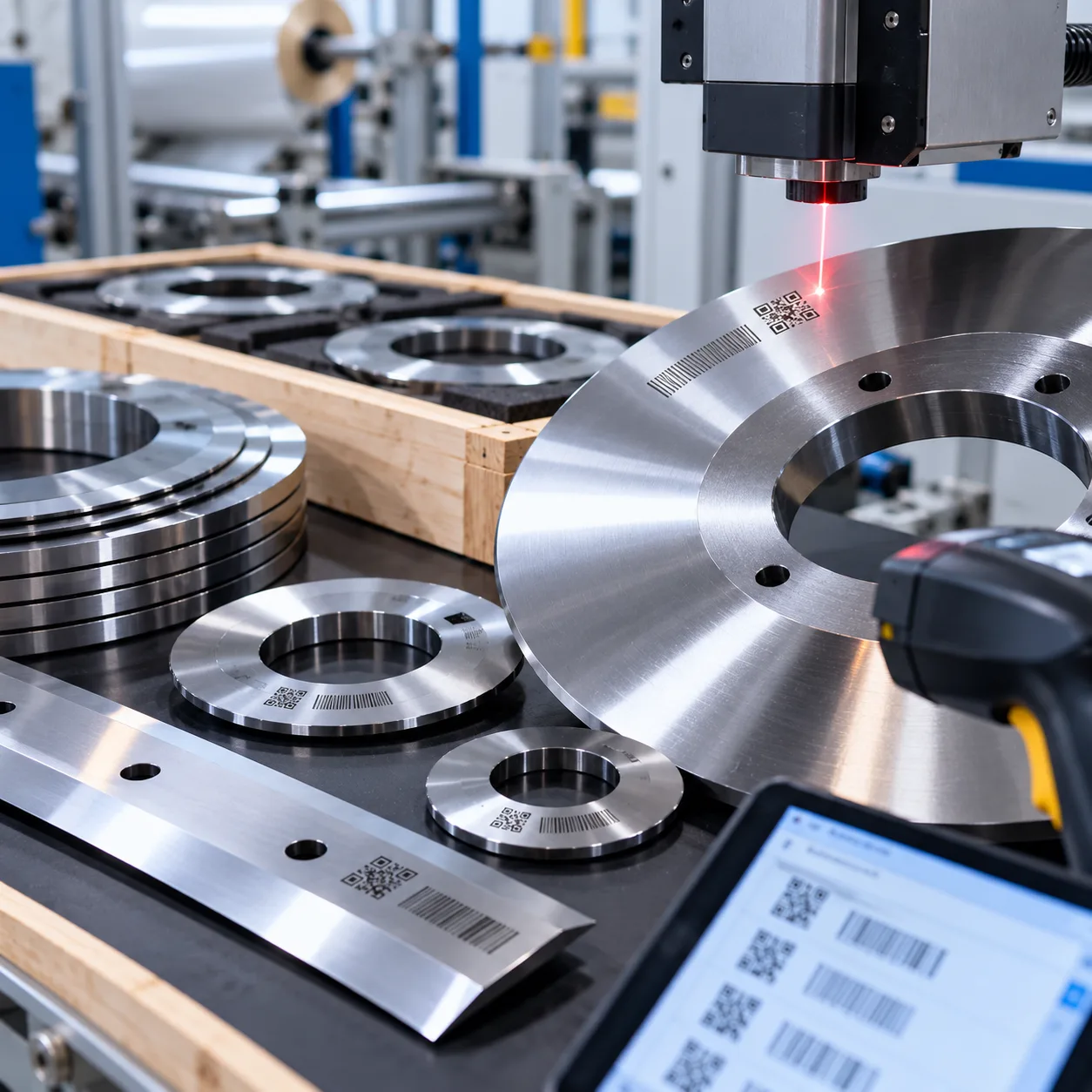
Industrial knife markings and blade traceability form the foundation of modern tooling control. We define direct part marking (DPM) as the permanent application of human-readable data and machine-readable codes directly onto a cutting tool's metal body. Instead of relying on tags or external packaging that get lost on the plant floor, DPM embeds identity permanently into the steel without compromising edge performance or structural integrity.
A complete blade traceability system bridges physical tools with digital production records, giving maintenance teams and plant managers complete visibility over every edge in service.
Core Components of a Modern Blade Traceability System
- Unique Part Identifiers: High-contrast 2D DataMatrix codes, QR codes, and alphanumeric serial numbers etched directly onto non-wear surfaces.
- Material and Manufacturing Data: Embedded metallurgical specs, including tool steel grade, heat treatment batch, Rockwell hardness (HRC), and OEM origin.
- Shop-Floor Scanning Infrastructure: Industrial handheld imagers and automated machine vision cameras at tool setup and changeover stations.
- Centralized Lifecycle Tracking: Digital database logging initial dimensions, run hours, sharpening counts, regrind limits, and retirement history.
Why Blade Tracking Matters Across Key Industries
Tracking industrial knives eliminates guesswork, reduces unplanned downtime, and protects product quality across high-demand sectors:
- Food Processing: Ensures strict sanitary traceability, rapid containment during blade failure or chipping, and compliance with food safety audit standards.
- Converting and Packaging: Prevents slit edge defects by enforcing scheduled blade rotations and matching knife profiles to specific web materials.
- General Manufacturing and Metalworking: Streamlines tool crib management, prevents premature blade scrapping, and ensures authentic, high-grade replacement tooling on every machine line.
Why Traceability Matters: Key Benefits for Plant Operations
Rapid Recall Management and Batch Defect Containment
When a slitting defect or edge chip occurs, a reliable blade traceability system lets us isolate affected production runs in minutes rather than days.
- Isolate defective runs: Cross-reference knife serial number tracking with machine logs to find exactly when a damaged edge was running.
- Contain batch risks: Trace raw material batches back to specific master rolls or food lots to minimize scrapped inventory.
- Root-cause analysis: Identify whether cut failures stem from material defects, improper machine settings, or blade wear.
Streamlining Maintenance, Regrinding, and Replacement Cycles
Tracking every grind cycle protects both cut quality and equipment health. Managing top and bottom slitter knives with unique IDs ensures that blades never exceed their maximum outer diameter (OD) reduction limits.
| Operation Metric | Without Knife Traceability | With Industrial Knife Markings |
|---|---|---|
| Sharpening Records | Manual logs, often lost | Direct part scan with automatic regrind cycle tracking |
| Tool Life Tracking | Estimated by run hours | Exact linear meters cut per sharpening |
| Inventory Control | Overstocking or unexpected stockouts | Real-time tool crib status linked to ERP/MES |
| Edge Failure Rates | High risk from over-ground blades | Strict automated retirement at minimum tolerance limits |
Preventing Counterfeit Tooling and Verifying Genuine OEM Materials
Substandard aftermarket knives cause unexpected downtime, premature wear, and machine damage. Permanent laser or dot peen markings guarantee OEM blade verification:
- Verify steel composition: Match the physical tool to certified mill test reports for genuine D2, M2, or tungsten carbide grades.
- Authenticate vendor sourcing: Ensure critical cutting lines use only verified, high-tolerance tooling.
- Protect equipment warranties: Maintain an unbroken chain of custody showing OEM-specified blades were used during operation.
Meeting Regulatory Compliance Standards (ISO 9001, FDA, and OSHA)
Auditors require verifiable proof of process control. Direct part identification simplifies regulatory reporting across heavily regulated sectors:
- ISO 9001 tooling records: Maintain complete, tamper-proof calibration, sharpening, and maintenance histories for every active blade.
- FDA food contact safety: Ensure food-processing knives use traceable, food-grade stainless steels without surface contaminations or flaking coatings.
- OSHA and operator safety: Prevent catastrophic blade shatter by systematically retiring fatigued or cracked tools before failure.
Essential Data Marked on Industrial Knives and Blades
Unique Part Numbers (UPN) and Serial Numbers
Every blade carries an exact Unique Part Number alongside an individual serial number. This knife serial number tracking allows maintenance teams to track a specific blade across its entire operational lifespan—from initial installation to the final regrind cycle.
Batch and Lot Numbers for Raw Material Provenance
Batch and lot markings trace each blade back to the original steel melt and heat treatment run. If raw material defects or heat-treat inconsistencies surface, batch and lot traceability makes it easy to isolate affected production runs within minutes without pulling unrelated tooling offline.
Tool Steel Grade, Coating Type, and Hardness Specs
To avoid fitting the wrong blade onto high-speed equipment, we permanently etch key metallurgy details onto the tool body:
Steel Grade Identification: D2, M2, tungsten carbide, or stainless grades (e.g., 440C).
Surface Coatings: TiN, DLC, PTFE, or ceramic coatings to verify wear resistance.
Rockwell Hardness (HRC): Exact core and surface hardness ratings to verify blade specifications before high-load runs on demanding setups like rubber cutting knives.
2D DataMatrix Codes and Machine-Readable Barcodes
High-density 2D DataMatrix barcodes pack extensive identification data into a compact footprint. These compact matrix marks resist surface wear and allow stationary scanners or handheld readers on high-speed lines—such as automated packaging machine knives—to log tool swaps directly into your MES or ERP system.
Sharpening Limits and Critical Dimensional Tolerances
We laser-etch clear visual wear limits, minimum blade width indicators, and critical thickness tolerances onto the blade body. This visual data guides grinding operators precisely, preventing over-sharpening and ensuring retired blades are replaced before edge failure causes unplanned line downtime.
Industrial Knife Marking Technologies Compared
Fiber Laser Marking and Dark Annealing
Fiber laser systems deliver unmatched precision for industrial knife identification. When working with hardened tool steels and tungsten carbide, we utilize laser annealing blades rather than deep engraving:
- Zero Structural Stress: Surface annealing alters the oxidation layer through controlled localized heating without vaporizing metal or inducing micro-fractures along critical cutting edges.
- High Contrast: Produces crisp, dark marks that allow optical scanners to read high-density 2D DataMatrix codes instantly.
- Corrosion Resistance: Preserves the passive layer on stainless and food-grade alloys, preventing premature rust during washdowns.
Dot Peen Marking for Heavy-Duty Tooling
Dot peen knife marking utilizes a pneumatically or electrically driven carbide stylus to indent alphanumeric characters and matrix patterns into the blade surface:
- Deep Durability: Creates mechanical indentations that survive aggressive shot-blasting, heavy sludging, and severe abrasive wear.
- Best Placement: Ideal for thick knife bodies, clamping rings, and machine holders rather than thin web-slitting blades where mechanical impact could induce unwanted runout. Clear markings make it easier to calibrate tooling according to our slitter knife setup guide for precise cutting.
Electrochemical Etching for Precision Hardened Tool Steels
Electrochemical etching uses a low-voltage electrical current and a specialized electrolyte solution to transfer stenciled marks onto conductive metals:
- No Material Distortion: Generates zero mechanical pressure and zero heat-affected zones (HAZ), making it safe for ultra-thin or razor-honed industrial blades.
- Low Entry Cost: An economical option for low-to-medium batch runs and manual toolroom marking stations.
- Edge-Safe Application: Leaves the original dimensional tolerances and Rockwell hardness (HRC) completely unchanged.
Marking Methods Comparison Matrix
| Technology | Equipment Cost | Cycle Speed | Optical Contrast | Stress on Steel | Recommended Knife Applications |
|---|---|---|---|---|---|
| Fiber Laser Annealing | Moderate to High | Fast (< 3 sec) | High (Dark/Oxidized) | None (Zero HAZ) | Slitter blades, food processing knives, circular slitters |
| Dot Peen Marking | Low to Moderate | Moderate | Low to Medium | Low (Localized Impact) | Heavy shear blades, granulator knives, toolholders |
| Electrochemical Etching | Low | Slow (Manual) | Medium to High | None (Chemical only) | Precision micro-blades, low-volume custom tooling |
Integrating Knife Traceability into Shop-Floor Software
Marking blades is only half the job. To get real value from a blade traceability system, we connect those marks directly to plant-floor systems. When our cutting tools feed live data into shop management software, we eliminate manual guesswork, stop premature blade changes, and keep machines running efficiently.
Scanning DPM Codes with Vision Systems and Handheld Readers
We capture direct part marking DPM data at every workstation using high-resolution industrial scanners:
- Fixed vision cameras: Mounted directly on the machine line to verify the correct knife profile, thickness, and material before the cycle starts.
- Rugged handheld 2D imagers: Used during changeovers to quickly scan low-contrast 2D DataMatrix barcode marks through cutting fluid or light oil.
- Automated gantry scanners: Integrated into grinding cells to read the knife serial number tracking code before and after sharpening.
Connecting Knife Lifecycle Data to MES and ERP Platforms
Linking tool data to Manufacturing Execution Systems (MES) and ERP platforms gives complete visibility over production:
- Job-to-blade pairing: Records precisely which knife serial number ran on each production batch.
- Wear limits & alerts: Tracks linear feet or tonnage cut per blade and triggers automated notifications when it approaches end-of-life.
- Cost allocation: Automatically charges tooling costs directly to specific customer work orders instead of general overhead.
| System | Tracked Knife Metric | Plant-Floor Impact |
|---|---|---|
| MES | Cut counts, run speed, knife change duration | Reduces unplanned downtime |
| ERP | Reorder points, vendor pricing, scrap rates | Lowers safety stock costs |
| CMMS | Regrind cycles, dimensional loss per grind | Optimizes maintenance schedules |
Automating Tool Crib Inventory and Sharpening History
Manual tool logs create blind spots. We use dedicated tool crib management software to track each knife through its complete operational cycle. Scanning a blade during checkout updates its status automatically:
- Tracks cumulative regrind cycle tracking data, including total metal removed and remaining usable blade life.
- Flags blades that have reached minimum thickness limits, preventing dangerous in-service failures.
- Enforces strict knife maintenance best practices by routing worn tooling directly to qualified grinding stations rather than back into circulation.
Improving Overall Equipment Effectiveness (OEE)
Real-time blade lifecycle management drives measurable OEE gains across every production line:
- Availability: Fast scanner verification cuts tooling setup and changeover times by up to 40%.
- Performance: Running matched, sharp blade sets eliminates micro-stops and feed-rate slowdowns caused by dull edges.
- Quality: Correlating product scrap rates with specific knife run-hours pinpoints the exact point where cut quality degrades, allowing us to swap blades before defects occur.
Best Practices for Marking and Managing Industrial Blades
Strategic Mark Placement
Never mark directly on the cutting edge, bevel, or primary wear path. The mark must sit where it will not interfere with blade alignment or experience heavy friction:
- Mounting Flanges and Hubs: Ideal for rotary blades and circular slitters where clamping surfaces protect the code.
- Recessed Blade Bodies: Excellent for heavy-duty granulator or shear knives away from direct impact zones.
- Non-Contact Side Faces: Perfect for precision tooling, such as a high-tolerance foil slitter blade, keeping the cutting surface completely flush.
Ensuring Readability Under ISO/IEC 29158 (AIM DPM)
Direct Part Marking (DPM) on reflective tool steel can create glare and contrast issues for standard scanners. We benchmark our marks against the ISO/IEC 29158 (AIM DPM) quality standard:
- Cell Contrast & Uniformity: Ensure laser annealing or etching creates enough visual contrast against ground steel finishes.
- Quiet Zones: Maintain a clear margin around 2D DataMatrix codes so fixed-mount cameras and handheld imagers can lock on instantly.
- Lighting Configuration: Use diffuse or polarized lighting on inspection stations to eliminate surface glare during automated scans.
Standardizing Data Syntax Across Multi-Vendor Inventories
Tool cribs often store blades from multiple manufacturers. Without a unified data structure, your software won't read codes consistently.
| Data Field | Recommended Format | Purpose |
|---|---|---|
| Unique Part Number (UPN) | SKU-XXXXX | Identifies machine model and blade geometry |
| Serial Number | SN-YYYY-##### | Tracks individual blade lifecycle and regrind count |
| Steel Grade & Hardness | D2-60HRC | Prevents improper heat-treat or grinding parameters |
| Data Matrix Syntax | GS1 / ISO 15434 | Ensures plug-and-play scanning across MES and ERP |
Protecting Markings Against Harsh Environments
Industrial knives operate in aggressive environments involving thermal cycling, abrasive slurries, and caustic washdowns.
- Food Processing Lines: Use laser dark annealing rather than deep surface engraving to prevent micro-pockets that trap bacteria or corrode under chlorinated sanitation washdowns.
- High-Heat & Heavy Wear Applications: For abrasive converting and recycling operations, apply deep laser marks or dot peen codes on side shoulders to withstand high friction and heavy oil exposure.
- Post-Regrind Protection: Position markings well clear of the scheduled grinding margin so knife sharpening routines never shave off critical traceability data.
FAQs About Industrial Knife Markings and Traceability
Does laser marking affect blade temper or cause edge micro-fractures?
When done correctly, laser marking does not alter tool temper or create stress risers. We use laser annealing for hardened tool steels, which relies on controlled thermal oxidation beneath the surface rather than aggressive material ablation.
- Zero Heat-Affected Zone (HAZ): Surface temperatures remain localized, preventing core de-tempering.
- Structural Integrity: Because the laser does not remove base metal, the blade avoids micro-fractures, notch effects, or premature fatigue failure under heavy shock loads.
What is the best marking standard for food-contact cutting blades?
For food processing and hygienic packaging environments, direct part marks must leave a smooth, non-porous finish to prevent bacterial harborage.
- Laser Dark Annealing: Creates high-contrast black marks without disturbing the microscopic surface finish, meeting strict FDA sanitary requirements.
- Corrosion Resistance: Preserves the passive oxide layer on stainless grades (such as 420, 440C, or surgical steels).
- Application Fit: Ideal for sanitary converting tools and specialized film cutting knives subjected to aggressive daily caustic washdowns.
How can 2D DataMatrix codes survive repeated regrinding cycles?
A traceability mark is only valuable if it lasts throughout the entire service life of the tool. We protect machine-readable 2D DataMatrix codes and serial numbers by following strategic placement protocols:
- Placement Away from Wear Zones: Marks are located strictly on the blade body, clamping flats, or mounting hubs—well clear of the cutting bevel and regrind envelope.
- Depth Control: Mark depth and contrast are calibrated so that routine cleaning and ultrasonic degreasing do not degrade optical readability.
- Custom Tooling Accommodation: For complex profiles and OEM special cutting components, we engineer dedicated marking zones into the CAD model before initial machining.
Can legacy industrial knives be retrofitted with traceability marks?
Yes. Unmarked blades already in plant circulation can be fully integrated into a modern knife traceability system.
- On-Site or Batch Laser Retrofitting: Existing blade inventories can be serialized and etched using fiber laser marking stations during scheduled maintenance intervals.
- Surface Cleaning Protocol: Parts only require standard degreasing and surface prep prior to marking.
- System Onboarding: Once marked, legacy knives are scanned directly into your tool crib management software to begin logging regrind counts, run hours, and position data immediately.