
Slitter Blade Types & Material Selection
Rotary Slitting Knives Types
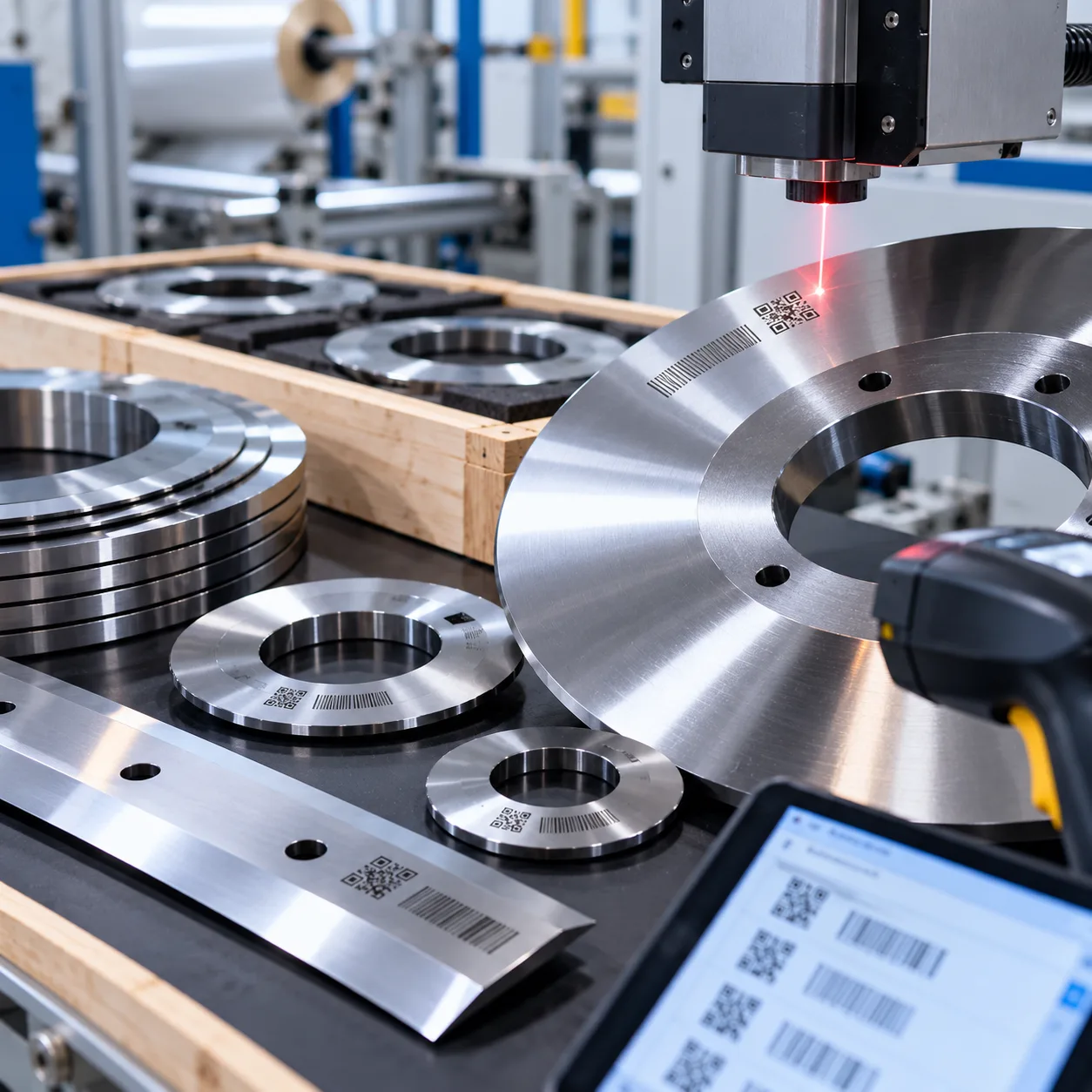
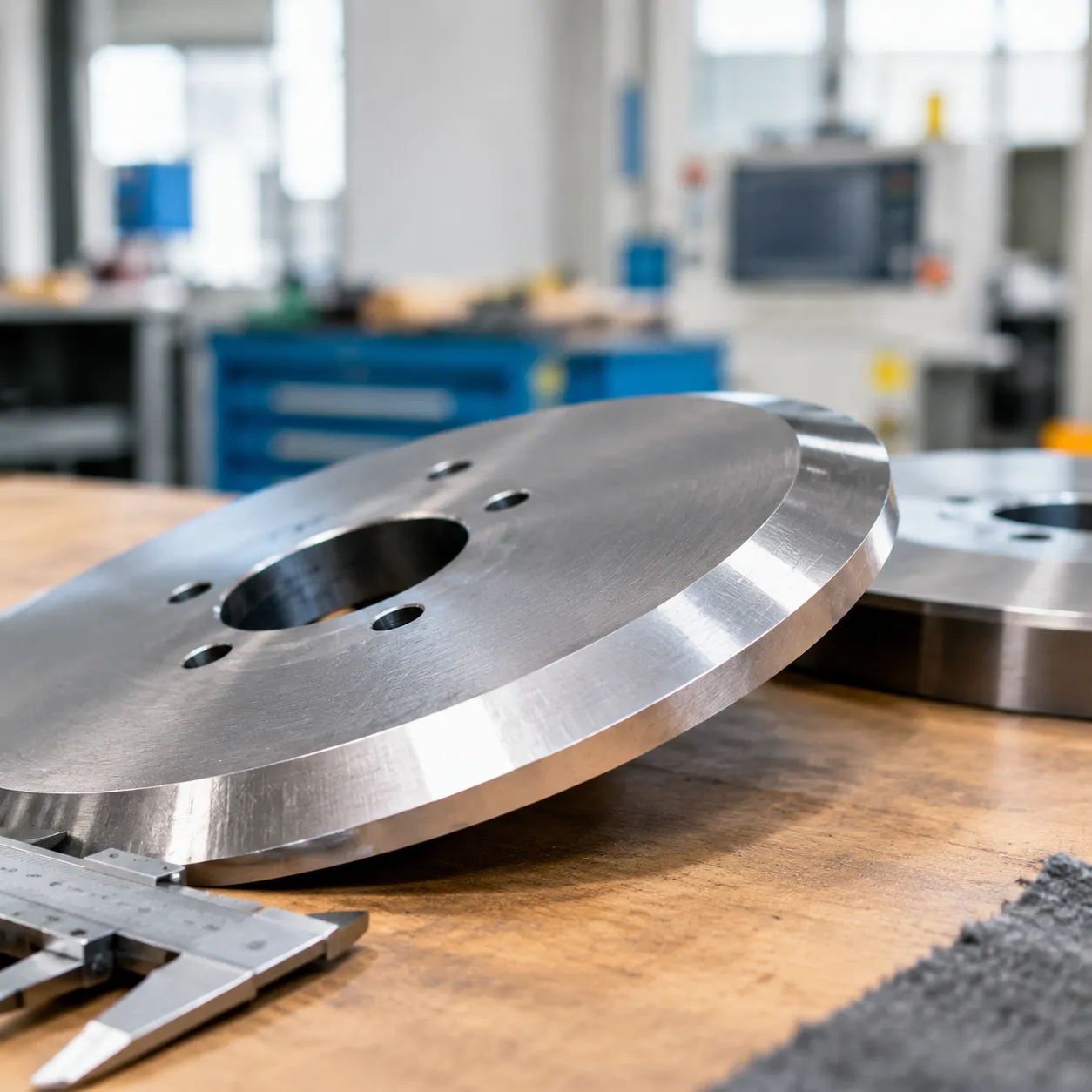
- Top Blades (Male Knives): Precision-ground upper blades featuring single or double bevels designed to shear cleanly against a counter-edge.
- Bottom Knives (Female Knives): Rigid counter-cutters mounted on the bottom shaft to support the substrate during a top and bottom slitter setup.
- Dish Slitter Blades: Concave, spring-loaded rotary blades that maintain continuous lateral pressure against the anvil blade during high-speed web slitting.
Rotary Slitting Blade Material Options
- D2 Tool Steel Blade Material: High-carbon, high-chromium steel providing an ideal balance of wear resistance, impact toughness, and cost efficiency for standard converting operations.
- M2 High-Speed Steel (HSS): Enhanced thermal stability and hardness retainment, making it perfect for high-speed continuous slitting lines.
- Tungsten Carbide Slitter Knives: Exceptional micro-structural density and extreme abrasion resistance, delivering maximum service life during demanding production cycles.
Substrate & Blade Material Selection Matrix
| Substrate | Ideal Blade Material | Primary Slitting Setup | Key Operational Advantage |
|---|---|---|---|
| Paper & Board | D2 Tool Steel | Shear Slitting | High impact resistance, cost-effective edge retention |
| Plastic Film & Packaging | M2 HSS / Tungsten Carbide | Razor / Shear Slitting | Razor-sharp edge, minimal burr and dust generation |
| Metallic Foils (Copper, Aluminum) | Tungsten Carbide | Precision Shear Slitting | Zero micro-chipping, strict blade runout tolerance |
| Non-Ferrous Metals & Steel Strip | D2 Tool Steel / Carbide Inserts | Heavy Shear Slitting | Maximum yield strength under extreme side pressure |
Designing & Machining the Blank
Getting the initial geometry right ensures the blade stays stable on the shaft without wobble, runout, or premature wear.
Slitter Blade Tolerances and Specs
We establish exact dimensional targets before cutting a single piece of steel. Every critical feature requires strict control to ensure accuracy:
- Outer Diameter (OD): Sized with an added grinding allowance (+0.5 mm to +1.0 mm) to leave enough material for post-heat-treatment sharpening.
- Bore Size (ID): Machined to tight H7 tolerances to match the machine arbor perfectly and eliminate axial play.
- Thickness & Parallelism: Held within ±0.005 mm to guarantee precise spacing in multi-knife setups.
Cutting Steel Stock into Blanks
We take high-grade tool steel bar stock or heavy plate and rough-cut it into round disc blanks using two primary methods:
- Waterjet Cutting: Ideal for flat plate material because it cuts clean profiles without creating heat-affected zones (HAZ) that ruin steel structure.
- Band Sawing: Preferred for thick round bar stock, providing fast, reliable disc separation.
Precision Machining Bores and Keyways
After cutting the raw disc, we secure it on a lathe to face the sides flat and bore the center hole. Utilizing our setup for precision machining, we bring the center bore to its preliminary dimensions.
ly, we broach or wire-EDM the drive keyways and locking pin holes. Proper keyway alignment guarantees that the finished slitter knife seats securely on the drive shaft, preventing slippage and chatter during high-speed cutting.
Blade Heat Treatment Process
Heat treatment transforms soft machined steel into durable, wear-resistant tooling. Controlling thermal cycles precisely during this stage prevents warping and maximizes long-term cutting performance.
Heating Cycles and Austenitizing
Tool steel requires staged heating to relieve internal stress before reaching peak transformation temperatures:
- Preheating Phase: Blanks are gradually elevated to 650°C–850°C (1200°F–1550°F) to ensure even heat distribution across the body.
- Austenitizing Peak: D2 tool steel is brought to 1010°C–1040°C (1850°F–1900°F) to alter the atomic structure and dissolve alloy carbides uniformly.
Quenching Methods: Vacuum vs. Oil
Rapid cooling locks in essential blade hardness. The choice between quenching mediums depends on core substrate thickness and required tolerances:
| Quenching Method | Process Characteristics | Primary Application |
|---|---|---|
| Vacuum Furnace (Gas Quench) | High-pressure nitrogen gas cooling in a vacuum environment; prevents surface scaling and minimizes distortion | Precision circular slitter knives and thin-gauge tool steel blades |
| Oil Quenching | Fast thermal extraction using temperature-controlled oil baths; provides maximum core hardness | Heavy-duty alloy blanks and thick rotary cutting tools |
Tempering for Target HRC Hardness
As-quenched steel is brittle and requires multiple tempering cycles to achieve the ideal balance of wear resistance and impact toughness:
- Primary Temper: Blanks are heated to 150°C–520°C (300°F–970°F) right after quenching to convert retained austenite into stable tempered martensite.
- Multiple Temper Cycles: We repeat the process two to three times to relieve internal stresses, stabilizing the material at a target hardness of 58 to 64 HRC based on target slitting substrates.
Precision Bevel Grinding & Edge Sharpening
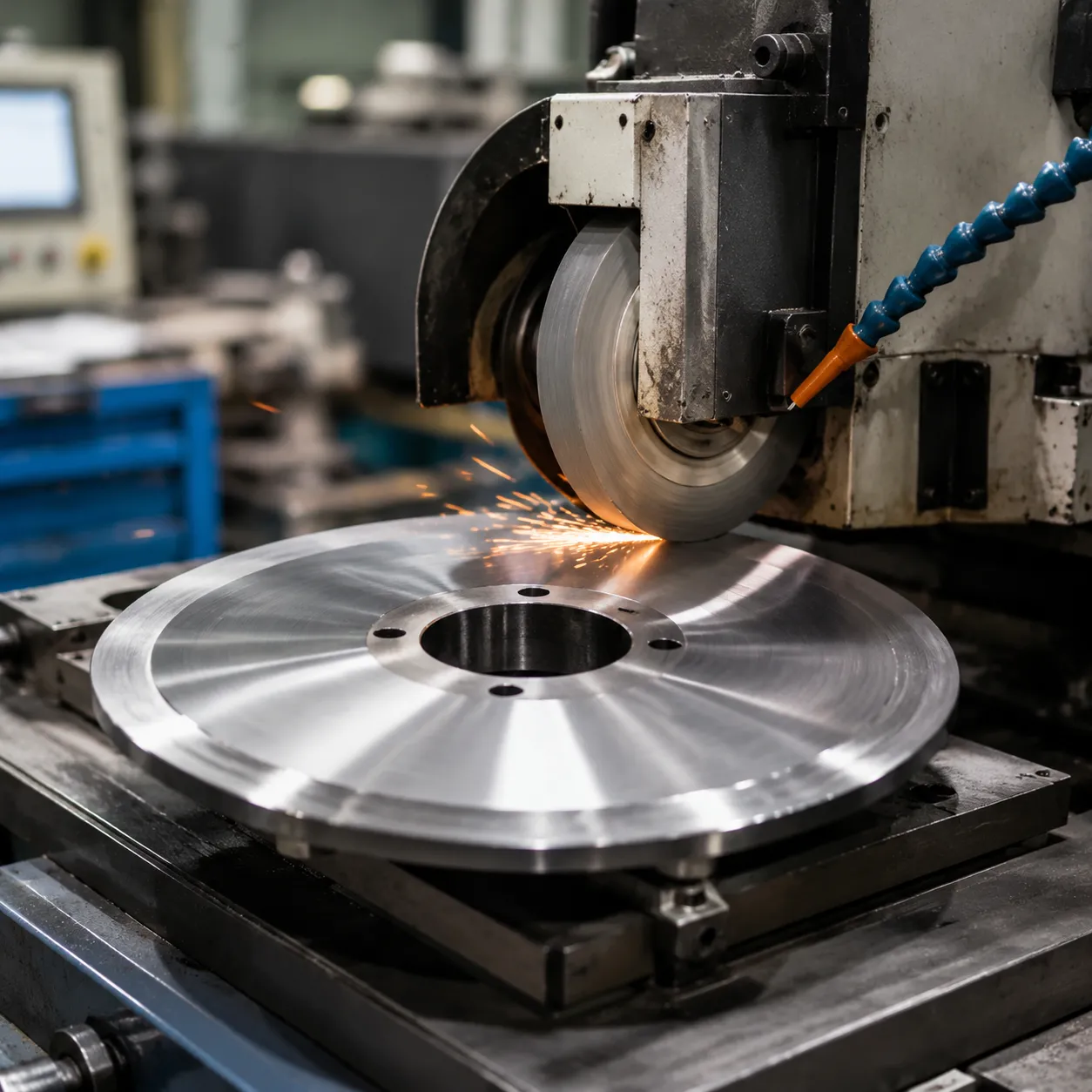
Once heat treatment is complete, we move to the most critical stage of how to make slitter blade components: precision grinding. This step transforms hardened steel blanks into high-performance industrial knives with tight tolerances.
Surface Grinding for Flatness
We start by rotary surface grinding both sides of the blade blank. This guarantees absolute parallelism and consistent thickness across the entire disc.
- Parallel Tolerance: Kept within strict micron-level limits to prevent edge wobble.
- Flatness: Eliminates axial runout during high-speed rotation on the arbor shaft.
Bevel Grinding Techniques
Next, we execute precision bevel grinding to shape the cutting geometry based on target substrates. The choice of bevel profile directly dictates cutting performance and tool longevity.
| Bevel Style | Common Applications | Key Advantage |
|---|---|---|
| Single Bevel | Heavy paper, metallic foils, thick sheet stocks | High structural strength and resistance to edge chipping |
| Double Bevel | Standard paper slitting, flexible packaging | Balanced lateral cutting forces and clean shear action |
| Razor Profile | Thin plastic films, specialty laminates | Minimal friction, ultra-sharp edge for drag slitting |
When producing ultra-sharp razor slitting knives, controlling the wheel speed and coolant flow during beveling prevents thermal micro-cracking along the edge.
Honing and Lapping for Burr-Free Edges
Grinding creates the profile, but micro-burrs and subtle grinding marks remain. We finish every edge with diamond honing and mirror-finish lapping.
- Micro-Burr Removal: Prevents early edge dulling and material tearing.
- Surface Refinement: Reduces friction and glue adhesion during continuous web processing.
- Shear Edge Integrity: Maximizes service intervals for film cutting knives running on high-speed equipment.
Quality Control & Wear Coatings
Rockwell Hardness Testing
We test every batch after heat treatment to verify structural integrity and wear resistance.
- Hardness Verification: We use a Rockwell C scale tester to check multiple points on steel blades, ensuring uniform hardness from the core to the cutting edge.
- Material Benchmarks: Tool steels typically target 58–64 HRC, while tungsten carbide units undergo Rockwell A (HRA) testing to balance toughness against chipping.
Measuring Runout and Tolerances
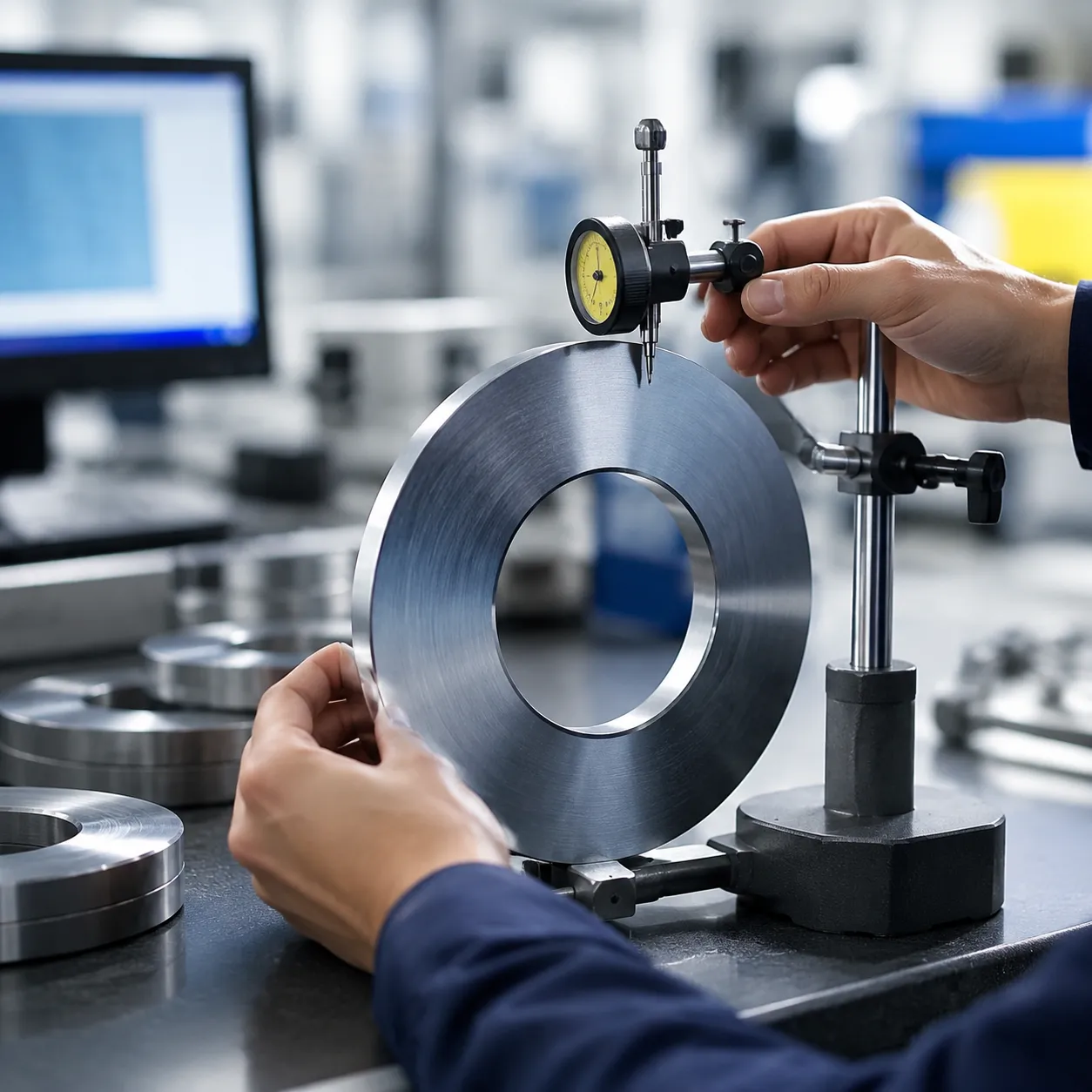
Minimal blade runout tolerance is critical to prevent wobbling, web tear, and premature edge wear during high-speed runs. We run every finished knife through a rigorous quality control process using optical comparators and CMMs to verify key parameters:
| Inspection Point | Standard Tolerance | Primary Inspection Tool |
|---|---|---|
| Flatness | Under 0.002 mm | Precision optical flat |
| Radial Runout | Under 0.003 mm | Dial indicator on precision arbor |
| Bore Concentricity | Under 0.002 mm | Coordinate Measuring Machine (CMM) |
Thin-Film Protective Coatings
Applying wear-resistant surface treatments significantly extends tool life when slitting abrasive or sticky substrates:
- Titanium Nitride (TiN): Adds a hard, gold ceramic layer that reduces friction and boosts edge life on standard film and paper lines.
- Titanium Aluminum Nitride (TiAlN): Offers extreme heat resistance for high-speed shear slitting and metallic substrates.
- PTFE / Teflon: Creates a non-stick barrier that stops glue and pressure-sensitive adhesives from building up on the blade sides.
Frequently Asked Questions
Ideal HRC Hardness for Industrial Slitter Blades
The ideal hardness depends on your cutting substrate and blade material:
- D2 and M2 Tool Steels: Hardened to 58–64 HRC to deliver optimal edge retention without becoming overly brittle when slitting paper, plastic films, or thin metals.
- Tungsten Carbide: Reaches hardness equivalent to 75–85 HRC, making it the primary choice for continuous high-speed converting of abrasive materials.
Preventing Slitter Blade Deflection
Wobble and deflection ruin cut edge quality and ruin tool life fast. We prevent deflection during operation through several strict steps:
- Strict Runout Control: Keep disc flatness and parallel thickness within micro-inch tolerances.
- Proper Side-Pressure Setup: Calibrate top and bottom knife overlap and cant angles precisely to avoid excessive lateral push.
- Precision Bore Fit: Mount blades on clean shafts with exact tolerances, like those engineered into a 170mm slitter blade with 20mm bore, ensuring complete rigidity under high shearing force.
Resharpening Custom Slitter Knives
We routinely regrind slitter blades without losing critical factory tolerances:
- CNC Precision Grinding: We remove minimal material from the bevel using precision grinding machinery and heavy coolant flow to protect the original heat treatment.
- Dimensional Accuracy: Lapping and honing processes restore a razor-sharp, burr-free edge while preserving bore concentricity and original disc parallel thickness.
- Extended Service Life: Re-sharpening high-performance custom machine knives delivers near-new slitting performance across multiple production lifecycles.