
Heavy-Duty Industrial Shredder Blades
Engineered for primary size reduction and high-torque recycling operations, Sharkcutting manufactures custom wear-resistant blades for single-shaft, dual-shaft, and quad-shaft shredders. Discover our full line of industrial cutting products, built with premium tool steels and deep heat treatment to deliver exceptional impact toughness and precision fit to meet strict OEM standards.
Quantifiable Durability for Heavy-Duty Industrial Shredding
Shark Cutting manufactures precision shredder blades designed to deliver maximum industrial cutting performance across demanding recycling applications. Backed by advanced CNC grinding and controlled vacuum heat treatment, our industrial knives maintain exceptional dimensional stability and edge sharpness under severe mechanical load.
Through continuous blade wear life optimization and rapid custom delivery, we help primary reduction facilities minimize unscheduled downtime and lower operational costs per ton. Explore our complete range of industrial blade products, including custom slitting knives and precision circular slitter knives.
Precision-ground shredder knives built to custom OEM machine specs.
High wear resistance range achieved through material-customized heat treatment processes.
Substantial blade wear life extension compared to standard carbon steel replacement knives.
Precision tool engineering fully compatible with major industrial shredder OEM specifications.
Fast delivery cycle for standard custom blade samples to keep production lines on schedule.
Engineered for High-Torque Primary Size Reduction
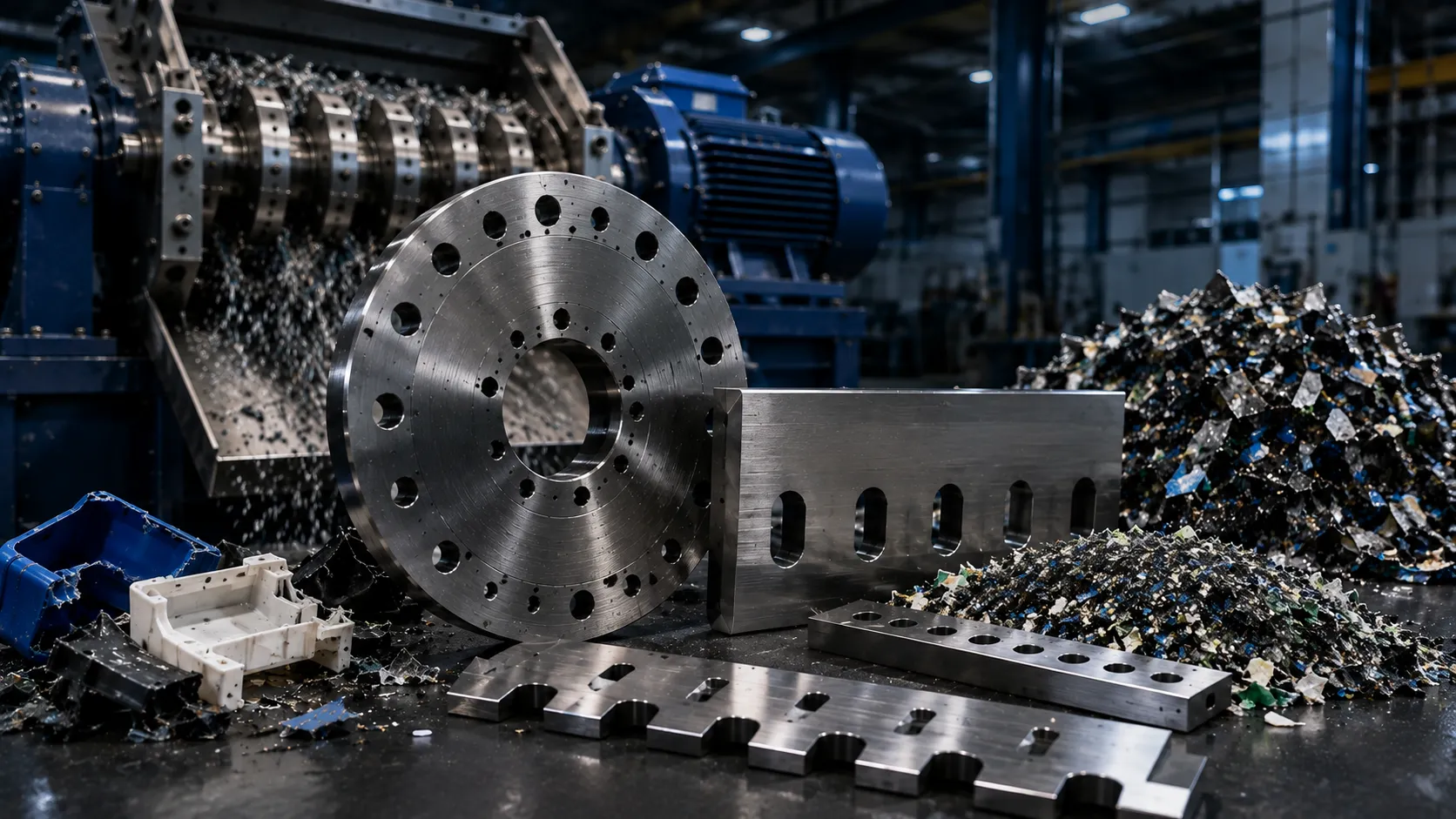
Primary size reduction demands cutting tools capable of absorbing immense mechanical shock, extreme torsional stress, and abrasive contamination. Engineered by Sharkcutting, our high-torque shredding blades feature optimized hook profiles, deep-hardened tool steel alloys, and micron-precise grinding tolerances. Unlike standard granulator knives built for high-speed shearing, our industrial shredder blades are purpose-built to deliver continuous throughput across heavy-duty recycling, scrap processing, and waste reduction lines. Explore our full range of industrial products to find the ideal cutting solution for your operational requirements.
High-Torque Impact Resistance
Primary reduction subjects cutting edges to destructive kinetic shock and sudden jamming forces. Sharkcutting optimizes tooth hook geometry, root radii, and keyway locking mechanisms to distribute stress evenly, effectively preventing edge chipping, catastrophic tooth shear, and shaft slippage during intense reduction cycles.
- Optimized Tooth Profiles: Engineered hook angles and reinforced tooth bases resist impact failure when processing bulky rigid plastics, scrap tires, and e-waste.
- Heavy-Duty Drive Locking: Precision keyways, splines, and hex bores ensure zero rotational play or shaft binding under peak torsional torque.
- Stress-Relieved Cores: Specialized thermal stress relief prevents micro-fracturing along the cutting interface during severe material jams.
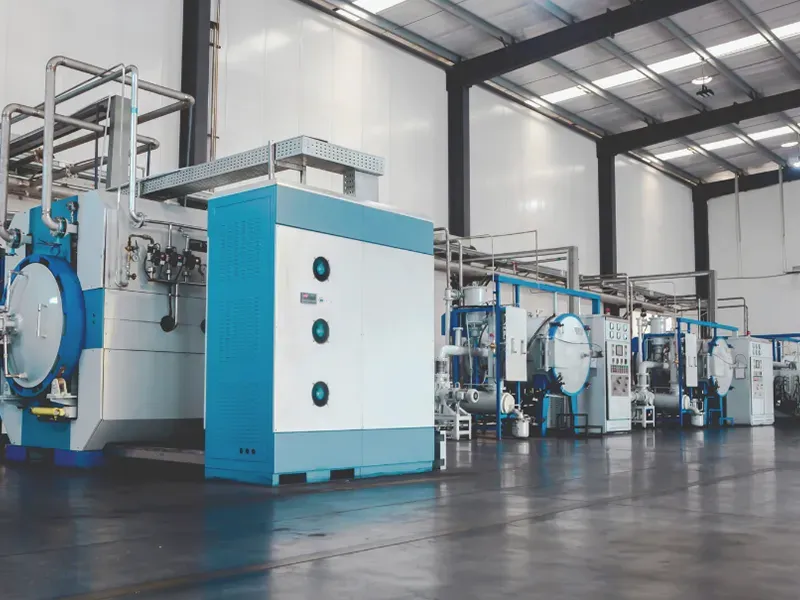
Deep Vacuum Heat Treatment
Surface-hardened knives quickly deteriorate under abrasive recycling conditions. Sharkcutting utilizes multi-stage vacuum heat treatment paired with sub-zero cryogenic quenching, transforming the steel microstructure to guarantee deep, uniform hardness from the blade edge straight through to the core.
- Core-to-Surface Hardness: Delivers a consistent 58–64 HRC rating depending on material selection, ensuring predictable wear without core brittleness.
- Sub-Zero Cryogenic Tempering: Refines grain structure and eliminates retained austenite, increasing wear life and dimensional stability under high temperatures.
- Extended Sharpening Cycles: Maintains high-performance cutting geometry through multiple resharpening cycles, dramatically lowering lifetime tooling cost.
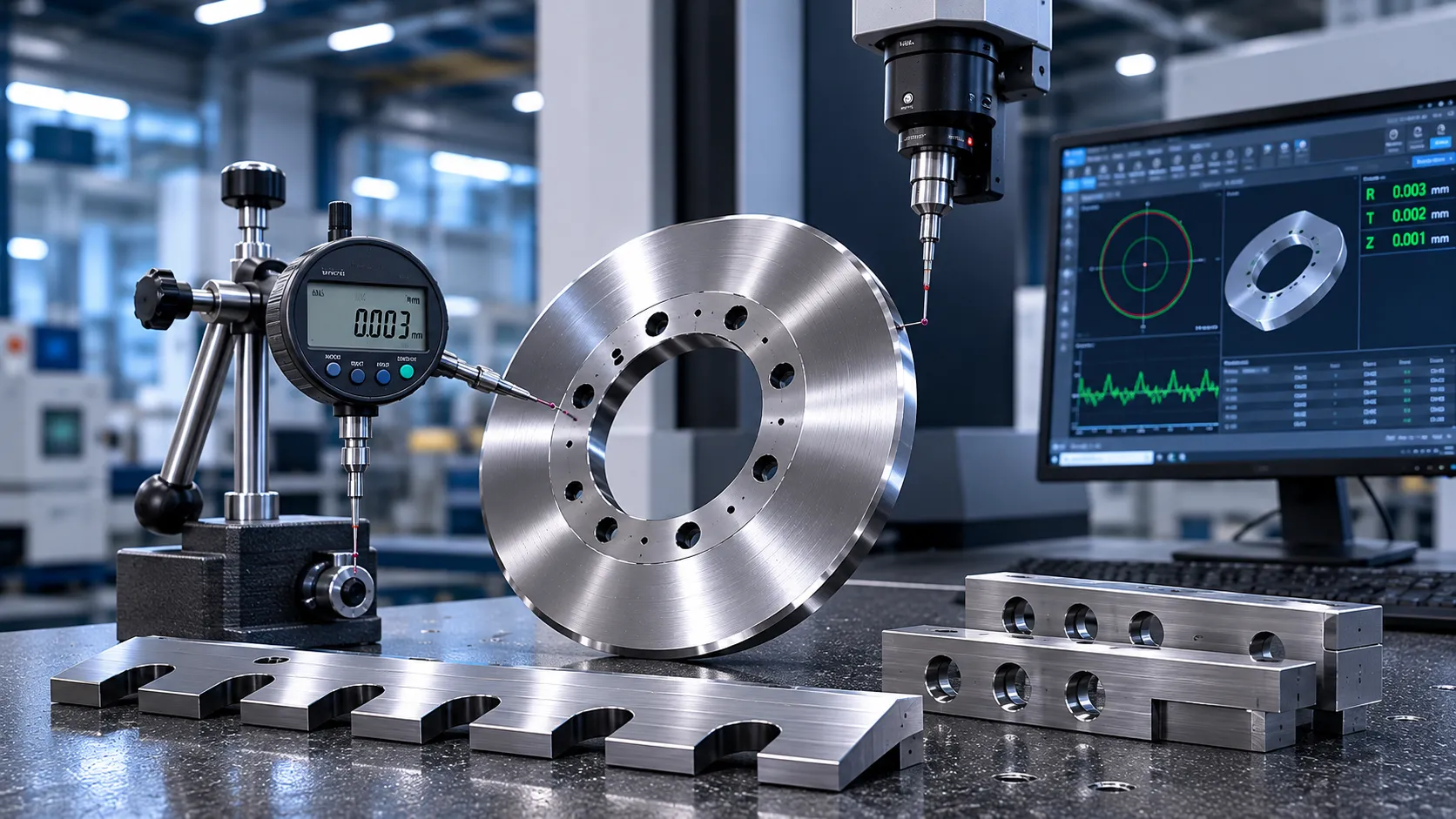
Micron-Level Clearance & Runout Control
Tight axial and radial tolerances are critical for maintaining clean cutting gaps between rotor blades, counter knives, and bed knives. CNC surface grinding ensures smooth meshing, minimal friction heat, and optimal material engagement across single-shaft, dual-shaft, and quad-shaft machines.
- Tight Precision Tolerances: CNC face and profile grinding maintains shaft-wide runout within ±0.01mm for uniform cutting action across the rotor.
- Anti-Wrapping Performance: Precision clearance prevents thin film, wire, or flexible rubber from wrapping around shafts or jamming cutting chambers.
- Factory-Matched Blade Sets: Individually balanced and indexed rotor blade sets streamline installation and reduce gearbox strain.
Primary Shredder Blades vs. Standard Granulator Knives
Selecting the wrong cutting tool configuration leads to premature edge breakdown, high power consumption, and costly plant downtime. While granulator knives operate at high RPMs for secondary sizing of clean scrap, high-torque shredding blades are designed for low-speed, high-torque primary size reduction of contaminated, un-sorted feedstocks. For converting continuous webs, flexible films, or foil lines, we also manufacture specialized slitting-knives, including ultra-sharp shear-slitting-knives designed for high-speed web conversion.
Engineered for coarse reduction, heavy impact loading, low RPM (10–80 RPM), and maximum tearing torque on heavy scrap.
Engineered for fine granulating, clean scissor-shearing cuts, high RPM (400–800 RPM), and pre-sorted, clean regrind materials.
Custom Tooth & Hook Configurations
At Sharkcutting, we design custom blade geometry, hook counts, spacer dimensions, and locking styles tailored to your shredder brand and feedstock requirements.
D2 / Cr12MoV High-Chromium Tool Steel
D2 (equivalent to SKD11 or 1.2379) stands as the global standard alloy for heavy-duty shredder knives operating in predictable, medium-impact environments. Containing 12% chromium alongside molybdenum and vanadium, D2 forms high-density chromium carbides throughout its matrix, delivering exceptional resistance to abrasive sliding wear during primary size reduction.
Key Technical Advantages
- High Wear Resistance: Dense carbide distribution prevents premature cutting edge rounding.
- Deep Vacuum Hardening: Retains structural integrity across 3 to 5 re-sharpening cycles.
- Dimensional Stability: Minimal volumetric distortion under heavy torsional shear loads.
Recommended Feedstocks
- Thick rigid plastics (HDPE purgings, ABS, PP pallets, PET bottle bales).
- Clean timber, lumber scrap, demolition wood, and pallet recycling.
- Uncontaminated paper, dense cardboard bales, and agricultural plastic film.
Metallurgical Properties & Performance Matrix
Direct technical comparison of key shredder blade steel grades used in primary size reduction and high-torque recycling machinery.
| Steel Grade | International Standard | Hardness (HRC) | Wear Life Rating | Impact Toughness | Primary Target Feedstock |
|---|---|---|---|---|---|
| D2 / Cr12MoV | AISI D2 / JIS SKD11 / W.Nr. 1.2379 | 58 - 62 HRC | High (4.5/5) | Moderate | Rigid plastics, timber, film bales |
| H13 / 5CrMnMo | AISI H13 / JIS SKD61 / W.Nr. 1.2344 | 52 - 56 HRC | Medium (3.5/5) | Very High | E-waste, scrap metal, truck tires |
| Carbide Tipped | WC Inlaid Compound / Cobalt Matrix | 64 - 68 HRC | Superior (5/5) | Low-Moderate | Glass-filled polymers, circuit boards |
| 55SiCr / 60Si2Mn | AISI 9254 / JIS SUP9 / EN 56SiCr7 | 54 - 58 HRC | Moderate (3/5) | High | Paper, baled textiles, municipal waste |
Unsure Which Steel Grade Fits Your Shredder Line?
Operating in severe wear environments or dealing with frequent tooth chipping? Our metallurgical engineers conduct free feedstock assessments to recommend customized steel alloys, carbide inserts, and heat treatment configurations tailored to your equipment.
Industrial Recycling Applications for Shredder Blades
Engineered for high torque and continuous severe impact, primary size reduction systems demand specialized cutting tooth geometries and metallurgical stability. Shark Cutting manufactures high-durability plastic shredder blades, e-waste metal recycling knives, tire processing blades, and solid waste reduction tools designed for extreme abrasion, as well as high-precision slitting knives for industrial material converting. Our industrial shredder knives deliver clean shearing action, minimal fine dust, and extended wear life across high-volume recycling facilities and waste processing plants worldwide.
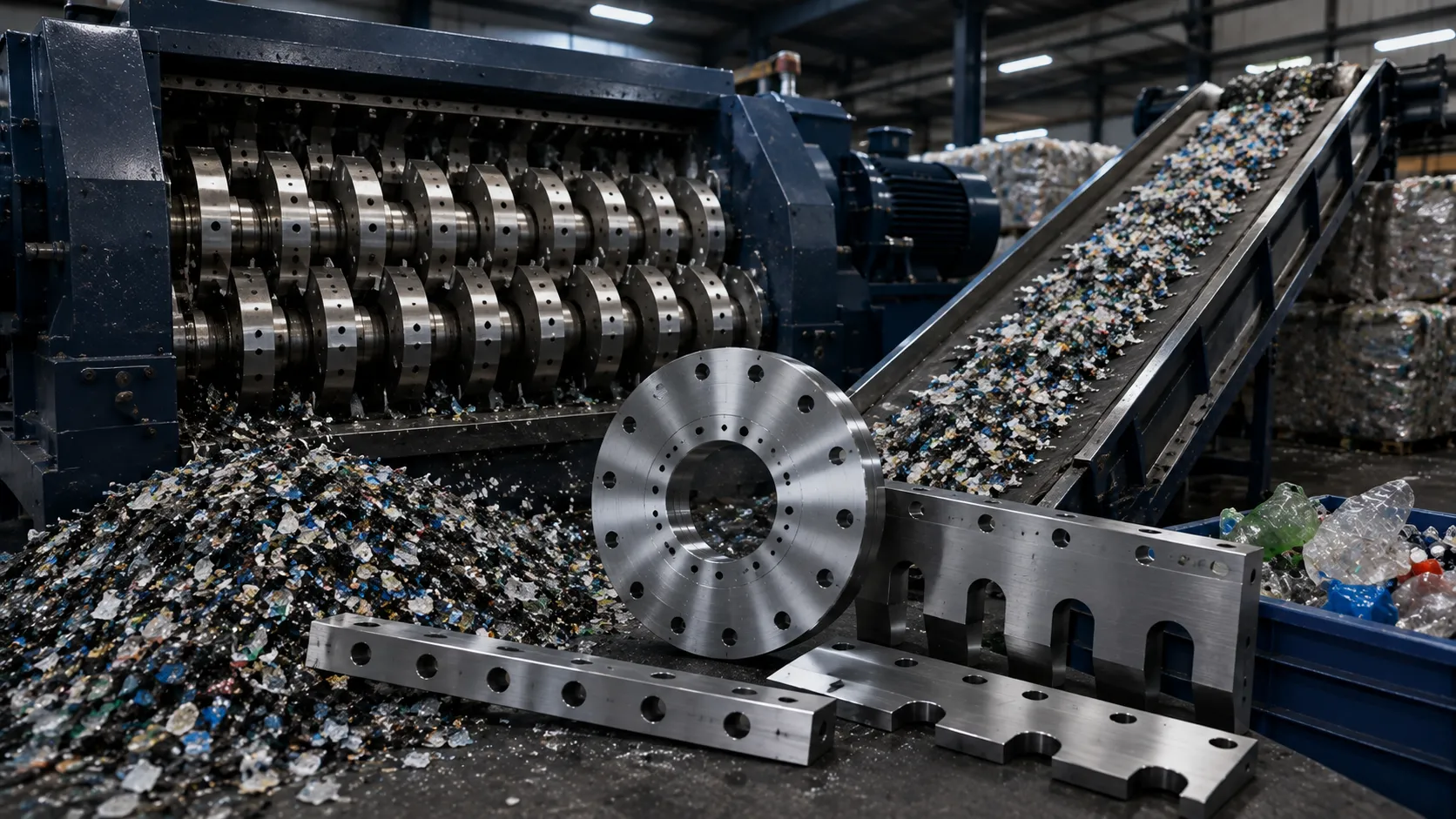 Plastic Waste
 Plastic Recycling
Engineered specifically for plastic shredder blades handling dense injection purgings, blow-molded drums, hollow pallets, film bales, and PET containers without edge micro-chipping or thermal distortion.
- Target Feedstock: HDPE, PP purgings, PET bottle bales, PVC pipe, ABS
- Steel Grade: D2 / SKD11 / Cr12MoV High-Chromium Tool Steel
- Hardness Range: 58–60 HRC Deep Vacuum Treated
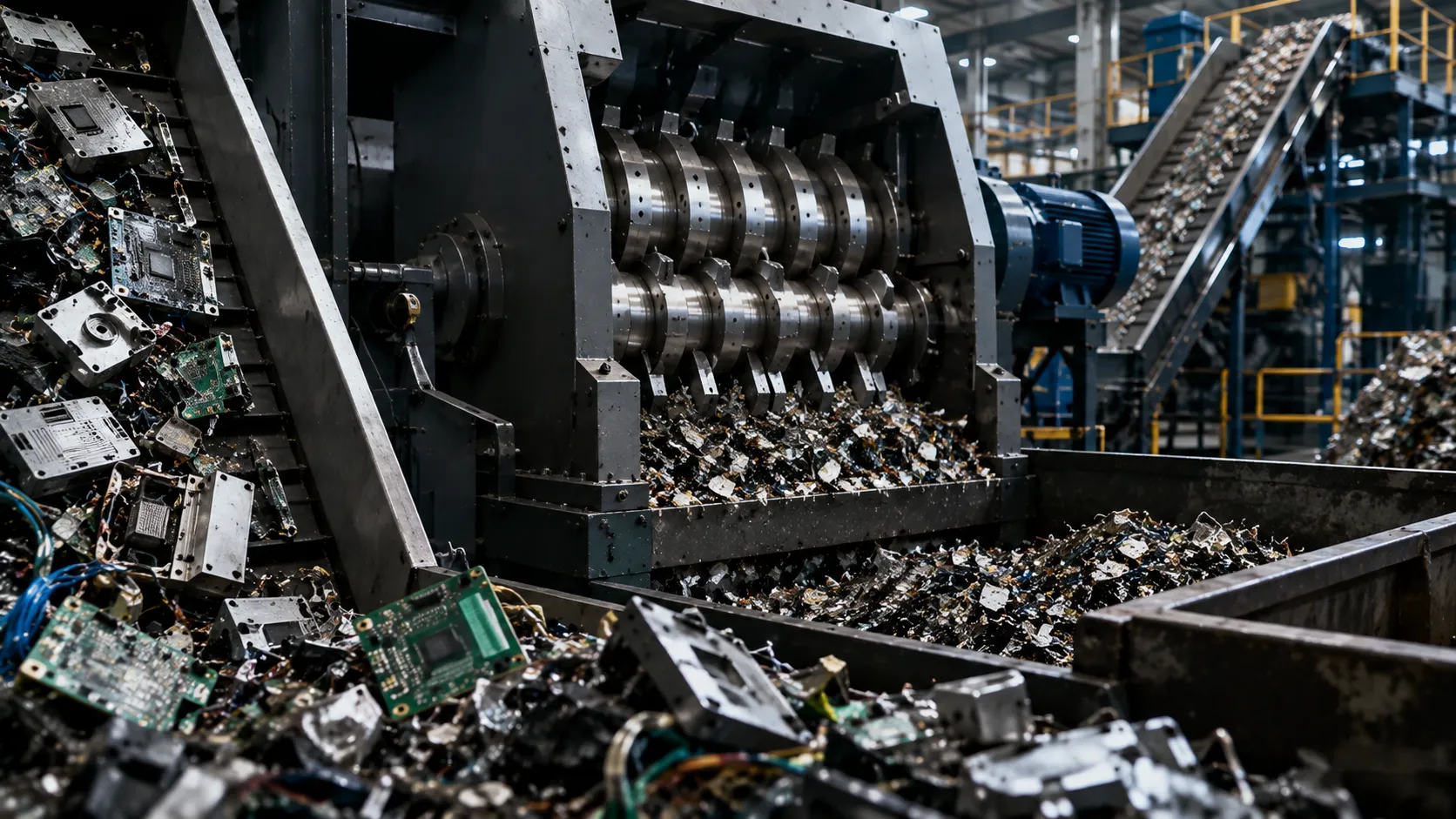 E-Waste & Metals
 E-Waste & Scrap Metal
Heavy-duty e-waste metal recycling knives designed to absorb intense shock loads when shredding computer housings, circuit boards, aluminum cans, copper cabling, and mixed electronic scrap.
- Target Feedstock: WEEE, circuit boards, aluminum UBCs, copper wire, light sheet
- Steel Grade: H13 / SKD61 / 5CrMnMo High-Toughness Alloy
- Hardness Range: 54–58 HRC Shock-Resistant Tempering
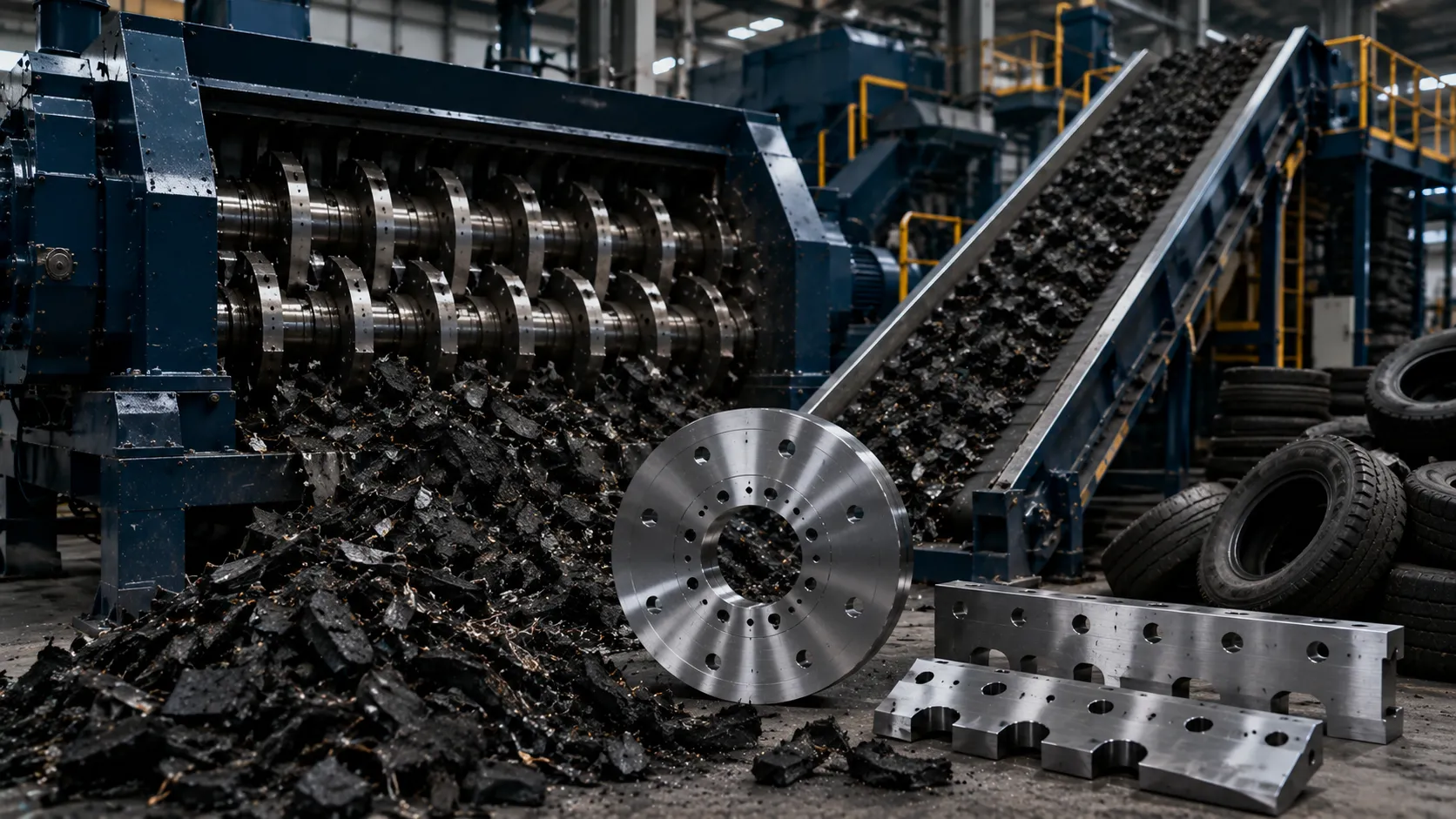 Tires & Rubber
 Tire & Rubber Processing
High-torque size reduction blades engineered to slice cleanly through steel-belted radial truck tires, off-the-road (OTR) tires, heavy conveyor belting, and resilient industrial rubber blocks.
- Target Feedstock: Truck tires, OTR tires, rubber slabs, conveyor belts
- Steel Grade: High-Impact Tool Steel / Hardfaced Cutting Edges
- Hardness Range: 58–62 HRC Severe Wear Resistance
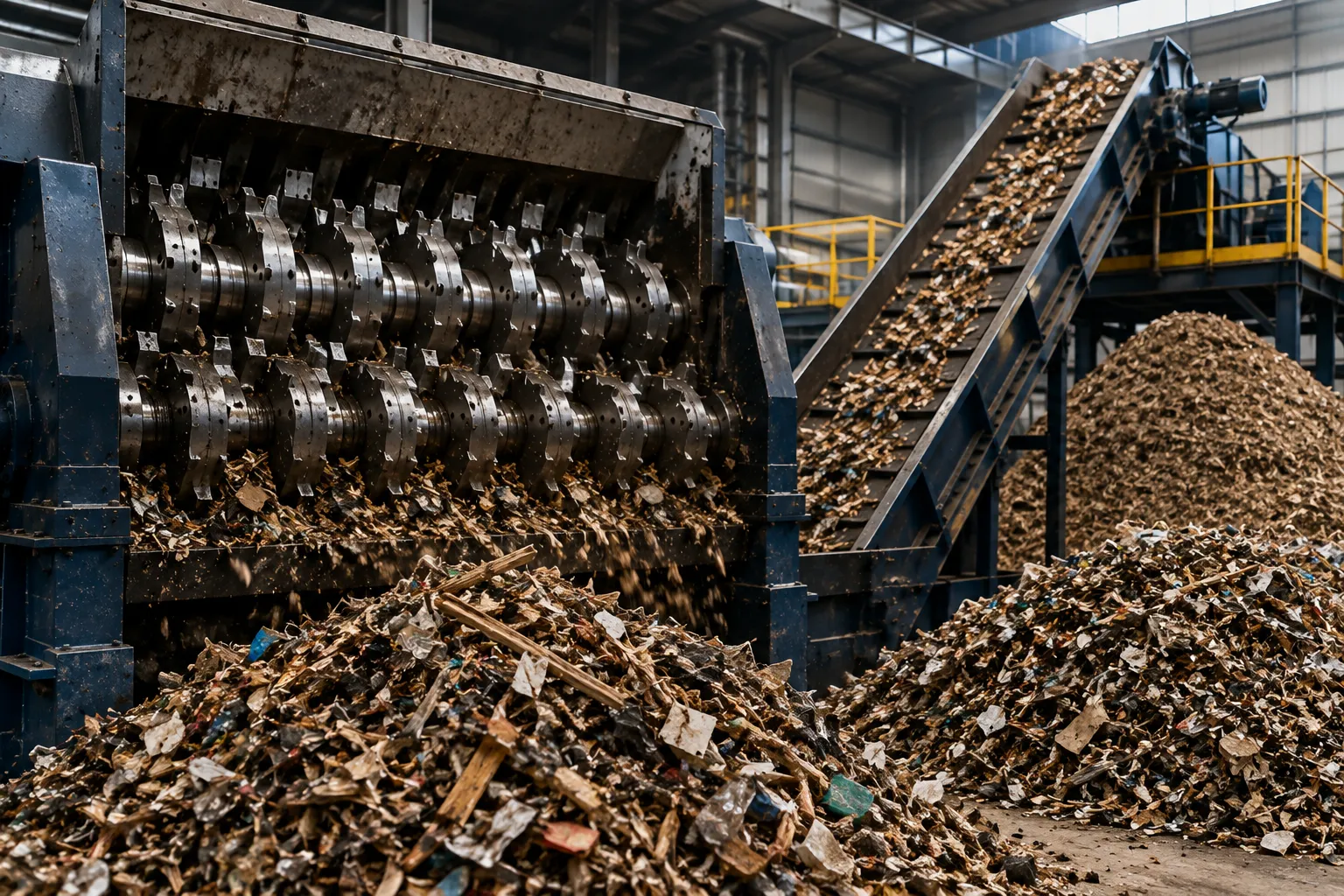 MSW & Wood
 RDF & Wood Recycling
Robust industrial shredder knives built to handle Refuse-Derived Fuel (RDF), municipal solid waste (MSW), construction demolition timber, and heavy wooden pallets with embedded nails.
- Target Feedstock: MSW, commercial waste, scrap pallets, RDF mixes
- Steel Grade: 55SiCr / Spring Steel / Tungsten Carbide Inserts
- Hardness Range: 54–58 HRC Core Fracture Toughness
Application Metallurgical Specification Matrix
Selecting the right shredder blade configuration requires precise alignment between alloy metallurgy, cutting edge geometry, and heat treatment protocols based on your specific feedstock stream. At Shark Cutting, we analyze rotor RPM, motor torque profiles, and tramp contamination risk to supply shredder knives that maximize tons-per-hour throughput while preventing edge chipping and catastrophic blade failure.
| Recycling Sector | Primary Wear Challenge | Recommended Alloy | Key Performance Advantage |
|---|---|---|---|
| Rigid Plastics & Heavy Purgings | Frictional abrasion, thermal friction buildup, and compressive force | D2 / Cr12MoV / SKD11 | Superior edge holding during continuous high-volume plastic shredding runs |
| E-Waste & Non-Ferrous Scrap | Sudden impact loading from tramp metals and non-ferrous components | H13 / 5CrMnMo / Hot-Work Alloy | Maximum fracture toughness preventing tooth breakage under heavy shock loads |
| Scrap Tires & Reinforced Rubber | Abrasive steel wire reinforcement and high frictional heat generation | Modified Tool Steel / Carbide Clad | Resists thermal annealing while maintaining aggressive bite through steel cord |
| Municipal Waste & RDF Production | Mixed abrasive contaminants including sand, glass, and mineral grit | 55SiCr / Carbide Tipped Inserts | Economical size reduction with re-sharpenable and easily replaceable tooth segments |
Optimized Tooth Geometry for Single, Dual, and Quad-Shaft Systems
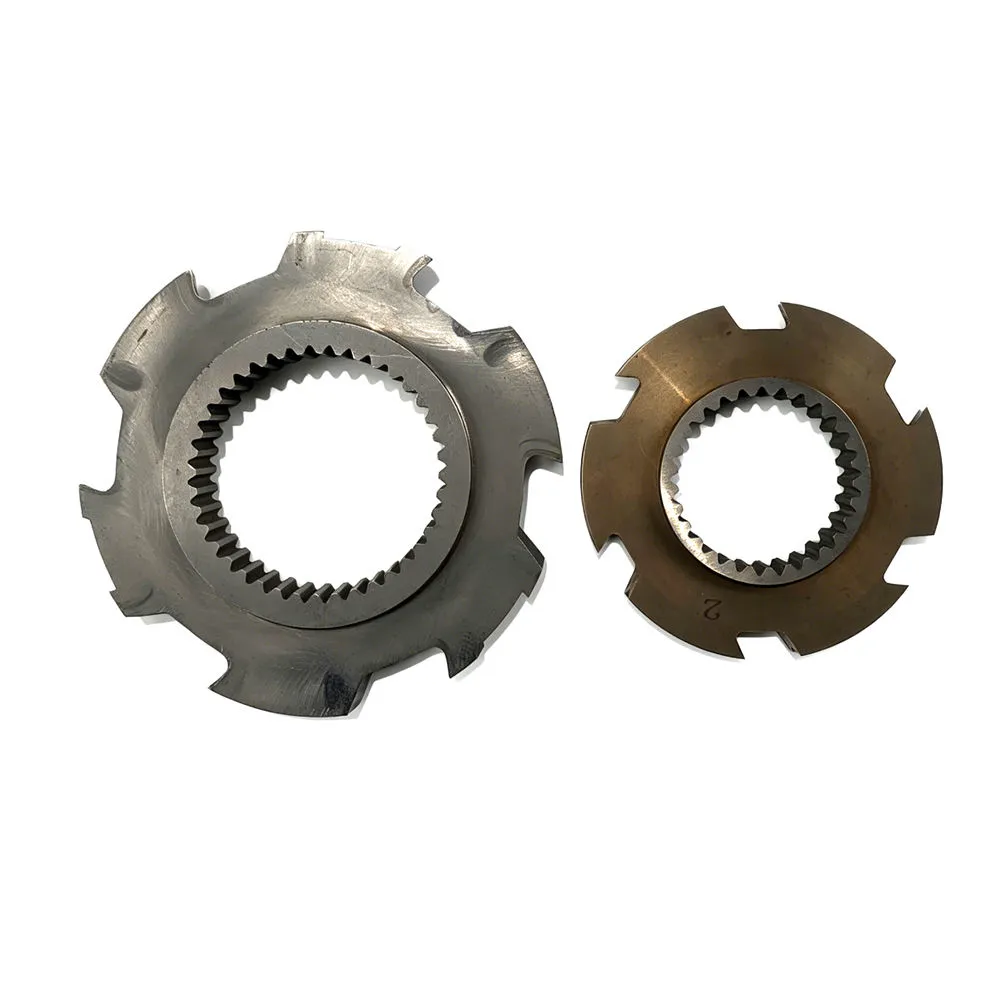
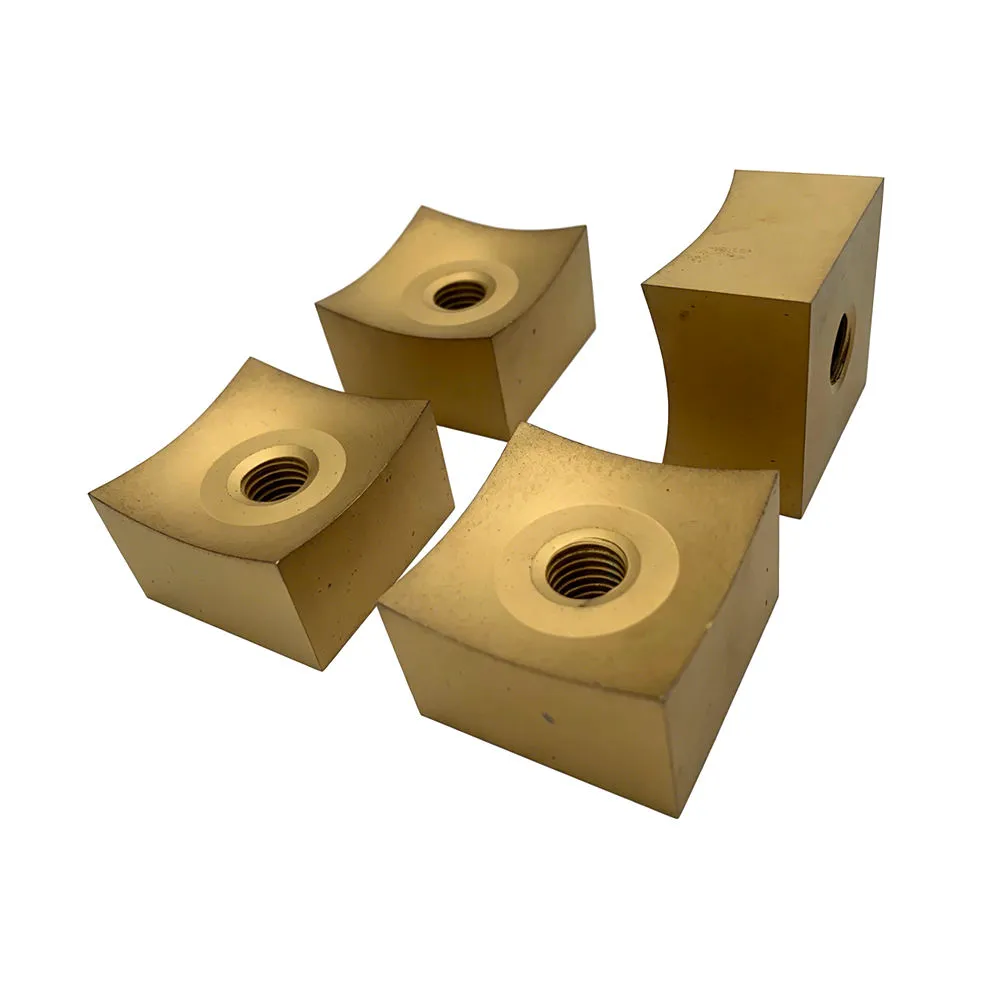
Different rotor configurations demand specialized knife geometry. Single-shaft shredders rely on indexable square or concave inserts working against stationary bed blades. Dual-shaft and quad-shaft systems utilize interlocking hooked knives to grab, tear, and force bulky waste through precise shear gaps. Shark Cutting customizes hook angles, tooth spacing, and axial clearances to eliminate material wrapping, shaft bind, and machine downtime.
Vacuum Heat Treatment and Multi-Stage Stress Relieving
Consistent blade longevity stems from rigorous metallurgical processing. Every Shark Cutting blade undergoes deep computer-controlled vacuum heat treatment followed by multi-stage tempering cycles. This process ensures uniform hardness from the primary cutting edge to the internal mounting keyway, providing high torque resilience while allowing multiple re-sharpening cycles throughout the blade's service life.
Need a Custom Blade Solution for Your Specific Feedstock?
Our engineering team evaluates feedstock contamination, rotor speed, and torque parameters to manufacture custom industrial shredder blades tailored directly to your recycling production lines.
Custom vs. OEM Blades: Elevate Cutting Performance and Reduce Operational Costs
Evaluating custom vs. OEM blades is a critical financial and operational decision for high-capacity recycling and primary size reduction facilities. Standard original equipment manufacturers (OEMs) often attach steep markup premiums, limited alloy options, and extended delivery timelines to replacement components. In contrast, custom-engineered tooling delivers tailored metallurgical upgrades, enhanced wear resistance, and tighter cost controls. At Sharkcutting, we manufacture direct-fit OEM replacement shredder knives engineered to match exact original dimensions while providing specialized tool steel grades and tooth profiles optimized for extreme processing environments.
| Evaluation Criteria | Standard OEM Procurement | Sharkcutting Custom Solution Recommended |
|---|---|---|
| Fit & Compatibility | ||
| Metallurgical Selection | ||
| Cost & Unit Expense | ||
| Lead Time & Supply Chain | ||
| Quality Verification |
Precision Direct-Fit Compatibility for Global Shredder Brands
Replacing original factory blades with aftermarket tooling requires precise geometric alignment. At Sharkcutting, we reverse-engineer original equipment manufacturer specifications to achieve ±0.01mm grinding tolerances across all critical dimensions. Our OEM replacement shredder knives maintain 100% direct-fit alignment for mounting holes, keyways, and rotor tooth profiles across major machinery brands including Untha, Vecoplan, Lindner, SSI, and Weima. In addition to shredder blades, our facility produces high-precision circular slitter knives for specialized industrial converting machinery.
- Eliminates rotor axial play and prevents destructive machine vibration
- Reverse CAD engineering available directly from worn or damaged physical samples
Custom Metallurgical & Alloy Grade Enhancements
Off-the-shelf OEM knives rely on baseline steel grades to accommodate generic operational conditions. However, demanding primary size reduction for glass-reinforced polymers, e-waste, or truck tires demands specialized metallurgy. Sharkcutting allows facility managers to upgrade standard carbon steel to high-chromium tool steels (D2, SKD11), shock-resistant hot-work die steel (H13), or tungsten carbide-tipped structures for maximum wear resistance.
- Deep vacuum heat treatment guarantees uniform core hardness and structural stability
- Optimized tooth profiles mitigate edge chipping and cracking under heavy impact loads
Direct Factory Pricing & Streamlined Turnaround
Supply chain markup from equipment dealerships significantly inflates maintenance expenditures. Sourcing replacement knives directly from Sharkcutting provides direct financial savings of 20% to 40% per set. Supported by a 15-day turnaround cycle on custom samples and dedicated consignment stocking agreements, recycling facilities can mitigate unscheduled downtime and maintain consistent production output. Our manufacturing scope also covers custom rotary slitting knives for continuous inline shearing systems.
- Direct manufacturer pricing eliminates unnecessary intermediary distributor fees
- Flexible safety-stock agreements ensure fast turnaround on high-wear replacement blades
100% Non-Destructive Quality Inspection Protocols
A single internal defect in a high-torque shredder blade can cause catastrophic shattering, severe rotor damage, and costly operational shutdowns. Sharkcutting subjects every custom replacement knife to comprehensive quality control procedures, including 100% ultrasonic flaw detection to reveal internal micro-cracks before shipment. Every delivered blade set is backed by full hardness (58–64 HRC) and dimensional certification.
- Ultrasonic NDT testing guarantees internal metallurgical purity and structural integrity
- Individual Rockwell hardness and dimensional test certificates accompany every shipment
Upgrade Your Facility's Industrial Cutting Strategy
Whether your operation requires drop-in replacement knives matching exact OEM specs or customized tool steel upgrades designed to double blade wear life, Sharkcutting delivers engineered cutting solutions tailored to your specific shredder lines.
Frequently Asked Questions About Shredder Blade Maintenance & Customization
Get authoritative answers regarding primary size reduction, custom CAD reverse engineering, steel grade selection, and precision clearance setup. Learn how Sharkcutting engineers optimize blade wear life, reduce machine downtime, and deliver superior industrial machine knives performance across heavy-duty recycling operations.
How many times can a heavy-duty shredder blade be reground?
Heavy-duty industrial shredder blades can typically undergo 3 to 5 regrinding cycles before reaching their minimum operational dimension tolerances. The exact number of re-sharpening sessions depends heavily on the specific tooth profile geometry, operational wear depth, feedstock abrasiveness, and initial vacuum heat treatment quality.
At Sharkcutting, our high-torque shredding blades undergo deep vacuum heat treatment, maintaining a uniform 58–64 HRC hardness profile from surface to core. Unlike inferior surface-hardened blades that lose edge hardness after the initial grind, our blades preserve structural integrity and edge retention throughout every regrinding phase.
Can replacement shredder blades be manufactured without original CAD drawings?
Yes, absolutely. You do not need original equipment manufacturer (OEM) CAD blueprints to source high-precision custom or direct-fit OEM replacement shredder knives.
Sharkcutting provides comprehensive reverse engineering services tailored for single-shaft, dual-shaft, and quad-shaft industrial shredders:
- Worn Sample Analysis: Send us a worn blade sample or damaged knife segment. Our engineering team uses precision CMM equipment and 3D optical scanners to reconstruct exact original geometry, tooth pitch, and mounting dimensions.
- Machine Model Mapping: Provide your shredder make, model (e.g., Untha, Vecoplan, Lindner, SSI, Weima, Zerma), and shaft specifications for verified database alignment.
- Custom Blueprint Generation: We generate precise 2D/3D CAD drawings for client approval prior to production, ensuring 100% mounting hole, bolt circle, and hex shaft keyway compatibility.
Which steel grade is recommended for recycling plastics containing sand, dirt, or metal impurities?
When processing contaminated post-consumer plastics, agricultural films, or e-waste containing abrasive sand, gravel, or trace tramp metal, material selection must balance high fracture toughness with wear resistance:
Standard D2 / SKD11 knives, while excellent for clean rigid plastics, contain high chromium-carbon carbide structures that can suffer brittle fracturing under sudden metal impact. Sharkcutting metallurgists evaluate your exact feedstock contamination levels to specify the optimal alloy and heat treatment balance.
What is the optimal clearance gap during industrial shredder blade installation?
Proper blade-to-counter-knife clearance is crucial for preventing material jamming, reducing motor load amperage, and eliminating excessive thermal stress on the rotor shaft assembly. For most dual-shaft and single-shaft heavy-duty shredder knives, optimal clearance ranges between 0.1 mm and 0.5 mm:
- Thin Film & Flexible Plastics (0.1 mm – 0.2 mm): Requires tight cutting gaps to achieve clean shearing and prevent thin materials from wrapping or folding between plastic shredder blades. Beyond heavy recycling, we also produce specialized film-cutting-knives for high-speed continuous slitting.
- Rigid Plastics & Wood Pallets (0.2 mm – 0.3 mm): Provides efficient crushing leverage without binding or rotor stalling.
- Heavy Tires & E-Waste Metal (0.3 mm – 0.5 mm): Allows sufficient clearance for high-torque deformation and primary tearing actions.
Sharkcutting blades are precision ground to axial and radial runout tolerances within ±0.01 mm, enabling plant technicians to set uniform tight clearances across the entire rotor assembly without risk of blade-to-blade collision. In automated production environments, these tolerances match the precision required for high-speed packaging-machine-knives.
Full Lifecycle Blade Support
Sharkcutting provides comprehensive engineering assistance—from metallurgy selection and reverse CAD drafting to precision re-sharpening guidelines and field support.
Need Maintenance Guidance?
Consult our tooling specialists to maximize your shredder knife maintenance routine today.
Shredder Knife Maintenance Checklist
Routine inspection procedures to minimize unscheduled machine downtime:
- Torque Verification: Re-torque mounting bolts every 100 operating hours to prevent knife loosening under severe cyclic torque.
- Clearance Auditing: Measure edge gap with feeler gauges across all rotor positions following heavy jam clearing.
- Edge Inspection: Check tooth corners weekly for micro-chipping or abrasive rounding before severe wear occurs.
Ready to Optimize Your Recycling Line with Custom Shredder Blades?
Whether you need direct-fit OEM replacement knives or wear-resistant alloy blades engineered for high-impact size reduction, Shark Cutting delivers expert technical support and fast turnaround. From custom shredder tooling to precision circular slitter knives, partner with a leading manufacturer to minimize downtime and lower your operational cost per ton.