
High-Performance Industrial Rubber Cutting Knives & Blades
Engineered for tire manufacturing, conveyor belting, and abrasive elastomer processing. Discover our high-performance products designed with superior wear resistance and keen edge retention to minimize costly machine downtime.
Blade Profile Inspector
Interactive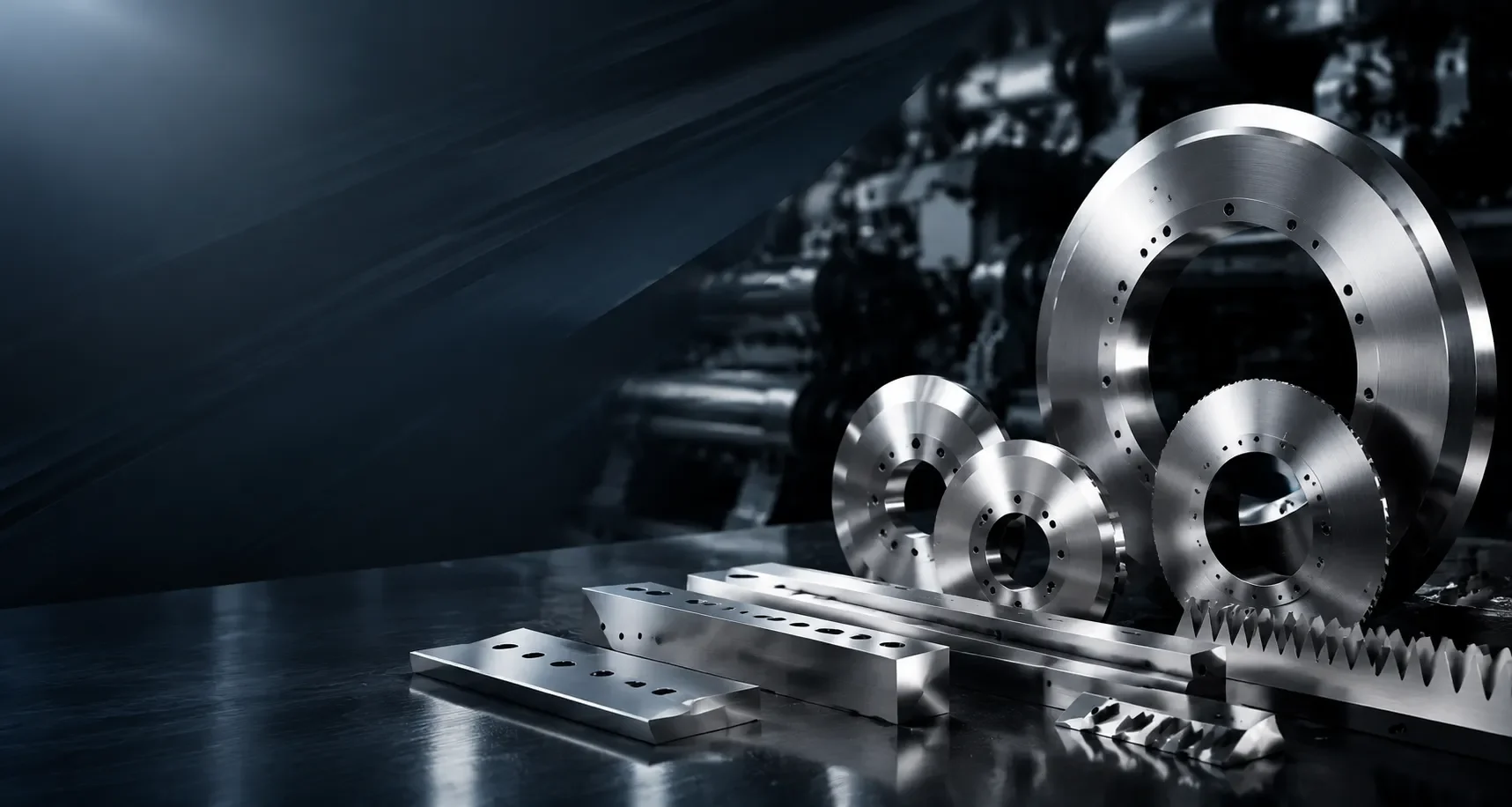
Key Manufacturing Metrics & Core Advantages
Quantified performance benchmarks validating Sharkcutting's precision engineering across heavy-duty rubber cutting and demanding precision rubber processing applications. Discover our full range of industrial machine knives built for high-performance operations.
±0.002 mm
Grinding Tolerance
Ultra-tight dimensional tolerance achieved through multi-axis CNC grinding ensures precise knife fitment and flawless slitting accuracy for specialized tools like paper cutting knives.
3x+
Extended Wear Life
Micro-grain tungsten carbide and premium HSS tool steels minimize severe abrasive edge wear to substantially reduce downtime, ideal for durable packaging machine knives.
100%
Quality Inspection
Every individual blade undergoes rigorous Rockwell hardness testing and optical flatness verification prior to dispatch.
50+
Elastomer Formulations
Tailored blade bevels engineered for clean cutting across natural rubber, synthetic polymers, silicone, and recycled materials.
demands durable guillotine rubber blades, or abrasive steel-reinforced stock calls for solid carbide rubber knives, our custom tooling delivers clean, burr-free cuts while drastically reducing costly machine downtime. Explore our full range of industrial products for specialized cutting applications.
 Web & Roll Slitting
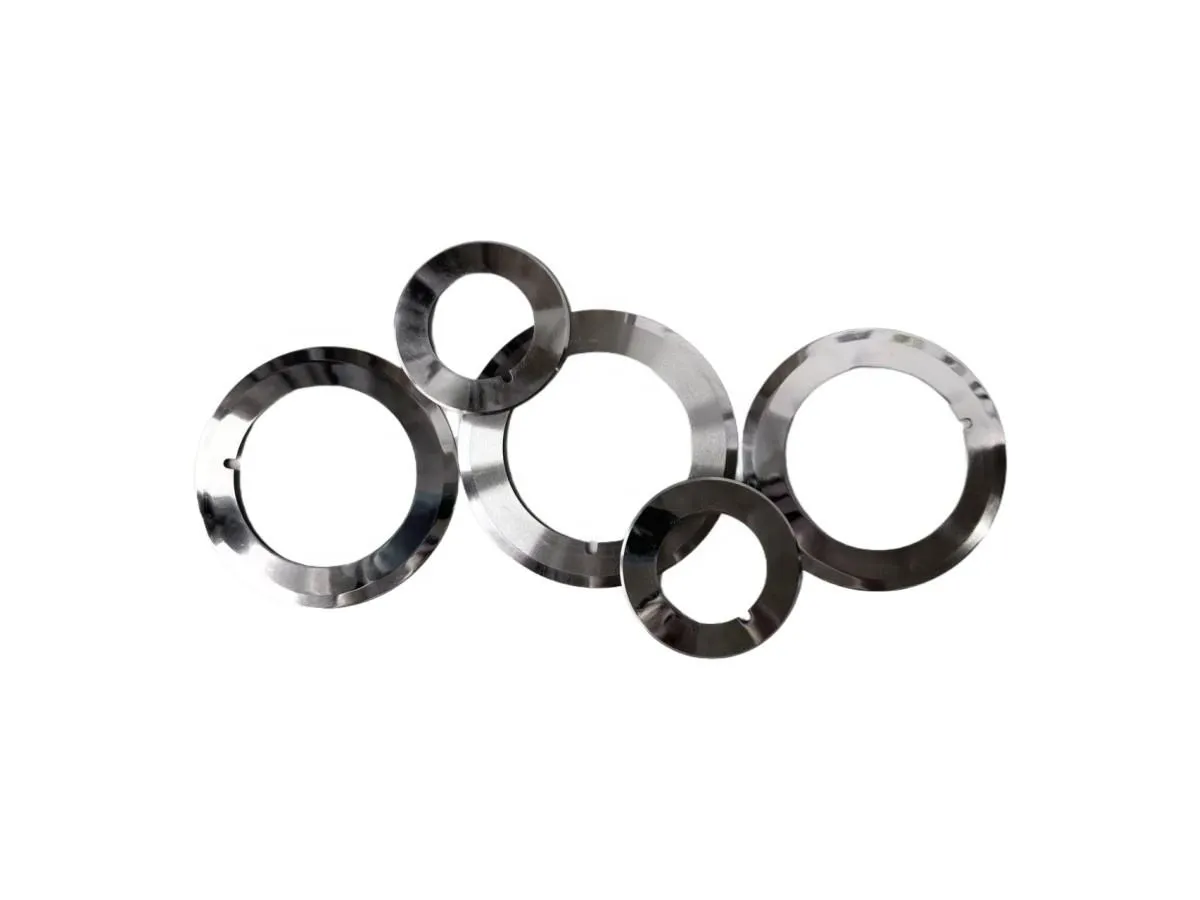
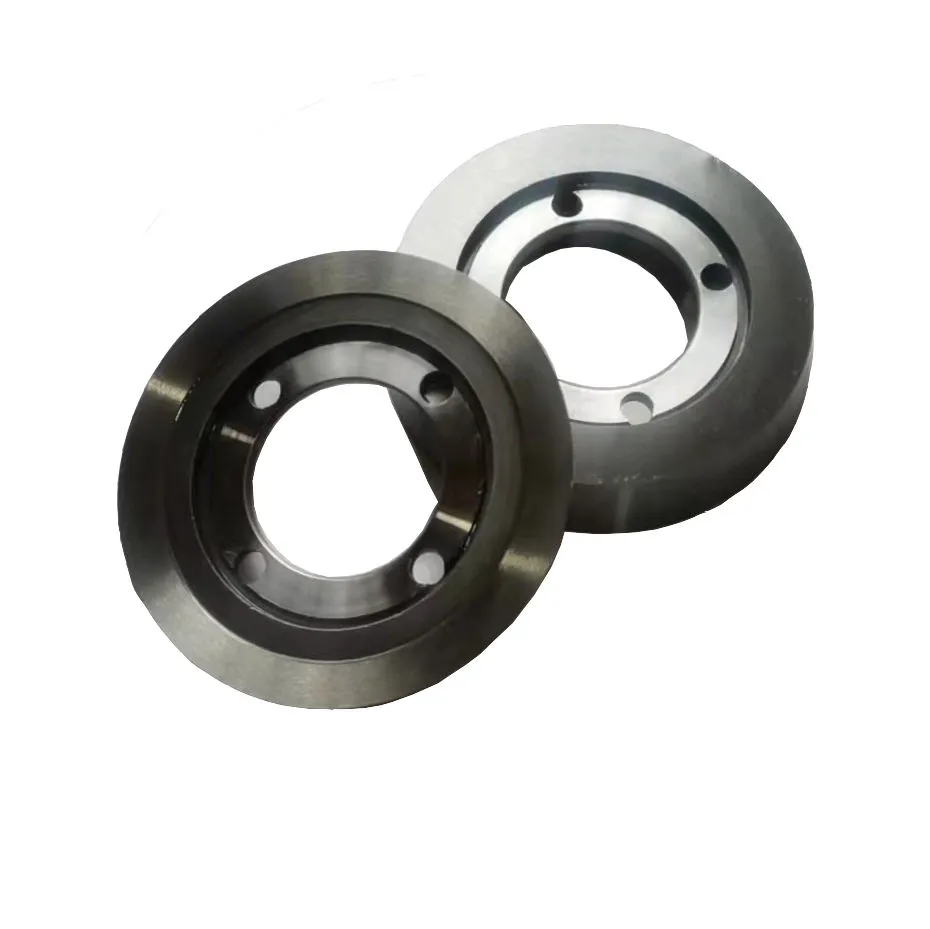
 Circular Rubber Slitting Knives
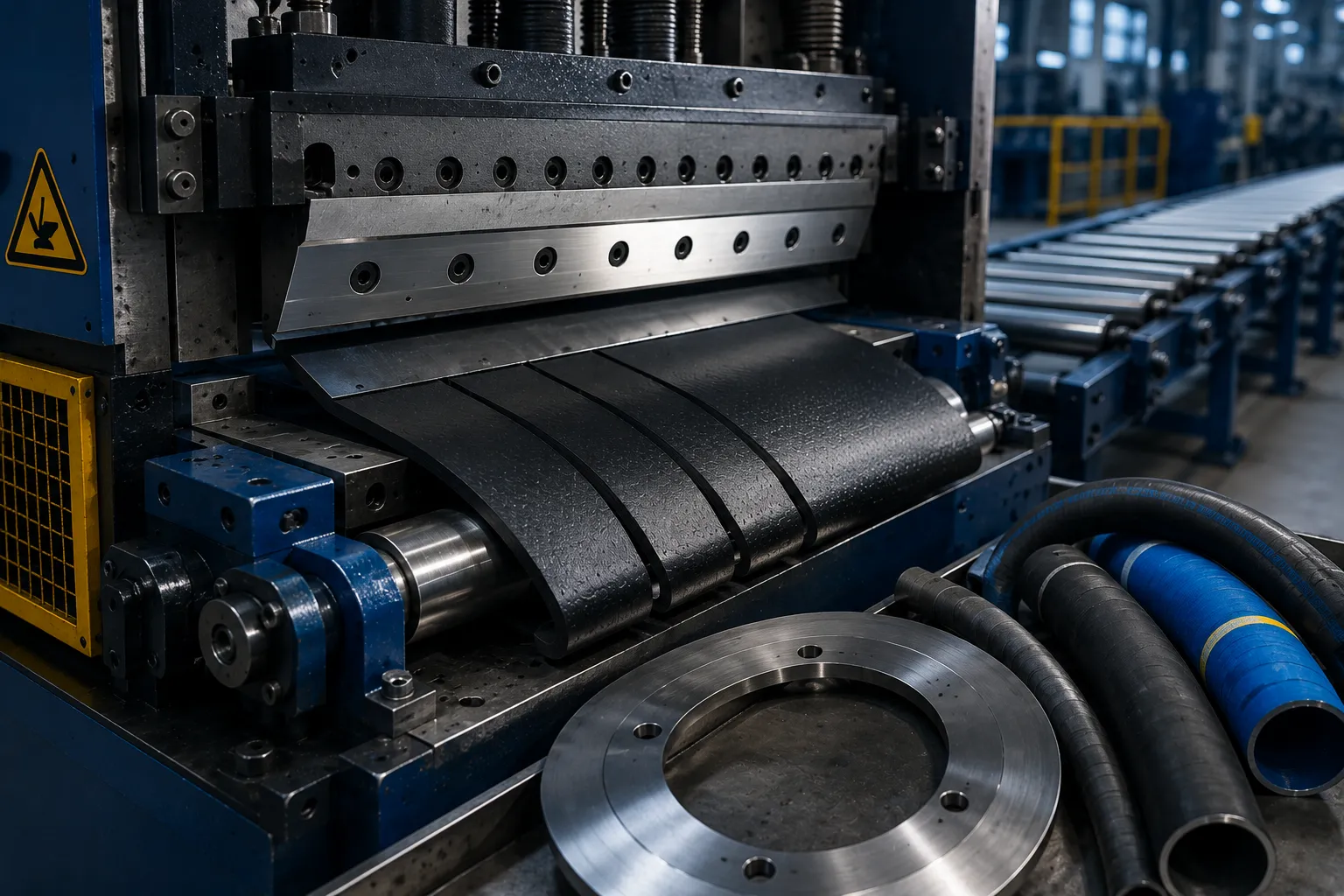
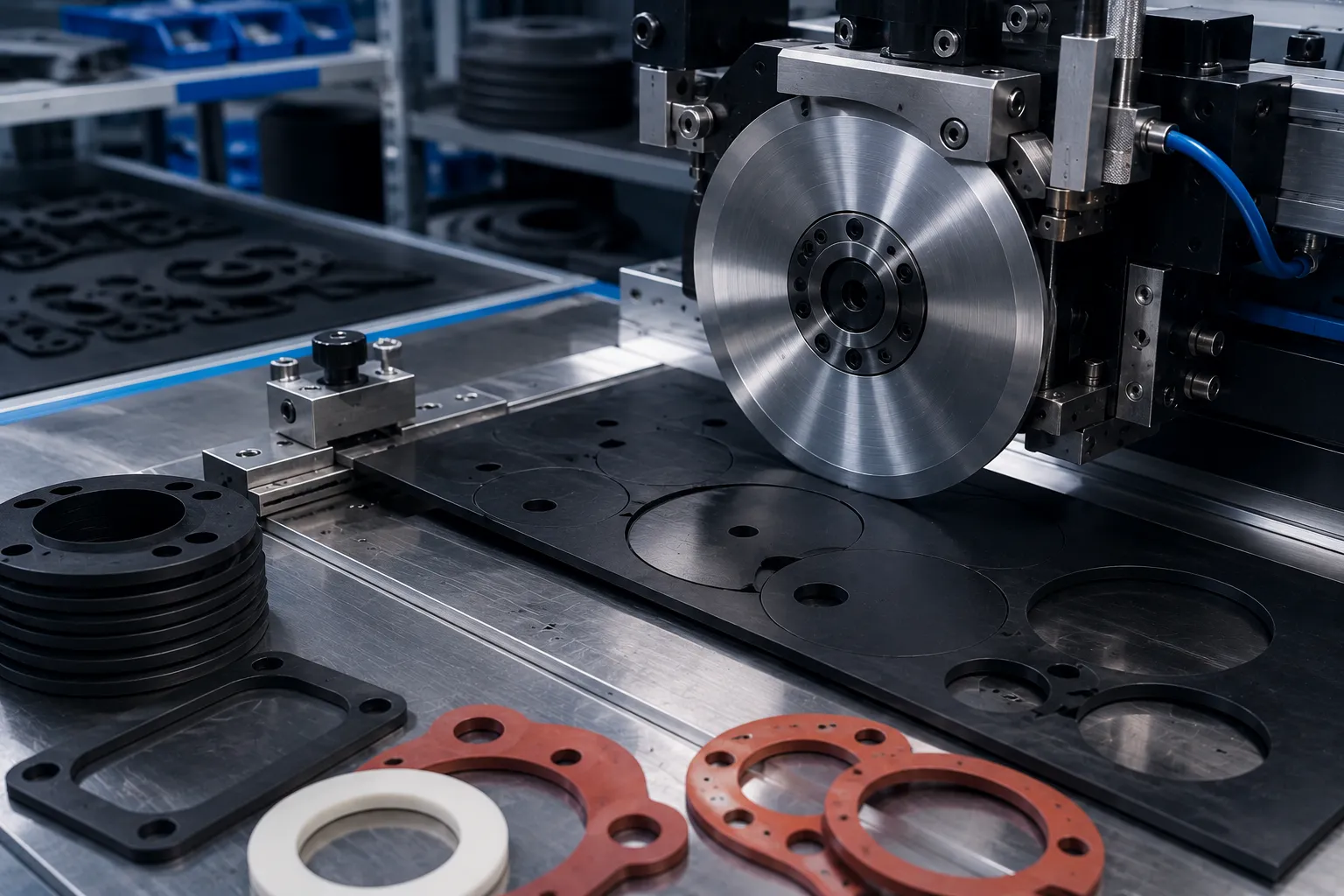
Developed for continuous web slitting, longitudinal edge trimming, and roll converting of uncured or vulcanized sheet stock. These circular slitter knives utilize micro-ground bevel edges and anti-friction finishes to prevent sticky rubber gumming, heat build-up, and edge deformation during high-speed production runs.
Compatible Machinery
Rotary slitting systems, calender line trimmers, duplex slitter-rewinders, and score cutting units.
Key Technical Capabilities
- Burr-Free Edge Profile: CNC micro-ground bevel angles eliminate material fraying and stringing.
- Anti-Gumming Surface Finish: Polished mirror or specialized coatings significantly reduce friction heat.
- Versatile Geometries: Available in dish top, flat bottom, shear, and score slitting configurations.
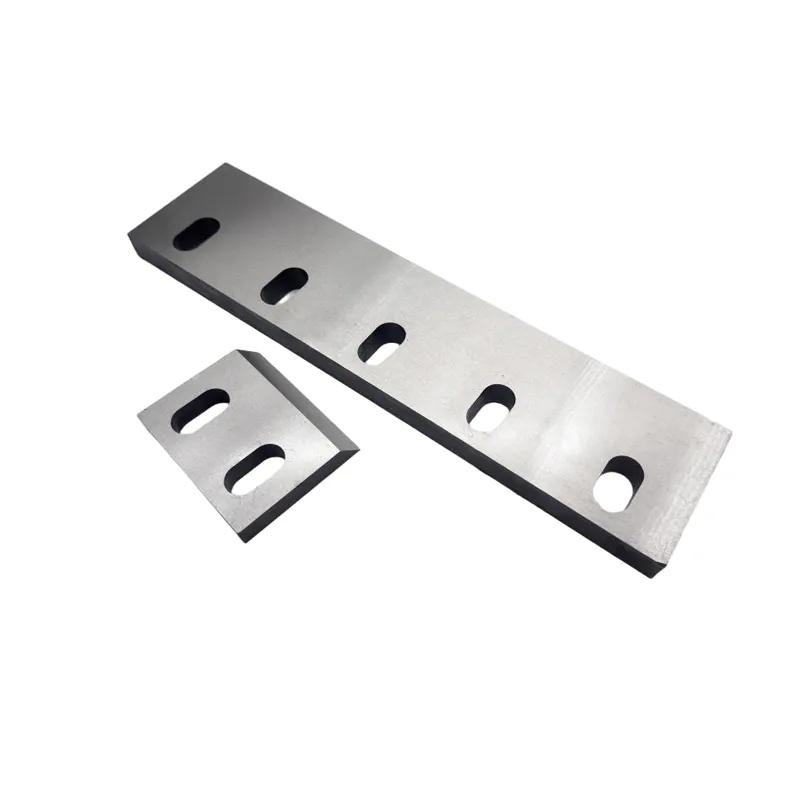 Heavy Impact Shearing
 Guillotine & Straight Rubber Blades
Engineered for raw rubber bale shearing, heavy slab partitioning, and continuous extrusion cross-cutting. Forged from high-grade, shock-resistant tool steel alloys, these guillotine rubber blades withstand repetitive heavy shock loads without edge chipping, rolling, or structural fracture.
Compatible Machinery
Hydraulic rubber bale cutters, inline extrusion choppers, batch-off cooling lines, and shear beds.
Key Technical Capabilities
- High Shock Load Absorption: Through-hardened alloy cores prevent cracking under heavy tonnage.
- Optimized Penetration Angle: Single and compound bevel angles minimize cutting resistance and drag.
- Seamless Monolithic Lengths: Precision ground up to 3,000 mm (118 in) in single-piece builds.
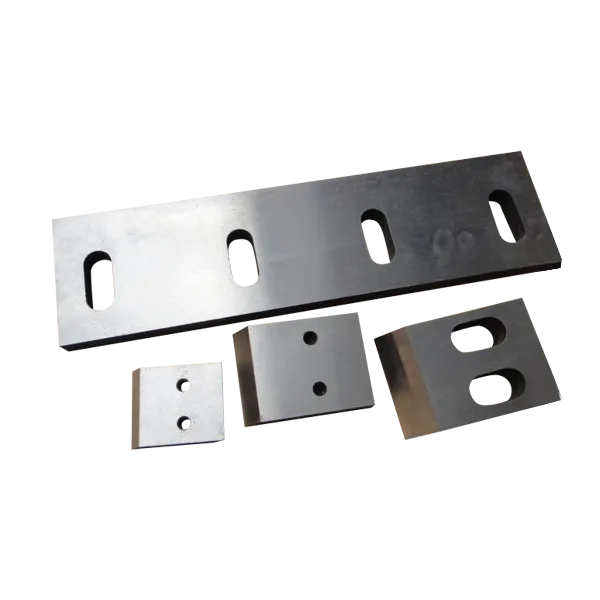 Extreme Wear Resistance
 Tungsten Carbide Rubber Knives
Specially formulated for severe abrasive processing environments. These solid or brazed-tip carbide rubber knives cut effortlessly through high-silica elastomeric compounds, dense carbon black formulations, and steel-wire embedded tire plies with virtually zero edge dulling.
Compatible Machinery
Steel-belted radial tire slitting machinery, continuous tread cutters, and automated micro-slitting modules.
Key Technical Capabilities
- Sub-Micron Carbide Grain Matrix: Premium carbide grade yielding exceptional 88–92 HRA hardness.
- Multiplied Service Life: Delivers up to 10x longer operational life compared to standard tool steel.
- Ultra-Tight Runout Tolerances: Precision ground runout and axial flatness held within ±0.002 mm.
Matching Blade Geometries to Elastomer Hardness & Machinery Setup
Elastomeric materials present distinct cutting challenges due to high elasticity, heat retention, and aggressive surface friction during continuous slitting. Selecting an improper bevel angle or tool steel alloy often leads to compound deformation, material pinch-off, gumming, and premature blade failure. Our complete catalog of high-performance slitting knives addresses these exact manufacturing obstacles.
At Sharkcutting, our metallurgical experts analyze your material's Shore hardness (A/D rating), filler abrasive content, and line speed to engineer custom knife profiles, clearance angles, and surface treatments that maintain peak cutting efficiency.
| Tool Geometry Type | Substrate Metallurgy | Target Application | Primary Technical Advantage | Hardness Rating |
|---|---|---|---|---|
| Circular Slitting Knives | D2, M2 High-Speed Steel, PM Steels | Web roll converting, calendered rubber sheet trimming | Prevents friction heat buildup and elastomeric gumming | 58–64 HRC |
| Guillotine & Straight Blades | High-Impact Shock Tool Steels | Natural rubber bales, dense slabs, extruded profiles | High mechanical shock absorption under high-tonnage shear | 54–60 HRC |
| Tungsten Carbide Knives | Sub-Micron Solid Carbide / Inlaid Tip | Tire tread stock, steel-belted radial layers, recycled rubber | Extreme edge sharpness retention against severe abrasive wear | 88–92 HRA |
Custom Sub-Category Tooling Options
All blade configurations can be custom machined with specific keyways, dish angles, vacuum relief holes, and bolt mounting patterns. We manufacture replacement tooling for major global machine brands as well as tailored custom OEM designs.
Advanced Coatings & Friction Control
To eliminate sticky rubber adhesion and excessive thermal expansion during continuous cutting, Sharkcutting offers high-performance non-stick surface coatings including Titanium Nitride (TiN) and Diamond-Like Carbon (DLC).
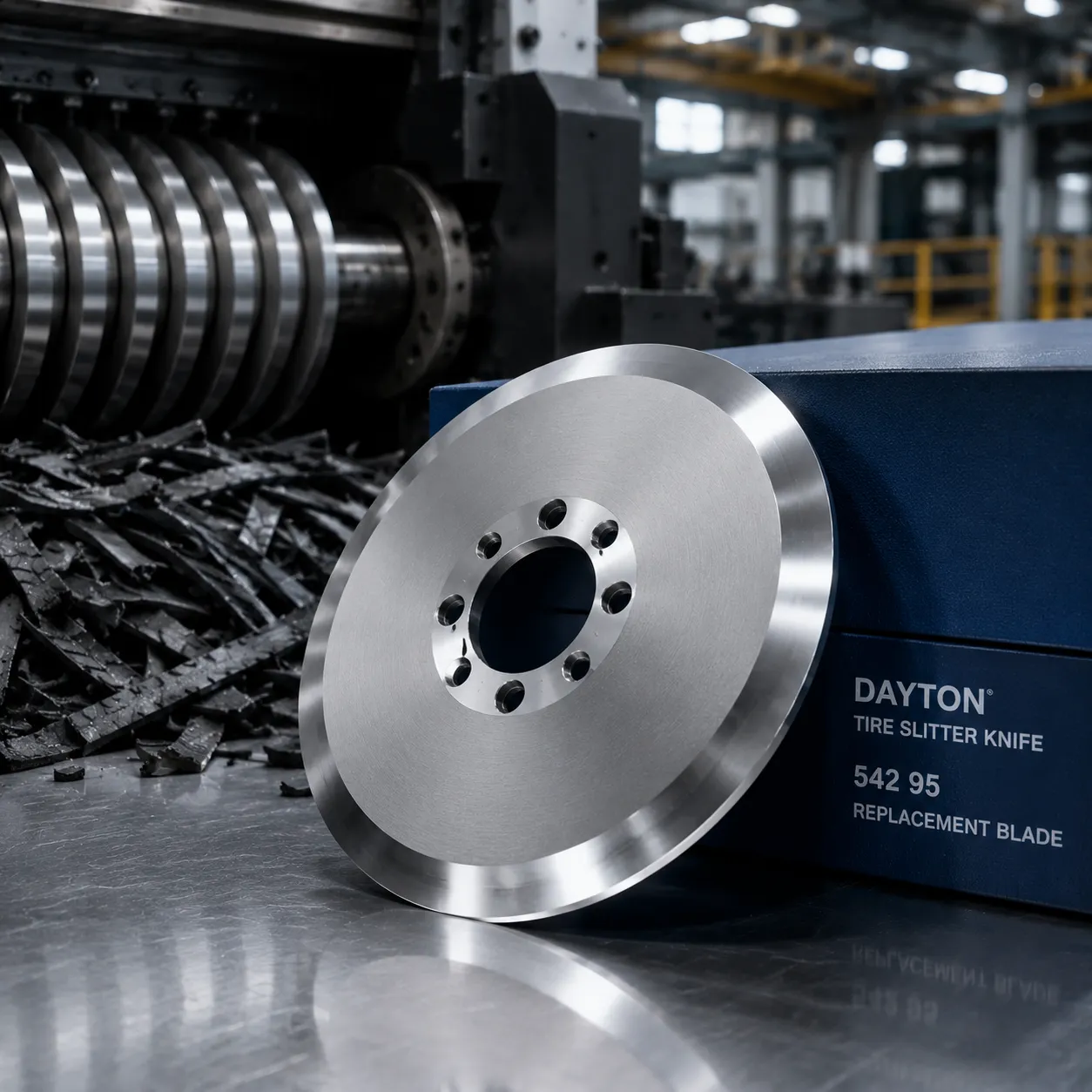
Custom Engineering & Blade Tailoring
Working with unique material durometers or proprietary machinery? Our engineering team designs custom tool geometries adapted to your exact Shore hardness and machine specifications. Discover our complete line of industrial slitting knives tailored for continuous operations.
Tire Manufacturing Blades & Tread Cutting Tools
In high-velocity automated tire assembly, cutting unvulcanized synthetic compounds alongside tough steel-belted radial layers requires exceptional blade edge retention and structural stiffness. Sharkcutting manufactures high-performance tire manufacturing blades that effortlessly shear through complex tire components—including tread extrusions, sidewall stocks, inner liners, and bead apex strips—without edge fraying or material distortion.
Our advanced circular slitter knives and guillotine blades prevent sticky rubber build-up and micro-tears during high-speed production runs. Utilizing sub-micron tungsten carbide and cryogenically treated high-speed steels, Sharkcutting tools easily withstand the intense frictional heat and thermal stress typical of continuous tire manufacturing lines.
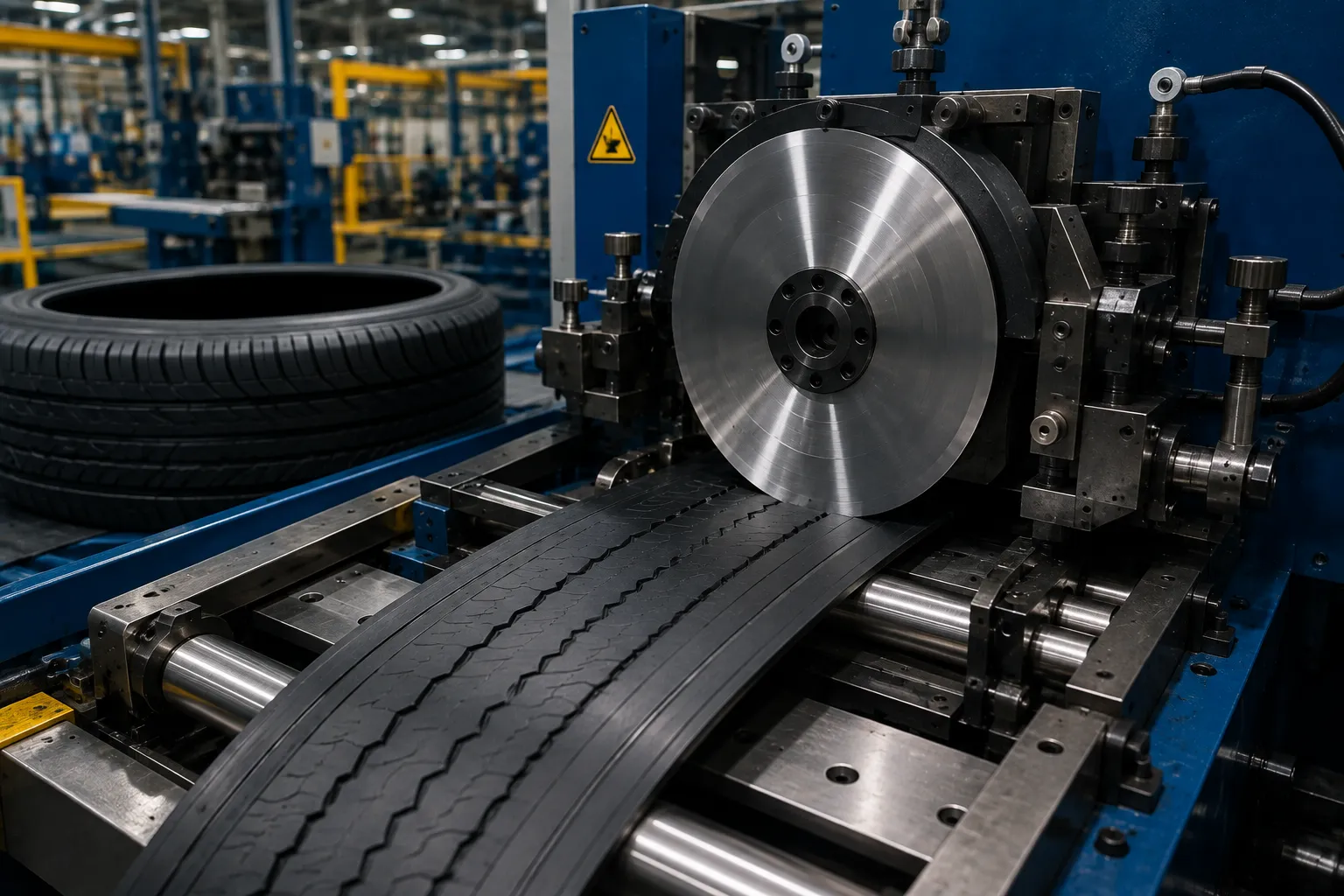
Target Material Classes
- Unvulcanized tread rubber & sidewall stocks
- Steel-belted radial ply & fabric carcass layers
- Inner liner sheets & textile cord reinforcements
- Bead apex rubber strips & apexed bead bundles
Metallurgy & Engineering
- Micro-grain Solid Tungsten Carbide (89–92.5 HRA)
- Cryo-treated M2/M35 High-Speed Steel with mirror bevels
- Precision CNC profile grinding down to Ra 0.2 µm finish
- Dual-bevel edge geometries engineered to stop gumming
| Operation Type | Primary Blade Profile | Recommended Alloy Grade | Verified Tool Life Gain |
|---|---|---|---|
| Continuous Tread Slitting | Circular Dished / Flat Slitting Knife | Micro-grain Tungsten Carbide | +350% vs Standard D2 |
| Steel-Belt Ply Shearing | Heavy-Duty Straight Guillotine Blade | Powder Metallurgy (PM-M4) | +280% vs Conventional HSS |
| Inner Liner Edge Trimming | Precision Rotary Score / Shear Slitter | TiN-Coated M2 High-Speed Steel | +200% vs Tool Steel |
Material Metallurgy & Wear Resistance Engineering
Industrial rubber processing subjects cutting tools to severe friction, thermal buildup, and intense abrasive wear. Choosing the correct metallurgy is critical to eliminating frequent machine downtime and maintaining precise tolerances. Sharkcutting engineers high-performance high-speed steel rubber blades and ultra-dense tungsten carbide knives optimized for challenging abrasive material cutting applications.
Metallurgy Selection Matrix
Match tool steel and carbide alloys to your specific elastomer hardness and line speeds.
| Material Grade | Hardness | Performance Profile | Recommended Application |
|---|---|---|---|
| D2 / M2 Tool Steel Standard Choice | 58–64 HRC |
| General rubber slitting, non-abrasive elastomer slabs, and standard web trimming. |
| PM Steel (Powder Metallurgy) High-Speed Choice | 62–66 HRC |
| High-speed continuous cutting, heavy-duty belting, and thick fabric-reinforced shearing. |
| Solid Tungsten Carbide Extreme Wear Choice | 88–92 HRA |
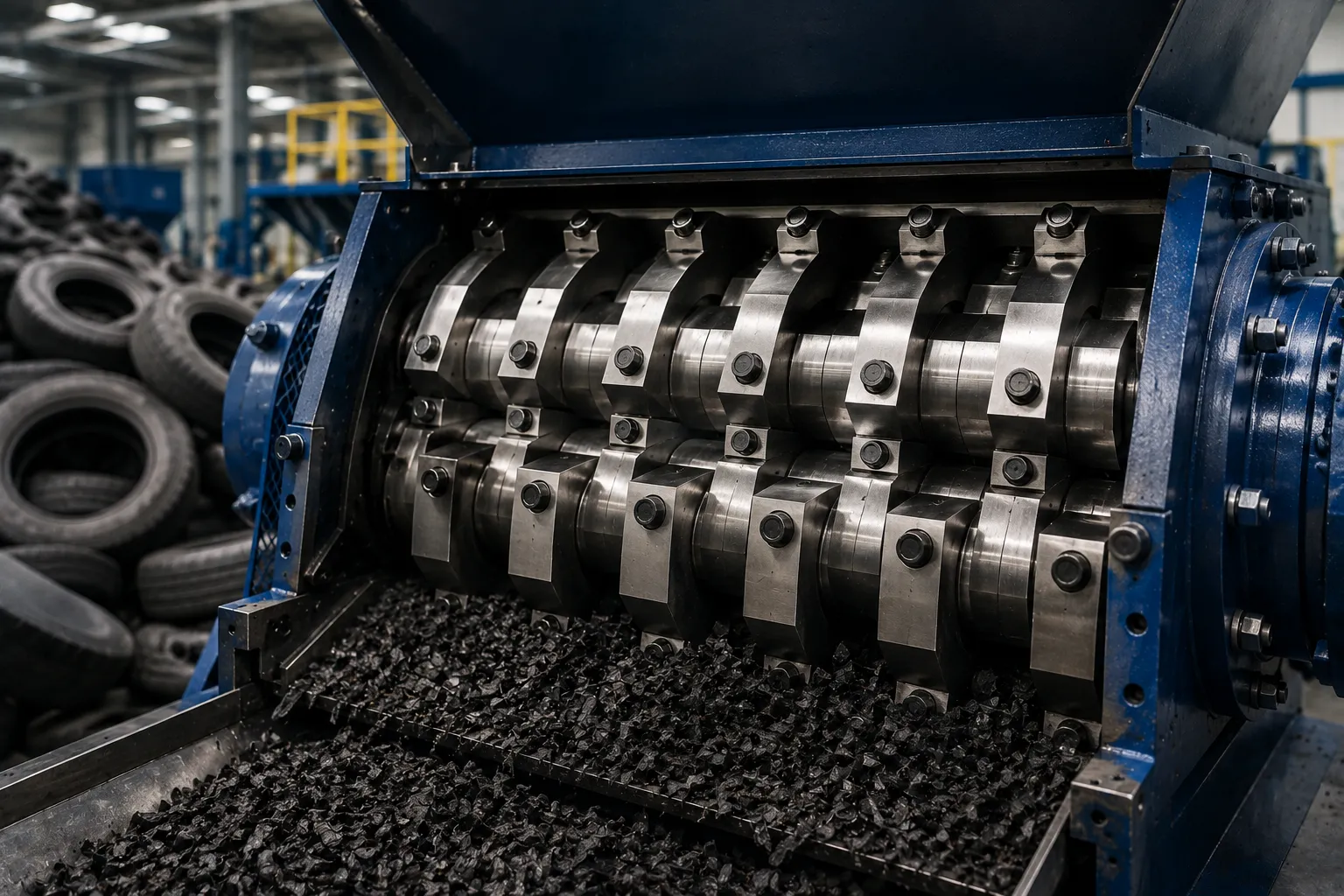
| Carbon-black heavy compounds, steel cord tire plies, silica fillers, and recycling granulators. |
Microstructural Density Control
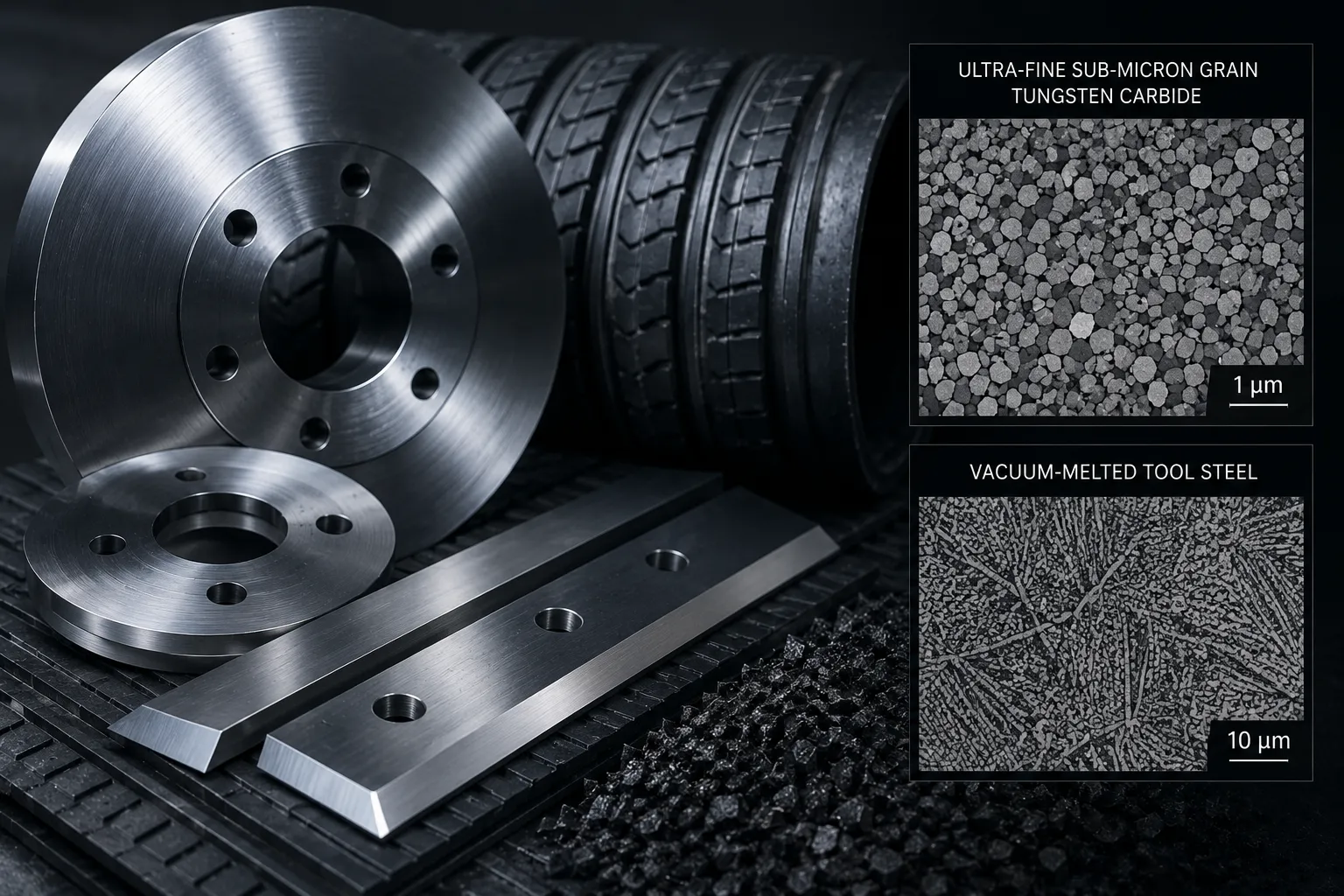
Sharkcutting utilizes ultra-fine sub-micron grain tungsten carbide and vacuum-melted tool steels. This uniform grain distribution prevents micro-spalling along the cutting edge when slitting highly abrasive rubber mixtures with our specialized circular slitter knives.
Advanced Processing Technologies
How Sharkcutting optimizes cutting edge geometry and surface chemistry to extend blade lifespan by up to 300%.
Micro-Precision Edge Grinding
Super-finished bevels with ultra-low surface roughness reduce friction coefficients during continuous high-speed shear operations.
- Minimizes rubber stretch & thermal deformation
- Prevents friction heat buildup at blade interface
Deep Cryogenic Treatment (-300°F)
Controlled thermal cycling at sub-zero temperatures transforms retained austenite into hardened martensite, creating dense carbide precipitation.
- Stabilizes internal crystalline microstructure
- Significantly increases edge retention under fatigue
Advanced Surface Coatings (TiN / DLC)
Optional Physical Vapor Deposition (PVD) non-stick coatings prevent rubber compound gumming and reduce chemical reactivity with additives.
- Titanium Nitride (TiN) for extended surface hardness
- Diamond-Like Carbon (DLC) for maximum anti-adhesion
Overcoming Wear, Heat, and Adhesion in Rubber Slitting
When processing natural and synthetic elastomers, three primary operational factors accelerate blade degradation: abrasive filler wear, friction-induced thermal breakdown, and material adhesion. Synthetic compounds often contain high concentrations of carbon black, silica, and metallic sulfur agents that act like microscopic grinding wheels against cutting edges. Without specialized metallurgical formulation, standard tool steel blades rapidly dull, causing burred edges, material tearing, and unscheduled line stoppages. Utilizing engineered shear slitting knives helps maintain maximum edge endurance under these severe conditions.
1. Mitigating Carbon Black Wear
Carbon black and silica additives demand tool materials with high volume fractions of hard carbides. Solid tungsten carbide knives provide 88–92 HRA surface hardness to maintain precise dimensional integrity over millions of shear cycles.
2. Controlling Thermal Expansion
High slitting speeds generate localized friction heat exceeding 400°F, softening standard steel blades. Utilizing high-speed steel rubber blades (M2 or Powder Metallurgy) ensures hot-hardness stability, preserving blade geometry under continuous thermal stress.
3. Stopping Unvulcanized Adhesion
Sticky green rubber compounds cling to rough blade faces, causing gumming and uneven cuts. Ultra-smooth grinding combined with TiN or DLC coatings creates a hydrophobic barrier for smooth, burr-free material separation during intensive abrasive material cutting.
Custom Rubber Cutting Blades & OEM Engineering Workflow
Integrating industrial rubber converting machinery with unique material formulations, specialized web widths, or custom slitting knives lines requires uncompromising manufacturing tolerances. At Sharkcutting, our end-to-end engineering workflow converts technical CAD drawings or worn physical samples into heavy-duty custom rubber cutting blades. By matching application-specific metallurgy with multi-axis CNC precision grinding, we eliminate fitment issues, minimize blade friction, and extend total edge life across high-speed tire manufacturing, conveyor processing, and elastomer converting operations.
Four-Step Precision OEM Knife Manufacturing Process
Drawing & Spec Analysis
Our tooling engineers conduct a comprehensive technical review of your OEM or ODM CAD drawings (.dwg, .pdf, .step, .dxf) or physical blade samples. We evaluate mounting hole configurations, concentricity tolerances, axial runout limits, and target arbor speeds to ensure perfect machine compatibility.
- Full CAD/CAM geometric verification & tolerance analysis
- Physical blade sample reverse-engineering & profiling
Material & Bevel Optimization
Knife durability depends directly on selecting tool steel that matches your rubber compound's Shore A hardness and filler abrasion level. We pair specialized blade bevel geometries—single, double, or micro-compound bevels—with high-grade D2, M2 HSS, or solid tungsten carbide alloys.
- Steel selection tailored for carbon black & silica fillers
- Custom bevel angle tuning to prevent binding & heat build-up
CNC Machining & Grinding
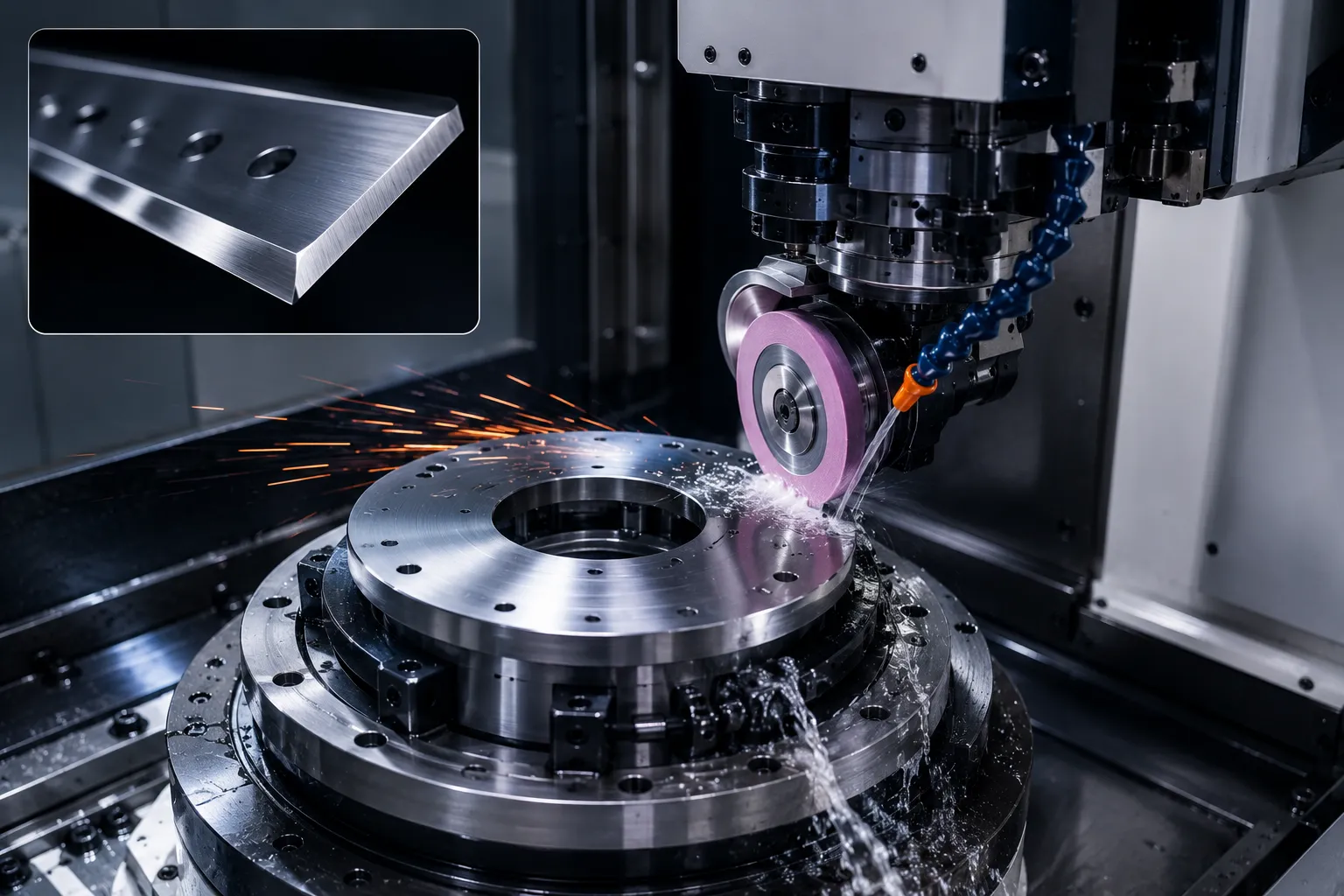
Utilizing multi-axis CNC grinding centers and atmosphere-controlled heat treatment systems, Sharkcutting converts raw tool steel into finished high-precision knives. Multi-stage CNC precision grinding ensures strict dimensional runout control within ±0.002 mm and smooth cutting edge geometry.
- Deep cryogenic treatment for structural grain stability
- Mirror surface finishing (Ra < 0.1 µm) to resist gumming
Quality Assurance & Shipping
Every production run undergoes rigorous 100% optical dimensional inspection, hardness testing, and edge sharpness evaluation. Finished OEM industrial knives are coated with protective VCI anti-rust oil, fitted with protective edge guards, and securely packed for global shipment.
- 100% optical comparator & Rockwell hardness testing
- Export-ready anti-corrosion packaging & heavy-duty crating
Solving Custom Tooling Challenges for Global OEMs & Converters
Standard off-the-shelf cutting blades often fail when processing tough vulcanized rubber, steel-reinforced conveyor belt plies, or continuous extrusion profiles. Whether processing material with high-precision circular slitter knives or heavy-duty shear slitting knives, premature edge blunting, friction-induced gumming, and thermal micro-cracking lead to frequent production halts and costly web waste.
Sharkcutting partners directly with original equipment manufacturers and rubber processors worldwide to deliver specialized knife profiles. Whether you require small-batch prototype development or large-scale OEM production fulfillment, our flexible production facilities accommodate intricate geometries and demanding tolerances with complete reliability.
Have a Custom Rubber Cutting Application?
Send us your blade drawings, machine model, dimensions, or cutting requirements. Our engineering team will evaluate the application and recommend the right blade geometry and material.
Frequently Asked Questions: Industrial Rubber Cutting Knives
Precision processing of dense elastomers, vulcanized compounds, and fabric- or steel-reinforced belting requires specialized metallurgy and engineered bevel angles. Get direct technical answers from the Sharkcutting engineering team regarding material selection, cutting heat reduction, professional rubber knife sharpening parameters, and custom OEM manufacturing workflows.
01 What knife material is best for cutting rubber with high carbon black or silica content?
For highly abrasive rubber compounds formulated with dense carbon black, silica fillers, or recycled crumb rubber, Solid Tungsten Carbide or Carbide-Tipped (TCT) blades deliver superior cutting performance. Standard tool steels quickly experience micro-abrasive edge rounding when slicing through mineral-filled elastomeric matrixes under high friction.
Solid carbide blades operate at hardness levels between 88 and 92 HRA, offering up to 10 to 15 times greater abrasive wear resistance than traditional D2 or M2 high-speed steels. Maintaining a razor-sharp cutting edge over long production runs maximizes overall blade lifetime, keeps slit width tolerances exact, and prevents frayed, burred edges on heavy rubber sheets and tire treads.
02 How can we achieve effective cutting heat reduction and stop rubber sticking during high-speed continuous slitting?
Preventing rubber gumming, blade drag, and thermal distortion during continuous slitting operations requires targeted friction management across several engineering vectors:
- Optimized Edge Geometry: Compound bevels or custom secondary relief clearance angles minimize side-wall friction against tacky elastomeric webs.
- Super-Finish Surface Grinding: Precision CNC grinding to a mirror polish (Ra < 0.2 µm) eliminates microscopic grinding marks where tacky, unvulcanized rubber easily adheres.
- Advanced Anti-Stick PVD Coatings: Specialty Thin-Film coatings such as Diamond-Like Carbon (DLC) or Titanium Nitride (TiN) drastically reduce the friction coefficient, providing consistent cutting heat reduction.
- Directed Air & Mist Cooling: Integrated cold-air jet nozzles or non-contaminating lubrication mist setups help dissipate frictional heat directly at the point of shear.
03 Does Sharkcutting offer blade regrinding services or technical regrinding guidance?
Yes. Sharkcutting offers comprehensive factory-grade reconditioning services for tool steel, high-speed steel, and tungsten carbide industrial blades. Our precision regrinding restores original factory bevel profiles, mirror surface finishes, and strict lateral runout tolerances within ±0.002 mm.
For clients managing in-house toolroom maintenance, we supply complete rubber knife sharpening parameter datasheets. These technical documentation packets outline recommended diamond grinding wheel grit sizes, wheel peripheral speeds, synthetic coolant formulations, and deburring procedures to prevent thermal micro-cracking and preserve original core hardness.
04 What is the minimum order quantity (MOQ) and lead time for custom OEM rubber blades?
We structure our procurement policies to accommodate both large-volume OEM production runs and specialized short-run replacement tooling:
Zero MOQ requirements. Standard slitting and shearing sizes are stocked for dispatch within 24 to 48 hours.
Flexible low MOQs (typically 5 to 10 pieces depending on geometry). Standard manufacturing lead time is 2 to 3 weeks upon drawing approval.
Expedited manufacturing and emergency breakdown support options are available for clients seeking urgent replacement tooling during line stoppages.
05 Why are runout tolerances and axial stability so critical for circular rubber slitting quality?
In continuous web converting and rotary slitting operations for rubber, even minimal axial flutter or radial runout causes uneven contact pressure against bottom counter-blades or anvil shafts. This dynamic instability accelerates localized edge chipping, causes variable strip width dimensions, and increases particulate dust generation along the slit edge.
Sharkcutting manufactures high-precision circular slitter knives and rubber cutting blades using advanced CNC finish grinding and rigorous optical inspection. By guaranteeing total indicated runout (TIR) within ±0.002 mm, our blades maintain uniform shear distribution, significantly increase operational blade lifetime, and produce clean, burr-free cuts across high-speed conversion lines.
06 What specifications are required to receive an accurate factory-direct quotation?
To receive a detailed engineering assessment and competitive quote within 24 hours, please submit the following operational parameters:
- Dimensional Data: Outer diameter (OD), inner bore diameter (ID), thickness, bevel angles, and keyway or mounting bolt patterns (or CAD engineering drawings in .DWG, .STEP, or .PDF format).
- Material Compound Details: Elastomer type (natural rubber, NBR, silicone, EPDM, polyurethane), Shore hardness rating (Shore A/D), and presence of steel wire, carbon, or textile reinforcements.
- Operational Setup: Cutting method (shear, crush/score, or razor cut), line speeds, cutting temperatures, and current blade replacement intervals.
Have a Specific Engineering Question?
Speak directly with a Sharkcutting application engineer to evaluate edge wear patterns, analyze custom CAD drawings, or select optimal tool steel grades for your high-speed processing lines.
Ready to Boost Your Rubber Cutting Efficiency and Extend Tool Life?
Partner with Sharkcutting to optimize your processing line performance. In addition to specialized rubber processing, we offer high-precision tooling such as packaging machine knives and film cutting knives. Contact our technical engineering team today for complimentary sample evaluations, drawing reviews, and factory-direct quotes on high-precision rubber cutting solutions.
Request Technical Quote
Submit your cutting specs below for immediate engineering review.
Strict confidentiality guaranteed. Technical designs stay secure.