

Formula details
Product Details
Overview
Shredder Blade Types and Configurations
Single-Shaft Shredder Knives
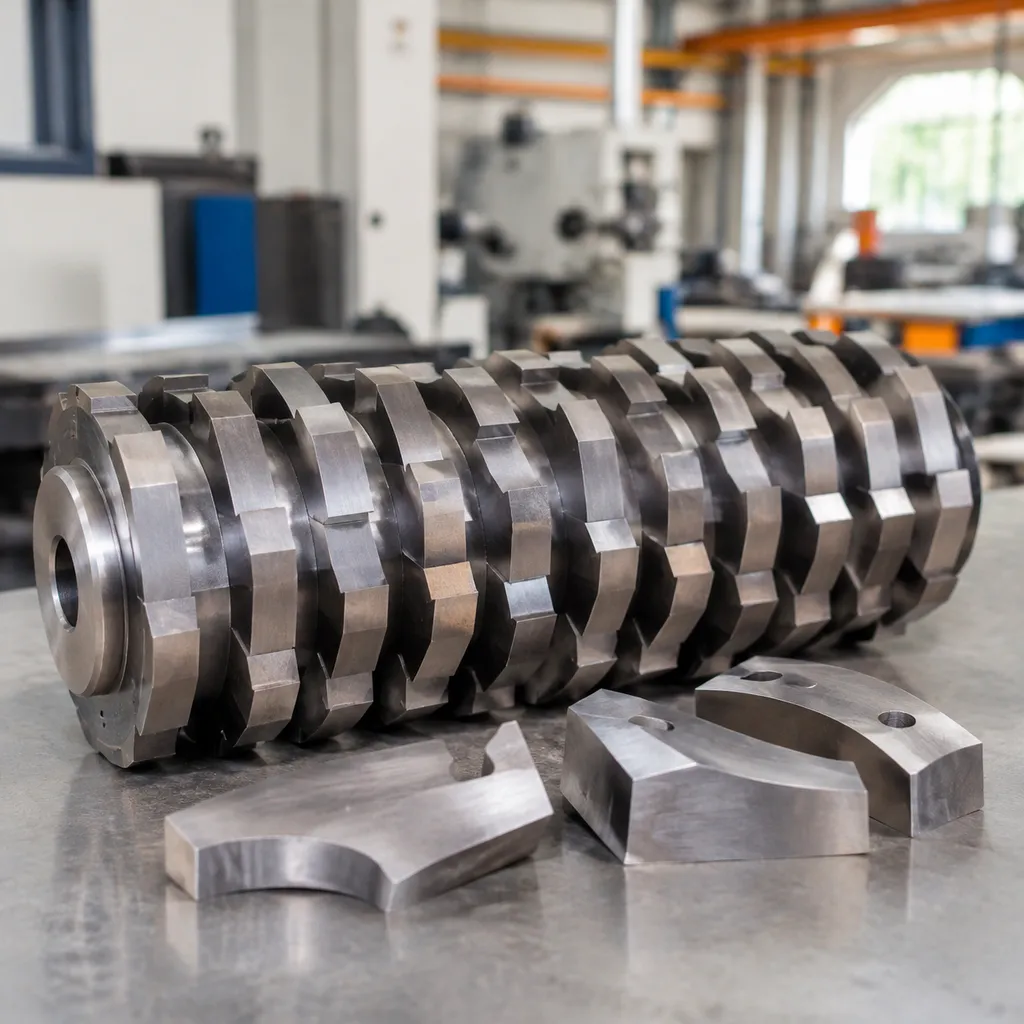
Single-shaft shredder block teeth mount onto a rotating rotor shaft and shear material against fixed counter knives.
Geometry: Concave or flat square cutter blocks designed for controlled size reduction.
Key Benefit: Multi-edge indexing lets operators rotate worn corners to extend service intervals before replacement.
Primary Uses: Plastic purge and lump crushing, municipal waste, and general industrial scrap.
Twin-Shaft Shredder Blades
Twin-shaft (dual-shaft) rotary cutters operate at low speeds with high torque, using opposing hooked discs to grab, tear, and shear bulky inputs.
Geometry: Custom hook profiles and tooth counts tailored to material density and feed behavior.
Key Benefit: High fracture toughness and anti-cracking alloy construction prevent catastrophic chipping under heavy shock loads.
Primary Uses: Electronic scrap, municipal solid waste, and tough industrial materials.
Quad-Shaft Shredder Blades
Quad-shaft configurations combine four interlocking cutter shafts with an integrated screen for single-pass size control.
Geometry: Precision-matched rotary shredder knives engineered for tight inter-shaft clearances.
Key Benefit: Consistent particle sizing with lower drive-motor power strain.
Primary Uses: High-volume recycling lines requiring uniform output without secondary granulation.
Stationary Counter Knives and Related Cutting Parts
Rotating blades only perform as well as the stationary components they shear against. We manufacture complete, matched cutting sets to eliminate uneven wear and excessive fines:
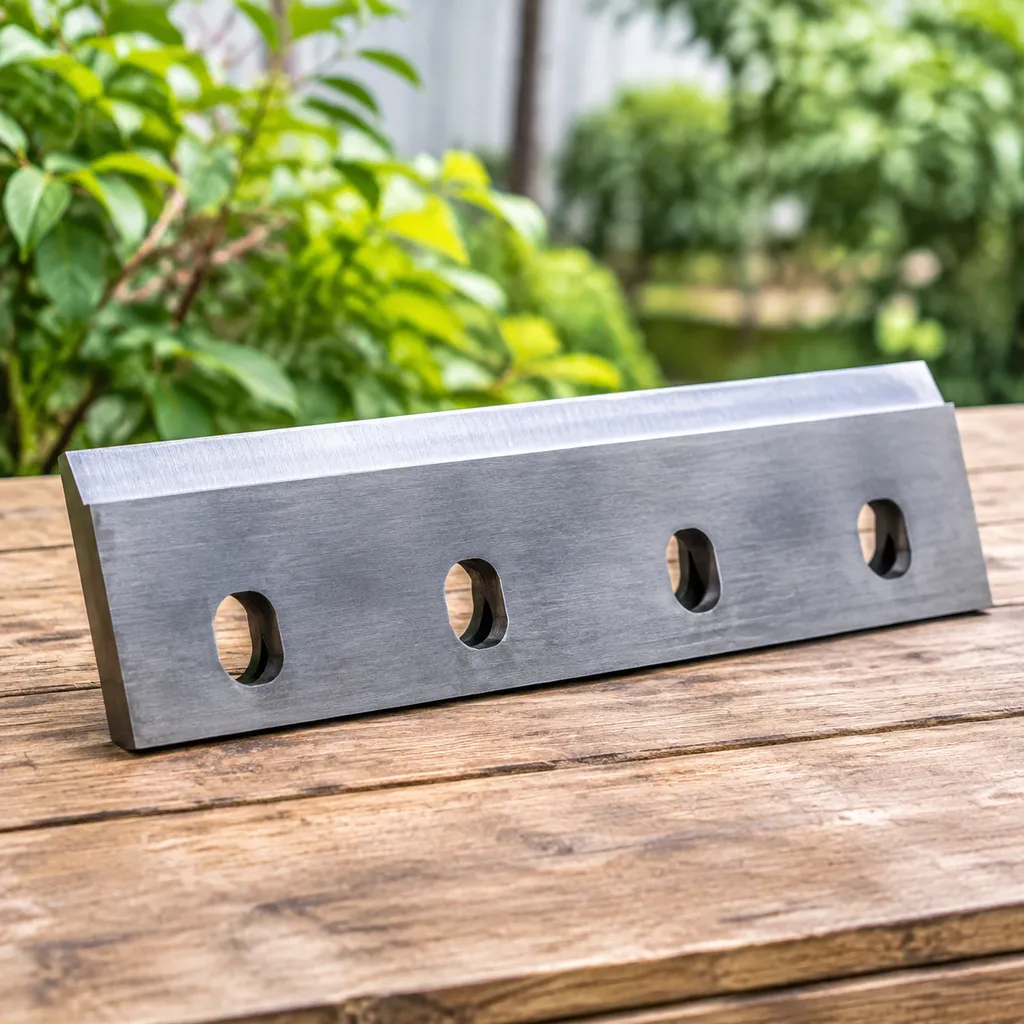
Bed Stator Blades: Fixed counter knives paired with rotor fly knives in plastic recycling wash plants and granulators.
Heavy-Section Crusher Knives: Thick-profile rotor and stator sets built for rigid plastics and bulky engineering purgings.
Precision-Matched Granulator Sets: Ground to ±0.001 mm to ±0.002 mm tolerances to maintain clean shear gaps and minimize dust.
Technical Specifications for Industrial Shredder Blades
Every industrial shredder blade we produce is machined to strict mechanical standards so it drops directly into your cutting chamber without shimming or rework. Below are the exact manufacturing specifications we maintain for standard and custom shredder knife blades.
Machine Configuration, Blade Profiles, and Dimensions
We manufacture replacement and custom shredder knife geometries across single-shaft, twin-shaft, and quad-shaft shredder platforms, as well as rotor fly knives, bed stator blades, and heavy-section crusher knives.
- Custom & OEM Dimensions: Built directly from your DWG files, 3D CAD models, or CMM reverse-engineered measurements from worn physical samples.
- Profile Options: - Multi-tooth cutter blocks, hooked shredder cutters, straight rotor knives, and precision-matched rotor/stator sets. For a deeper look at sizing standards, review our plastic shredder blade dimensions guide and specifications.
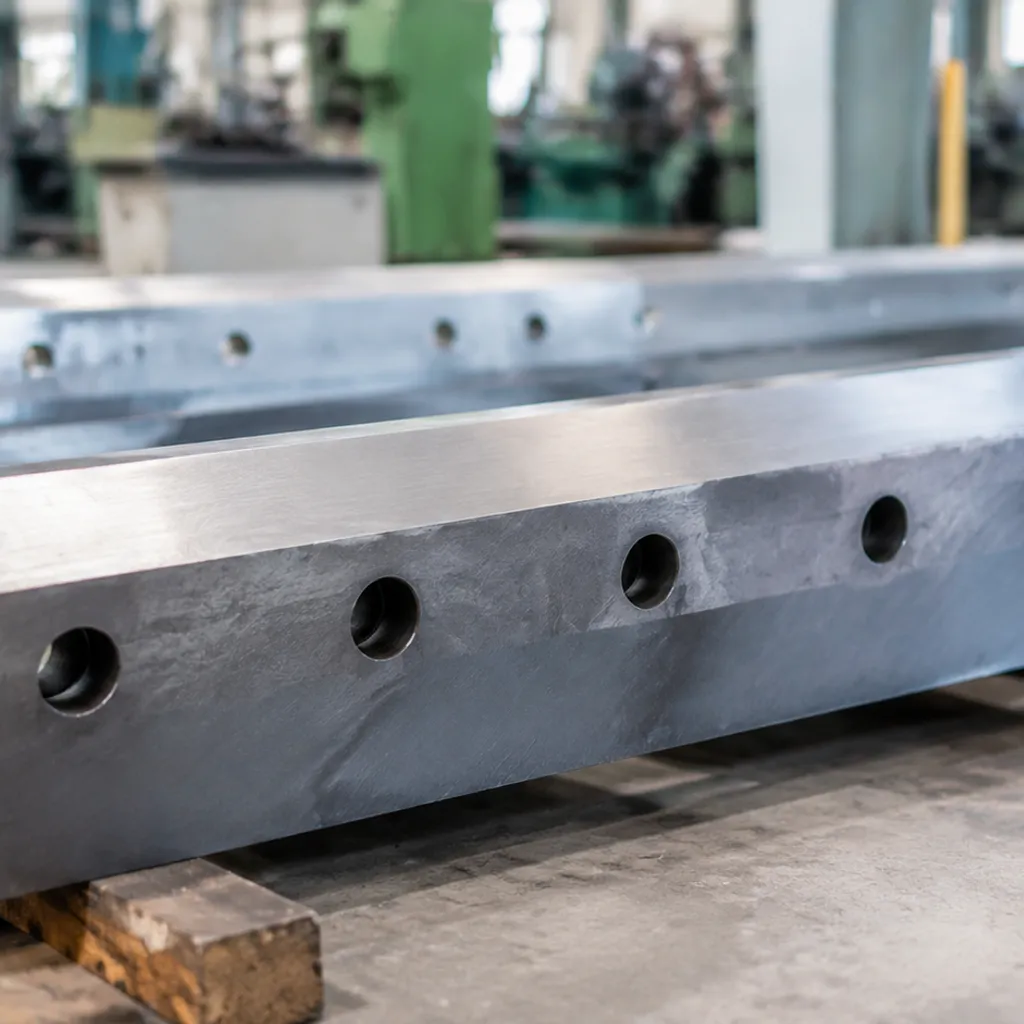
- Extended Length Capability: Precision grinding equipment supports straight and guillotine-style shear profiles up to 6,000 mm in length.
Mounting Interface, Cutting Geometry, and Tolerances
Accurate shaft fitment and cutting clearance prevent premature bearing wear, jamming, and excess motor amp draw.
- Grinding Tolerance: Held to ±0.001 mm to ±0.002 mm via multi-axis CNC grinding for exact bore alignment, keyway fit, and uniform blade thickness across full sets.
- Mounting Interfaces: Machined to match OEM hexagonal shafts, keyed bores, countersunk bolt patterns, and locating pin holes with a 100% fit guarantee.
- Cutting Geometry: Ground with application-specific hook angles, relief clearances, and shear edges to reduce drive-motor power strain and minimize fines or dust.
Material Grades, Target Hardness Ranges, and Surface Finish
We match alloy selection and vacuum/cryogenic heat treatment to your specific feedstock and impact load:
| Material Grade | Target Hardness | Primary Shredder & Recycling Applications | Key Performance Trait |
|---|---|---|---|
| S7 Shock-Resistant Steel | 54–58 HRC (54–56 HRC for rigid purge) | Heavy-duty shredder teeth, rigid purge/lump crushing, metal crop choppers | Maximum impact energy absorption and fracture toughness |
| 55SiCr / Hardfaced Alloy Steel | Application-matched core & edge | Single-shaft, twin-shaft, and quad-shaft shredder block teeth | High anti-cracking resistance under heavy torque |
| D2 / SKD11 / Cr12MoV | 58–62 HRC (58–60 HRC for PET) | Plastic granulating rotor/stator knives, crusher blades, PET shredding | High compressive strength and balanced wear resistance |
| High-Cr Carbide Inlaid | 88–91 HRA | Thin polymer film and abrasive sheet granulation | Extreme abrasion resistance and minimal dust/fines |
- Surface Finish: Precision-ground cutting faces and mounting flats ensure clean shearing and tight stack-up tolerances (with ultra-fine surface finishes down to Ra less than 0.1 μm available on specialized carbide rotary tooling).
Supply Formats, Part Numbering, and Product Traceability
- Supply Formats: Supplied as individual replacement shredder knife blades, complete shaft sets, or matched rotor-and-stator kits.
- ISO 9001 Traceability: Operating under ISO 9001 certified quality management, every production batch undergoes 100% dimensional verification and Rockwell hardness testing prior to shipment.
- Part Identification: Each industrial shredder blade is marked with part numbers and batch codes so your maintenance team can verify hardness records and reorder exact-match replacements quickly.
Material Options for Wear Resistance and Impact Toughness
Choosing the right alloy for an industrial shredder blade comes down to balancing edge retention against impact resistance. Too hard, and the blade chips under shock loads; too soft, and abrasive feedstock wears the cutting edge down fast.
Select Steel Around the Feedstock and Operating Conditions
We match every shredder knife to the exact material entering your hopper and the torque profile of your machine. For a deeper breakdown of how these alloys perform in heavy size-reduction equipment, see our https://sharkcutting.com/crusher-blade-materials-guide-compare-d2-skdhttps://sharkcutting.com/crusher-blade-materials-guide-compare-d2-skd11-and-more/">crusher blade materials guide comparing D2, SKD11, and more.
| Material Grade | Hardness Range | Best Suited Feedstock & Applications | Core Performance Advantage |
|---|---|---|---|
| S7 Shock-Resistant Steel | 54–58 HRC (54–56 HRC for heavy purge) | Rigid purge/lump crushing, heavy-duty shredder teeth, metal crop choppers | Maximum impact energy absorption and fracture toughness |
| 55SiCr / Hardfaced Alloy Steel | Tailored to spec | Single-shaft, twin-shaft, and quad-shaft shredder block teeth | High anti-cracking strength for high-torque waste shredding |
| D2 / SKD11 / Modified D2 / Cr12MoV | 58–62 HRC (58–60 HRC for PET) | Plastic granulating, PET bottle shredding, rotor fly & bed stator knives | Balanced wear resistance, deep hardenability, and compressive strength |
| M2 / SKH51 High-Speed Steel | 62–66 HRC | High-speed rotary slitting and polymer film slicing | High thermal edge stability and red hardness |
| High-Cr Carbide Inlaid / Solid Tungsten Carbide | 88–92 HRA (88–91 HRA for film/sheet) | Abrasive polymer film conversion, thin film/sheet granulation | Extreme abrasion resistance with minimal dust and fines |
Heat Treatment and Edge Preparation
Raw steel only performs as well as its thermal processing and final grind. Our shredder knife blades go through controlled metallurgical finishing to prevent premature failure on the production floor:
- Precision Vacuum Heat Treatment: Ensures uniform grain density throughout the blade cross-section without surface decarburization.
- Deep Cryogenic Stress Relief: Stabilizes the microstructure to maximize wear life and prevent catastrophic chipping or cracking under heavy shock loads.
- Multi-Axis CNC Grinding & Edge Geometry: Held to ±0.001 mm to ±0.002 mm tolerances with optimized shear cutting angles that reduce drive-motor power strain and deliver cleaner cuts.
- 100% Hardness Verification: Every finished industrial shredder blade undergoes Rockwell hardness testing before shipping to guarantee consistent field performance.
Applications by Material Being Shredded
Plastic Recycling
Processing post-consumer and post-industrial plastics—including PET bottles, HDPE, PVC, film reclaim, and heavy rigid purge lumps—requires high wear resistance and clean shearing action.
Recommended Alloys: D2, SKD11, Modified D2, or Cr12MoV (58–60 HRC) for PET bottle shredding and general granulation; S7 shock-resistant steel (54–56 HRC) for heavy purge and lump crushing; High-Cr Carbide Inlaid blades (88–91 HRA) for abrasive thin film and sheet granulation.
Operational Advantage: Precision-ground cutting edges reduce fines and dust while delivering up to 3x extended service life in PET bottle lines. For wash plants and reclaim systems, explore our dedicated plastic recycling cutting solutions engineered to prevent film wrapping and lower drive-motor power draw.
Wood and Bulky Waste
Municipal waste streams, pallets, and bulky industrial refuse often contain hidden nails, staples, and dense knots that cause standard blades to fracture.
Recommended Alloys: 55SiCr, tough alloy steels, or hardfaced block teeth engineered for anti-cracking performance.
Operational Advantage: Deep cryogenic stress relief and vacuum heat treatment give our single-shaft, twin-shaft, and quad-shaft shredder blades the core toughness needed to absorb sudden shock loads without catastrophic chipping.
Rubber, Tires, and Reinforced Materials
Rubber processing and tire size-reduction involve high elasticity, heavy friction, and steel wire reinforcement that rapidly dulls conventional tool steels.
Recommended Alloys: High-toughness shock-resistant grades like S7 (54–58 HRC) and wear-resistant alloy steels.
Operational Advantage: Our https://sharkcutting.com/products/recycling-bladeshttps://sharkcutting.com/products/recycling-blades/shredder-blades/">heavy-duty industrial shredder blades maintain sharp, consistent shear clearances to slice through tough elastomers cleanly instead of tearing or overheating the material.
Electronic Scrap and Mixed Waste
Shredding e-waste, circuit boards, cables, and mixed commercial scrap combines brittle plastics with abrasive metals and connectors.
Recommended Alloys: S7 shock-resistant steel or hardfaced alloy shredder cutter blocks that balance edge retention with high fracture toughness.
Operational Advantage: Held to ±0.001 mm to ±0.002 mm grinding tolerances, our rotor and stator configurations keep tight running clearances to process mixed metallic and non-metallic scrap reliably with minimal unscheduled downtime.
Replacement Shredder Knives Matched to Your Machine
We manufacture direct OEM replacements backed by a 100% fit guarantee and ±0.001 mm to ±0.002 mm grinding tolerances, ensuring your industrial shredder blade drops straight onto the rotor without shimming or machine modifications.
Identify the Correct Replacement
You do not need an original equipment blueprint to order exact-fit replacement shredder blades. Send us whichever identification method you have available:
- OEM Part Numbers & Machine Models: Share your shredder make, model, and shaft configuration (single-shaft, twin-shaft, or quad-shaft) so we can match existing tooling specifications.
- Technical Drawings & CAD Files: Submit DWG files or 3D CAD models for direct CNC production.
- Worn Physical Samples: Ship us a used cutter or rotor block. We use CMM reverse engineering to capture the exact geometry, bore dimensions, and cutting angles—even on heavily worn parts like a heavy-duty tire shredder blade replacement cutter or a precision shredder knife box set.
Check Fit and Assembly Requirements
Before installing new rotary cutters or stationary bed knives, verify these critical assembly checkpoints to protect your drive system and maximize blade life:
| Assembly Checkpoint | What to Verify | Why It Matters |
|---|---|---|
| Shaft & Bore Interface | Hex, splined, or keyed bore dimensions and thickness | Eliminates rotational play and prevents shaft scoring under high torque |
| Rotor-to-Stator Clearance | Uniform gap between moving fly knives and fixed bed knives | Maintains clean shearing action, reduces fines/dust, and lowers motor power draw |
| Matched Set Consistency | Uniform outer diameter and thickness across the entire rotor | Prevents uneven load distribution, vibration, and localized chipping |
| Fastener & Seat Condition | Clean mounting pockets and undamaged bolt threads | Ensures full clamping force and stops bolt shearing during heavy shock loads |
Every batch undergoes 100% full dimensional verification and Rockwell hardness testing before shipping, guaranteeing consistent clearance and immediate drop-in readiness across your entire cutting chamber.
Custom Shredder Blade Manufacturing
Standard catalog knives often fall short when you are running specialized scrap lines or older machinery. We provide custom shredder blade manufacturing engineered around your exact rotor geometry, shaft tolerances, and throughput targets—backed by a 100% fit guarantee for direct OEM replacements.
Manufacture from Drawings, CAD Files, or Samples
You do not need original factory blueprints to source precision-matched industrial shredder blades. We build bespoke cutting tools from multiple technical inputs:
- 2D Blueprints & 3D Models: Send over DWG files or 3D CAD models, and we machine your shredder knife blades to grinding tolerances of ±0.001 mm to ±0.002 mm.
- CMM Reverse Engineering: If technical drawings are unavailable, ship us a worn physical sample. Our team uses coordinate measuring machines (CMM) to capture exact mounting interfaces, bolt hole patterns, and keyways.
- Prototype Testing: Before committing to a full production run, we offer rapid prototyping so your maintenance crew can verify rotor clearance and cutting engagement on the line.
Adapt the Blade to the Application
Different waste streams punish a shredder knife in completely different ways. Rather than relying on a one-size-fits-all geometry, we tailor the alloy, hardness, and cutting profile to your specific feedstock—whether you are sizing PET bottles, HDPE containers, PVC pipe, or thick purge lumps.
- Custom Tooth & Hook Profiles: We modify hook angles and tooth counts to improve material grab and reduce drive-motor power strain. For specialized polymers, our plastic shredder blade design minimizes fines and dust while maintaining clean shear cuts.
- Application-Matched Metallurgy: We pair high-impact S7 shock-resistant steel (54–58 HRC) for heavy purge and bulky scrap with wear-resistant D2/SKD11 (58–62 HRC) or High-Cr Carbide inlaid (88–91 HRA) edges for abrasive films and rigid plastics.
- Custom Coatings & Single-Shaft Options: Depending on friction and heat buildup in your chamber, we apply custom surface coatings or supply tailored [single-shaft shredder circle blades](httpshttps://sharkcutting.com/product/customizable-single-shaft-shredder-circle-blade-machine
Manufacturing Quality and Inspection

Consistent performance on the recycling floor depends on strict factory oversight before a single industrial shredder blade ships out. Every batch of our shredder knife blades goes through verified metallurgical and dimensional checks under our https://sharkcutting.com/https://sharkcutting.com/manufacturing/quality-control/">ISO 9001 quality control process to eliminate premature chipping, cracking, or installation delays.
Material and Heat-Treatment Verification
We control metallurgical consistency from raw bar stock to finished edge so your hardened steel shredder knives hold up under heavy shock loads:
- 100% Rockwell Hardness Testing: Every shredder knife is tested to verify target hardness ranges—such as 54–58 HRC for S7 shock-resistant grades, 58–62 HRC for D2/SKD11 alloys, and 88–91 HRA for High-Cr carbide inlaid cutters.
- Precision Vacuum & Cryogenic Treatment: Controlled vacuum heat treatment paired with deep cryogenic stress relief ensures uniform grain density throughout the core, preventing brittle fracture during high-torque impacts.
Dimensional and Fit Inspection
Tight tolerances keep rotor-to-stator clearances exact, lowering drive-motor strain and reducing dust or fines:
- Full Dimensional Verification: Using multi-axis CNC grinding and coordinate measuring machine (CMM) checks, we hold grinding tolerances between ±0.001 mm and ±0.002 mm.
- 100% Fit Guarantee: Whether produced from your OEM blueprints or reverse-engineered from worn samples, every replacement shredder blade is verified for exact bore, keyway, thickness, and mounting hole alignment before packing.
Supplier Documentation
To support global procurement teams across 50+ countries, each order is backed by our ISO 9001 certified standards and traceable inspection records confirming dimensional accuracy and Rockwell hardness pass results.
Blade Life, Regrinding, and Replacement Planning
Maximizing the service life of an industrial shredder blade comes down to controlling mechanical wear, maintaining proper cutting geometry, and planning spare inventory before a sudden breakdown stops your line.
Wear Factors: Contamination, Clearance, and Dulling
Even hardened steel shredder knife blades lose their edge quickly when operating conditions drift out of spec. Three main factors accelerate wear:
Abrasive Contamination: Dirt, grit, sand, and stray tramp metal in municipal waste, electronic scrap, or unwashed plastic streams cause rapid abrasive wear and micro-chipping.
Improper Rotor-to-Stator Clearance: When the gap between rotary knives and stationary bed blades widens beyond tolerance, the machine tears instead of shears—generating excess heat, fines, and higher drive-motor power draw.
Running on Dull Edges: Pushing worn cutting edges past their service limit increases mechanical shock loads, risking catastrophic cracking across rotor teeth and mounting seats.
Indexing and Regrinding Procedures for Usable Blades
You do not always need to scrap a shredder knife the moment the first edge dulls. Depending on your machine setup, you can extend total blade life through controlled maintenance:
Multi-Edge Indexing: Many square or block-style single-shaft cutter teeth can be rotated to expose fresh, factory-ground cutting corners before removal.
Precision Surface Regrinding: When regrinding rotor fly knives, bed stator blades, or granulator sets, maintain original bevel angles and remove equal stock across matching sets. Always use flood coolant to prevent localized overheating, which ruins the blade's vacuum heat treatment and drops surface hardness.
Clearance Resetting: After regrinding, adjust the stator or bed knife position to restore exact cutting clearance across the full rotor width.
Preventive Spare-Set Planning to Reduce Downtime
Waiting until a blade fractures to order replacements leads to costly line stoppages. We recommend keeping at least one complete, matched spare set on the shelf—especially for high-wear operations like PET bottle washing and rigid purge crushing, where our https://sharkcutting.com/product/plastic-shredder-bladehttps://sharkcutting.com/product/plastic-shredder-blade-supplier-for-durable-blade-sets/">durable plastic shredder blade sets deliver up to 3x longer service life between changeovers. Rotating one set in production while a backup set is inspected or reground keeps your throughput consistent and eliminates emergency shipping delays.
Pricing, Minimum Orders, and Delivery
We supply direct factory pricing for every industrial shredder blade order, providing custom quotes within 24 hours of receiving your equipment details or CAD files. Because every recycling line runs under different load conditions, we do not use flat-rate price lists—you only pay for the exact metallurgy and machining your machine requires.
Cost Drivers and Pricing Variables
Your final price per shredder knife depends on four primary engineering factors:
Alloy and Carbide Selection: Standard alloy steels like 55SiCr or D2 / SKD11 cost less than shock-resistant S7 tool steel or High-Cr carbide-inlaid blades.
Blade Geometry and Size: Heavy-section crusher rotor knives, multi-hook twin-shaft cutters, and long stationary stator blades up to 6,000 mm require varying raw stock volumes and multi-axis CNC grinding time.
Precision Tolerances and Heat Treatment: Tighter grinding tolerances (±0.001 mm to ±0.002 mm), vacuum heat treatment, deep cryogenic stress relief, and custom surface coatings add specialized processing steps.
Order Volume: Larger production runs spread setup and tooling costs across more shredder knife blades, lowering the unit price.
Minimum Order Quantities (MOQ) and Trial Orders
We support both full-plant maintenance schedules and initial performance testing. Whether you need a complete set of rotary shredder knives for a twin-shaft rebuild or a small batch for prototype testing on a single-shaft machine, we accommodate flexible order quantities. If you are qualifying a new china shredder blade supplier, we can produce a trial set from your DWG drawings or reverse-engineer a worn sample so you can verify fit and wear life on your line before placing a bulk order.
Lead Times, Export Packaging, and International Shipping Terms
Production lead times depend on stock availability for standard OEM replacements versus custom CNC machining and heat-treatment cycles for bespoke profiles. Every shipment goes through 100% dimensional and Rockwell hardness inspection before leaving our facility. We ship industrial cutting tools to over 50 countries, packing each blade in protective, corrosion-resistant export crating to prevent edge damage or rust during international sea or air transit. We work with standard international freight and trade terms to deliver directly to your facility or port of entry.
Frequently Asked Questions
How do I identify the correct replacement shredder knife?
Provide your machine manufacturer, equipment model, existing part numbers, or a technical drawing (DWG or 3D CAD file). If you do not have original specifications on hand, we verify the exact geometry and mounting dimensions directly from a physical blade sample to ensure a 100% fit guarantee.
Which steel grade suits my material and operating conditions?
We match the alloy and Rockwell hardness to your feedstock impact and abrasion levels:
S7 Shock-Resistant Steel (54–58 HRC): Ideal for heavy-duty shredder teeth, thick-walled purgings, and high-impact applications requiring maximum fracture toughness.
55SiCr / Hardfaced Alloy Steel: Engineered for single-shaft, twin-shaft, and quad-shaft shredder blocks where anti-cracking durability is critical.
D2 / SKD11 / Cr12MoV (58–62 HRC): Best for plastic granulating, PET bottle shredding, and general recycling where high wear resistance and compressive strength are needed.
High-Cr Carbide Inlaid (88–91 HRA): Suited for highly abrasive polymer films and thin-sheet granulation to minimize fines and dust.
Can Sharkcutting manufacture blades from a sample without a drawing?
Yes. Our engineering team uses Coordinate Measuring Machine (CMM) reverse engineering to capture exact dimensional profiles, hole spacing, and cutting angles from your worn physical samples, producing direct OEM replacements with grinding tolerances of ±0.001 mm to ±0.002 mm.
Can you supply knives for my shredder brand and model?
Yes. We manufacture direct OEM replacement https://sharkcutting.com/product/single-shaft-shredhttps://sharkcutting.com/product/single-shaft-shredder-blades-durable-industrial-cutting/">single-shaft shredder blades, multi-shaft cutter blocks, and https://sharkcutting.com/product/four-shaft-shredder-blade-for-efficient-https://sharkcutting.com/product/four-shaft-shredder-blade-for-efficient-recycling/">four-shaft shredder blades compatible with major international recycling and size-reduction equipment across more than 20 industries.
Should I replace individual blades or a complete set?
While individual damaged blades can be swapped out, replacing rotor fly knives and bed stator blades as a precision-matched set maintains uniform cutting clearance, prevents uneven shaft load, reduces drive-motor power strain, and keeps pellet or flake sizing consistent.
Can these shredder blades be indexed or reground?
Yes. Multi-edge square and block teeth can be rotated to fresh cutting edges before removal. When all edges wear down, our vacuum heat-treated and deep cryogenically stress-relieved blades maintain uniform grain density throughout the steel core, allowing repeatable precision regrinding without losing structural integrity.
What are the minimum order quantity and production lead time?
We support both prototype runs for testing and full-volume production orders. Exact minimum order quantities and manufacturing timelines depend on blade dimensions, material grade, and custom tooling requirements—contact our engineering team for specific scheduling alongside your quote.
Which inspection documents can be supplied?
Every batch undergoes 100% full dimensional verification and Rockwell hardness testing under our ISO 9001 certified quality system. We provide full inspection reports verifying dimensional tolerances and hardness values prior to shipment.
What information is needed for an accurate quotation?
To receive direct factory pricing within 24 hours, send us your shredder brand and model, blade dimensions or CAD/DWG drawings, target material being shredded, and required order quantity.
Request a Quote for Shredder Blades
Sourcing replacement shredder knife blades or custom industrial shredder blade sets starts with clear technical specifications so our engineering team can verify exact machine fit and material requirements. We provide direct factory pricing within 24 hours of receiving your inquiry.
Key Information Required for a Technical RFQ
Submit any of the following details to help us prepare an accurate quote for your shredder knife order:
| RFQ Detail | What to Send Our Team | Why It Matters |
|---|---|---|
| Technical Drawings | DWG files, 3D CAD models, or PDF blueprints | Confirms exact tolerances (±0.001 mm to ±0.002 mm) and mounting interfaces |
| Machine Details | Equipment brand, model number, and shaft configuration | Matches OEM geometry for single-shaft, twin-shaft, or quad-shaft systems |
| Physical Samples | Worn or broken existing knives | Allows us to perform CMM reverse engineering when drawings are unavailable |
| Application & Material | Feedstock type (e.g., PET, HDPE, rigid purge, scrap) | Guides steel selection (S7, 55SiCr, D2, SKD11, or carbide) and target hardness |
| Order Quantity | Required piece count or full rotor/stator sets | Determines production scheduling and direct factory volume pricing |
If you are also sourcing heavy-duty crusher blades for efficient material processing, include those rotor and stator dimensions in the same request to consolidate your quotation.
Quotation Process and Response Timeline
- Step 1 — Submit Your Specs: Send your drawings, equipment model, blade dimensions, or sample details through our quote request form.
- Step 2 — Engineering Review: Our team checks tolerances, steel grade compatibility, heat treatment requirements, and CMM reverse-engineering needs if you are matching an existing part.
- Step 3 — 24-Hour Direct Factory Quote: You receive a complete quote with direct factory pricing, recommended metallurgy, and production lead times within 24 hours.
- Step 4 — Prototype or Production: Once approved, we move into rapid prototyping or full production backed by ISO 9001 quality standards, 100% dimensional verification, and Rockwell hardness testing before shipping to your facility.